

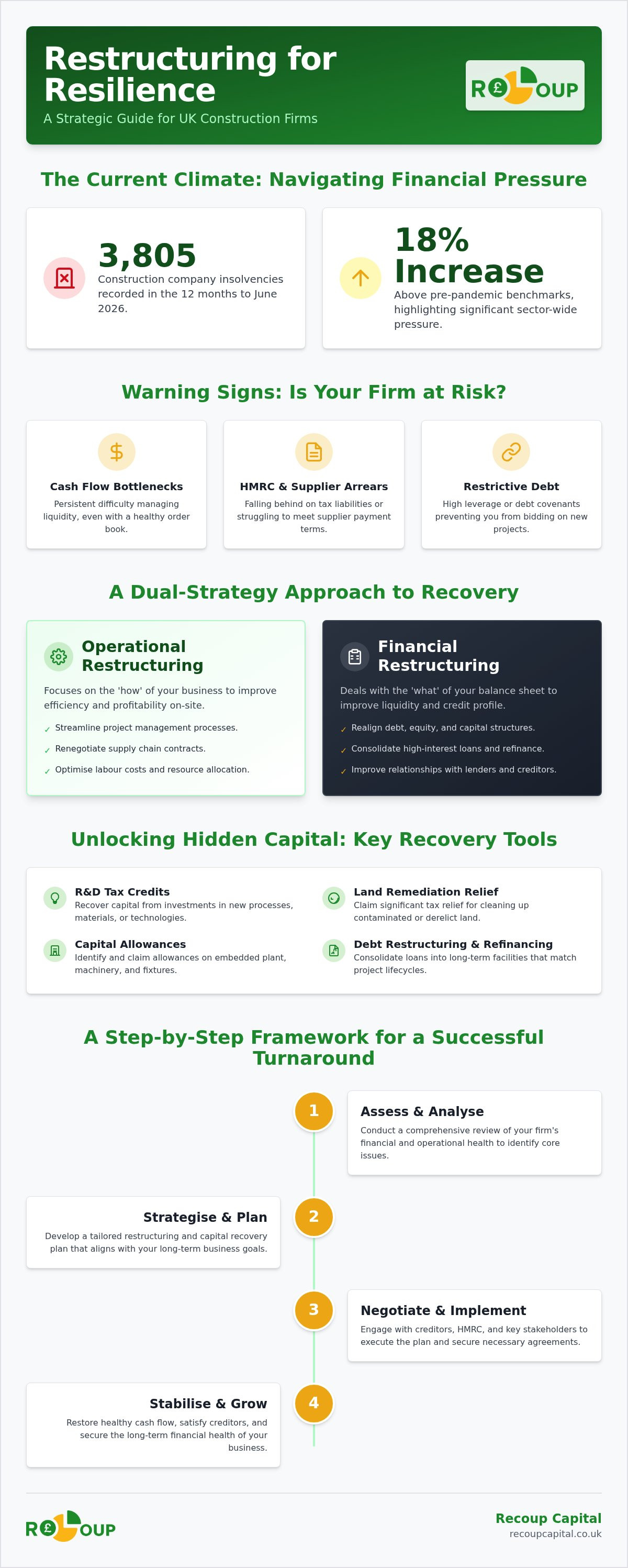
With 3,805 construction company insolvencies recorded in the 12 months to June 2026, your sector currently faces more financial pressure than any other in the UK. This figure sits nearly 18% above pre-pandemic benchmarks; it is a sobering reality for directors battling razor-thin margins and relentless material cost inflation. You have likely felt the weight of significant debt burdens or the frustration of navigating HMRC compliance whilst trying to keep sites operational. It is an exhausting cycle that can make the future of your firm feel increasingly uncertain.
We recognise that construction company restructuring is often viewed with apprehension, yet it remains one of the most effective tools for corporate survival and growth. This guide will show you how to stabilise your balance sheet, realign existing debt, and unlock hidden capital through strategic, tax-efficient recovery. We will explore how to reframe financial returns as strategic assets that fund your operational turnaround. By the end of this article, you will have a clear roadmap to restore cash flow, satisfy creditors, and secure the long-term financial health of your business.
Key Takeaways
- Learn why proactive construction company restructuring is a strategic tool for long-term survival rather than just a reactive response to financial distress.
- Discover how corporate finance and debt realignment can provide the essential breathing space needed to stabilise your balance sheet and reinvest in new projects.
- Identify how to unlock non-dilutive capital by uncovering hidden value through R&D Tax Credits, Land Remediation Relief, and Capital Allowances.
- Follow a logical, step-by-step framework to navigate the regulatory complexities of the UK market whilst ensuring full HMRC compliance.
- Understand the advantage of partnering with specialist chartered tax accountants who use a success-based model to maximise your firm's capital recovery.
What is Construction Company Restructuring?
To many directors, the idea of restructuring carries a heavy stigma, often associated with the final stages of business failure. However, viewing it through such a narrow lens is a mistake. At its core, construction company restructuring is a strategic tool used to reorganise a firm's legal, operational, and financial framework. It isn't just about avoiding a shutdown; it's about building a more resilient foundation. If you've ever asked, What is corporate restructuring?, you'll find it is a broad discipline aimed at restoring viability and protecting core assets before a crisis becomes terminal.
The construction industry is uniquely vulnerable to financial instability. Unlike many other sectors, builders and contractors deal with high-value projects, long payment cycles, and the persistent drain of retentions. These factors create a fragile environment where even a minor delay can trigger a cash flow crisis. Proactive restructuring allows you to address these issues early, moving away from reactive insolvency and towards a managed turnaround. The ultimate objective is to improve liquidity, reduce debt, and safeguard the business you've worked hard to build.
The Distinction Between Operational and Financial Restructuring
Successful recovery usually requires a two-pronged approach. Operational restructuring focuses on the "how" of your business. It involves streamlining project management, renegotiating supply chain contracts, and optimising labour costs to ensure every site remains profitable. On the other hand, financial restructuring deals with the "what" of your balance sheet. This involves the realignment of debt, equity, and capital structures to ease the pressure from lenders and improve your credit profile. Because of the volatility in material costs and interest rates, most UK firms require a hybrid model that addresses both efficiency and debt management simultaneously.
Signs Your Construction Firm Needs a Strategic Review
Recognising the need for construction company restructuring before it's forced upon you is critical for director protection. Look for these specific red flags:
- Persistent cash flow bottlenecks despite having a healthy order book of upcoming projects.
- Difficulty meeting HMRC liabilities or falling behind on supplier payment terms.
- High leverage and restrictive debt covenants that prevent you from bidding on new work.
If your firm matches these criteria, engaging in corporate finance advisory can help identify the most tax-efficient path forward. Early intervention transforms a potential collapse into an opportunity for long-term growth.
The Strategic Role of Corporate Finance in Construction
Corporate finance is often misunderstood as a tool reserved exclusively for high-growth phases or complex mergers. In reality, it is the engine room of a successful construction company restructuring. It provides the technical means to realign debt, unlock liquidity, and protect the director's position. By taking a proactive approach to your capital structure, you're not just surviving; you're repositioning your firm for a more profitable second act. This process serves as a protective shield against aggressive creditor action whilst providing the clear framework needed for a long-term turnaround.
Accurate valuation is often the difference between a successful rescue and a forced liquidation. You cannot negotiate from a position of strength if you don't understand the true market value of your plant, machinery, or even your intangible assets like site permissions. Specialist valuation services ensure that you aren't underselling assets just to satisfy short-term debt pressure. Professional negotiation support when dealing with lenders or HMRC is equally critical. It shifts the narrative from one of financial desperation to one of long-term commercial viability, ensuring that creditors see a viable path to repayment rather than a terminal risk.
Debt Restructuring and Refinancing Options
High-interest loans and rigid repayment schedules are often the primary drivers of construction failure. Through strategic refinancing, you can consolidate these burdens into long-term facilities that better match your project cycles. Negotiating "breathing space" during seasonal lulls or project delays is a standard part of the UK restructuring process. You might explore our corporate finance advisory services to see how these adjustments can stabilise your monthly outgoings and provide the cash flow needed to bid on new contracts.
Acquisitions and Disposals as a Turnaround Strategy
Restructuring isn't always about shrinking. Divesting non-core assets or underperforming divisions can provide the immediate capital injection needed to save the wider group. This "right-sizing" strategy makes your business more agile and attractive to potential investors. On the other hand, some firms use restructuring as an opportunity for strategic acquisitions. By purchasing a struggling supplier or a competitor with a complementary project list, you can secure your supply chain and increase market share. Professional valuation ensures that every disposal or acquisition is executed at a fair price, protecting your equity and the interests of your stakeholders.
Unlocking Capital: R&D and Tax Incentives as Restructuring Tools
A successful construction company restructuring often hinges on identifying capital that is currently trapped within the business. While traditional debt realignment focuses on external creditors, a forensic review of tax-deductible innovation looks inward to generate immediate cash flow. This isn't about taking on more debt; it's about reclaiming what your firm has already earned through technical advancement. By reframing tax returns as strategic assets, you can inject liquidity into your operations without diluting your ownership. When planning a construction company restructuring, these incentives act as a vital catalyst for recovery.
Maximising R&D Tax Credits in Construction and Engineering
Many directors overlook the fact that their daily problem-solving on-site actually qualifies for R&D tax incentives. Whether you are developing modular construction methods, experimenting with sustainable materials, or designing bespoke engineering solutions for complex sites, these activities are often eligible for significant cash credits. A successful claim can provide a substantial cash injection directly from HMRC, providing the non-dilutive capital needed to fund your turnaround.
R&D in construction is the resolution of technical uncertainty in building processes.
You can learn how to claim R&D tax credits for construction to turn past technical challenges into future project funding. Similarly, Land Remediation Relief remains a powerful tool for firms developing contaminated or derelict land. This relief can offset a substantial portion of the cleanup costs, lowering the financial burden of site preparation whilst margins remain tight.
Capital Allowances on Commercial Property
Beyond R&D, capital allowances on commercial property offer another avenue for capital recovery. Many construction firms own or lease premises where tax-deductible fixtures and plant are "hidden" within the building's fabric. Utilising forensic surveying allows you to identify these assets, from heating systems to specialised lighting, which can drastically reduce your corporation tax liabilities. Identifying these hidden savings can transform your balance sheet by significantly lowering your tax burden.
Understanding capital allowances for property owners is essential for any director looking to maximise their firm's internal reserves. These savings often represent a significant portion of a company's value, providing the extra financial cushion needed to navigate market volatility and invest in new project bids. By treating tax efficiency as a core part of your restructure, you ensure that no capital is left on the table.
A Step-by-Step Guide to the Restructuring Process
Executing a successful construction company restructuring is not a single event; it is a methodical journey that requires precision and professional oversight. For UK directors, the process must balance legal compliance with the practical need to keep sites operational. Moving too quickly without a structured plan often leads to missed capital recovery opportunities or, worse, unintended regulatory breaches. By following a clear, phased approach, you can transform a period of financial distress into a controlled realignment that protects your firm's future whilst maintaining project momentum on the ground.
Professional guidance is indispensable at every stage. The UK regulatory landscape is complex, and the consequences of getting a restructure wrong can be severe for both the business and its directors. You need a partner who understands the nuances of construction finance, from the intricacies of project-based accounting to the specific way HMRC views industry-specific tax claims. This ensures that every decision you make is grounded in technical accuracy and long-term viability.
Phase 1: Diagnostic and Financial Assessment
Before any changes can be implemented, you must have a crystalline understanding of your current position. This begins with a forensic audit of your balance sheet and a deep dive into individual project margins. It is common for "hidden" cash flow leaks to exist within long-term contracts or neglected retention accounts. During this phase, you should also assess your eligibility for tax-based capital recovery, such as R&D tax credits or Land Remediation Relief. Identifying these potential cash injections early allows them to be integrated into your wider turnaround strategy as non-dilutive capital, reducing your reliance on expensive external debt.
Phase 2: Stakeholder Negotiation and Implementation
Transparency is your most valuable asset when dealing with creditors. Once the diagnostic phase is complete, you must communicate your plan to lenders, key suppliers, and HMRC. If you're seeking a Time to Pay arrangement or debt realignment, showing a proactive and professional roadmap significantly increases your chances of success. Implementation involves executing these agreements whilst simultaneously introducing cost-saving measures. It is vital that these efficiencies don't compromise site safety or build quality, as maintaining your reputation is essential for securing future project bids. We recommend that directors contact our corporate finance specialists to manage these complex negotiations and ensure your construction company restructuring is executed with technical precision.
Partnering for Recovery: How Recoup Capital Can Help
Unlike a generalist accountant who handles your annual filings, Recoup Capital operates as a dedicated specialist in the mid-market construction sector. We recognise that construction company restructuring requires more than just balancing books; it demands a deep integration of corporate finance and tax-efficient recovery. Our team of specialist chartered tax accountants focuses on identifying the capital your business has already earned but hasn't yet claimed. By taking a proactive stance today, you can often avoid the restrictive path of formal insolvency and instead build a bridge toward renewed profitability.
One of the primary barriers to seeking expert help is the fear of escalating costs during a financial squeeze. We address this directly through our success-based fee model for R&D tax credit claims. This approach aligns our interests with yours, ensuring that our partnership is based on delivered results rather than upfront fees. It's a low-friction way to explore whether your firm is sitting on significant untapped capital that could fund your entire construction company restructuring strategy. We combine this tax expertise with mid-market corporate finance advisory to provide a unique, comprehensive advantage that generalist firms simply cannot match.
Expert Guidance Through Regulatory Complexity
Navigating the shifting sands of HMRC compliance requires more than just a passing knowledge of the rules. With the 2024 merger of R&D schemes and the increased scrutiny on claims, your submissions must be technically robust and meticulously documented. We specialise in translating your on-site building innovations into a language that satisfies the latest regulatory standards. This ensures your claims are not only maximised but also fully protected against future inquiry. You can discover more about why to choose Recoup Capital for your business recovery and how our protective guidance helps you manage these complex landscapes with confidence.
A Long-Term Partnership for Growth
Our commitment to your firm doesn't end with a single successful claim or a debt realignment. We aim to establish a long-term collaboration that supports your business through every phase of its evolution. By reframing financial returns as strategic assets, we help you reinvest recovered capital into modular building methods, sustainable materials, or strategic supply chain acquisitions. This ongoing strategic advice ensures you stay ahead of market volatility whilst continuing to innovate. If you're ready to stabilise your balance sheet and unlock new cash flow, contact us for a no-obligation consultation on your firm's financial health.
Secure Your Firm's Future Through Strategic Realignment
Navigating financial distress requires a fundamental shift in perspective. Rather than viewing construction company restructuring as a sign of failure, it's more accurate to see it as a strategic pivot toward long-term stability. By realigning your debt and identifying non-dilutive capital through R&D tax credits or capital allowances, you can transform your balance sheet without losing control of your business. We've seen how early intervention, backed by forensic financial analysis, provides the essential breathing space needed to move from survival back to innovation.
Recoup Capital brings a unique blend of specialist R&D and corporate finance expertise to every partnership. Our success-based fee model for tax recovery ensures that we're fully invested in your results, whilst our proven track record with UK construction firms provides the reliability you need during complex transitions. You don't have to navigate these regulatory pressures alone. We're here to act as your protective guide, turning technical challenges into strategic assets for your firm's second act. Speak to our specialists about restructuring your construction business today. Let's work together to build a more resilient future for your firm.
Frequently Asked Questions
Is construction company restructuring the same as insolvency?
No, they aren't the same. Restructuring is a proactive strategy used to realign your firm's legal, financial, or operational structure to prevent formal insolvency. Whilst insolvency often involves winding down or liquidation, construction company restructuring focuses on business rescue and long-term viability. It allows directors to protect core assets and improve liquidity before a situation becomes terminal, ensuring the company can continue to trade and meet its future obligations.
Can I claim R&D tax credits if my construction company is currently restructuring?
Yes, you can still claim R&D tax credits provided your company is a going concern and not in a formal liquidation process. In fact, identifying qualifying innovation is often a central part of a successful construction company restructuring plan. These credits provide a non-dilutive cash injection that can be used to satisfy creditors or reinvest in site operations. Our specialists ensure your claim is robust and fully compliant with the latest HMRC standards.
How long does a typical corporate restructure take for a building firm?
The duration of a restructure varies significantly based on the complexity of your debt and project list. A typical process for a UK building firm can take anywhere from three to twelve months to fully implement. This timeline includes the initial diagnostic phase, negotiation with stakeholders like HMRC, and the execution of new financial arrangements. Maintaining project momentum during this period is essential, so we work efficiently to minimise any operational disruption on your sites.
What are the costs associated with construction company restructuring?
Costs generally include professional fees for corporate finance advisory, valuation services, and specialist tax consultancy. At Recoup Capital, we use a success-based fee model for R&D tax credit claims, meaning you only pay a percentage of the capital we recover for you. This approach minimises your upfront financial risk during a turnaround. Other costs depend on the depth of the forensic audit required and the complexity of negotiations with your lenders or key suppliers.
Will restructuring my company affect my ability to win new contracts?
Proactive restructuring actually strengthens your bidding position by stabilising your balance sheet and improving your credit profile. Main contractors and local authorities look for financial resilience when awarding tenders. By addressing debt and unlocking trapped capital early, you demonstrate a commitment to long-term viability. This transparency often builds greater trust with stakeholders compared to struggling with unmanaged debt, which can lead to restrictive covenants that prevent you from bidding altogether.
Can Recoup Capital help negotiate with HMRC for Time to Pay arrangements?
Yes, our corporate finance team provides expert negotiation support when dealing with HMRC. We help directors present a clear, professional roadmap for repayment through Time to Pay arrangements. By demonstrating that your firm is taking active steps to recover capital through incentives like R&D tax credits or capital allowances, we can often secure more favourable terms. This proactive approach shows HMRC that your business is viable and committed to meeting its tax liabilities over a managed period.
What is the difference between an R&D specialist and a general accountant in this process?
A general accountant handles your standard compliance, but an R&D specialist brings deep technical knowledge of construction-specific innovation. We employ specialist chartered tax accountants who understand the nuances of modular building, sustainable materials, and bespoke engineering. Unlike a generalist, we conduct forensic assessments to identify qualifying activities that are often missed. This ensures your claim is maximised and robust enough to withstand HMRC scrutiny, providing a more significant cash injection for your business.
How do capital allowances fit into a business turnaround plan?
Capital allowances are a vital component of a turnaround plan because they significantly reduce your corporation tax liability. By using forensic surveying to identify tax-deductible fixtures and plant within your commercial property, we can unlock substantial "hidden" savings. This recovered capital is then reframed as a strategic asset, providing the extra liquidity needed to reinvest in growth or settle outstanding debts. It's a highly effective way to improve your firm's cash position internally.


