

Could your commercial property be hiding a tax relief opportunity that your standard accounting has completely overlooked? Distinguishing between different capital allowances often feels like a minefield, especially when the line between plant and machinery and structural work starts to blur. It's a common frustration for UK business owners who fear missing out on legitimate relief or falling foul of complex HMRC compliance. You likely want clarity and results rather than a dense technical manual.
In this guide to having the structures and buildings allowance (SBA) explained, you'll discover how this specific relief can significantly reduce your Corporation Tax liability through strategic capital recovery. We'll clarify the current 3% annual relief rate, break down exactly which buildings qualify, and provide the confidence you need to initiate a robust claim. We're moving beyond the basics to show you how these financial returns function as strategic assets for your business. By understanding the mechanics of this incentive, you can transform a complex regulatory procedure into a straightforward opportunity for innovation and growth.
Key Takeaways
- Identify which non-residential construction and renovation costs qualify for relief to ensure no eligible expenditure is left on the table.
- See the structures and buildings allowance (SBA) explained in relation to Plant & Machinery to understand why the order of your claims significantly impacts your cash flow.
- Learn how to correctly prepare the mandatory Allowance Statement, a vital document for proving qualifying interest and securing long-term HMRC compliance.
- Explore how forensic surveying techniques can identify hidden structural savings that standard accounting practices might miss during a typical tax review.
- Understand the "First Use" rule and why the timing of when your building enters service dictates the success of your capital recovery strategy.
What is the Structures and Buildings Allowance (SBA)?
The Structures and Buildings Allowance (SBA) is a vital component of the UK capital allowances framework. It provides tax relief for the cost of constructing, renovating, or converting non-residential buildings and structures. Before its introduction in 2018, many businesses found themselves unable to claim relief on the "shell and core" of their properties because the previous Industrial Buildings Allowance (IBA) had been abolished years earlier. This left a significant gap in capital recovery for those investing in commercial real estate. Having the structures and buildings allowance (SBA) explained clearly is the first step toward reclaiming those substantial costs.
Eligibility extends to UK limited companies and individuals paying Income Tax, provided they hold a "qualifying interest" in the property. This typically means you must own the freehold or a leasehold interest when the construction costs are incurred. By allowing businesses to write off these expenses over several decades, the SBA effectively turns a significant capital burden into a strategic tool for long-term growth.
The 3% Annual Relief Rate
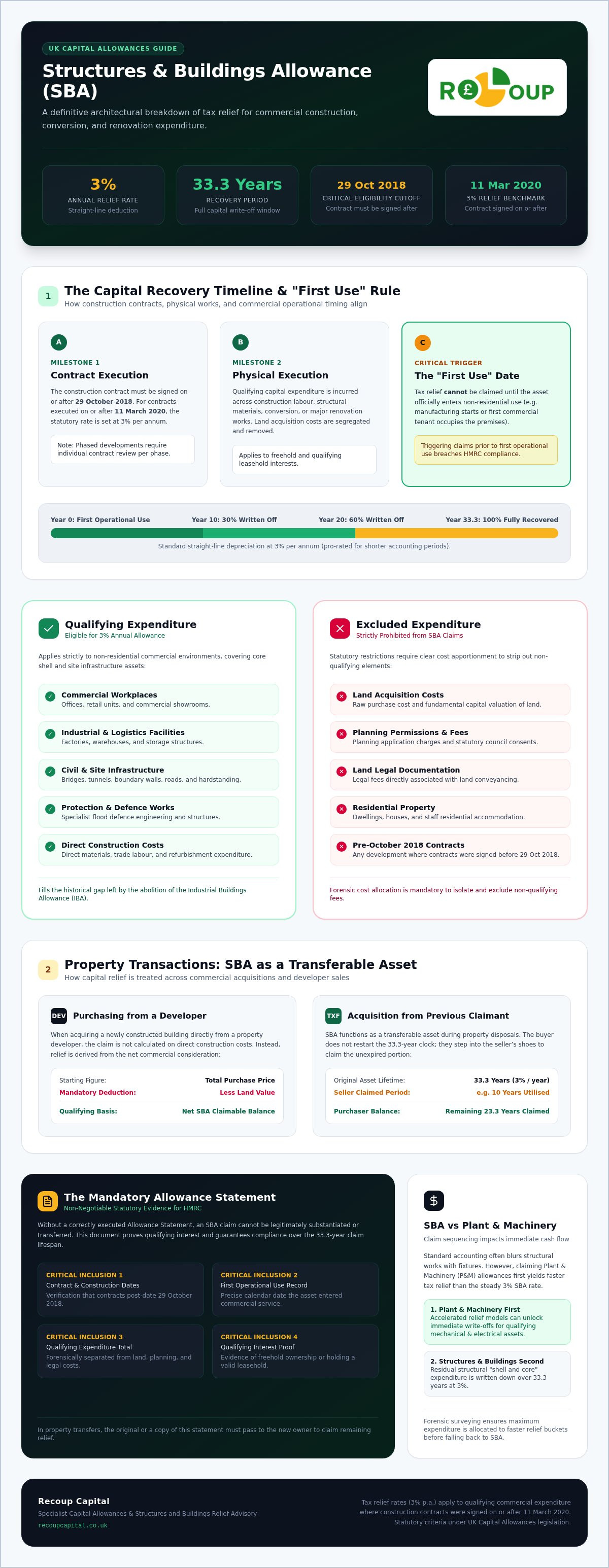
Since April 2020, the SBA has been set at a flat rate of 3% per annum, enabling businesses to recover qualifying costs over a 33.3-year period. This 3% rate specifically applies to qualifying expenditure where the construction contract was signed on or after 11 March 2020. If your accounting period is shorter than a full calendar year, the relief is reduced proportionally. This steady, straight-line relief provides a reliable way to manage the depreciation of commercial assets over their useful life.
Qualifying Structures and Buildings
Assets must be used for non-residential purposes to meet the criteria. This covers a broad spectrum of commercial environments. Whilst "buildings" usually encompass standard offices and factories, "structures" include assets that support the core property or site infrastructure. Examples of qualifying commercial assets often found in the construction and engineering sectors include:
- Offices, retail units, and showrooms
- Factories, warehouses, and storage facilities
- Bridges, tunnels, and boundary walls
- Hardstanding, roads, and flood defences
Land costs and planning fees are strictly excluded from any claim. You can review our capital allowances expertise to see how these structural costs fit into a comprehensive tax plan designed to maximise your capital recovery.
Eligibility Criteria and Qualifying Expenditure
Securing tax relief through the SBA requires a precise understanding of when a building officially enters service. This is known as the "First Use" rule. You cannot begin claiming the allowance until the structure is brought into non-residential use. For a new factory, this might be the day production starts. For a renovated office block, it's often the date the first tenant moves in. Having the structures and buildings allowance (SBA) explained through the lens of timing ensures you don't trigger a claim prematurely, which could lead to compliance issues with HMRC.
Qualifying expenditure includes the direct costs of construction, such as labour and materials. It also extends to the conversion of existing premises or significant renovation projects. If you purchase a building from a developer, your claim is typically based on the purchase price after deducting the value of the land. When buying from a previous owner who has already claimed SBA, you simply take over the remaining balance of their allowance. This makes the SBA a transferable strategic asset that adds value during property transactions.
Critical Dates for SBA Eligibility
The most important date in the SBA calendar is 29 October 2018. If the construction contract for your project was signed before this date, the expenditure will not qualify for the allowance. This rule remains strict even if the actual building work started much later. In the case of phased developments, the eligibility of each section depends on its specific contract date. You might find that some parts of a large-scale engineering project qualify whilst older phases do not, requiring a forensic approach to cost allocation.
Excluded Costs You Cannot Claim
Precision is vital when separating qualifying costs from exclusions. Land acquisition is the most significant exclusion; you must always deduct the land value from your total investment. Other common exclusions include:
- Planning permissions and legal fees associated with land purchase.
- Residential property, including staff accommodation or dwellings.
- Landscaping and site preparation, unless strictly necessary for the building's structural integrity.
VAT treatment also varies. If your business isn't VAT-registered, the VAT you pay on construction costs can be included in your SBA claim. However, VAT-registered entities must exclude these amounts. If you're unsure how these exclusions affect your specific project, reviewing your capital allowances strategy with a specialist can help uncover hidden recovery opportunities whilst maintaining full compliance.
SBA vs. Plant and Machinery Allowances
One of the most frequent errors in commercial tax planning is treating all building expenditure as a single bucket. When you have the structures and buildings allowance (SBA) explained in a strategic context, it becomes clear that this relief exists as a "last resort" for costs that don't qualify elsewhere. In the hierarchy of capital recovery, you should always prioritise Plant and Machinery (P&M) allowances. This is because P&M relief rates are significantly more aggressive, offering 18% for the main pool or 6% for the special rate pool, compared to the flat 3% provided by the SBA.
The introduction of Full Expensing has widened this gap even further. Whilst the SBA requires 33.3 years to fully recover costs, Full Expensing allows companies to claim 100% relief in the very first year for qualifying main pool assets. Even for special rate assets, the 50% first-year allowance provides a much faster return on investment than the straight-line SBA method. Forensic analysis is the only way to ensure these high-value items aren't accidentally buried within the structural build costs.
Why the Hierarchy Matters for Cash Flow
Extracting P&M first is essential for accelerating tax relief and improving immediate cash flow. Items sitting on the boundary between structure and machinery, such as bespoke cabling or specialised flooring for heavy equipment, require careful classification. By Understanding Capital Allowances as a tiered system, you can ensure that every pound spent is working as hard as possible for your bottom line. Failing to identify these items early means waiting decades for relief that could have been claimed in year one.
The Role of Integral Features
A building's "shell and core" might qualify for the SBA, but the systems that make it functional often fall under the "integral features" category of P&M. This includes electrical systems, cold water supplies, and sophisticated heating or cooling installations. These are high-value components that general accounting often misses because they are wrapped into a single contractor invoice. Miscategorising a 6% asset as a 3% asset costs the business money over time by unnecessarily delaying the recovery of capital. Forensic surveying identifies these components at a granular level, ensuring that structural costs are strictly separated from high-yield machinery claims.
How to Claim: The Allowance Statement Requirement
The Allowance Statement is the non-negotiable foundation of your claim. HMRC requires this document to be created before any relief is requested in a tax return. It serves as permanent evidence of your eligibility. Without it, your claim simply doesn't exist in the eyes of the tax authorities. Having the structures and buildings allowance (SBA) explained through its administrative requirements helps you avoid the risk of clawbacks or rejected filings during an audit.
You must retain these records for the entire duration of the claim plus the standard six-year statutory period. Given the 33.3-year lifespan of the relief, this requires a disciplined approach to digital archiving. Losing the statement mid-way through the relief period could result in the immediate cessation of your tax benefits, as the burden of proof always rests with the taxpayer.
Creating a Compliant Allowance Statement
To build a robust statement, you must include several specific data points that define the life cycle of the asset. HMRC mandates that you record the date of the earliest construction contract, the total amount of qualifying expenditure, and the date the building was first brought into non-residential use. This document must also clearly identify the property and the nature of your "qualifying interest," whether you hold the freehold or a long-term lease. Whilst you secure structural relief, you might also be eligible for R&D Tax Credits Explained to recover costs from technical innovation within your facility.
SBA and Property Transactions
When a property changes hands, the SBA doesn't follow the same "pooling" rules as plant and machinery. Instead, the allowance remains tied to the building itself. For a buyer to continue the claim, they must receive the original Allowance Statement from the seller. If this document is lost or never created, the chain of relief is broken; the buyer may lose the ability to claim for the remaining decades of the allowance period. This makes the statement a vital asset during the due diligence process of any commercial property transaction.
Unlike other capital allowances, there are no "balancing adjustments" when you sell a property. You don't trigger a tax charge on the relief already claimed. However, the total SBA you've claimed over the years is deducted from the property's base cost when calculating Capital Gains Tax. This makes the allowance a strategic tool that requires careful long-term planning. If you are preparing for a sale or acquisition, you can speak with our specialists to ensure your documentation is forensic-grade and ready for scrutiny.
Maximising Your SBA Claim with Specialist Guidance
General accountants provide excellent broad financial oversight, yet they often lack the forensic surveying expertise required to uncover deep-level capital recovery. Many businesses leave money on the table because structural costs are simply lumped together in a single construction invoice. Having the structures and buildings allowance (SBA) explained by a specialist reveals how forensic precision transforms a standard tax return into a strategic asset. By integrating SBA with other incentives like Land Remediation Relief or Patent Box, you create a comprehensive tax strategy that protects your bottom line whilst funding future innovation. This relationship-first approach ensures that your business stays compliant whilst maximising every available pound.
The Forensic Surveying Advantage
Specialists don't just look at the final figure on a construction invoice. They dissect every line item to separate land costs, plant and machinery, and qualifying structural work. This granular approach ensures you aren't underclaiming on high-value integral features or overclaiming on excluded landscaping. This level of detail is exactly Why Claim with Recoup Capital? is a preferred route for many UK firms. Robust, evidence-backed claims significantly reduce the likelihood of HMRC enquiries. We act as a protective guide through the complexities of the regulatory landscape, ensuring that your documentation is forensic-grade and ready for scrutiny.
Success-Based Recovery
Our success-based fee model removes the financial risk often associated with specialised consultancy. You don't pay an upfront cost; we only take a fee once we've successfully identified and secured your tax savings. This aligns our interests with yours, focusing purely on results rather than traditional sales pitches. When you have the structures and buildings allowance (SBA) explained as part of a long-term partnership, the focus shifts from paperwork to profit. The capital recovered through these claims isn't just a refund; it's a strategic resource. You can reinvest these funds into new equipment, talent, or further property developments. It's about turning complex regulatory requirements into approachable opportunities for business growth.
Ready to see what's hidden in your property portfolio? Book a consultation with our Capital Allowances specialists to begin your recovery journey.
Secure Your Long-Term Capital Recovery Strategy
Having the structures and buildings allowance (SBA) explained reveals that whilst the 3% relief rate is a long-term play, its cumulative impact on your Corporation Tax liability is substantial. Success depends on more than just basic bookkeeping; it requires a meticulous Allowance Statement and a clear understanding of the hierarchy between structural work and integral features. By prioritising Plant & Machinery first and using forensic surveying to isolate qualifying costs, you ensure no capital remains trapped in your property's "shell and core" or lost to inefficient tax planning.
Our team of chartered tax accountants and forensic surveyors specialises in the construction and engineering sectors, providing the precision needed to satisfy HMRC. We operate on a success-based fee model, ensuring you can explore your eligibility without any upfront risk or obligation. This partnership-oriented approach transforms complex regulatory procedures into approachable opportunities for growth and reinvestment. Maximise your capital recovery with a specialist SBA assessment today and let us help you turn your commercial property into a strategic business tool. We're ready to help your business innovate and thrive.
Frequently Asked Questions
Can I claim SBA on a building I already own?
You can claim SBA on an existing building provided the construction contract was signed on or after 29 October 2018. If you purchased the building second-hand, you must obtain an allowance statement from the previous owner to continue their claim. Having the structures and buildings allowance (SBA) explained in this context highlights that relief is tied to the asset's life cycle rather than the purchase date. This allows you to recover capital on older investments that meet the criteria.
What is the current rate for Structures and Buildings Allowance in 2026?
The current rate for the Structures and Buildings Allowance remains at 3% per annum for the 2026 tax year. This flat rate allows businesses to write off qualifying expenditure on a straight-line basis over a 33.3-year period. It's a reliable mechanism for long-term capital recovery. Whilst other allowances like Full Expensing offer immediate relief for machinery, the SBA provides a steady reduction in Corporation Tax liability for the structural "shell and core" of your commercial property.
Do I need a specialist surveyor to claim SBA?
Whilst HMRC doesn't legally mandate a specialist surveyor, using one is vital for identifying the maximum qualifying spend. General accountants often miss the forensic details required to separate structural costs from land or plant and machinery. A specialist surveyor uses granular analysis to break down contractor invoices, ensuring your claim is both robust and compliant. This protective guidance reduces the risk of HMRC enquiries whilst uncovering hidden savings that standard tax reviews typically overlook.
What happens to my SBA claim if I sell the building?
If you sell a building, your entitlement to claim SBA ends on the date of the transfer. The remaining allowance passes to the new owner, provided you give them a valid allowance statement. Unlike other capital allowances, there are no balancing charges or credits triggered by the sale. However, the total amount of relief you've claimed will be deducted from the property's base cost, which may increase your Capital Gains Tax liability upon disposal.
Can I claim SBA on a building located outside the UK?
You can claim SBA on buildings located outside the UK if your business is within the charge to UK tax. This typically applies to UK-resident companies with overseas branches or individuals with foreign property businesses taxed in the UK. The building must still be in non-residential use and meet all other standard eligibility criteria. It's an important consideration for international firms looking to manage their global tax footprint through UK-based capital recovery strategies.
Is SBA available for property developers or just property owners?
Property developers cannot claim SBA on buildings they intend to sell as trading stock. The allowance is designed for the person who holds the "qualifying interest" and brings the building into non-residential use. Once a developer sells the property to an end-user or an investor, that buyer becomes the party eligible to start the claim. This ensures the relief supports those making long-term investments in the UK's commercial infrastructure rather than short-term traders.
How does SBA interact with the Annual Investment Allowance (AIA)?
SBA and the Annual Investment Allowance (AIA) operate in completely separate pools. AIA is specifically for plant and machinery, offering 100% relief in the first year, whereas SBA covers the building's structure at 3%. You cannot use your AIA limit to cover structural costs. A forensic approach ensures you correctly identify assets like electrical systems for AIA first, leaving only the remaining structural costs for the slower SBA recovery.
Can I claim SBA on a renovated or extended commercial property?
You can claim SBA on renovations, conversions, or extensions to existing commercial properties. The expenditure must relate to the "shell and core" work rather than internal fixtures that might qualify for plant and machinery relief. Having the structures and buildings allowance (SBA) explained for renovations means you can recover the costs of enhancing an older building, provided the new work contract was signed after October 2018. It's a powerful tool for modernising your business premises.


