

Could the very contamination stalling your development project actually be the key to reclaiming six figures in Corporation Tax? Redeveloping derelict land often feels like a gamble where the house always wins, especially when unforeseen remediation costs begin to erode your margins. It's frustrating to see potential profit buried under layers of Japanese Knotweed or industrial pollutants whilst you struggle to decipher the technical jargon of environmental reports. Understanding what qualifies as contaminated land for tax relief is the first step toward transforming your balance sheet.
We've designed this 2026 guide to provide the clarity you need. You'll discover exactly how your business can claim 150% tax relief on the costs of cleaning up contaminated or derelict land. We'll outline a clear yes/no framework for qualification and explain how to align your remediation strategy with HMRC expectations, ensuring you reduce your Corporation Tax liability without the fear of incorrect claims. From identifying hidden fixtures to addressing the "harm" threshold, we're here to guide you through the complexities of capital recovery and strategic business growth.
Key Takeaways
- Discover how to unlock a 150% Corporation Tax deduction on your remediation expenditure, effectively transforming environmental liabilities into strategic business assets.
- Learn exactly what qualifies as contaminated land for tax relief by mastering the 'Relevant Harm' test and the SPOSH framework used by HMRC.
- Understand the crucial distinction between contaminated and derelict land, including the specific rules for sites that have been vacant since April 1998.
- Identify which man-made and natural pollutants, ranging from asbestos to Japanese Knotweed, allow for significant capital recovery under current 2026 regulations.
- Gain insights into how a forensic surveying approach helps you accurately separate development costs from qualifying remediation spend to ensure your claim is robust.
What is Land Remediation Relief (LRR) and Why Does It Matter?
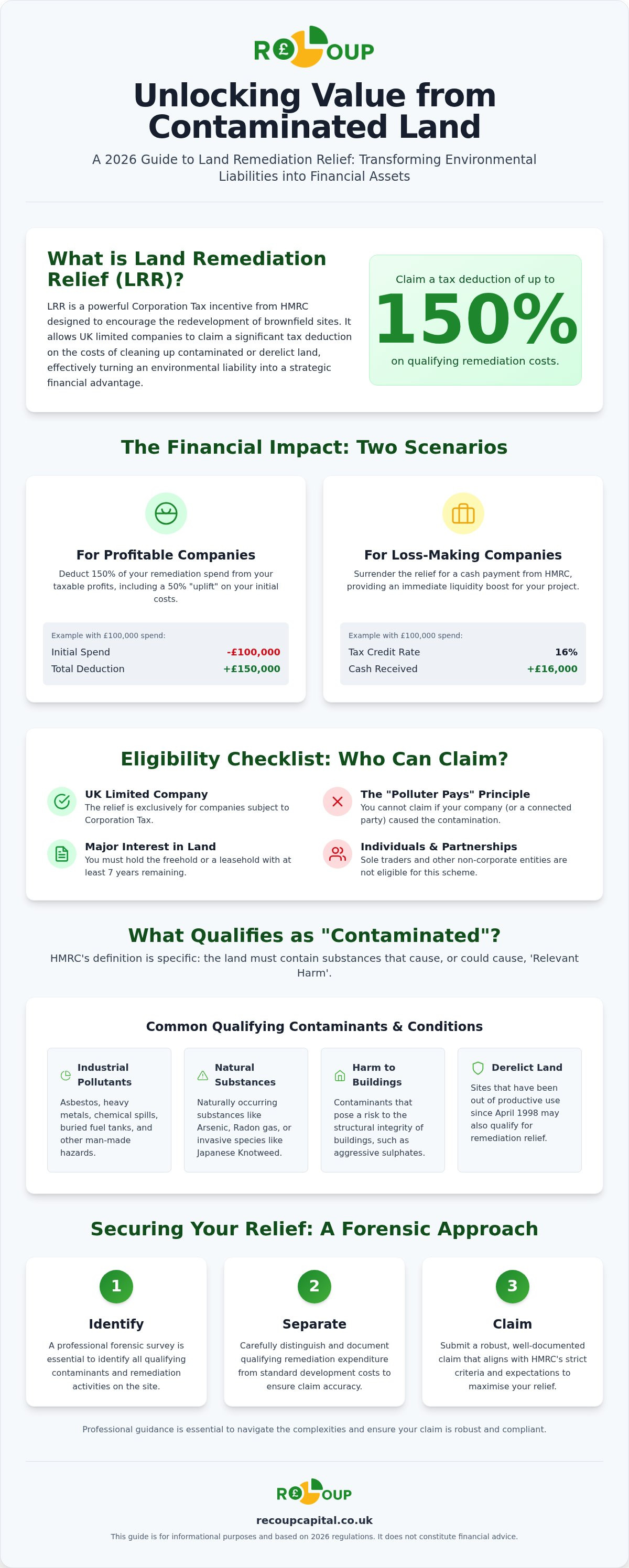
Land Remediation Relief (LRR) is a powerful tax incentive designed to offset the high costs of cleaning up brownfield sites. For many developers, understanding exactly what qualifies as contaminated land for tax relief is the difference between a project that's financially viable and one that's a liability. At its core, LRR allows UK limited companies to claim a 150% deduction on qualifying expenditure against their taxable profits. This means the government effectively subsidises the environmental clean-up, encouraging the reuse of industrial land whilst protecting the natural landscape from "harm".
It's vital to remember that this relief is exclusively available to companies within the charge of Corporation Tax. Individuals, sole traders, and partnerships are unfortunately excluded from this specific scheme. For companies currently in a loss-making position, the relief doesn't just sit on the books; it can be surrendered for a cash tax credit, providing an immediate liquidity boost when it's needed most. This makes LRR a strategic tool for managing cash flow during the early, capital-intensive phases of a development.
The Financial Impact of 150% Relief
The maths behind LRR is simple but transformative. If your business spends £100,000 on qualifying remediation activities, you can deduct £150,000 from your taxable income. If you've already deducted the initial £100,000 as a business expense, the relief provides an additional 50% "uplift". For loss-making companies, HMRC allows you to surrender the credit for a 16% cash payment. This turns a tax deduction into tangible capital that can be reinvested into the project. LRR often works best when integrated with other incentives, such as Capital Allowances, to maximise the total recovery on your investment.
Who Can Claim? Eligibility for UK Limited Companies
Qualification isn't just about the dirt; it's about your legal standing. To claim, your company must hold a "major interest" in the land, which typically means a freehold or a leasehold with at least seven years remaining at the time the work was commissioned. The most significant hurdle is the "polluter pays" principle. You cannot claim LRR if your company, or a person with a relevant connection to your company, caused the contamination. The relief is intended for those taking on the burden of historical pollutants, not those responsible for creating them. Identifying what qualifies as contaminated land for tax relief requires a forensic look at both the site's history and your company's acquisition timeline to ensure you meet these strict HMRC criteria.
The Technical Definition: What Counts as 'Contaminated' for HMRC?
HMRC's definition of "Land in a Contaminated State" is rooted in the Finance Act 2001, and it's far narrower than a general environmental definition. To understand what qualifies as contaminated land for tax relief, you must look beyond the presence of pollutants and focus on the specific "Relevant Harm" threshold. This legal standard dictates that land is only considered contaminated if substances are present that cause, or have a significant possibility of causing, significant harm to humans or the environment.
The distinction between man-made pollutants and naturally occurring substances is a common point of confusion. Whilst man-made contaminants like industrial chemicals or buried fuel tanks are clear candidates, naturally occurring substances like arsenic or radon can also qualify. However, they must be present in concentrations that pose a genuine, non-standard threat. If a substance is naturally present in the soil at typical regional levels and doesn't meet the "Significant Possibility of Significant Harm" (SPOSH) criteria, it won't qualify for the 150% relief. It's the risk level, not just the presence of the substance, that triggers the tax benefit.
HMRC's 'Relevant Harm' Framework
The "Relevant Harm" test isn't limited to human health; it covers a broad spectrum of "receptors" that could be adversely affected. Significant harm might include serious injury or death to humans and animals, or the impairment of reproductive functions in local plant life. It also extends to the wider ecosystem, such as the pollution of groundwater or nearby watercourses. Beyond biology, the framework includes damage to the structural integrity of buildings, where contaminants like aggressive sulphates or methane gas threaten foundations. If your site poses a risk to any of these categories, you're likely sitting on a significant tax-saving opportunity. Consulting with land remediation specialists can help you document these specific risks in a way that satisfies HMRC's technical requirements.
Proving Contamination: The Evidence Trail
You can't claim LRR based on a hunch; you need a robust evidence trail that bridges the gap between environmental science and tax law. This begins with Phase 1 and Phase 2 environmental site assessments. A Phase 1 report provides the historical context and identifies potential risks, whilst Phase 2 involves actual soil and water sampling to confirm the concentration of pollutants. HMRC places immense weight on these technical reports as they provide the data needed to justify the "harm" claim. Your acquisition survey is perhaps the most vital document in your arsenal, as it serves as the baseline for your entire application. The state of the land at the moment of acquisition dictates the entire potential of your claim, as you cannot claim for contamination that occurred whilst the land was under your ownership.
Derelict Land vs Contaminated Land: Navigating the Qualification Gap
Whilst the previous focus was on the chemical and biological state of the soil, Land Remediation Relief also extends to sites that are physically "broken" rather than chemically toxic. This is where the category of derelict land becomes vital. It's essential to distinguish between these two categories when determining what qualifies as contaminated land for tax relief, as the rules for derelict sites are significantly stricter regarding their history. Unlike contaminated land, which can be claimed regardless of when the pollutant was introduced, derelict land must have been documented as such since at least 1 April 1998.
A common misconception is that any "empty" or "unoccupied" site is automatically derelict. HMRC applies a much higher bar. For a site to be considered derelict for LRR purposes, it must be incapable of being brought into beneficial use without the removal of redundant services or structures, such as old foundations or abandoned underground utilities. If a building is merely vacant but structurally sound enough for use, it won't meet the criteria. The relief is intended to incentivise the difficult work of reclaiming land that has been left behind by the UK's industrial past.
Qualifying Criteria for Derelict Sites
For a derelict site to qualify, the claimant company must still hold a major interest, typically a freehold or a long leasehold. The remediation work usually involves the removal of "post-industrial" obstacles. This includes the stripping out of redundant machinery foundations, the removal of obsolete sewers, or the clearing of former gasworks infrastructure. These sites are often found in the heart of urban areas, where the cost of clearing the "ghosts" of previous buildings often makes development unfeasible without the 150% tax uplift. Proving the site has been derelict since 1998 requires a robust paper trail, often involving historical OS maps, local authority records, or aerial photography.
The "Polluter Pays" Trap: A Vital Distinction
The "polluter pays" principle remains the most significant legal barrier to a successful claim. You cannot claim relief if your company, or any "connected" party, was responsible for the contamination or the state of dereliction. HMRC takes a wide view of "connectedness," meaning if you purchase a site from a sister company or a subsidiary that caused the original pollution, the relief is void. However, acquiring a site with full knowledge of its contamination is not a barrier; in fact, that's exactly what the relief is designed for. The distinction lies in the act of causing the mess versus the act of cleaning it up. Rigorous due diligence during the acquisition phase is essential to ensure that your company isn't inadvertently stepping into the shoes of the polluter, which would disqualify you from claiming what qualifies as contaminated land for tax relief.
Common Contaminants and Qualifying Remediation Activities
Identifying the physical substances on your site is the practical starting point for any claim. Asbestos, heavy metals, and industrial solvents are the usual suspects, but the list of qualifying pollutants is extensive. When assessing what qualifies as contaminated land for tax relief, it's essential to look at the specific activities undertaken to neutralise these threats. HMRC doesn't just reward the presence of pollutants; it rewards the active, costly process of making the land safe for its intended use again.
Invasive Species and Natural Contaminants
Japanese Knotweed is a primary example of a biological contaminant that qualifies for relief. Whether you opt for long-term in-situ chemical treatment or the more immediate "dig and dump" method, the associated costs are generally eligible. Natural gases like radon and methane also fall under the scheme's remit. Since these gases often require the installation of protective membranes and complex venting systems within new structures, the expenditure on these specific protective measures can be claimed. Naturally occurring heavy metals, such as arsenic or cadmium, also qualify if they exist in concentrations that exceed standard safety levels for the site's future purpose.
- Asbestos: Costs for safe removal, disposal, or encapsulation within the ground.
- Hydrocarbons: Treatment of soil contaminated by historical fuel leaks or oil spills.
- Ground Gases: Installation of active or passive venting systems to prevent gas build-up.
What Costs Can You Actually Claim?
Qualifying expenditure is strictly defined to ensure the relief targets the remediation itself rather than general development. You can claim for directly employed staff costs, which include gross salary, Class 1 NIC, and employer pension contributions, provided they're spent on remediation activities. Materials used during the process, such as chemical neutralisers or clean capping soil, are also fully eligible. For a deeper dive into these categories, you can read more about how Land Remediation Explained applies to your specific sector.
- Staff Costs: Only the proportion of time spent directly on remediation work qualifies.
- Sub-contractors: If the sub-contractor is unconnected to your company, you can claim 65% of the total payment.
- Proportionate Expenses: If an activity serves both remediation and general construction, only the "extra" cost attributable to the contamination is eligible.
Understanding what qualifies as contaminated land for tax relief involves a forensic split of your project budget. If you're unsure which of your project costs meet these criteria, contact Recoup Capital for a forensic review of your expenditure to ensure no qualifying spend is left on the table.
Securing Your Relief: Why Professional Guidance is Essential
Navigating the boundary between standard construction and specialist remediation is where most businesses stumble. Whilst identifying what qualifies as contaminated land for tax relief is a technical environmental exercise, justifying those costs to HMRC is a purely financial one. The complexity lies in the "extra" cost principle; you can only claim for the expenditure that was incurred specifically because of the contamination. If you were going to excavate for a foundation anyway, only the additional costs of treating or disposing of the polluted spoil would qualify. Separating these overlapping costs requires a level of forensic detail that standard accounting often misses.
Recoup Capital employs a specialist approach to ensure every penny of qualifying spend is captured. We look beyond the obvious "dig and dump" invoices to identify overlooked costs in staff time, material diversions, and sub-contractor mark-ups. This level of detail is then distilled into a robust technical report. This document serves as your primary defence during the CT600 filing process, providing HMRC with the evidence-backed narrative they require to approve a claim. Strategic businesses often view LRR not as a standalone refund, but as a component of a broader R&D tax credit strategy, where innovation in remediation techniques can trigger multiple relief streams simultaneously.
The Risk of Inaccurate Claims
HMRC is increasingly vigilant regarding "aggressive" claims that attempt to reclassify general site preparation as remediation. A common mistake is claiming for the removal of non-harmful topsoil or standard levelling works that don't meet the "Relevant Harm" threshold. Such errors don't just risk a rejected claim; they can trigger wider audits into your company's tax affairs. Our success-based fee model is designed to mitigate this risk. By only charging when a claim is successful, we ensure our interests are perfectly aligned with yours, focusing on robust, defensible results that accurately reflect what qualifies as contaminated land for tax relief under 2026 regulations.
Partnering with Recoup Capital for Capital Recovery
Our team acts as your protective guide through the entire regulatory landscape. We provide an end-to-end service that begins with a detailed site survey and ends with direct HMRC liaison. We don't replace your existing accountants; we partner with them. Our specialists provide the niche technical expertise required for land remediation whilst your accountants maintain their focus on your broader financial health. This collaborative approach ensures you maximise every available relief without disrupting your established professional relationships. Enquire about your Land Remediation Relief today to see how we can transform your environmental challenges into strategic assets for growth.
Maximising Your Brownfield Investment Potential
The journey to reclaiming 150% tax relief on your project costs starts with a precise understanding of what qualifies as contaminated land for tax relief. By mastering the "Relevant Harm" framework and distinguishing between historical dereliction and active pollutants, your business can transform environmental liabilities into strategic financial assets. Whether you're addressing asbestos, ground gases, or invasive species, the key is a forensic approach to cost allocation that stands up to HMRC scrutiny.
Don't leave your capital recovery to chance. Our team of specialist chartered tax accountants provides national coverage across the UK, operating on a success-based fee structure to ensure your claim is both robust and rewarding. We act as your protective guide, ensuring your remediation strategy is as tax-efficient as it is environmentally sound. It's time to unlock the hidden value in your brownfield investments and fuel your company's future growth through professional capital recovery.
Request a no-obligation Land Remediation Relief assessment
Frequently Asked Questions
Is Japanese Knotweed considered contaminated land for tax relief?
Yes, Japanese Knotweed is officially recognised as a biological contaminant by HMRC. Companies can claim the 150% tax relief on costs related to its removal or treatment, provided the work is necessary to bring the land back into beneficial use. This includes both chemical treatment in-situ and the more expensive excavation methods. It's a prime example of what qualifies as contaminated land for tax relief in a biological context.
Can I claim Land Remediation Relief if I am a property developer?
Property developers are fully eligible to claim Land Remediation Relief, provided they operate as a UK limited company. The relief is available for land held as trading stock, which is common in development projects. However, the company must not be the party responsible for the original contamination. This incentive is specifically designed to help developers offset the high costs associated with bringing difficult brownfield sites back into productive use.
What is the time limit for making a Land Remediation Relief claim?
You generally have up to three years from the end of the accounting period in which the remediation expenditure was incurred to submit a claim to HMRC. This window allows companies to gather the necessary environmental reports and forensic accounting evidence required for a robust submission. It's essential to track these deadlines carefully as part of your wider tax strategy to ensure you don't miss out on significant capital recovery opportunities.
Can I claim for the removal of asbestos from an existing building?
Asbestos removal from a building qualifies for relief if the substance is being removed to prevent "relevant harm" during redevelopment. This includes asbestos found in the fabric of a building or buried in the ground from previous demolitions. The relief covers the costs of specialist contractors and safe disposal. It's often a major component of what qualifies as contaminated land for tax relief for those transforming old industrial structures.
Does Land Remediation Relief apply to residential property developments?
Land Remediation Relief applies to both commercial and residential property developments. As long as the claimant is a limited company and the remediation work meets HMRC's "relevant harm" criteria, the specific end use of the land doesn't disqualify the claim. This makes the relief a vital tool for housebuilders working on complex brownfield sites where the cost of cleaning up historical pollutants might otherwise make a project financially unviable.
What happens if my company is making a loss; can I still get the tax relief?
Loss-making companies can still benefit from this relief by surrendering their remediation losses for a cash tax credit. HMRC currently allows a cash payment of 16% of the qualifying remediation loss. This provides a crucial liquidity boost for companies in the early stages of a project before they've reached profitability. It transforms a technical tax deduction into a strategic asset that can be immediately reinvested back into the development's operations.
Can I claim LRR if I purchased the land from a connected company?
No, you cannot claim Land Remediation Relief if you purchased the site from a connected company that was responsible for the contamination. HMRC's "polluter pays" principle is strict; if a sister company or subsidiary caused the pollution, the relief is unavailable to the entire group. It's vital to conduct thorough due diligence on the site's ownership history before acquisition to ensure your company isn't blocked from accessing these incentives.
Do I need an environmental survey to qualify for the tax relief?
Yes, a professional environmental survey is essential to substantiate your claim. HMRC requires technical evidence, typically in the form of Phase 1 and Phase 2 reports, to prove that the land meets the "relevant harm" threshold. These surveys identify the specific pollutants and the risks they pose to humans or the environment. Without this documentation, it's almost impossible to provide the forensic detail needed to confirm what qualifies as contaminated land for tax relief.


