

An HMRC enquiry is a technical challenge, not an accounting one; defending your claim requires a specialised technical defence that generalists often cannot provide. If you've recently received a compliance check letter, the 30-day deadline can feel incredibly daunting, making the need for expert hmrc r&d enquiry support more urgent than ever. It's natural to worry about the risk of penalties for "carelessness" or the fear of losing the vital capital you've already reinvested into your business. You might feel overwhelmed by technical jargon whilst trying to gather years of project evidence under significant time pressure.
We understand that your focus should be on growth, not paperwork. This guide provides a definitive roadmap for 2026, showing you exactly when and how to engage professional assistance to protect your innovation funding. By following this checklist, you'll discover how to resolve enquiries successfully with your claim value intact and your management time protected. We'll explore how to navigate the current 7.75% late payment interest rates and the mandatory digital filing requirements that define the current regulatory landscape, ensuring your business remains a resilient partner in the UK's innovation economy.
Key Takeaways
- Understand the shift towards AI-assisted compliance and why standard accounting narratives often fail to meet HMRC's stringent technical benchmarks.
- Identify the specific "red flags" in HMRC correspondence that indicate you need immediate, specialised hmrc r&d enquiry support to protect your innovation capital.
- Learn how a forensic review of your original claim can uncover hidden weaknesses before they lead to costly penalties or disallowed expenditure.
- Discover the "Technical Defence" strategy that reframes your R&D activities into the specific language and evidence-based structure HMRC caseworkers expect to see in 2026.
- See how a success-based partnership model aligns your interests with experts who focus on resolving enquiries whilst minimising the drain on your management time.
Understanding the Modern HMRC R&D Enquiry Landscape
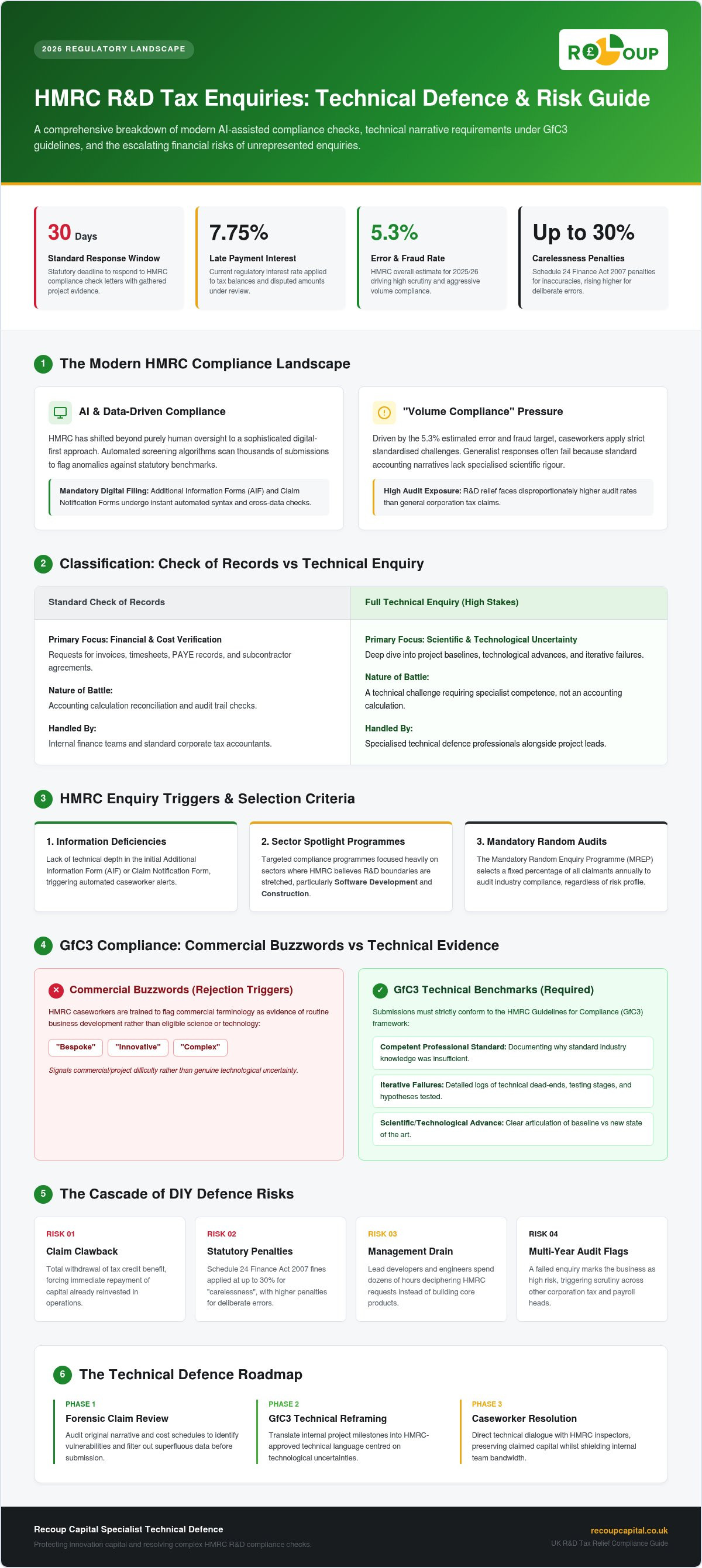
HMRC has fundamentally transformed its approach to compliance. In the current 2026 environment, the process is no longer just about human oversight; it's driven by sophisticated data analytics and AI-assisted screening. These tools scan thousands of submissions to identify anomalies that don't align with the UK Research and Development Tax Credit guidelines. This digital-first strategy explains why R&D claims face significantly higher scrutiny than other tax reliefs. HMRC estimates the overall R&D error and fraud rate at approximately 5.3% for the 2025/26 period. This figure keeps the spotlight firmly on innovation claims, leading to a more aggressive "volume compliance" model.
You must distinguish between a standard "check of records" and a full technical enquiry. A check of records typically focuses on verifying specific costs, such as subcontractor invoices or payroll data. In contrast, a technical enquiry is a deep dive into the scientific or technological uncertainty of your project. It's a technical battle rather than an accounting one. It is here that professional hmrc r&d enquiry support becomes a strategic asset, helping you articulate the technical nuances that automated systems and generalist caseworkers might overlook.
Why HMRC Opens Enquiries on Innovation Claims
Several triggers can land a letter on your desk. Often, it's a lack of technical detail in the initial Additional Information Form (AIF) or the Claim Notification Form. HMRC also runs "spotlight" programmes targeting specific sectors, such as software development or construction, where they believe the boundaries of R&D are being stretched. Even if your claim is perfect, you might be selected for the Mandatory Random Enquiry Programme (MREP). This initiative ensures that a percentage of all claimants undergo a full audit to maintain industry-wide standards, regardless of their risk profile.
The Consequences of a Poorly Managed Response
Handling an enquiry without specialist hmrc r&d enquiry support carries heavy risks. If HMRC isn't satisfied with your technical narrative, they can withdraw the entire tax credit benefit. This is particularly damaging if the funds have already been reinvested into your business. Beyond the loss of capital, you face penalties under Schedule 24 Finance Act 2007. These can reach 30% for "careless" inaccuracies, whilst "deliberate" errors carry even higher costs. A failed enquiry also flags your business for future audits across other tax heads. Understanding how R&D tax credits explained in a technical context is vital to avoiding these long-term administrative burdens.
The Escalating Risks of a DIY Enquiry Response
Attempting a DIY response is often a game of high-stakes guesswork. Whilst your internal finance team is excellent at tracking expenditure, they rarely possess the technical vocabulary needed to defend an R&D claim. HMRC doesn't just want to see receipts; they want to see proof of a technological breakthrough. Providing too much information can be just as damaging as providing too little. Irrelevant data often gives inspectors more "hooks" to challenge your eligibility. This is where professional hmrc r&d enquiry support proves its value by filtering your response to only include what truly matters to the caseworker.
The time-cost for your internal staff is another hidden drain. When your lead developers or engineers spend dozens of hours deciphering HMRC's technical requests, they aren't building your next product. This distraction can stall your innovation pipeline for months. It's a heavy price to pay for a process that carries no guarantee of success without expert oversight.
Technical Narrative vs. Financial Data
HMRC caseworkers are specifically trained to identify markers of scientific or technological uncertainty. If your response relies on commercial buzzwords like "bespoke," "innovative," or "complex," you're likely to trigger a rejection. These terms signal commercial difficulty rather than a technological advance. The HMRC Guidelines for Compliance (GfC3) set a high bar for what constitutes a "competent professional" and how iterative failures must be documented. Technical specialists are required for narrative defence because they translate engineering challenges into the specific legislative language HMRC requires to approve a claim.
The Professional Standards Barrier
The compliance landscape in 2026 is uncompromising. The mandatory Additional Information Form (AIF) has turned what was once a descriptive exercise into a rigid digital submission process. Generalists often struggle with these requirements, failing to provide the granular detail now expected by HMRC's automated screening tools. Why claiming R&D tax credits requires technical rigour is simple: HMRC now flags any submission that lacks specific technological uncertainty markers. If you're concerned about your current documentation, securing a technical review is a proactive way to safeguard your innovation capital before a formal check begins.
Checklist: When Should You Seek Professional Enquiry Support?
Receiving an enquiry letter triggers a high-pressure countdown. You have exactly 30 calendar days from the date on the letter to provide a comprehensive technical and financial response. This window is notoriously tight, especially when you're trying to run a business. Deciding whether to handle this internally or seek specialised hmrc r&d enquiry support is a critical strategic choice. If your original claim was prepared by a generalist accountant or a high-volume "claims mill," you're already at a disadvantage. These providers often lack the technical depth required to withstand the modern Mandatory Random Enquiry Programme (MREP) or targeted compliance checks.
Project complexity also dictates your need for help. Whilst "Blue Sky" innovation is easier to defend, incremental process improvements are much harder to justify to a sceptical caseworker. If your R&D involves complex software architectures or intricate engineering workarounds, a standard narrative won't suffice. You need a partner who can translate your iterative failures into the specific evidence HMRC demands. Understanding HMRC's approach to Research and Development tax reliefs reveals that they've significantly increased compliance staffing, making "rubber-stamp" approvals a thing of the past.
The HMRC Letter Diagnosis
Your first step is to "read between the lines" of the HMRC correspondence. Does the letter ask for specific technical evidence of scientific or technological uncertainties? This is a clear red flag that they're questioning the core eligibility of your work. They might also challenge the status of your "externally provided workers" versus subcontractors, a common area for disallowed expenditure. If the inspector is questioning the "competent professional" status of your lead engineers, you're facing a technical challenge that no amount of financial data can solve. In these cases, professional hmrc r&d enquiry support becomes essential to bridge the gap between your engineering reality and HMRC's rigid benchmarks.
Internal Resource Assessment
Before you commit to a DIY response, be honest about your internal capacity. Do you have the original technical lead available to answer detailed, often repetitive questions for several weeks? If your key innovators have moved on, defending the claim becomes significantly harder. Most standard accountants won't provide a success-based guarantee for an enquiry defence because they don't have the technical experts to back it up. You can explore our R&D tax credits explained guide to see where your documentation might be lacking. If you can't guarantee a robust technical narrative within that 30-day window, bringing in a specialist is the most reliable way to protect your innovation capital.
How Specialised Support Protects Your Innovation Capital
Specialised hmrc r&d enquiry support acts as a protective shield for your business, ensuring that regulatory scrutiny doesn't derail your growth. When an enquiry begins, the primary goal is to safeguard your innovation capital, reframing your tax credit from a simple refund into a strategic asset for future reinvestment. A specialist doesn't just process paperwork; they act as a buffer between your team and HMRC, managing the entire correspondence flow so your developers can stay focused on their core work. This partnership approach transforms a high-stakes investigation into a manageable procedural step.
The Forensic Review Process
The first stage of a robust defence is a forensic review of your original submission. We don't just look for errors; we search for missed opportunities. Often, claims prepared by generalists overlook hidden eligible costs or fail to document the full extent of a technological advancement. Our technical experts work to:
- Identify eligible expenditure that was omitted in the initial claim.
- Strengthen the evidence of "technological advancement" by aligning project logs with HMRC's specific benchmarks.
- Prepare your technical leads for potential interviews, ensuring they can articulate uncertainties without using commercial jargon that might trigger a rejection.
This deep dive ensures that your defence is rooted in technical reality, making it far harder for a caseworker to dismiss your project as "routine" work.
Strategic Communication with Tax Inspectors
Communication with HMRC is a delicate balancing act. Providing too much information can lead to "scope creep," where an inspector begins poking into unrelated accounting periods or different tax heads. A specialist manages the information flow, ensuring every document submitted is relevant and serves to close the enquiry. We use our understanding of current precedents to negotiate settlements or, ideally, "no-change" outcomes where your claim value remains entirely intact.
Managing these relationships requires a blend of professional authority and transparency. You can see our FAQs on R&D enquiries for more detail on how these timelines typically progress. By controlling the narrative from day one, we minimise the administrative burden on your staff and protect your reputation with the tax office. If you're currently facing a compliance check, you don't have to face it alone. Speak with our technical defence team to discover how we can secure your innovation funding and resolve your enquiry with confidence.
Resolving Your Enquiry with Recoup Capital’s Specialist Team
Engaging specialised hmrc r&d enquiry support shouldn't feel like another administrative hurdle. At Recoup Capital, we've built our reputation on a partnership-oriented approach that prioritises your business innovation over generic paperwork. We explicitly reject aggressive sales pressure, preferring to demonstrate our value through the forensic resolution of complex compliance checks. Our goal is to ensure your enquiry is resolved with your claim value intact, allowing you to reinvest that capital where it matters most. We act as your protective guide, transforming an intimidating regulatory procedure into a manageable opportunity for long-term growth.
Our Result-Driven Methodology
We believe that a technical defence requires more than just an accountant's perspective. Our team combines the precision of chartered tax accountants with the practical experience of industry-specific engineers. This dual-lens approach allows us to speak HMRC's technical language whilst understanding the engineering reality of your projects. By reframing your tax return as a strategic asset, we help you maintain institutional credibility with HMRC. Our national service coverage ensures we understand the specific regulatory frameworks affecting UK limited companies in 2026, making your defence as robust as possible. We don't just process paperwork; we build a technical case that stands up to the highest levels of scrutiny.
Taking the Next Step to Protect Your Business
The first 48 hours after receiving an HMRC letter are the most critical. When you engage us, we start with a no-cost introductory consultation to assess the specific risks outlined in your correspondence. You can securely share your HMRC letters with our team, and we'll provide a clear, evidence-based assessment of your position. Why choose Recoup Capital for your innovation defence is simple: our success-based fee structure ensures we're completely aligned with your outcomes. We only win when you keep your credit, making our involvement a powerful risk-mitigation tool rather than an additional cost.
Don't let a 30-day deadline force you into a rushed, DIY response that could jeopardise your future funding. We'll handle the liaison, the technical narratives, and the forensic cost reviews, leaving you free to focus on your next breakthrough. Our proactive approach ensures that your business doesn't just survive an enquiry but emerges with improved compliance and a clearer path to future innovation. It's about more than just defending a claim; it's about securing the financial foundation of your company's future.
Securing Your Innovation Strategy for the Future
Navigating the 2026 compliance landscape requires more than just accurate bookkeeping; it demands a technical narrative that withstands rigorous scrutiny. We've explored how a DIY response can inadvertently lead to disallowed expenditure or costly penalties for "careless" submissions. By prioritising a forensic review of your technical uncertainties and managing the communication flow with tax inspectors, you protect the innovation capital your business relies on for growth. Securing professional hmrc r&d enquiry support transforms this potentially intimidating regulatory challenge into a streamlined, strategic advantage for your company.
Our specialist technical and tax team provides national UK coverage to help you resolve enquiries with confidence. We operate on a success-based fee model, meaning our goals are perfectly aligned with yours: keeping your claim value intact whilst minimising the drain on your management time. Don't let a 30-day deadline jeopardise the funding you've worked hard to earn. Protect your R&D claim today - get a professional review of your HMRC enquiry letter. Your next breakthrough deserves a solid financial foundation, and we're here to act as your protective guide through every step of the process.
Frequently Asked Questions
How long do I have to respond to an HMRC R&D enquiry letter?
You typically have 30 calendar days from the date on the letter to provide the requested information. This deadline is strict. If you cannot meet it, you must formally request an extension before the window closes. Missing this deadline without a valid reason can lead to HMRC disallowing your claim entirely or issuing penalties for non-compliance. Specialist hmrc r&d enquiry support helps you manage this tight timeframe whilst ensuring every technical detail is accurate.
Can HMRC ask for my tax credit back after it has already been paid?
Yes, HMRC can reclaim tax credits that have already been paid if they later find the claim was invalid or inaccurate. Under the statutory enquiry window, they generally have 12 months from the filing date to open a check. If they discover evidence of "careless" or "deliberate" behaviour, they can look back even further. In these cases, you may also be liable for late payment interest and financial penalties alongside the reclaimed amount.
What is the difference between a compliance check and a technical enquiry?
A compliance check is the broad term HMRC uses for any review of your tax affairs. It often starts with a request for basic records or payroll data. A technical enquiry is a specific, deep-dive audit into the "scientific or technological uncertainty" of your R&D projects. Whilst a compliance check verifies the numbers, a technical enquiry challenges the core eligibility of your innovation under the DSIT guidelines and requires a specialised technical defence to resolve.
Will hiring a specialist make me look "guilty" to HMRC?
Absolutely not. HMRC often prefers dealing with professional advisers because it ensures that information is provided in the correct format and technical language. Engaging experts demonstrates that your business is taking "reasonable care" with its tax affairs. This can be a vital defence against penalties if an error is found. It shows you are committed to compliance rather than trying to hide inaccuracies, which builds institutional credibility with the tax office.
How much does professional HMRC enquiry support typically cost?
At Recoup Capital, we operate on a success-based fee model for our clients. This means our professional fees are calculated as a percentage of the tax benefit or cash credit we successfully defend for you. This structure ensures our interests are completely aligned with yours. You don't face the risk of high hourly legal fees regardless of the outcome. Instead, you only pay based on the innovation capital we help you retain through the process.
What happens if I cannot provide the specific evidence HMRC is asking for?
If contemporary records like timesheets are missing, we can often build a technical defence using alternative evidence. This might include project emails, version control logs, or testimony from your "competent professionals." HMRC understands that R&D documentation isn't always perfect. The key is to present a credible, technical narrative that proves the advancement occurred. A specialist can help identify these alternative evidence streams to satisfy the inspector's requirements and protect your claim value.
Can a specialist help if I have already sent a response to HMRC?
Yes, it's possible to engage support even after you've started the process. If your initial response has triggered further, more aggressive questions, we can step in to clarify the technical narrative or correct any misunderstandings. It's often better to involve experts early to prevent "scope creep." However, we can still negotiate with HMRC or provide additional evidence to resolve ongoing disputes and protect your reinvestment capital even if the enquiry is well underway.
Does an R&D enquiry mean my whole business is being audited?
Usually, an R&D enquiry is limited to the specific tax credit claim and the associated expenditure. However, there is always a risk of "scope creep" if the inspector finds significant errors in your payroll or subcontractor records. By using professional hmrc r&d enquiry support, you can ensure that the enquiry stays focused on the R&D projects. This prevents HMRC from expanding their check into other areas of your Corporation Tax or VAT affairs unnecessarily.


