

Preparing a data room for a tech company sale should start well before a buyer requests documents. A virtual data room is a secure online space where authorised people can access relevant company information. Setting it up early gives you time to organise records and address gaps before due diligence begins. The room typically brings together financial, legal, operational and compliance documents, with access managed as the deal progresses.
It’s understandable to focus first on which files a buyer will want, but timing matters just as much. Due diligence can take weeks or months, and a disorganised room can make it harder to answer questions clearly. This guide explains what a data room is, how to prepare its key document categories, how to protect sensitive information and when to start. You’ll have a practical framework for building a room that is easier to maintain and ready for a buyer’s review.
Key Takeaways
- Set up a secure virtual room and manage access by role and deal stage, with confidentiality terms in place before sensitive files are shared.
- Organise financial, legal and operational records into clear folders, including forecasts, material contracts and intellectual property information.
- Prepare relevant UK compliance evidence, including data protection policies and records that support how personal information is handled.
- Start assembling documents before a buyer begins due diligence, then keep the room accurate and current as the transaction progresses.
What is a data room?
A virtual data room is a secure website where authorised people can access company documents. For a UK technology sale, the seller usually administers it, often with their lawyers. Fees depend on the provider, number of users, storage and selected security features.
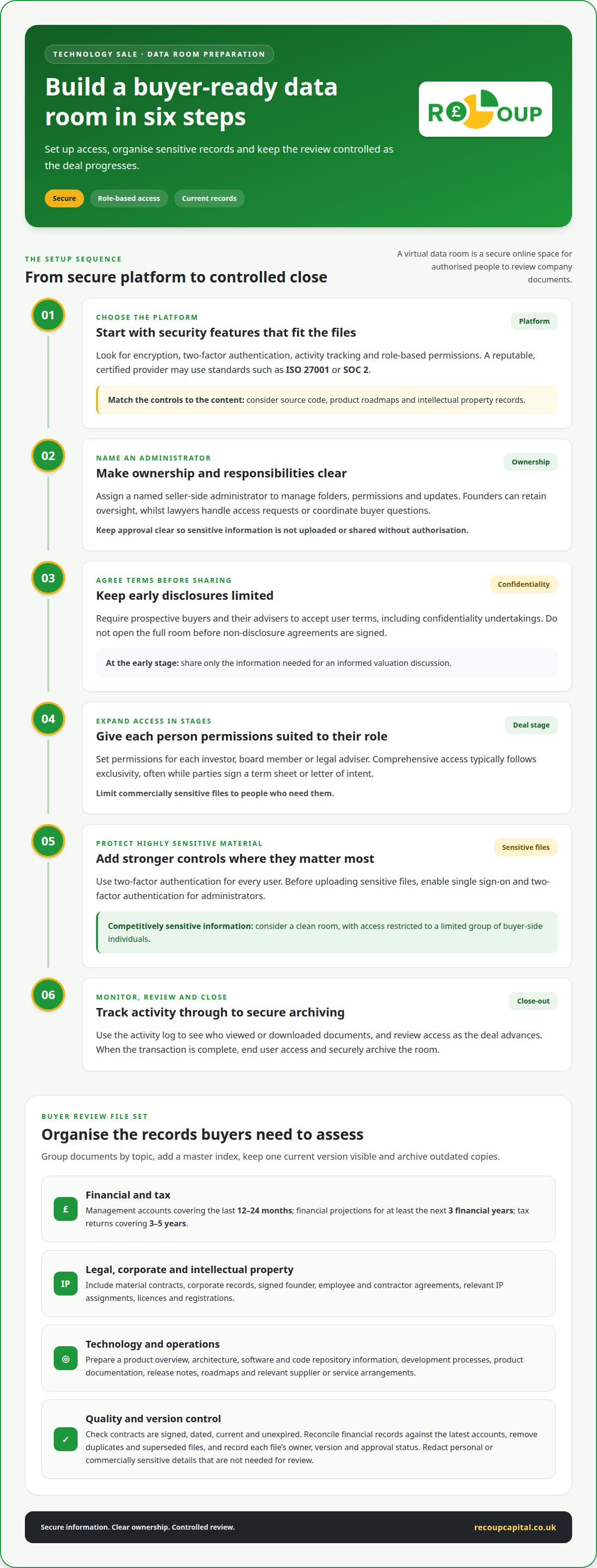
- Choose a secure virtual platform. Look for encryption, two-factor authentication, activity tracking and role-based permissions. A reputable, certified provider may use standards such as ISO 27001 or SOC 2. Match the features to the documents you’ll share, including source code, product roadmaps and intellectual property records.
- Set clear ownership and administration. Assign a named seller-side administrator to manage folders, permissions and updates. Founders can retain oversight, whilst lawyers handle access requests or coordinate buyer questions. Keep responsibilities clear so sensitive information isn’t uploaded or shared without approval.
- Agree access terms before sharing. Require prospective buyers and their advisers to accept user terms, including confidentiality undertakings. Don’t open the full room before non-disclosure agreements are signed. At an early stage, share only the information needed for an informed valuation discussion.
- Expand access as the deal progresses. Give each investor, board member or legal adviser permissions suited to their role. Comprehensive access typically follows exclusivity, often while parties sign a term sheet or letter of intent. Limit commercially sensitive files to people who need them.
- Protect highly sensitive material. Use two-factor authentication for every user, and enable single sign-on and two-factor authentication for administrators before uploading sensitive files. For competitively sensitive information, consider a clean room with access restricted to a limited group of buyer-side individuals.
- Monitor activity and close access. Use the activity log to see who viewed or downloaded documents, then review access as the deal advances. When the transaction is complete, end user access and securely archive the room. These controls help protect confidential records without blocking appropriate review.
Financial, legal and operational due diligence documents
Buyers use due diligence to assess a company’s financial position, legal obligations, operations and risks. A structured data room helps founders respond to questions from buyers and their advisers with relevant, organised records.
Prepare and organise diligence documents
- Group documents by financial, legal, operational and corporate topics, then add a master index. Include management accounts covering the last 12-24 months, financial projections for at least the next 3 financial years, and tax returns covering 3-5 years. Keep one current version visible, archive outdated copies and record each file’s owner, version and approval status.
Check intellectual property and open-source compliance
- Map the company’s intellectual property to its owners and supporting records. Gather signed founder, employee and contractor agreements, relevant assignments, licences and registrations. For open-source software, prepare a record of components, licences and how they’re used in the product. Unclear ownership, missing agreements or undocumented dependencies can prompt buyer questions and slow diligence.
Assemble technology and product records
- Prepare a clear overview of the product, its architecture, software, code repositories and development processes. Add product documentation, release notes, roadmaps, material technology contracts and records explaining how the system operates. Include relevant operational documents, such as supplier agreements and service arrangements. These records help buyers understand what the business has built and what it relies on.
Review documents for quality and redaction
- Check that contracts are signed, dated, current and unexpired, and reconcile financial records against the latest accounts. Remove duplicate or superseded files, correct inconsistencies and redact personal or commercially sensitive details that aren’t needed for review. Missing contracts, unclear IP ownership and mismatched figures can create uncertainty, invite follow-up questions and affect a buyer’s assessment.
For transaction planning alongside document preparation, corporate finance support can help bring the sale process into focus.
Sector-specific regulatory and compliance documents
Include corporate and fundraising records, a current cap table, financial and tax documents, key contracts, employment records, intellectual property records and relevant compliance policies. Together, these help a buyer understand the company’s capital structure and the controls behind its technology.
- Organise folders and versions. Create separate folders for corporate governance, fundraising, financial records, tax, contracts and compliance. Add an index that records contents and later changes, and keep one current version visible. Move superseded files into an archive rather than leaving conflicting copies beside current documents.
- Reconcile capital and fundraising records. Include the cap table, share allotments, options, shareholder agreements, investment agreements and board approvals. For UK fundraising, add relevant SEIS or EIS information, including an Advance Assurance letter where applicable. Match each record to the company’s corporate documents so buyers can follow how ownership and capital have changed.
- Prepare UK governance and transaction records. File constitutional documents, director and shareholder decisions, material contracts, tax records and evidence of ICO registration. Include the company’s Data Protection Policy and documents showing how personal information is handled. Identify whether the National Security Investment Act could be relevant to the proposed transaction.
- Include technology-specific compliance evidence. Add policies and records relevant to the product, such as data protection processes, security controls and software licensing information. According to the Information Commissioner’s Office, GDPR is relevant when employee data is shared through a data room. Minimise personal data in disclosed files, and share it only when the transaction is sufficiently certain.
- Review activity and update the room. Assign an owner to review the activity log and document changes after material events, such as new fundraising, board approvals or equity grants. If personal data is shared internationally, a data-sharing agreement may need standard contractual clauses prescribed by the GDPR, according to the European Commission. Record updates so buyers can distinguish current evidence from archived material.
Timing data room preparation
Preparing a data room for a tech company sale should begin before a buyer starts due diligence. Open access in stages, and share sensitive documents only after agreeing confidentiality terms.
Choose when to open the data room
- Prepare early, then control the release. Start preparing a data room for a tech company sale before sale discussions become detailed, leaving time to address gaps before buyer investigations. Some due diligence processes take a couple of weeks, while others take months. Initially, share key financial information so a prospective buyer can make an informed valuation judgement. Don’t release the full room before non-disclosure agreements are signed. Comprehensive access typically follows exclusivity, often whilst the parties sign a term sheet or letter of intent.
Update documents during the sale process
- Keep the room live and controlled. Assign an owner to review records regularly, track changes and remove outdated files. Update documents after material events, such as new financial reporting, board approvals, fundraising or equity grants. Record who changed each file and retain its version history, helping buyers distinguish signed agreements from drafts. Keep responding to due diligence questions and maintain the room until it closes, usually about a day before signing definitive documents. After completion, end access and securely archive the records.
For support aligning transaction decisions with your sale timeline, discuss your corporate finance needs.
Recoup Capital
Recoup Capital can help when sale planning raises questions about your company’s tax position and potential incentives. Its specialists help limited companies identify and claim incentives linked to eligible activity and expenditure, including R&D Tax Credits, Capital Allowances, Land Remediation Relief and Patent Box.
These services don’t replace legal or technical due diligence, but they can help you understand whether relevant tax incentives belong in your financial picture. Consider speaking with Recoup Capital to explore how your company’s innovation or property-related expenditure may fit available reliefs, and whether relevant records support that assessment.
Contact Recoup Capital to discuss your company’s circumstances.
Make your next move with confidence
A sale can also be a useful time to consider how your company’s financial position supports its future plans. Preparing a data room for a tech company sale gives you a structured basis for those discussions, while the records may prompt questions about innovation and property-related expenditure. Reviewing these areas alongside transaction planning can help you identify financial considerations relevant to your next decision.
Recoup Capital offers R&D Tax Credits, Capital Allowances and Land Remediation Relief. These are separate from data room preparation, but may be relevant when assessing your company’s wider financial position. A useful next step is a conversation grounded in your business and its circumstances.
Contact Recoup Capital to discuss your sale. You can move forward with a clearer view of the decisions ahead.
Frequently Asked Questions
What does “due diligence” involve?
Due diligence is a buyer’s detailed review of a company before deciding whether to proceed and on what terms. It can cover financial performance, ownership, contracts, staff, technology, intellectual property and potential liabilities. For example, a buyer may compare reported revenue with customer agreements and investigate whether the company can continue using its core software after a sale.
How should a data room be structured and indexed for a company sale?
Use a clear folder hierarchy, descriptive file names and an index so buyers can locate records without relying on a founder’s memory. For example, separate corporate approvals from customer contracts, then use consistent names such as “Customer agreement, Acme, signed”. Assign each document an owner and status, and keep a record of additions or changes so reviewers can follow the file trail.
What financial statements and forecasts do buyers expect to see?
Prepare the company’s profit and loss statements, balance sheets, cash flow information, budgets and forecasts, with assumptions that explain the figures. Buyers may also examine revenue by product or customer, gross margin, operating costs, debt and working capital. If actual performance differs from a forecast, include a concise explanation, such as a delayed product launch or a change in customer demand.
What customer, supplier, employee and commercial contracts should be included?
Include material customer and supplier agreements, employment and contractor terms, software licences, leases, financing arrangements and other contracts central to operations. Focus on signed documents and amendments, not just headline agreements. Flag provisions on change of control, exclusivity, renewal, termination or assignment, as these may affect how the business operates after a sale. Include schedules that form part of each agreement.
What UK GDPR, data protection and cybersecurity records should be prepared for due diligence?
Prepare the Data Protection Policy, evidence of ICO registration, privacy notices, records describing personal-data handling and relevant processor agreements. The Information Commissioner’s Office identifies GDPR as relevant to employee data shared through a data room. For cybersecurity context, organise policies, access-control procedures, incident records and continuity plans, where held, so buyers can understand how the company manages information risks.
How should sensitive information and personal data be redacted or anonymised in a sale data room?
Share only the personal data needed for the buyer’s review, and anonymise or redact details that do not affect the assessment. For example, replace employee names with role labels when identities aren’t relevant, or remove personal contact details from a customer export. Apply redactions permanently, not as removable overlays, and keep an internal record explaining what was withheld and why.


