

The highest-value exit isn’t always the one that gets you out fastest. An exit strategy for tech founders in the UK should reflect what you want from a sale, how ready the business is and whether you plan to leave immediately or stay involved. Planning early gives you more room to shape those choices.
A sale can feel like the finish line, but buyers will also want a clear picture of your finances, operations, ownership and intellectual property. This guide explains business exit planning, preparing your company and data room, and weighing options such as a strategic sale, private equity investment or IPO. The aim is to help you understand the trade-offs and choose a route that supports both your business and your next move.
Key Takeaways
- Start exit planning early so you have time to strengthen the business and shape the outcome you want.
- Understand how the sale structure and eligibility for tax relief can affect what you retain from a deal.
- Prepare clear financial, operational and intellectual property records to support buyer due diligence.
- Compare a strategic sale, private equity investment and an IPO against your goals for control, proceeds and ongoing involvement.
What is business exit planning?
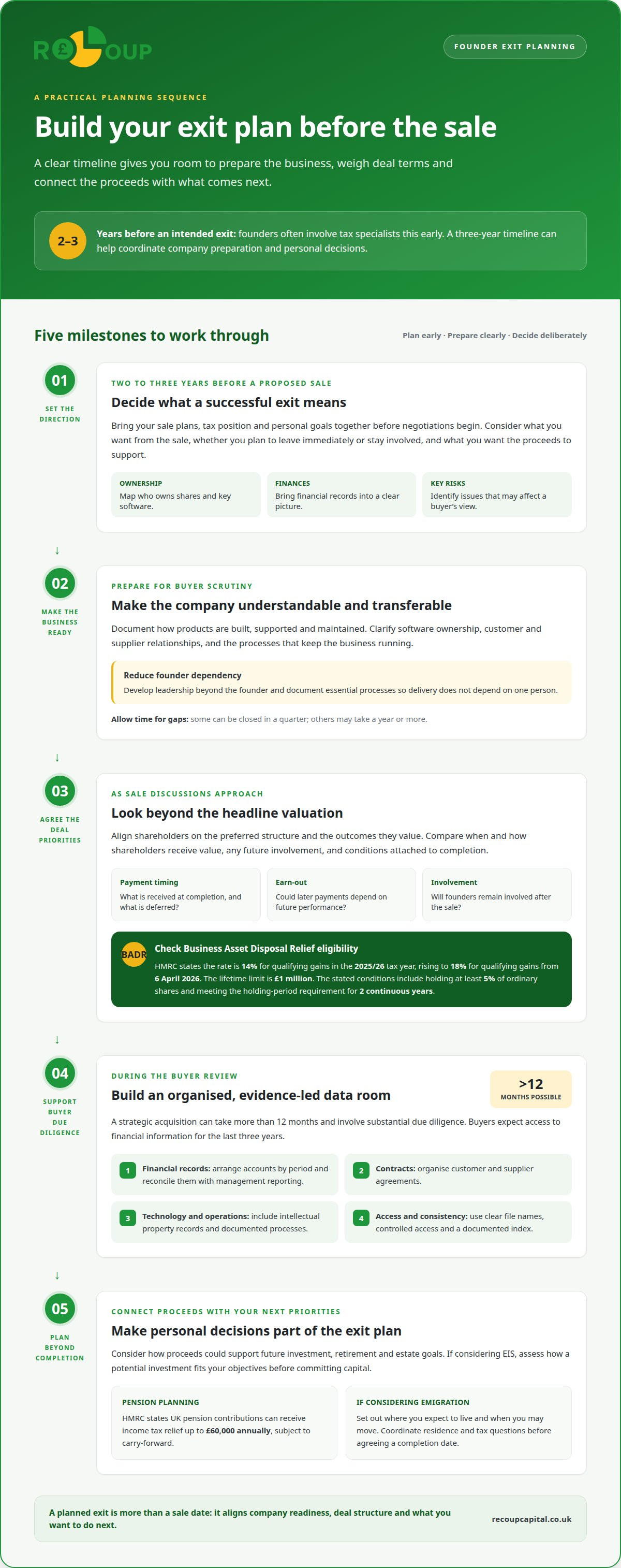
Business exit planning brings your sale, tax position and personal goals into alignment before negotiations begin. Founders often involve tax specialists two to three years before an intended exit.
Exit-planned and exit-ready approaches
Being exit-planned means deciding what you want from a future sale; being exit-ready means preparing the company to withstand buyer scrutiny. The distinction matters: a founder may have a preferred route but lack reliable records or leadership depth. For example, document who owns key software and ensure essential processes don’t depend on one person.
Benefits of exit strategy planning
Planning gives founders time to compare deal structures, prepare shareholders and protect business growth. It can also reveal issues to address before a buyer’s review. Agreeing decision-making roles with leadership, for example, can prevent confusion during negotiations. A clear plan connects sale proceeds with your next priorities, rather than treating completion as the only objective.
A three-year timeline creates room to coordinate company preparation and personal decisions. Two to three years before a proposed sale, map ownership, financial records and key risks. Consider how changes to operations or leadership could affect a buyer’s view. As discussions approach, align shareholders on the preferred structure and the outcomes they value most.
Post-exit planning should cover how sale proceeds could support future investment, retirement and estate goals. If considering the Enterprise Investment Scheme (EIS), assess how a potential investment fits your objectives before committing capital. HM Revenue & Customs states that UK pension contributions can receive income tax relief up to £60,000 annually, subject to carry-forward. Estate planning can also help founders consider how assets pass to family.
If you’re considering emigration, include the proposed move in your exit timeline. Changing countries can affect the tax and residence questions surrounding a sale, so coordinate these decisions before agreeing a completion date. Set out where you expect to live, when you may move and how that timing relates to the transaction.
What is an exit strategy - and why do start-ups need one?
An exit strategy sets out how founders might sell or transfer ownership, and what they want afterwards. For a start-up, planning connects founder independence with business continuity, valuation and stakeholder expectations.
Preparing a technology business for sale
Preparing means making the technology company understandable and transferable to a buyer. Due diligence can expose dependence on a founder, unclear software ownership or fragile operations. Map how products are built, supported and maintained, then document key customer and supplier relationships. Develop leadership beyond the founder so delivery can continue during negotiations and after ownership changes.
Business valuation and investor support
Valuation estimates what a company may be worth, while investor support helps explain the assumptions behind that estimate. A headline figure alone may not persuade stakeholders if growth, revenue quality or funding needs lack evidence. Build a clear account of performance, customer retention and future opportunities. Investors can then assess how additional capital might support growth and help achieve the company’s objectives.
Valuation and deal terms
Valuation is one part of a deal; the terms determine how and when shareholders receive value. Two offers with similar headline figures can differ in payment timing, future involvement or conditions attached to completion. Review the proposed structure alongside its assumptions, including any deferred payment or earn-out. This helps founders understand what they would receive at completion and what depends on later performance.
Business Asset Disposal Relief
Business Asset Disposal Relief (BADR) can reduce capital gains tax on qualifying gains, so eligibility may affect a founder’s net proceeds. HM Revenue & Customs states the rate is 14% for qualifying gains in the 2025/26 tax year, rising to 18% for qualifying gains from 6 April 2026. The lifetime limit is £1 million. HM Revenue & Customs also states that founders must hold at least 5% of ordinary shares and meet the holding-period requirement for 2 continuous years. Check the shareholding and timing against the planned transaction; they can influence whether relief applies.
Exit-readiness checklist and data room preparation
An exit-readiness review identifies gaps between your current position and a sale or transfer. A strategic acquisition can take more than 12 months and involve substantial due diligence.
Preparing for sale or transfer
Preparing a start-up for sale means making its finances, operations and ownership clear to a prospective buyer. Buyers need to understand what they are acquiring and how the business will continue. Organise financial records, customer and supplier contracts, intellectual property documents, and explanations of the business model. A well-structured data room helps buyers find relevant evidence without repeated requests.
Benefits of early preparation
Early preparation gives founders time to identify and address gaps before a transaction is under way. Some gaps can be closed in a quarter; others may take a year or more. Compare the current position with the exit plan, then prioritise issues that could affect buyer confidence or transaction progress. This focuses effort on practical improvements rather than rushed changes during a sale.
Preparing for buyer due diligence
Due diligence is the buyer’s review of a company’s records, risks and performance before completing an acquisition. Buyers expect access to a technology business’s financial information for the last three years. Arrange accounts by period and reconcile them with management reporting. Include contracts, intellectual property records, operational processes and material risks, using clear file names and controlled access. A documented index helps you answer questions consistently.
Legal, financial and employment risks
Before an exit, identify contractual, financial and workforce issues that could affect completion or future operations. Review customer and supplier agreements, ownership records, outstanding liabilities and the consistency of financial statements. For employment matters, clarify roles, key-person dependencies, incentive arrangements and commitments affecting staff after a sale. Resolve discrepancies and record material issues clearly so buyers can assess them during due diligence and stakeholders understand the proposed outcomes.
Choosing an exit strategy
Choosing an exit strategy for tech founders in the UK starts with priorities around control, capital and continued involvement. Compare each option with how much equity owners want to sell and the outcomes they need.
An initial public offering (IPO) makes a company’s shares available to public-market investors. For a UK tech company, an IPO on the London Stock Exchange or AIM involves preparing for a public listing and investor scrutiny. Founders and other significant shareholders typically retain at least 50% of their equity, with the remaining amount typically subject to a lock-up period of six to twelve months. An IPO prospectus may require three years of historical financials.
A strategic acquisition can suit an entrepreneur seeking a full sale to a buyer who sees value in the technology, customers or market position. Such a sale often involves 100% of the company’s equity, allowing existing shareholders to fully liquidate on day one. An earn-out may instead let shareholders share in future upside over one to three years. That can connect part of the payment to later performance, so owners should consider the terms as well as the headline valuation.
Private equity may suit a company that is profitable and has potential for further growth. Investment usually involves a controlling stake, so founders should establish how much independence they want to retain. Private equity funds typically aim to exit within three to seven years of acquisition. This route may suit owners willing to remain involved through another growth phase.
Acquisitions have been the dominant exit strategy for high-growth UK companies over the past decade. Still, the best choice depends on readiness, stakeholder priorities and how much equity founders wish to retain. For an exit strategy for tech founders in the UK, record your objectives, compare likely deal structures, then weigh preparation against the control and timing each route offers.
For support weighing transaction options, explore corporate finance advice for business exits.
Recoup Capital
Recoup Capital can help tech founders assess whether eligible tax incentives could support their company’s financial position as exit planning progresses. This may be useful when preparing financial information for a potential buyer or deciding how to support growth before a sale.
Its work includes assessing R&D Tax Credits, Capital Allowances, Land Remediation Relief and Patent Box. These incentives address different business activities, so their relevance depends on the company’s circumstances. Any resulting capital can be considered as part of wider business and transaction planning, rather than as a substitute for choosing an exit route or preparing for due diligence.
If you’re weighing these considerations as part of your sale preparation, contact Recoup Capital to discuss your business.
Turn your exit intentions into a clear next step
A well-considered exit strategy for tech founders in the UK starts with deciding what success means after the transaction. That might mean stepping away, staying involved during a transition or using released capital to pursue another venture. Write down your priorities before discussions progress, then use them to assess whether an opportunity fits your personal and business goals.
It can also help to align shareholders on the outcomes that matter most. Different expectations around timing, future involvement and proceeds can shape how you assess an offer. A focused conversation now gives you a stronger basis for decisions as opportunities develop.
If you’re ready to consider how your business and financial position fit into your plans, discuss your exit with Recoup Capital. Take the next step with a clearer sense of what you want your exit to make possible.
Frequently Asked Questions
How can you generate interest in your business from potential buyers?
Show why your business fits a buyer’s strategic priorities, then approach relevant organisations discreetly. A concise, non-confidential overview can explain your product, customer base, competitive position and growth opportunity without revealing sensitive details. Shortlist potential acquirers whose products or markets complement yours. Clear evidence of customer demand and product differentiation gives initial discussions substance and helps identify serious interest.
What advice would you give to founders currently considering an exit?
Start by deciding what you want personally and professionally from a transaction, then discuss those priorities with co-founders and shareholders. Consider whether you’d accept a transition role, keep equity or prefer a clean break. These preferences can influence which approaches are worth pursuing. Keep operating the business carefully during a sale process: steady customer service and leadership attention help preserve the value buyers are assessing.
What are the key steps between deciding to exit and successfully doing so?
First, agree the intended outcome with co-founders and establish who can speak for the owners. Next, appoint suitable legal and financial advisers, define the likely transaction structure and identify potential buyers. After initial discussions, assess offers before agreeing terms. The buyer’s due diligence and final legal documentation follow, with completion once the parties meet the agreed conditions. Keep employees and customers informed at appropriate stages.
What are the main exit strategies for UK tech founders?
The main routes include a strategic acquisition, private equity investment or an initial public offering (IPO). A strategic buyer may value your technology, team or customer relationships within its existing business. Private equity can suit a profitable company with further growth potential. An IPO gives investors access to publicly traded shares but brings public-market scrutiny. Choose by comparing control, liquidity, future involvement and the business’s readiness.
How do UK tech founders sell a company to a strategic buyer or private equity firm?
Founders typically identify suitable buyers, share an initial overview and invite proposals before negotiating preferred terms. A strategic acquirer may pursue the technology or market position; a private equity firm generally seeks a profitable business and may take control. Once the parties agree on a preferred offer, they proceed through due diligence and legal documentation. Assess both price and conditions, including any ongoing role or deferred consideration.
What is the typical valuation multiple for UK tech start-ups by sector and revenue?
There isn’t one reliable multiple that applies across UK tech sectors or revenue levels. A useful valuation depends on factors such as recurring revenue, growth, margins, customer concentration, intellectual property and the quality of financial records. Buyers may use revenue or earnings measures differently depending on the company’s business model and profitability. Treat a headline multiple as a starting point, then test its assumptions against your company’s performance.


