

An R&D tax credit can affect both reported earnings and a buyer’s confidence in a claim. Under the former UK SME scheme, its value typically came through a reduction in Corporation Tax; under the Merged Scheme, it may be recognised as other operating income, depending on the accounting policy. Understanding how R&D tax history impacts business valuation means considering both the financial treatment and the evidence supporting each claim.
It’s understandable to focus on the amount claimed, but contemporaneous records matter too. Up-to-date documentation supports the qualifying activity described in a claim and can help reduce uncertainty or delays during buyer due diligence.
This article explains how claim history and record-keeping can shape valuation discussions, what buyers may scrutinise, and why differences between tax records and financial reporting matter. A clear, well-supported account of past R&D activity can make a company’s innovation easier to assess.
Key Takeaways
- Assess R&D tax relief alongside the company’s reported earnings, as its accounting treatment can vary by scheme and accounting policy.
- Contemporaneous records help connect claimed expenditure to qualifying R&D activity and support a clearer due diligence process.
- Pending refunds and potential liabilities can affect valuation discussions, so their status and supporting evidence matter.
- Address claim uncertainty early in a sale process to give buyers and sellers a more informed basis for valuation adjustments.
HMRC scrutiny and potential tax adjustments
HMRC scrutiny can affect whether a historic R&D tax credit supports the value assigned to a business. Buyers may review claim evidence alongside transfer pricing and financial records.
HM Revenue & Customs states that the UK introduced the Research and Development Expenditure Credit scheme in April 2013 for large companies. In a cross-border group, HMRC may request the transfer pricing policy and supporting documentation when assessing an R&D claim. If the claim describes UK teams creating valuable intellectual property, but transfer pricing records assign the group’s returns elsewhere, that inconsistency can attract scrutiny. HMRC may deny relief or adjust transfer pricing, increasing UK taxable profits and potentially creating double taxation. The risk centres on whether the records tell a consistent account of the work, intellectual property and allocation of returns.
For historic claims, UK companies can claim R&D tax credits up to two years after the end of an accounting period. A company making its first claim, or returning after no claim for three years, must submit advance notice of its intention to claim. The Claim Notification Form is due within six months after the relevant tax year ends. These are claim and notification deadlines, not a general deadline for correcting every past return.
Valuing pending refunds and liabilities
A pending R&D refund is a potential asset, while a possible repayment or tax adjustment is a potential liability. Buyers assess each in light of the claim documentation, HMRC correspondence and consistency with transfer pricing records. A well-evidenced claim may be treated differently from one with unresolved questions; uncertainty can affect price, timing or negotiated deal protections. Sellers should distinguish submitted claims from estimates in their transaction information.
Adjusting for tax relief uncertainty
Valuation adjustments account for the possibility that an R&D claim may not be accepted in full or may take longer to resolve. Buyers can model the expected benefit against the strength of the evidence and any exposure to additional corporation tax; sellers can support their position with reconciled claim and financial records. A transaction review may also map property-related exposures, including stamp duty land tax, alongside R&D positions. Clear separation of confirmed amounts and disputed assumptions helps both sides negotiate on a more informed basis.
Contemporaneous R&D records
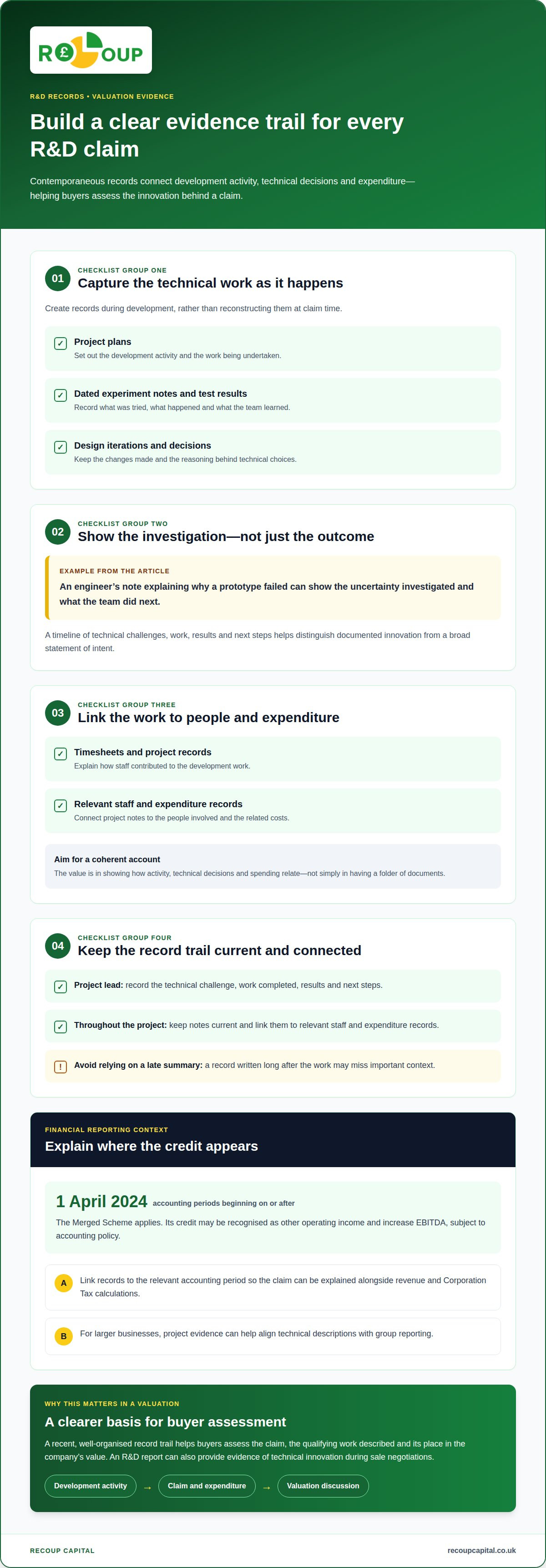
Contemporaneous R&D records are created as development happens, rather than reconstructed at claim time. They connect the development activity, expenditure and technical decisions to the qualifying work described in a claim. For valuation, this timeline helps buyers distinguish documented innovation from a broad statement of intent.
Useful evidence can include project plans, dated experiment notes, design iterations, test results and records of decisions. For example, an engineer’s note explaining why a prototype failed can show the uncertainty the team investigated and what it did next. Timesheets and project records can also explain how staff contributed. The aim is a coherent account, not simply a folder of documents.
Keep records current throughout the project. A project lead can record the technical challenge, work completed, results and next steps, then link those notes to relevant staff and expenditure records. This makes it easier to explain the development and how it fits the definition of qualifying research and development. A summary written long after the work may miss important context.
Accounting treatment adds another layer for a buyer. For accounting periods beginning on or after 1 April 2024, the Merged Scheme applies; its credit may be recognised as other operating income and increase EBITDA, subject to accounting policy. Records linking the claim to the relevant period help explain the benefit shown in revenue and corporation tax calculations. Larger businesses can also use project evidence to align technical descriptions with group reporting.
An R&D report can provide evidence of technical innovation during sale negotiations. A recent, well-organised record trail gives buyers a clearer basis for assessing the claim and its place in the company’s value. If a transaction is approaching, corporate finance support can help bring the R&D position into the wider valuation discussion.
How are pending R&D tax credit refunds or liabilities treated in a business valuation?
A pending R&D tax credit is a claim awaiting resolution, while a potential liability is an exposure linked to a claim that may need correction or repayment. In a valuation, neither should automatically be treated as cash received or a debt payable. Buyers assess the supporting evidence, current status and likely effect on the transaction.
First, distinguish a submitted claim, an amount recognised in the accounts and cash received. These represent different stages. A buyer may examine the claim calculation, supporting project records, HMRC correspondence and the company’s accounting treatment. This review helps establish whether the expected benefit is sufficiently supported for inclusion in the valuation and whether its timing affects cash available after completion.
Potential liabilities need equal care. A challenge to qualifying activity, expenditure or the claim calculation may create exposure to reduced relief, repayment or additional Corporation Tax. The valuation discussion should identify the relevant accounting period, amount at issue and reason for uncertainty. For example, a claim with an unresolved mismatch between project evidence and submitted figures presents a different risk from one supported by reconciled records.
Buyers and sellers can then decide how the exposure fits the deal’s financial model. They may distinguish the claim from ordinary working capital, reflect it in the agreed price or address it through transaction terms. Treatment depends on the sale agreement’s definitions and the parties’ negotiations, so precise classification matters. A refund expected after completion may not provide the buyer with immediate operating cash.
- For sellers: present each claim’s status, calculation and supporting evidence separately from cash received.
- For buyers: assess the potential benefit alongside any repayment or tax adjustment exposure.
- For both parties: agree how unresolved claims affect price, completion accounts or other transaction protections.
This approach makes the valuation more transparent. It also helps prevent a forecast benefit from being counted as settled value while an associated liability is overlooked.
How should buyers and sellers adjust a UK company’s valuation for R&D tax relief uncertainty?
Buyers and sellers should separate the value supported by completed R&D claims from benefits that remain uncertain. Any adjustment depends on claim evidence, HMRC correspondence, accounting treatment and the effect on forecast cash flow. A single headline figure can obscure whether the company has received the credit, recorded it or is still awaiting a decision.
For buyers, the review should map each claim to its accounting period, submitted amount and current status. They can compare the technical narrative with project records and financial accounts, identifying gaps that could change the expected value. A well-supported claim can reduce uncertainty and delays during buyer due diligence. Unresolved questions, by contrast, may lead the buyer to model a lower expected benefit or negotiate specific protections.
Sellers can strengthen their valuation case by preparing a clear schedule of claims before marketing the business. Separate amounts already received from pending claims, and show how each figure relates to the relevant period and company accounts. Eligible R&D claims should be completed six months before the beginning of a sale process. This gives the seller more opportunity to present a settled position rather than asking buyers to price an incomplete claim.
Both sides should also distinguish claim uncertainty from the company’s underlying innovation and trading prospects. A buyer might value a technical project for its commercial potential while treating the associated tax credit separately. The sale agreement can address unresolved claims through its price mechanics or other negotiated protections, with definitions covering responsibility for later adjustments. Clear wording helps prevent disputes over who receives a refund or bears a repayment.
- Buyers: assess the evidence, claim status and effect on forecast cash flow.
- Sellers: organise claim schedules and reconcile them to accounts before marketing.
- Both parties: agree how future refunds or adjustments affect the transaction.
For a structured assessment of R&D tax relief within a sale, discuss valuation support as part of the transaction planning.
Recoup Capital
Recoup Capital helps businesses assess R&D tax claims and related incentives, including Capital Allowances, Land Remediation Relief and Patent Box. For a company preparing for a sale or reviewing how historic claims appear in its accounts, this support can bring the tax position into the wider business valuation discussion.
Recoup Capital’s R&D Tax Credits support helps businesses understand claims and the records behind them, while its corporate finance expertise can put those considerations into transaction context. Seeking support before a sale process begins leaves more scope to organise claim information and explain how it relates to the company’s financial position.
Contact Recoup Capital to discuss how R&D tax history fits your valuation considerations.
Make the next valuation decision with confidence
How R&D tax history impacts business valuation is not just a question of past claims. It can shape how clearly a company explains its investment in innovation and plans for future growth. Before a sale or investment discussion, consider how the tax position fits the wider commercial story: what the company has developed, how that work supports its prospects and how incentives feature in its financial planning.
Recoup Capital offers R&D Tax Credits, Capital Allowances and Land Remediation Relief. These services can form part of a broader discussion about identifying incentives and making informed decisions about business value. A considered approach can turn complex tax history into a clearer starting point for discussions about the company’s future.
Take the next step at a pace that suits your plans. Start a conversation with Recoup Capital about your valuation considerations and available support.
Frequently Asked Questions
Are R&D tax credits treated as revenue or a tax reduction?
The answer depends on the scheme and the company’s accounting policy. Under the former SME scheme, the benefit typically reduced Corporation Tax or could be received as a repayable credit. Under the Merged Scheme, a credit may be recognised as other operating income. This affects how the benefit appears in the accounts, so compare its presentation across periods when reviewing historic performance.
Can unused R&D losses be transferred as part of a company sale?
Unused R&D losses may potentially be carried forward within the same company after a share sale, subject to change-of-ownership and continuity rules. They don’t automatically transfer to a buyer as a separate asset or move freely between group companies. For example, a purchaser acquiring shares should distinguish losses remaining in the company from any expectation that they can be used after completion.
Do R&D credits count towards EBITDA?
They can, depending on the scheme and accounting treatment. Merged Scheme R&D credits may be recognised above the line as operating income, which can increase EBITDA, subject to accounting policy. A credit recorded as a Corporation Tax reduction generally affects the tax line instead. Buyers often review reported EBITDA and an adjusted view, so the treatment and relevant accounting entries should be clear.
Does having an R&D claim make my company easier to sell?
An R&D claim alone doesn’t make a company easier to sell. A claim supported by a clear technical and financial account can help a buyer understand the company’s innovation and the basis for its tax position. For example, linking a product-development project to its commercial purpose gives the buyer useful context. The wider sale still depends on the business, its prospects and the transaction terms.
How does R&D tax credit strengthen business EBITDA?
An R&D credit can strengthen reported EBITDA when the applicable accounting treatment recognises it as operating income above the tax line. This may raise reported earnings for that period, but it doesn’t itself show improved trading performance. For a fair comparison, separate the credit from operating results and show how the accounting policy presents it alongside other income.
How does a well-prepared R&D claim support a smoother due diligence process?
A well-prepared claim gives a buyer a traceable route from the technical work to the expenditure and figures in the submission. For example, project notes, staff-cost records and the claim calculation can help answer follow-up questions without rebuilding the explanation from scattered files. This can reduce uncertainty and delays during due diligence, giving both sides a clearer basis for discussing the claim.


