

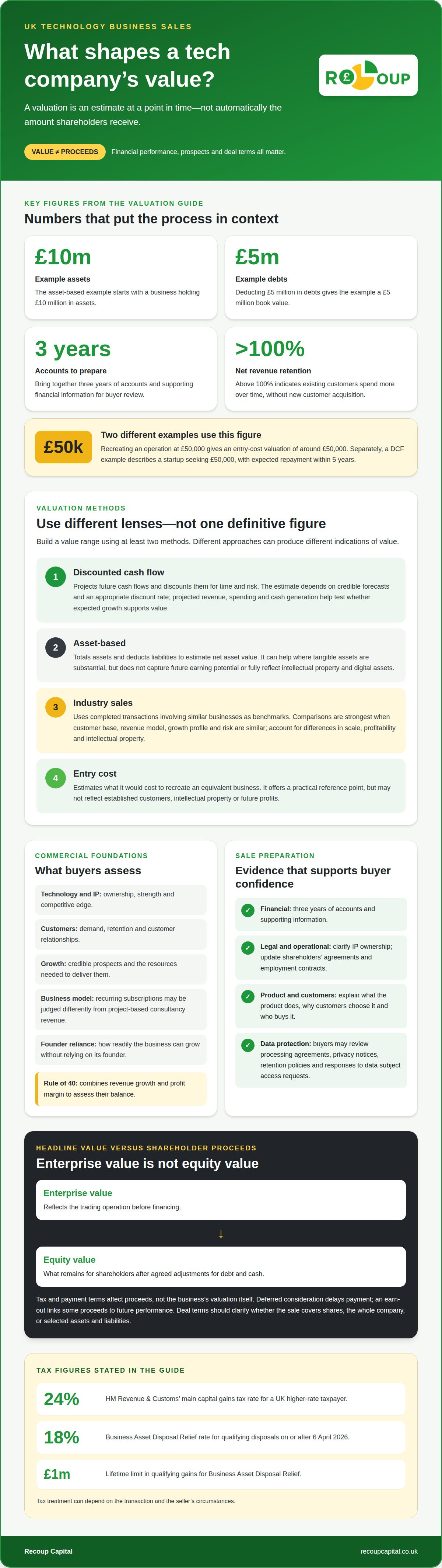
A tech company’s sale value isn’t the same as the amount its shareholders ultimately receive. Valuing a tech company for sale in the UK means estimating its economic worth at a particular point in time, then distinguishing enterprise value, which reflects the trading operation before financing, from equity value, what remains for shareholders after agreed adjustments for debt and cash.
It’s understandable to look for one clear figure, but a valuation depends on more than revenue or physical assets. Buyers may weigh earnings and future cash flows alongside intellectual property, customer relationships, growth prospects and market position. Different methods can therefore produce different indications of value.
This article explains what a business valuation means, which factors can shape a UK technology company’s worth and how market-based, earnings-based and asset-based methods work. It also shows why enterprise value and equity value differ, helping you interpret a headline valuation in the context of a potential sale.
Key Takeaways
- Build a value range using at least two methods, rather than treating one calculation as a definitive sale price.
- Assess the technology, intellectual property, customer retention and growth prospects alongside financial performance.
- Use discounted cash flow to consider how projected cash flows and risk affect the business’s estimated value.
- Separate enterprise value from equity value so you can understand how debt, cash and other agreed adjustments affect shareholders’ proceeds.
What is a business valuation?
A business valuation estimates economic value at a particular point in time. For owners valuing a tech company for sale in the UK, the result depends on its future prospects as well as its current financial position.
Discounted cash flow valuation
Discounted cash flow valuation estimates worth by projecting future cash flows and discounting them to reflect the value of money over time. It matters because a pound received today can be invested, while future income carries uncertainty. The calculation therefore depends on credible forecasts and an appropriate discount rate. For a technology business, projected revenue, spending and cash generation help show whether expected growth supports its valuation.
Asset-based valuation
An asset-based valuation totals a company’s assets and deducts its liabilities to estimate net asset value. For example, a business with £10 million in assets and £5 million in debts has a book value of £5 million. This method can help where tangible assets form a substantial part of the business. However, it doesn’t capture future earnings potential, and technology companies may rely more on intellectual property and digital assets than physical equipment.
Loss-making technology firm valuations
A technology firm can retain a high valuation despite making a loss when buyers see a competitive edge and sufficient financial backing. Current profit is only one part of the assessment: proprietary technology, customer demand and credible growth prospects can shape expectations of future earnings. For a seller, the key is explaining how the business can convert its market position into sustainable cash flow. Forecasts should connect growth plans to the resources needed to deliver them.
Entry-cost valuation estimates what it would cost to recreate an equivalent business. If replicating the operation would cost £50,000, its entry-cost valuation would be around £50,000. This entry valuation offers a practical reference point, but it may not reflect established customers, intellectual property or future profits.
Broker and M&A adviser fees vary by transaction. The amount depends on scope, deal structure and complexity, and is provided after a quote request.
Buyers may review data processing agreements, privacy notices, retention policies and evidence of responses to data subject access requests. Weaknesses can delay completion or lead to specific indemnities in the sale agreement.
Tax affects proceeds, not the business’s valuation itself. HM Revenue & Customs states that a UK higher-rate taxpayer’s main capital gains tax rate is 24%.
Factors affecting business value
Technology company value reflects financial performance, market position and the strength of its commercial foundations. Buyers also assess how readily the business can grow without relying on its founder.
Preparing a technology business for sale
Preparing for a sale or investment means organising financial, operational and legal evidence so buyers can assess the business. This matters because unresolved issues can weaken confidence or slow a transaction. Bring together three years of accounts and supporting financial information, clarify ownership of intellectual property, and update shareholders’ agreements and employment contracts. A clear value proposition should explain what the product does, why customers choose it and who buys it.
Valuing a business through industry sales
Industry sales valuation uses completed transactions involving similar businesses as benchmarks. It helps owners value a business against market evidence, rather than relying on an internal forecast alone. The comparison is strongest when the businesses share a similar customer base, revenue model, growth profile and risk. Consider who bought each comparable business and why, then account for differences in scale, profitability and intellectual property before drawing a conclusion.
Sector, size and business model
Sector, scale and revenue model shape how buyers interpret growth, risk and earnings. A software business with recurring subscriptions may be judged differently from a technology consultancy whose revenue depends on project work. Customer retention, intellectual property, scalability and profitability also matter. Net revenue retention above 100% indicates that existing customers spend more over time without new customer acquisition. The Rule of 40 combines revenue growth and profit margin to assess their balance.
Tax and deal structure
Tax treatment and payment terms affect the proceeds a shareholder receives, not simply the headline valuation. HM Revenue & Customs sets Business Asset Disposal Relief at 18% for qualifying disposals on or after 6 April 2026, with a lifetime limit of £1 million in qualifying gains. Earn-outs can have tax implications, so sellers should consider their tax position when agreeing the terms.
Deferred consideration delays payment, while an earn-out links some proceeds to future performance. The sale agreement should make clear whether the deal covers shares, the whole company, or selected assets and liabilities. Those terms influence what is paid, when it is received and how the transaction is assessed for tax.
Which valuation method should you use?
For a UK technology company, a useful valuation tests future earning potential against current financial performance. Comparing at least two methods can show where assumptions, rather than business fundamentals, drive the estimate.
Discounted cash flow analysis
Discounted cash flow (DCF) estimates a business’s present value by reducing projected future cash flows to reflect time and risk. It matters when a technology company’s value depends on income expected from products or growth not yet fully reflected in current earnings. In one example, a startup seeks £50,000 and expects repayment within 5 years.
That example shows why forecasts matter as much as the calculation. A different view of future revenue, costs or the discount rate changes the result. The discount rate reflects the time value of money and the risk attached to projected cash, not simply the interest paid on borrowing.
Cash flow and operational sustainability
Cash flow shows whether a company can fund its day-to-day operations and planned expansion from money coming into the business. Positive cash flow supports operational sustainability, while a forecast that depends on repeated external investment needs careful scrutiny. Review how customer receipts, payroll, development spending and other commitments interact across the forecast period.
Revenue growth alone doesn’t establish that expansion is financially sustainable. A technology business may win customers quickly yet need substantial spending to serve them. DCF makes this connection visible by linking forecast cash generation to the resources required to deliver it. Test whether expected future cash remains plausible if growth slows or costs rise.
Valuing technology companies for sale
UK technology companies are valued by weighing financial forecasts, market evidence and assets against the company’s risks and prospects. DCF can be useful for a business with credible projections, while asset-based or market-based methods can provide a different perspective. No method captures every feature of a technology business equally well.
Use at least two approaches to build a defensible value range, then investigate why their estimates differ. A gap may reflect uncertain forecasts, limited tangible assets or assumptions about future earnings. The aim is not to average the figures mechanically, but to understand which evidence best represents the company’s likely performance and the risks a buyer would assess.
How do enterprise value and equity value differ?
Enterprise value represents the trading operation before financing; equity value is what remains for shareholders after agreed adjustments. For example, a UK technology business valued at 6x ARR on an enterprise value basis does not give its owner that full amount: deduct debt and add surplus cash above normal working capital requirements to estimate equity value.
Market comparisons and precedent transactions help test a business valuation against evidence from similar companies and completed sales. Comparable company analysis can compare enterprise value to EBITDA or price-to-earnings multiples. Private UK businesses compared with public companies may need a 30% to 50% discount. The right comparison depends on business model, growth, profitability and risk, not just sector labels.
There is no single SaaS multiple that fits every UK sale in 2026. A 6x ARR figure is one enterprise value example, not a standard for all SaaS businesses. Buyers assess recurring revenue quality, customer retention, growth prospects and market position, then consider how these affect the company’s ability to sustain future performance.
Product development also influences selling prospects. A product that is ready for the market, supported by reliable technology and clear customer demand, gives buyers evidence of commercial traction. An early-stage product can require further investment before generating revenue. The business’s customer base, customer concentration and position against competing solutions help explain how durable its sales may be.
Growth forecasts carry more weight when supported by a defined route to market. Marketing that reaches the intended customers and converts interest into sales strengthens the evidence behind revenue expectations. Buyers also examine whether the company can expand its market share without weakening customer retention or increasing costs disproportionately. Explore corporate finance support to assess transaction value and deal considerations.
Recoup Capital
Recoup Capital helps technology businesses identify and claim government tax incentives, which can be relevant when reviewing a company’s financial position ahead of a sale or investment. Its support includes R&D Tax Credits and Capital Allowances, alongside Land Remediation Relief and Patent Box. These incentives are distinct from a business valuation, but understanding which may apply can help clarify the company’s financial records and potential tax position.
Consider this support if your technology business has undertaken research and development, invested in qualifying assets or holds patents linked to its innovation. The appropriate relief depends on the company’s activities and circumstances. Recoup Capital can help assess relevant claims, giving you a clearer picture to consider alongside valuation advice and transaction planning.
Contact Recoup Capital to discuss your business’s circumstances.
Make your next move with a clear plan
When valuing a tech company for sale in the UK, your next step is to turn the estimate into a practical exit plan. Decide what matters beyond the headline figure: timing, the form of the transaction and the evidence a buyer will need. Aligning these priorities early can help you make informed decisions as discussions progress.
There may also be opportunities to review government incentives alongside sale preparation. Recoup Capital offers R&D Tax Credits, Capital Allowances and Land Remediation Relief. These are separate from a valuation, but identifying relevant claims can support a clearer view of the business’s financial position. Their relevance depends on the company’s activities and circumstances.
Contact Recoup Capital to discuss your sale and consider how to prepare for the next stage. A thoughtful plan puts you in a stronger position to approach that stage with clarity and confidence.
Frequently Asked Questions
What information do I need to value my business?
Gather financial records and evidence explaining how the business earns and retains revenue. Useful material includes management accounts, a breakdown of recurring and one-off sales, customer contract terms, forecast assumptions, debt schedules and records showing ownership of software and other intellectual property. For a SaaS company, explain how the reported revenue reconciles with customer and subscription data, so an analyst can follow the figures.
How can you combine methods into a realistic range?
Apply each suitable method to consistent financial information, then examine why its result differs. For example, compare a cash-flow forecast with relevant transaction evidence and net assets, noting which assumptions drive each estimate. Don’t calculate a range by simply averaging the results. Instead, explain which evidence is most relevant to the company and show how changes in growth, margins or risk affect the valuation indication.
Is a business worth 3 times profit?
Not automatically. Three times profit is a common benchmark, but the appropriate multiple varies with industry and risk. A buyer may adjust its view for recurring revenue, customer concentration, reliance on the founder, growth prospects and the quality of reported earnings. Clarify which profit measure is being multiplied, whether it reflects a representative trading period and what liabilities or unusual costs affect that figure.
What mistakes should you avoid?
Avoid treating turnover as a substitute for profit or assuming that one buyer’s indicative offer establishes the company’s market value. Check that forecasts distinguish signed customer commitments from hoped-for sales, and that exceptional costs are explained rather than silently removed. Also avoid overlooking owner dependence: document who manages key relationships and technical knowledge, since a buyer will assess how the business operates after completion.
What should you do next?
Decide what decision the valuation needs to support: setting an asking range, assessing an offer or planning a future exit. Then agree the transaction’s scope and the valuation date, because a share sale and an asset sale involve different items. Use the estimate as a basis for informed discussion, and keep a record of assumptions so you can explain how the figure was reached.
What should you prepare before valuing the business?
Prepare a well-organised information pack with current financial records, forecasts, customer and supplier agreements, staff responsibilities, intellectual property records and details of debt or surplus cash. Include a short explanation of the business model, how customers find and use the product, and what supports future growth. Consistent, clearly labelled documents make it easier to trace figures and address questions during valuation discussions.


