

A newer kitchen doesn’t automatically make the whole bill a capital improvement. For UK property business tax, replacing worn units with broadly equivalent modern ones can count as a repair. A substantial upgrade, or replacing a kitchen that still works, is more likely to be capital expenditure.
That distinction matters because repairs to a rental property are generally claimed against rental income, while capital improvements are treated differently and may be relevant when the property is sold. The line can be unclear: the work may look similar, but its purpose, scale and effect on the property all matter. To separate repair costs from capital improvements for tax, ask whether the work restores what was there or creates a meaningful improvement.
This guide explains the distinction and applies it to kitchens, glazing, roofs, bathrooms and heating. You’ll see when like-for-like replacements can be repairs, when an upgrade points to capital expenditure, and how to assess a project that combines both.
Key Takeaways
- Classify kitchen work by whether it restores an existing feature or materially improves it; the scope and condition before work matter.
- Double glazing can be treated differently depending on the property work’s purpose and its effect on the asset’s character and function.
- Separate repair work from upgrades in projects involving roofs, bathrooms or heating, as each part may have a different tax treatment.
- Recognise when work to land or a building is capital expenditure, and how that classification can affect when the cost is considered for tax.
Is replacing a kitchen a capital improvement or a repair?
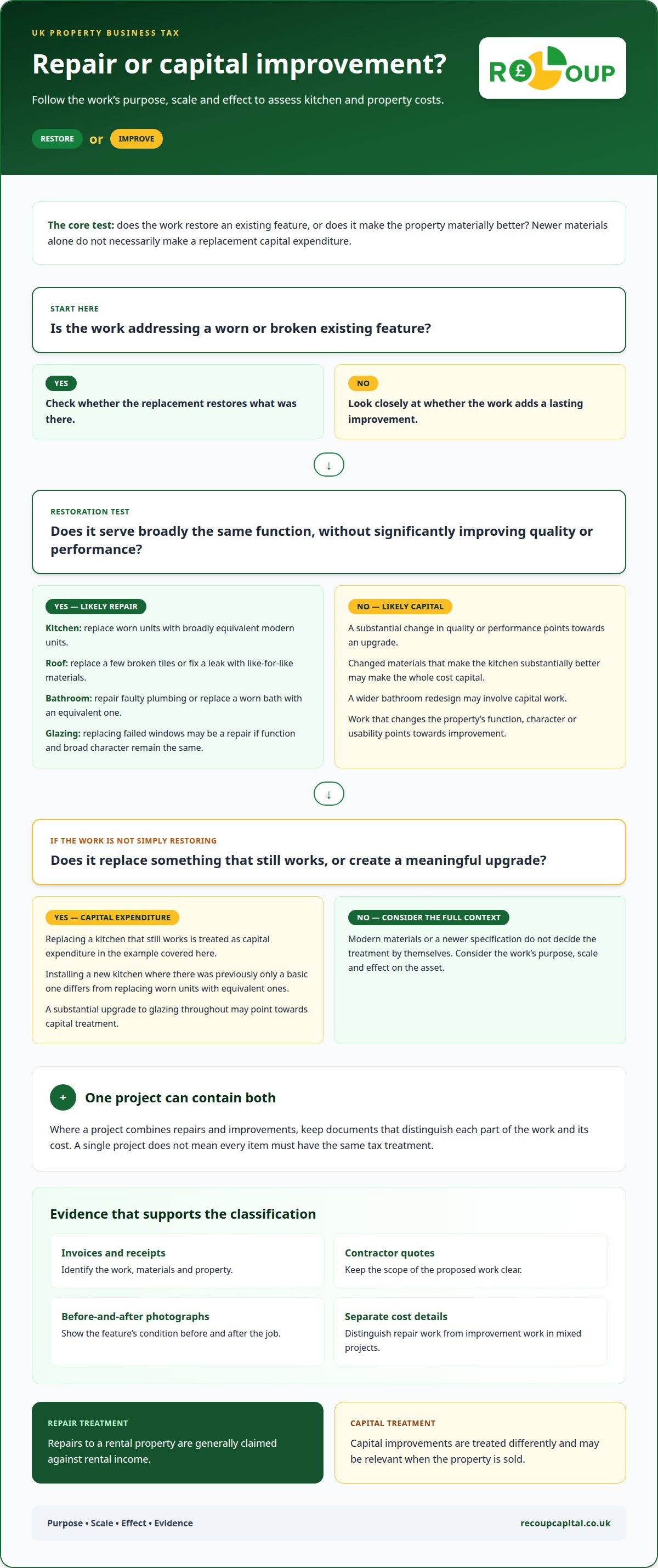
For UK property business tax, the key distinction is whether the work restores an existing feature or improves it. Replacing a kitchen like for like can be a repair; a substantial upgrade may be capital expenditure.
Like-for-like replacements and upgrades
A like-for-like replacement restores a worn or broken item to its original condition, even if it uses modern materials. Updated materials alone don’t necessarily turn repair expenditure into capital expenditure. Replacing kitchen units with broadly equivalent modern units can count as a repair. By contrast, a substantial change in quality or performance points towards an upgrade. A modern replacement may still be a repair if it serves the same function without significantly improving quality or performance.
Repeated kitchen and bathroom replacements
Repeated replacement means renewing kitchen or bathroom items as they wear out, rather than undertaking one larger transformation. For landlords, the existing room’s condition and function help distinguish maintenance from improvement. Replacing worn units with equivalent ones differs from installing a new kitchen where there was previously only a basic one. Likewise, replacing a worn bath with an equivalent one may restore the room, while a wider redesign could involve capital work.
Replacing a kitchen that still works is a different case: the example considered here treats that work as capital expenditure. How often work has been done does not determine its tax treatment by itself. The scope and effect of each replacement matter.
Capital expenditure on asset replacement
Expenditure is capital when replacing an asset creates a significant improvement, rather than simply repairing the existing one. For example, if changed materials make the kitchen substantially better, the whole cost may be capital, including redecoration and making good damaged decorations. The tax risk of claiming capital work as a repair is that the expense may be disallowed against rental income, changing the taxable profit. This classification is separate from transaction taxes such as Stamp Duty Land Tax.
Records supporting repair expense claims
Keep invoices and receipts identifying the work, materials and property, along with contractor quotes and photographs showing the condition before and after the job. These records help explain why the replacement restored an existing feature rather than upgrading it. For projects combining repairs and improvements, retain documents that distinguish each part of the work and its costs.
If HMRC challenges a repair expense claim, clear records help support the classification and amount claimed. Treating capital expenditure as a repair risks losing the deduction and having the tax calculation revised. Detailed invoices and evidence make the basis for the claim easier to establish.
Is fitting double glazing a capital improvement?
For UK property business tax, replacing single glazing with double glazing can count as a repair when the property’s function and character remain broadly the same. The decision depends on the work’s effect, not simply on the newer specification.
The test for repairs and improvements
The practical test is whether the work restores an existing asset or changes it into something materially better. This matters because repair expenditure is generally claimed against rental income, while capital expenditure is treated differently. Replacing worn windows in a residential property can restore their existing function; work that transforms the property’s character or usability points towards an improvement.
The Law Shipping Co Ltd v CIR illustrates the difference: in 1923, work that changed an unusable ship into a merchant vessel capable of carrying cargo was treated as capital. The same reasoning directs attention to what the asset could do before and after the work.
Distinguishing repairs from capital improvements
A repair addresses deterioration and returns an asset to working order; a capital improvement adds lasting function, usability or value. Replacing failed single-glazed windows with double-glazed units can be a repair if they serve the same role and preserve the property’s broad character. However, replacing single glazing throughout as a substantial upgrade is also identified as a typical capital improvement for landlords.
The distinction affects how costs are claimed and when they affect profits. An invoice’s description doesn’t settle the matter: the work’s scale, purpose and result all count.
Upgrading property as a capital improvement
An upgrade is capital expenditure when it materially improves the property rather than simply restoring a worn feature. Better long-term usability or added resale value can support capital treatment. In short, work counts as a capital improvement when it changes the property’s function, character or lasting benefit beyond restoring its previous condition.
For glazing, consider whether replacement units simply restore the windows’ existing role or form part of a wider residential upgrade. This context explains why similar-looking work can receive different tax treatment, and why it’s important to distinguish repairs from improvements before claiming costs.
Examples involving roofs, kitchens, bathrooms and heating
For rental properties, the work’s purpose helps distinguish deductible revenue expenditure from capital improvements. The examples below show how the classification affects rental income and may matter when the property is sold.
Examples of deductible repairs
A repair restores a worn or damaged feature without substantially changing the property. Examples include replacing a few broken roof tiles, fixing a leak with like-for-like materials, repainting walls, and repairing faulty bathroom plumbing or heating. Qualifying repair costs for rental properties can generally be claimed against rental income in the year they’re incurred.
The scope still matters. The distinction depends on the scale and nature of the work: limited repairs may be maintenance, while more extensive work may be treated as capital expenditure. Installing a new central heating system or underfloor heating is also an improvement, unlike repairing a fault in an existing system.
Repair costs across property types
Residential landlords can generally deduct qualifying repair costs from rental income. Commercial property owners must also distinguish revenue repairs from capital work when calculating property business profits. An owner-occupier has no rental income against which to claim ordinary repair costs. Repairs and maintenance aren’t deductible when calculating Capital Gains Tax on a home sale.
Separating repair costs from capital improvements for tax depends on the work’s purpose and the property’s use. Capital improvements to a rental property may instead be considered when calculating the gain on sale. Replacing a roof or adding solar panels are examples of capital work. If a project includes separate repairs and upgrades, the repair element may be apportioned reasonably.
Repairs to a property bought in disrepair
Buying a property shortly before carrying out repairs doesn’t automatically make those costs capital. The property’s condition and the work’s scope remain important. However, refurbishing or repairing a property bought in a derelict or run-down state is treated as capital expenditure for property business tax.
For example, repairing a leak in an otherwise usable rental property differs from bringing a derelict building into usable condition. To distinguish repairs from capital improvements for tax, consider the property’s starting condition as well as the work completed. This affects whether expenditure is treated as a rental expense or part of the capital investment.
Capital costs of land, buildings and improvements
Land and building costs are capital, not ordinary revenue expenditure deductible from property business profits. For a rental property, qualifying capital improvements may instead form part of its base cost when calculating capital gains on sale. Some capital expenditure may also qualify for capital allowances, including certain industrial or agricultural buildings and plant or machinery within buildings.
Consider the project’s scale and result. Building an extension, converting a loft into habitable space or creating a new garden layout changes the property’s structure or adds a distinct asset. These are capital improvements, unlike work that simply restores an existing feature. Replacing part of a building during reconstruction can be different: only the actual cost of normal repairs to an old part preserved in the rebuilt structure is deductible as revenue expenditure.
Lease terms can also shape the classification. In HM Revenue & Customs’ property income guidance, Fred’s lease of a property in poor repair lasts 21 years, and refurbishment he agrees to carry out when granted the lease is capital expenditure. The commitment is part of securing the lease, rather than routine maintenance during ownership. A property bought shortly before repairs isn’t automatically capital, but refurbishing a derelict or run-down property is treated as capital expenditure.
A change to an asset’s character can be decisive. Replacing gas pipes with polyethylene piping was held to be capital expenditure in Auckland Gas Co Ltd v IR Commrs because it substantially changed the system. By contrast, replacing worn glazing may restore its original function, while installing double glazing throughout as an upgrade can be capital. The outcome depends on the work’s nature and effect, not its label.
For projects involving buildings or plant, review potential capital allowances to understand whether qualifying expenditure can receive tax relief.
Recoup Capital
Recoup Capital helps businesses assess tax opportunities, including the classification of property expenditure. If your project involves commercial buildings, plant or machinery, consider whether qualifying capital expenditure may fall within Capital Allowances rather than treating every cost as a repair.
This support is especially relevant when a project combines maintenance with larger works, or when the tax treatment could affect business profits. Recoup Capital also works with companies on R&D Tax Credits, Land Remediation Relief and Patent Box when those incentives fit their circumstances.
To discuss how your business property costs may be treated, contact Recoup Capital.
Make property decisions with a clearer tax strategy
Make classification part of wider property planning rather than leaving it until the accounts are prepared. Before approving work, consider its commercial purpose, expected effect on the asset and place in your investment plans. A consistent approach helps your business make informed decisions and explain the reasoning behind them.
Understanding how to separate repair costs from capital improvements for tax can prompt a broader review of how property expenditure supports your business. Recoup Capital works with companies on tax incentives and finance, helping them consider relevant opportunities alongside their business plans. Its services include R&D Tax Credits, Capital Allowances and Land Remediation Relief.
For a considered discussion about your business’s tax position, contact Recoup Capital. A clearer view of the options can help you plan your next move with confidence.
Frequently Asked Questions
PIM2030 - Deductions: repairs: is it capital?
The reference alone doesn’t determine whether expenditure is capital. For a property-income deduction, consider what the work did: did it restore a property feature or create a lasting improvement? Repairing existing drainage, for example, differs from adding a new drainage system. If a project combines both, identify the separate work and apportion costs reasonably where appropriate.
Can I claim capital improvements against income tax each year?
Generally, landlords can’t deduct capital improvements from rental income in their annual Self Assessment return. Keep those costs separate from repair expenses, which may be claimed against rental income for the relevant year. Capital improvement expenditure may instead be relevant when calculating Capital Gains Tax on sale. Some capital expenditure, such as qualifying plant or machinery within buildings, may also be eligible for capital allowances.
Self Assessment: repair or capital?
Classify the work before entering it as a rental expense on Self Assessment. A repair that restores an existing feature may be claimed against rental income, while capital expenditure is generally not deducted as an ordinary annual property expense. If a contractor’s invoice covers both, separate the repair tasks from the improvement work and apportion the expenditure on a reasonable basis.
How does HMRC distinguish repairs from capital improvements for tax purposes?
The distinction depends on the asset’s condition, purpose and outcome, not the invoice description. Consider whether the work restores an existing feature or changes its character, function or lasting usefulness. The project’s scale matters too: maintaining part of a building differs from reconstructing it. If a project includes repairs alongside capital work, the repair portion can be apportioned reasonably.
Are like-for-like replacements deductible as repairs under UK tax rules?
They can be, if the replacement restores the existing item without materially improving the property. For example, replacing worn carpet with equivalent flooring can be a deductible repair for a rental property. Modern materials don’t automatically make work capital. The key is whether the replacement serves a broadly similar function and character. Keep invoices describing the item replaced and the work done.
How are repairs and improvements treated differently for UK property income tax?
Repairs to a rental property can generally be deducted from rental income in the year they’re incurred. Capital improvements aren’t normally deductible as annual property expenses; they may instead affect the property’s base cost for a later Capital Gains Tax calculation. Certain capital expenditure may qualify for capital allowances. Keep each category distinct in your records, especially when a project includes both maintenance and upgrades.


