

A credible R&D audit file is built as work happens, not assembled in a rush when questions arise. In practice, building an audit-proof R&D documentation system means keeping a clear trail from each project’s technical uncertainties and work carried out to the evidence and costs claimed. This can include project records, test results, decisions, relevant communications and staff time linked to specific tasks, so another person can understand how the work supports the claim.
Keeping evidence organised can be difficult when project documents are spread across teams, tools and folders. A consistent approach helps: control document versions, manage access, keep records retrievable and record R&D hours against the work they relate to, rather than relying on broad estimates later. This guide explains what compliance audit documentation should show, how to avoid common record-control gaps and how to connect time records to project tasks. You’ll have a clearer framework for finding, following and explaining supporting evidence if an R&D claim is reviewed.
Key Takeaways
- Build a clear audit trail that links R&D activities to supporting records, decisions and conclusions, including significant findings and evidence that challenges an initial view.
- Use consistent document controls to keep records organised, current and retrievable, with clear ownership and appropriate access permissions.
- Protect sensitive project records with access controls and two-factor authentication, and review who can view or change them.
- Record staff time against specific project tasks as work progresses, so allocated hours can be connected to the R&D activities they support.
1. What is Compliance Audit Documentation?
Compliance audit documentation is the structured evidence that lets a reviewer follow an activity, its controls and its conclusions. To support a UK R&D tax relief claim, keep project descriptions, technical uncertainties, work records, staff involvement and costs linked to evidence such as designs, test results, meeting notes and invoices. These records help demonstrate how the project developed and how the claimed expenditure relates to its R&D work.
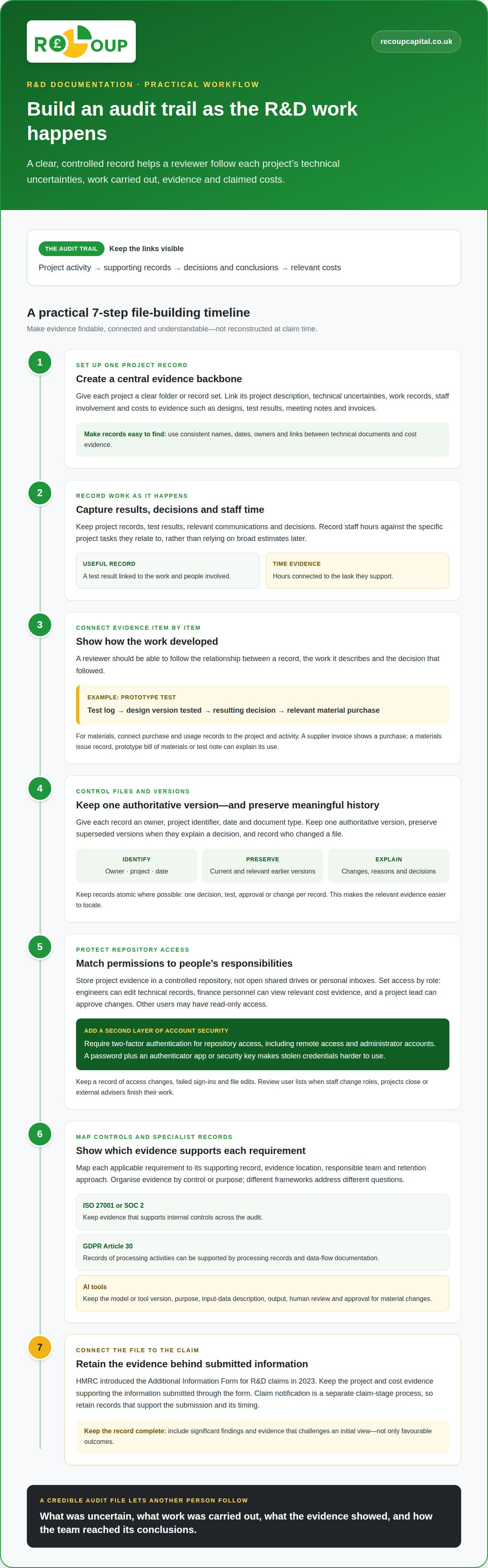
Build a central evidence backbone rather than scattering records across email, personal drives and project tools. Give each project a clear folder or record set, with consistent names, dates, owners and links between technical documents and cost evidence. For example, connect a prototype test log to the design version tested, the decision that followed and the relevant material purchase. This makes workflows easier to follow and records easier to retrieve during reviews and retention periods.
Record significant findings, including results that do not support the original hypothesis. If a test fails, retain the result, the team’s interpretation and the next decision; don’t replace it with a later successful result. A concise decision log can show the evidence considered, the conclusion reached and who approved the next step. Contradictory evidence matters because an audit trail should explain how conclusions were reached, not just present favourable outcomes.
For ISO 27001 or SOC 2 reviews, organisations need evidence that supports their internal controls across the audit. GDPR Article 30 concerns records of processing activities, which can be supported by processing records and data-flow documentation. These frameworks address different questions, so organise evidence by control or purpose rather than assuming one file proves everything. Named owners and dated approvals make records easier to trace.
For materials used in R&D, link purchase and usage records to the relevant project and activity. A supplier invoice may show a purchase, but a materials issue record, prototype bill of materials or test note can explain how it was used for the project. Keep superseded drawings alongside current versions when they help show design changes. Together, these records create a more complete account of the work and its supporting evidence.
2. Document-control pitfalls and record quality
Scattered files, vague filenames and overwritten drafts make evidence hard to trace. Use a repeatable internal workflow: assign each record an owner, project identifier, date and document type. Keep one authoritative version, preserve superseded versions where they explain a decision, and record who changed a file. A test report called “prototype test, final” is less useful than one linked to its project, test date and design version.
Make records atomic: each should capture one decision, test, approval or change. This helps reviewers find the right evidence without having to interpret a combined file. A change log can link a revised model output to the reason for the change, the person responsible and the resulting decision. Building an audit-proof R&D documentation system means making those links part of everyday workflows, not reconstructing them after preparing a claim.
Map each applicable requirement to the record that demonstrates it, then identify an owner and review point. For example, GDPR Article 30 relates to records of processing activities and data-flow documentation. A regulation-to-records matrix can show the relevant obligation, evidence location, responsible team and retention approach. This avoids treating a policy document as proof that a control operated in practice.
AI tools need their own change history. Keep the model or tool version, its purpose, a description of input data, the output, human review and approval for material changes. If an engineering team changes a model used to assess prototype results, retain the earlier version and explain how the revised output affected the project decision. These records help distinguish a controlled change from an unexplained shift in results.
HMRC introduced the Additional Information Form for R&D claims in 2023. Keep the project and cost evidence supporting information submitted through the form; claim notification is a separate claim-stage process, so retain records that support the submission and its timing. In-house teams hold the project knowledge, while an accountant or specialist adviser can help organise claim evidence and prepare submissions. For practical support with the R&D claim process, connect the records to the claim before filing.
3. Access control and two-factor authentication
Store project evidence in a controlled repository, not open shared drives or personal inboxes. Set access by role, so engineers can edit technical records while finance personnel can view relevant cost evidence. A project lead may approve changes, while other users have read-only access. This reduces accidental edits and clarifies who can see sensitive activities, findings and supporting files.
Require two-factor authentication for accounts that access the repository. A password plus an authenticator app or security key makes stolen credentials harder to use. Apply the same rule to remote access and administrator accounts, which can change permissions or delete records. Keep a record of access changes, failed sign-ins and file edits, so an audit trail shows who accessed evidence and when.
Use role-based access controls that reflect actual responsibilities. For example, a departing engineer should lose access promptly, while the project owner retains access to relevant records. Review user lists when staff change roles, projects close or external advisers finish their work. Remove unnecessary permissions, but preserve records of approved access changes. This helps identify missing access logs or unexplained permission changes.
Adopt naming conventions that identify project, document type, date and version. A filename such as “Project-A_Test-Report_2026-04_v02” is easier to locate than “final report”. Keep earlier versions in a read-only archive and record the reason for each revision. A change log can connect a new design version to its author, approval and related test findings.
Test retrieval as well as access. Ask an authorised reviewer to locate a specific report, then confirm that the activity log records the search and file access. Check that unauthorised roles cannot open or alter it. These tests show whether controls work in practice, rather than merely appearing in a written policy. Apply the same approach to backups, archive folders and records retained after a project ends.
4. Capturing R&D hours against project tasks
Record staff time against named projects and tasks while work is underway. A weekly timesheet might separate prototype design, testing, technical review and routine production duties. This shows how employee time was divided between R&D and non-R&D activities. A single year-end estimate gives less detail about who performed the work and how their hours relate to project evidence.
Connect time records to project management and accounting tools. Use a shared project code across timesheets, payroll records and cost reports, then reconcile the outputs before preparing a claim. For example, a manufacturing engineer’s recorded testing hours should align with the project schedule and test documentation. Keep the reconciliation statement, explain any adjustments and retain approval from the responsible manager.
Define the technical advance and uncertainty in practical terms. Record the existing capability, the result the team sought, the technical obstacle and why the route forward was uncertain. Then link each task to work addressing that obstacle, such as trials comparing materials or iterations of a component. Preserve test results, design changes and conclusions, including unsuccessful approaches.
Join HR, project and time data through stable employee and project identifiers. HR records can establish an employee’s role and pay details; project logs explain their activities; approved timesheets show the hours allocated. Review exceptions such as missing timesheets, duplicate entries or hours charged to closed projects. Document corrections and approvals so the final allocation is traceable to the underlying records.
R&D documentation and tax-credit software can support time capture, project tagging, evidence storage and reporting; pricing depends on features, users and integration needs. Compare tools by how clearly they connect hours with tasks and source records, rather than relying on a software-generated total alone. For help linking project evidence and staff time to an R&D tax relief claim, bring those records together before submission.
Recoup Capital
Recoup Capital helps UK companies connect project records, staff time and cost evidence with an R&D tax relief claim. Its specialists and chartered tax accountants provide guidance on R&D Tax Credits, helping businesses assess their innovation activity and prepare supporting information. This is useful when evidence is spread across technical, finance and HR teams, or when a claim needs a clearer link between project tasks and reported expenditure.
Well-organised records give that work a stronger foundation, but interpreting the claim rules and identifying relevant evidence can still take care. Recoup Capital also offers Capital Allowances, Land Remediation Relief and Patent Box for businesses considering other tax incentives. To discuss your R&D records and claim, contact Recoup Capital.
Make stronger records part of your next project
Set up your documentation process to grow with the work. At the start of each project, agree how teams will record technical decisions, staff activity and relevant costs. That makes building an audit-proof R&D documentation system an operational habit, rather than a last-minute exercise when preparing a claim. As projects evolve, review whether the evidence still reflects how the work was carried out and what the team learned.
If you’d like support connecting your records with potential tax incentives, Recoup Capital can help businesses with R&D Tax Credits, Capital Allowances and Land Remediation Relief. These are distinct reliefs, so the relevant route depends on the activity and expenditure involved. A discussion can help you consider how your project evidence fits the claim process and what to organise next.
Contact Recoup Capital to discuss your records and possible next steps. A clear process gives your team a stronger foundation for documenting innovation and planning ahead.
Frequently Asked Questions
What is Compliance Audit Documentation?
Compliance audit documentation lets a reviewer understand what a company did, what evidence it considered and how it reached its conclusions. For an R&D project, this might include a dated design review, a test result and a note explaining why the team changed its approach. Together, these records make the reasoning behind the work easier to follow.
What contemporaneous records should be collected for R&D staff time, costs, subcontractors and consumables?
Collect records as the work happens, then link them to the project and accounting entries. Examples include approved timesheets, payroll records, supplier invoices, subcontractor agreements and invoices, plus purchase and usage records for consumable materials. A materials issue note can clarify which project used an item. Keep supporting explanations for allocations where an invoice or payroll entry covers both R&D and other activities.
How long must UK R&D tax relief records be retained, and what are the statutory deadlines?
Retention depends on the records involved and the company’s tax and statutory record-keeping obligations; no single deadline safely covers every R&D document. Set a retention schedule that accounts for tax records, company records and any ongoing enquiry or dispute. Preserve claim calculations and supporting project evidence together, and don’t destroy relevant records while HMRC is asking questions about a claim.
How can a company build an R&D documentation workflow using project logs, timesheets and accounting systems?
Give each project a consistent identifier, then use it in project logs, timesheets and accounting records. Ask project leads to record technical progress and decisions, while staff submit time against named tasks. Finance can reconcile time and cost information with payroll and ledgers, recording adjustments and approvals. For example, a monthly exception report can flag missing timesheets or costs without a project code.
How do HMRC enquiries into R&D claims work, and what evidence helps respond successfully?
During an enquiry, HMRC examines the claim and may ask the company to explain its projects, activities or costs. Respond to each request with relevant source records and a clear explanation of how they support the information submitted. A response index linking each question to project notes, time records, invoices or calculations helps organise the evidence and identify gaps before replying.
What common documentation gaps lead to rejected R&D claims, penalties or compliance risks?
Common weaknesses include unsupported staff-time allocations, costs that cannot be linked to project activity, generic technical descriptions and records created only after the work. Missing approvals or unexplained changes can also make a claim harder to substantiate. These gaps may lead HMRC to question or reduce claimed amounts; inaccurate submissions can bring further compliance consequences. Keep explanations aligned with source records and correct errors transparently.


