

Could one HMRC letter determine whether your R&D tax claim stands? Knowing how to survive an HMRC R&D tax investigation starts with acting promptly: an initial enquiry letter typically gives you 30 days to provide information, so review each question and gather evidence to support your projects and costs.
An HMRC R&D tax investigation can feel daunting, particularly if you’re unsure what HMRC is assessing or what may happen next. An enquiry is a check of your claim, not an automatic finding that it is wrong. A clear, factual response and constructive engagement can help HMRC understand the work and the basis of the figures.
This guide explains what an enquiry involves, from written questions and possible follow-up discussions to the outcomes HMRC may reach. You’ll learn how to prepare project evidence, respond if a claim is challenged and reduce the risk of penalties or repayment demands. The focus is practical: what to expect, what to do and how to keep the process organised.
Key Takeaways
- Understand what HMRC’s opening questions are likely to focus on, so you can organise a clear, relevant response.
- Bring project records and cost evidence together to explain the work and support the figures in your claim.
- Prepare for possible outcomes, from a claim being accepted to adjustments, repayment demands or penalties.
- Learn how prompt, accurate communication and early attention to past errors can help reduce compliance risks.
1. What communication can I expect from HMRC?
HMRC’s opening letter usually sets out its questions and the documents it wants. It often asks why the company considers its work to qualify as research and development. Later questions may examine the costs claimed and the scheme used. Read each point carefully, assign responsibility for gathering evidence and keep a dated record of everything you send. A clear response helps HMRC assess the claim and work towards closing the enquiry.
Build an evidence file around each project, linking technical records to the expenditure claimed. Useful material can include project plans, design versions, test results, meeting notes, staff time records, invoices and payroll records. Match each cost to the relevant project and explain the calculation, rather than sending unlabelled documents. There is no additional record-keeping requirement specifically for R&D tax relief, but records supporting both activity eligibility and expenditure matter. Contemporaneous notes can show what the team knew, what uncertainty arose and how it was addressed.
HMRC may refer a complex claim to specialist R&D officers or ask to speak with directors, engineers, developers or project staff. For claims submitted since 8 August 2023, the Additional Information Form requires a competent professional to be identified. Prepare that person to explain the technical challenge, the advance sought and why a competent professional could not readily deduce the solution. A clear project account, supported by evidence from people directly involved, is more useful than broad claims about innovation. The decision in HMRC v AHK Recruitment Ltd highlights the importance of evidence supporting an R&D claim.
Can a company amend or withdraw an R&D tax relief claim during an investigation? It can seek to correct or withdraw a claim, but should address the proposed change transparently with HMRC and its tax adviser. If an enquiry also concerns a property transaction, keep those records distinct, including documents relevant to Stamp Duty Land Tax. If HMRC continues after the written response, expect further correspondence or discussions; a formal interview usually lasts around two hours. Organise the evidence by project and question so responses remain accurate and consistent.
2. What is an HMRC R&D tax enquiry?
HMRC opens an enquiry to check whether a company’s submitted R&D claim is accurate and supported. The statutory basis for opening an enquiry into a Corporation Tax return is Finance Act 1998 Schedule 18 paragraph 24. HMRC uses risk assessments and may also select claims randomly. A large first claim can prompt review, but selection alone does not establish that a claim is incorrect. The enquiry may examine whether projects meet the qualifying R&D definition, alongside the scheme and costs used.
The opening letter usually lists questions and requested records, with a typical response deadline of 30 days. Read the whole letter, note the deadline, and group each request by project, technical issue or cost category. A formal information notice must request information reasonably required to check the return and claims in it. If an item is unclear, identify the exact question and seek clarification promptly rather than omitting it from your response.
Plan one coordinated written reply. Assign technical questions to people who worked on the projects, and financial questions to whoever prepared the submitted figures. A specialist adviser can help organise the response, but project staff should explain what they did and why the technical uncertainty was not readily resolved. If the requested material cannot be assembled by the deadline, contact HMRC before it expires, explain what remains outstanding and request more time. A missed 30-day deadline may leave HMRC deciding from the information already available.
Enquiries can take time to reach closure and may involve further written questions. Keep copies of every letter, response and document supplied, with a clear record of dates and outstanding requests. If HMRC raises a repayment demand, establish which accounting period, claim elements and calculations it concerns. Respond to the stated reasons with evidence, and take specialist advice before agreeing figures or payment arrangements. A well-organised R&D tax claim process can help clarify the basis of a claim and its supporting material.
3. Possible enquiry outcomes and penalties
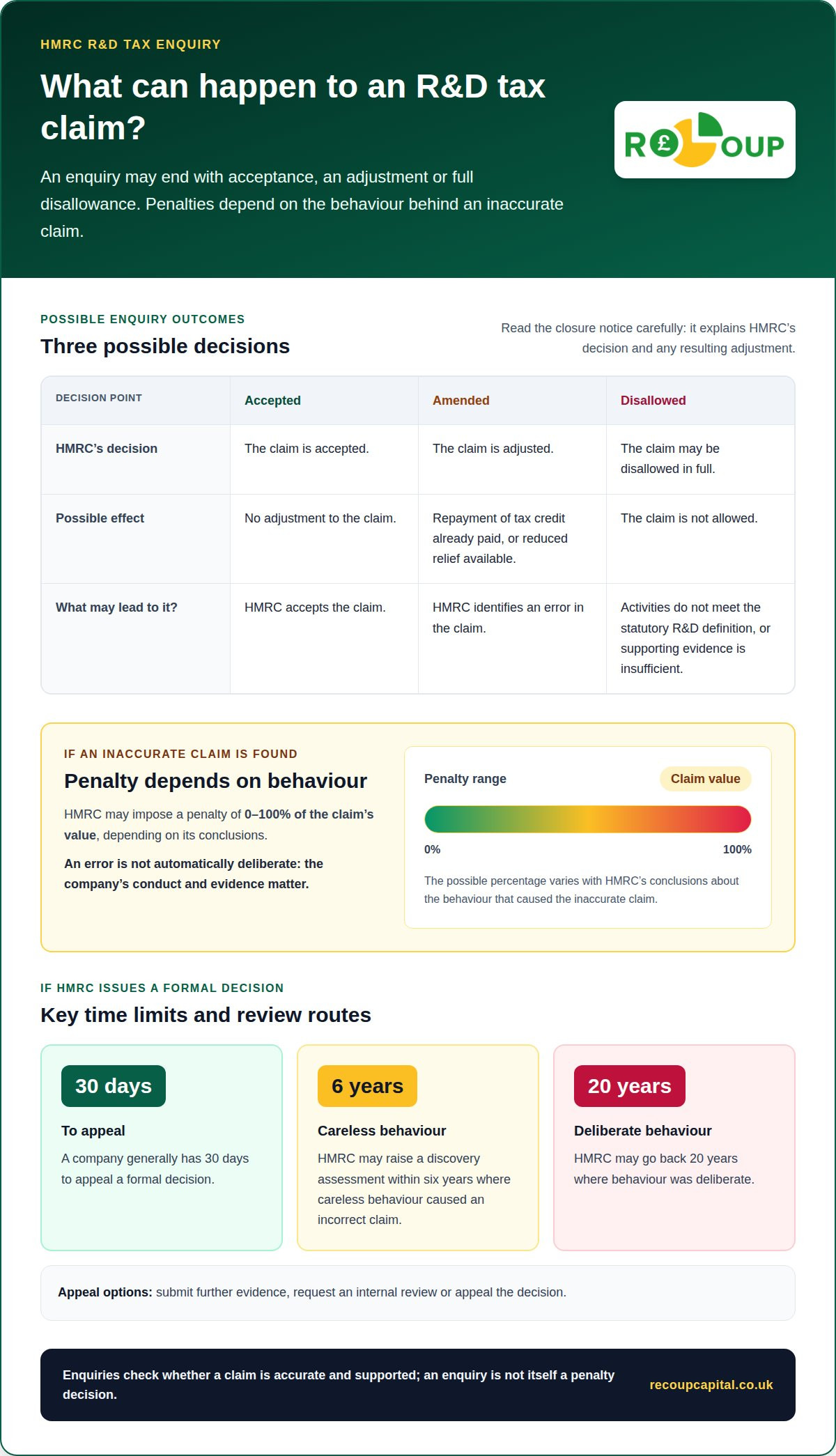
An HMRC enquiry can close with the claim accepted, amended or disallowed in full. If HMRC identifies an error, it may seek repayment of tax credit already paid or reduce the relief available. A claim may be fully disallowed if the activities do not meet the statutory R&D definition or the supporting evidence is insufficient. Read the closure notice carefully: it explains HMRC’s decision and any resulting adjustment.
Penalties depend on the behaviour that caused an inaccurate claim. HMRC may impose a penalty of 0–100% of the claim’s value, depending on its conclusions. An error is not automatically deliberate; the company’s conduct and evidence matter. Respond accurately to each enquiry letter, meet the stated deadlines and keep copies of correspondence. If HMRC issues a formal decision, a company generally has 30 days to appeal. It can submit further evidence, request an internal review or appeal the decision.
For UK R&D tax relief investigations, HMRC applies the statutory rules governing enquiries, qualifying R&D and inaccurate returns. Enquiries into Corporation Tax returns use Finance Act 1998 Schedule 18 paragraph 24; tax-geared penalties for return errors are provided under Finance Act 2007 Schedule 24. The company’s response should address the technical basis of the claim and the figures questioned, rather than treating every enquiry as a penalty decision.
Time limits depend on the circumstances. HMRC may raise a discovery assessment within six years where careless behaviour caused an incorrect claim, and may go back 20 years where behaviour was deliberate. HMRC’s enquiry rate was 17% in 2023/24, checking 9,700 of 61,000 claims received. These figures describe that year, not the likely outcome for an individual company. If a decision changes a claim, consider whether earlier claims require review. Keep a timeline of letters, responses and decisions, so any appeal or correction addresses the relevant periods and reasons.
4. How do I reduce the risk of penalties or repayment demands?
Start by checking that each relief claim matches the project evidence, qualifying costs and Corporation Tax return. If you find an inaccuracy, quantify its effect on the return and any credit received, then consider correcting it promptly. HM Revenue & Customs may go back 20 years to assess an incorrect UK R&D claim where the behaviour was deliberate. The applicable time limit depends on the conduct behind the error.
For an inaccurate return, penalties under Schedule 24 of the Finance Act 2007 depend on whether HMRC considers the behaviour careless or deliberate. Penalties aren’t automatic: reasonable care and full cooperation during an enquiry may reduce or remove them. A voluntary disclosure can also lead to lower penalties than HMRC discovering the error itself. The disclosure should explain what was wrong, how it happened and which accounting periods need correcting.
Work through the Corporation Tax calculation again, including the relief claimed, any repayment due and the effect on tax payable. For R&D tax credits paid for accounting periods beginning on or after 1 April 2023, interest is charged from payment until repayment. A disclosure where the company took reasonable care should cover accounting periods up to 4 years from the end of the relevant tax period; where it was careless, the period is up to 6 years. Keep calculations and supporting records together.
Disclosure requires careful thought. Under Article 6 of the European Convention on Human Rights, a company disclosing a penalty may give up its right to silence, and HMRC can use disclosed information when considering penalties. Take advice before making statements about behaviour, while responding accurately to HMRC’s requests and deadlines, including any 30 days stated in a formal decision. For a structured review of the figures and potential adjustments, discuss your R&D tax position with a specialist adviser.
Recoup Capital
Recoup Capital helps limited companies identify and claim tax incentives, including R&D tax credits. If HMRC has questioned your claim, specialist guidance can help you understand its basis and organise evidence explaining the technical work and related expenditure. A clear account of project activity and costs is useful when preparing a response, while an accurate claim can support more informed decisions in future.
Recoup Capital’s specialists and chartered tax accountants provide guidance on claims, helping businesses consider how incentives may support investment and growth. The right next step depends on where you are in the enquiry and which parts of the claim HMRC has queried. For support with your R&D tax position, contact Recoup Capital.
Make your next R&D decision with confidence
An HMRC enquiry can also prompt a closer look at how your business records innovation and supports future claims. Bring technical teams and financial decision-makers into the same conversation so project evidence and tax figures tell a consistent story. That practical foundation can help you approach how to survive an HMRC R&D tax investigation with greater clarity, while keeping future investment decisions in view.
Recoup Capital helps limited companies assess tax incentives and prepare R&D tax credit claims. Its services also include Capital Allowances and Land Remediation Relief, which may be relevant to a broader review of your company’s tax position. Start with your circumstances and the questions HMRC has raised, rather than assuming a particular outcome.
Contact Recoup Capital to discuss your claim and consider a clear next step for your business.
Frequently Asked Questions
What is an HMRC R&D tax enquiry?
It is HMRC’s examination of a company’s R&D claim and the tax return containing it. The check may consider whether projects meet the tax definition of research and development, how costs were classified and whether the relief was calculated correctly. For example, HMRC may ask the company to explain a technical challenge and connect it to the expenditure included in the claim.
How long does an enquiry last?
An HMRC R&D enquiry typically takes six to 12 months to reach closure, though the time depends on the questions raised and the completeness of responses. Further requests, technical discussions or delays in gathering records can extend the process. Keep a dated log of correspondence and outstanding actions; this helps the company see what HMRC is waiting for and keeps its response planning on track.
Should I get help before responding to HMRC?
Yes. Consider getting advice promptly, especially if the letter challenges project eligibility, cost treatment or the accuracy of a submitted return. An adviser can help interpret the questions, organise a coherent response and identify where technical staff should explain the work. For example, a finance lead can reconcile costs while an engineer explains project decisions. The company remains responsible for giving HMRC accurate information.
What communication can I expect from HMRC?
Expect formal written correspondence, often followed by further questions if the first response leaves issues unresolved. HMRC may also arrange a telephone discussion or meeting and ask to speak with directors or staff involved in the projects. Keep every letter and response together, and record any verbal request in writing afterwards. This creates a clear timeline and helps the company track each issue through to a decision.
Can HMRC apply penalties if I made a mistake?
Yes. HMRC can charge a penalty for an inaccurate claim if it considers the error careless or deliberate, but a mistake does not make a penalty automatic. The company’s conduct, including the care taken to prepare the return and its cooperation in correcting an issue, can affect the penalty. If you’re considering how to survive an HMRC R&D tax investigation, address errors openly and get advice before making a disclosure about your conduct.
Can HMRC ask me to repay a tax credit I’ve already received?
Yes. If HMRC concludes that some or all of a claim was not due, it can amend the company’s tax position and seek repayment of credit already received. The amount depends on which projects or costs HMRC accepts and how the claim changes. Ask for the calculation and reasons behind any demand, then compare them with your claim records. If the company disagrees, it can challenge the decision through the available review or appeal process.


