

A project can be technically difficult without qualifying as R&D. In practice, what ‘readily deducible’ means for R&D is whether a competent professional could work out the solution using knowledge already available in the field or established methods. If they couldn’t, because the work involved genuine scientific or technological uncertainty, the project may have sought a qualifying advance.
It’s understandable to focus on how new, complex or time-consuming the work felt. But those factors alone don’t determine eligibility, and HMRC doesn’t give ‘readily deducible’ a single fixed definition. The key question is whether the work aimed to advance overall knowledge or capability, rather than simply applying existing know-how to meet your business’s needs.
This article explains how to compare a project with what was already known, assess it from a competent professional’s perspective and distinguish technical uncertainty from routine development. It also explains why a project can involve experimentation yet still fall short, and what evidence can make the case clear.
Key Takeaways
- Assess whether the project sought a scientific or technological advance, not simply a new or valuable result for your business.
- Compare the work with what a competent professional could reasonably know or deduce from the wider field at the project’s outset.
- Separate genuine technical uncertainty from routine adaptation, optimisation or problem-solving using established methods.
- Build a clear account of the advance sought, why existing knowledge was insufficient and how the work tried to resolve the uncertainty.
What is an advance in science or technology?
For UK R&D tax purposes, an advance means progress in science or technology, rather than simply a new or improved result for one business. The UK R&D tax relief schemes discussed here apply to accounting periods beginning on or after 1 April 2024, according to HMRC. A project must seek an advance and attempt to resolve scientific or technological uncertainty.
Uncertainty exists when a competent professional cannot readily establish whether a solution is achievable, or how to achieve it in practice, using existing knowledge or established methods. Paragraphs 13 and 14 of the DSIT Guidelines explain scientific or technological uncertainty. The question is not whether your team found the work challenging, but whether the relevant field’s knowledge could resolve the technical problem.
This distinction separates a technical advance from a commercial one. A product may be cheaper, more attractive or better suited to customers without advancing science or technology. For example, changing a website’s layout using established software libraries may create a fresh commercial result, but it does not, by itself, overcome technical uncertainty. A project’s cost, duration and commercial value don’t establish a technical advance either.
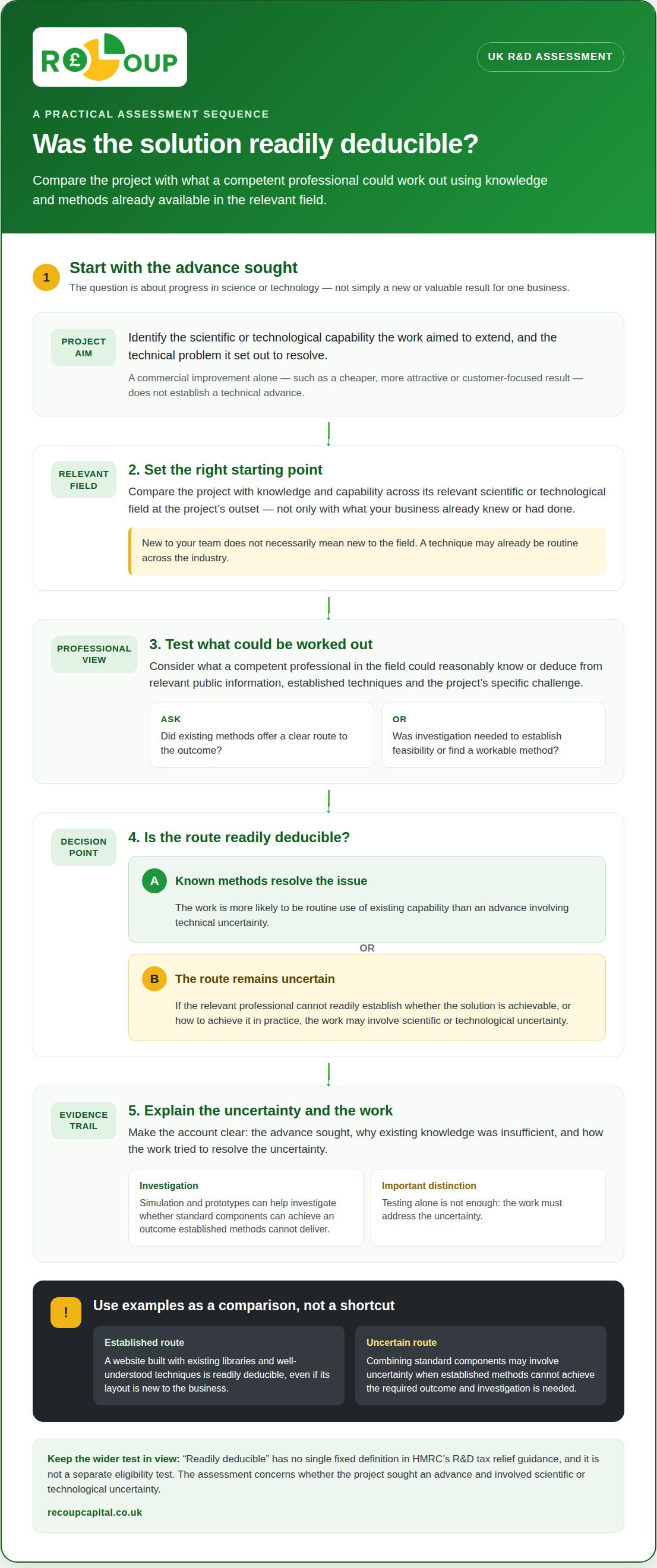
The relevant field matters. Paragraphs 15-17 of the DSIT Guidelines identify recognised technical sectors, so the assessment should place the work within the appropriate scientific or technological context. It then compares the project’s starting point with knowledge and capability in that field, not merely with what the company had done before. An advance must go beyond routine adaptation, copying or familiar problem-solving.
Evidence of systematic investigation can help show the project’s purpose. For instance, a team might use simulation and prototypes to investigate whether standard components can achieve an outcome that established methods cannot deliver. Testing alone isn’t enough: the work must address the uncertainty. Paragraph 28 of the DSIT Guidelines also identifies activities that don’t directly contribute to resolving it, helping distinguish qualifying technical work from supporting tasks.
R&D advance compared with overall knowledge or capability
Compare the work with knowledge across the relevant field, not just with what your business already knows. That distinction helps determine whether the work seeks an advance or applies existing capability.
Advances in overall knowledge and capability
An advance must extend knowledge or capability in the field, rather than merely improve one company’s development process. A technique can be new to your team yet routine across the industry, so novelty within the business alone doesn’t qualify. Conversely, separate companies may pursue similar work at the cutting edge. Assess each project against the field’s overall capability, not simply whether another business has reached a similar result.
The readily deducible threshold
The threshold is whether a competent professional could readily deduce or achieve the proposed advance using accessible knowledge and established methods. Public information matters, but a competitor’s result doesn’t automatically make the method readily available. If the method remains undisclosed as a trade secret, investigating how to achieve that result may still involve uncertainty. The focus is what the field could reasonably work out, not whether the task was difficult for one company.
Professional assessment of deducibility
Competent professionals assess the starting knowledge in their field, then consider whether existing methods could resolve the technical issue. They look at relevant public information, established techniques and the project’s specific challenge. The key question is whether those sources offered a clear route to the outcome, or whether investigation was needed to establish feasibility or find a workable method. This comparison helps distinguish a genuine advance from routine use of known approaches.
Examples and risks of claims
Building a website with existing libraries and well-understood techniques is readily deducible, even if the layout is new to the business. By contrast, combining standard components may involve uncertainty if established methods can’t achieve the required outcome and simulation or prototypes are needed. A claim for readily deducible work risks including activity that doesn’t meet the R&D criteria, weakening the explanation of the project and its qualifying work. A clear R&D tax credits claim connects the advance sought with the methods and evidence behind the work.
Definition of not readily deducible
For UK tax purposes, “not readily deducible” describes knowledge or a solution that a competent professional in the field could not readily derive from what was already available. It is not a separate eligibility test. HMRC considers deducibility as part of the wider question of whether the project involved scientific or technological uncertainty and sought an advance.
There is no specific definition of “readily deducible” in HMRC’s R&D tax relief guidance. The assessment focuses on whether the work involved scientific or technological uncertainty and sought an advance. Read alongside the uncertainty criteria, it directs attention to what could be worked out from existing knowledge, rather than treating every unfamiliar task as eligible R&D.
The practical test is whether the relevant knowledge was readily available or could be deduced by a competent professional. If that professional could use known methods to resolve the issue, the solution is likely to be considered routine. If the route to a solution remained uncertain despite their relevant expertise, the work may involve technological uncertainty relevant to R&D tax relief.
That distinction matters because tax relief concerns qualifying R&D activity, not simply development spending or a product that feels innovative. A project must seek an advance in science or technology and attempt to resolve uncertainty. The work may succeed or fail; what matters is its nature and purpose in addressing the technical problem.
CTA 2010 section 1138 defines research and development activities for tax purposes by reference to whether they are treated as R&D in accordance with GAAP. This provides a statutory reference point, while the DSIT Guidelines explain how to assess the scientific or technological character of the work. In practice, the project account should connect its technical aim, the knowledge available at the outset and the uncertainty the team sought to resolve.
Meaning of ‘readily deducible’ in HMRC guidance
HMRC’s guidance doesn’t give “readily deducible” a standalone definition or a mechanical test. The phrase appears three times in the R&D tax relief guidance, twice alongside “competent professionals”. The DSIT Guidelines provide further detail on this requirement in paragraph 19.
In practice, ask whether a competent professional in the relevant field could work out the advance or solution from knowledge available when the project began. Consider public technical information, established methods and whether the proposed outcome was already achievable. A task isn’t non-routine simply because the business hasn’t done it before or because it took substantial effort.
Software illustrates the distinction. A developer using familiar libraries and techniques to build a website with a different layout is applying existing capability. The result may be new to that company, but the technical route is already understood. By contrast, uncertainty may arise when standard tools cannot meet a technical requirement and investigation is needed to establish whether a solution is achievable.
The availability of knowledge also matters. Another company may have achieved a similar result, yet the method could remain unknown to the field because it is protected as a trade secret or intellectual property. The result alone doesn’t settle deducibility. The assessment considers whether a competent professional could access or infer the method, rather than whether someone, somewhere, had succeeded.
For research and development claims, explain the project’s starting knowledge, the specific uncertainty and why established methods couldn’t resolve it. Then connect the investigation, such as modelling, testing or prototyping, to the attempt to achieve an advance. Those activities support the explanation; their presence alone doesn’t prove eligibility for a tax credit. To understand how the technical case fits into R&D tax relief, review the factors used to assess a claim.
Recoup Capital
Recoup Capital helps limited companies assess and claim R&D tax relief, including whether project activity sought to resolve genuine scientific or technological uncertainty. Its specialists and chartered tax accountants can help connect the technical work, the advance sought and the evidence supporting a claim. This support can be useful when a project involved complex development but it’s unclear whether the solution relied on existing knowledge or went beyond it. A clear assessment helps distinguish potentially qualifying R&D from routine work, so the claim reflects the activities actually undertaken. If you’d like help assessing your R&D project, contact Recoup Capital.
Put your R&D position into focus
Understanding what ‘readily deducible’ means in practice for R&D can help you make informed decisions about recording and assessing innovation work. A useful next step is to clarify the project’s technical story: what the team set out to achieve, what made the route uncertain and how the work progressed. A clear account supports sound decisions about a claim and provides a stronger foundation for future projects.
Recoup Capital helps limited companies assess R&D Tax Credits and consider other relevant reliefs, including Capital Allowances and Land Remediation Relief. The right discussion starts with your project and its supporting evidence, not assumptions based on how novel or demanding the work felt.
Start a conversation with Recoup Capital about your R&D position and take a considered next step for your business.
Frequently Asked Questions
How do I know if I’m carrying out R&D?
You may be carrying out R&D if your project aims to make a scientific or technological advance and tackles uncertainty that available knowledge cannot readily resolve. Start by identifying the technical obstacle and the work undertaken to address it. For example, a team investigating why a process behaves unpredictably may be doing R&D; routine implementation of a known process would not qualify on that basis alone.
How do I know if my project qualifies for R&D tax credits?
A project may qualify if it seeks an advance in science or technology and attempts to resolve scientific or technological uncertainty. Eligibility depends on the activities, not the project’s label, the sector or whether the work succeeded. Separate the technical investigation from routine production, commercial planning and other work that doesn’t resolve the uncertainty. A company’s own records should show how the project developed and what technical work took place.
How does HMRC approach this area in practice?
HMRC considers a project’s technical aims and whether it sought to overcome uncertainty, rather than treating novelty or effort as proof of R&D. Explain the starting position, identify the technical obstacle and describe how the team investigated it. Project plans, design records and test results can connect the stated uncertainty with the work actually performed, rather than relying on broad claims about innovation.
What Actually Counts as R&D?
R&D can include technical work that directly investigates scientific or technological uncertainty, such as developing and testing a new method when existing approaches don’t achieve the required outcome. The qualifying activity is the investigation, not every task associated with the wider project. Marketing, branding, routine validation and aesthetic choices don’t become R&D simply because they support a product involving technical development.
What does “readily deducible” mean in UK R&D tax relief guidance?
It means a competent professional could work out the knowledge or solution using what was available in the relevant field. The assessment looks beyond whether the approach was new to your company. For instance, a familiar process applied in a new workplace may be readily deducible, even if your team had to learn how to use it. The important comparison is with the field’s knowledge and capability.
When is a scientific or technological solution readily deducible by a competent professional?
A solution is readily deducible when a professional with relevant field knowledge could reasonably derive it using accessible information and established methods. Consider what was known at the project’s outset, then compare it with the technical challenge and the route taken. Records of design choices, test results and changes in approach can clarify whether the team followed a known route or investigated an unresolved technical problem.


