

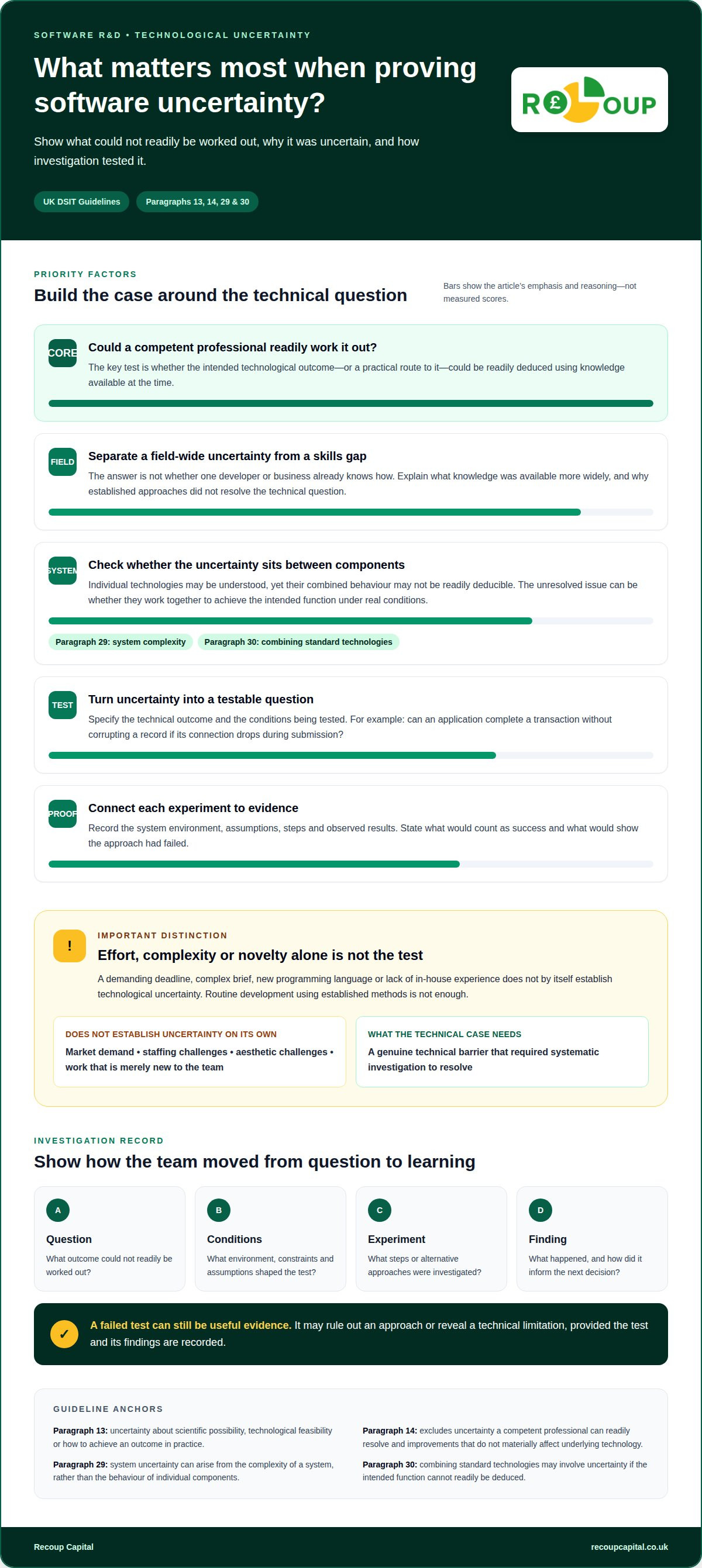
Proving technological uncertainty for a software project means showing that the work sought a technological advance and that the solution was not readily deducible, rather than simply difficult or new to your team. Paragraph 13 of the UK DSIT Guidelines defines uncertainty as a lack of readily available or deducible knowledge about scientific possibility, technological feasibility or how to achieve an outcome in practice. Routine development using established methods doesn’t meet that test.
That distinction can be difficult to establish: a project may involve substantial effort without addressing genuine technological uncertainty. The key question is whether a competent professional could readily work out how to achieve the intended outcome, including when standard components are combined in a complex system.
This article explains how system uncertainty fits the UK R&D criteria and how specifications, technical limits and experimental evidence can help show what was genuinely uncertain. It also explains why a focused test can be informative even when it shows that an approach doesn’t work.
Key Takeaways
- Learn what makes a software challenge a genuine technological uncertainty, rather than a skills gap or routine development task.
- See how complexity in combining standard components can create uncertainty at system level.
- Explore how specifications and technical limits can shape focused experiments that test whether an outcome is achievable.
- Understand how documenting test conditions, results and failed approaches can help explain the technical work behind a claim.
What Is Scientific Or Technological Uncertainty In R&D Claims?
A software project must seek a technological advance by overcoming genuine technological uncertainty. A complex brief or demanding deadline alone doesn’t meet that test.
Sources of Uncertainty in Software Projects
Uncertainty arises when a competent professional can’t readily determine whether a technical outcome is possible or how to achieve it. For example, a team may need to find out whether software can preserve data integrity when connections repeatedly fail.
Routine product development can uncover genuine uncertainty along the way. A standard feature may expose an unforeseen technical barrier that requires iterative development, experiments and feedback. Potentially qualifying work concerns investigating and resolving that barrier, not the routine work around it. Before starting, teams should review existing approaches and record why they can’t readily resolve the problem.
Software Development as a Technology
Software development applies scientific and technological knowledge through code, systems and digital processes. Creating software can involve technological advancement, but writing code or adopting a new programming language doesn’t establish uncertainty on its own.
Consider a team adapting an established method to process data across connected systems. If the outcome is readily deducible, the work is routine, even if the team lacks experience. If technical constraints prevent a competent professional from working out how to achieve the result, systematic investigation may be needed. The relevant question is what the wider field could achieve at the time, not what is new to one business.
HMRC and DSIT Guidance for Software Projects
HMRC’s R&D framework and the DSIT Guidelines address whether work seeks an advance by resolving scientific or technological uncertainty. Paragraph 14 of the DSIT Guidelines excludes uncertainty a competent professional can readily resolve, along with improvements that don’t materially affect underlying technology. Market demand, staffing and aesthetic challenges don’t meet this technical test.
For software projects, the rules therefore turn on the technical work and its evidence, not the product label. According to UK Government, for accounting periods no longer than 18 months, claims can be amended within two years of the period of account’s last day; for longer periods, the limit is 42 months from its first day. These are claim deadlines, not extra time to establish that project work meets the R&D criteria.
HMRC's definition of scientific or technological uncertainty
Paragraph 13 of the UK DSIT Guidelines defines scientific or technological uncertainty by reference to knowledge that isn’t readily available or deducible. For software teams, the practical task is to identify what could not be worked out and how investigation addressed it.
Technical Uncertainty as a Testable Question
A technological uncertainty becomes testable when it is framed as a question about a specific outcome under defined conditions. For example: can an application complete a transaction without corrupting a record if its connection drops during submission?
This framing links the technical issue to evidence. Record the system environment, the assumption being tested, the steps taken and the observed result. Define what would count as success and what would show that the approach failed. This makes the investigation understandable beyond the development team and helps explain why the answer wasn’t apparent beforehand.
Defining Technological Uncertainty
Technological uncertainty exists when a competent professional cannot readily deduce whether a technological outcome is feasible or how to achieve it in practice. Paragraph 13 covers uncertainty about scientific possibility, technological feasibility and the practical route to an outcome.
The test isn’t whether a developer personally knows the answer. Consider a team integrating a software platform with a legacy system: documentation may describe both components but leave open whether they can exchange data reliably under the required conditions. Evidence should establish what knowledge was available, which technical question remained unresolved and why standard approaches didn’t answer it. This distinguishes uncertainty in the wider field from an individual skills gap.
Uncertainty in Research
In R&D, uncertainty concerns a technical question that requires systematic investigation, rather than routine implementation of a known solution. A team might test alternative data-processing approaches because existing knowledge doesn’t show which one can meet a particular operating constraint.
Connect each experiment to the question it addresses. Record the hypothesis, test conditions, observations and conclusion, including unsuccessful trials. A failed test can still provide useful evidence if it rules out an approach or reveals a technical limitation. Together, these records show the investigation’s purpose and how its findings informed the next decision.
What about system uncertainty?
System uncertainty arises when a system’s overall behaviour can’t readily be deduced, even though its individual components are understood. In software engineering, the unresolved issue may be how components interact under real operating conditions, rather than how any single component works.
Paragraph 29 of the UK DSIT Guidelines describes system uncertainty as uncertainty caused by a system’s complexity rather than by the behaviour of individual components. Paragraph 30 explains that combining standard technologies can involve technological uncertainty when a competent professional cannot readily deduce how to combine them to achieve the intended function. Familiar parts, therefore, don’t settle whether the integrated system will work as required.
Consider a service that connects a payment platform, an inventory database and a fulfilment system. Each may work reliably on its own, yet their combined behaviour could be uncertain if updates arrive in different orders or one service responds slowly. A useful investigation isolates the problematic interaction, records the conditions and tests whether a proposed method resolves it. Complexity alone doesn’t establish eligibility: the uncertainty must concern a technological outcome that wasn’t readily deducible.
Gradually replacing a legacy system can provide a practical test case. A business might introduce a new customer-record service while older applications still rely on the existing database. The technical question could be whether both systems can maintain consistent records during the transition. Test the actual connection conditions, data formats and sequence of updates, rather than simply showing that each application runs separately.
Evidence is strongest when it explains the system boundary, the components involved and the interaction under investigation. Record the intended function, assumptions, test environment, observations and resulting decision. A successful demonstration in a controlled setting doesn’t, by itself, show that the integrated product is ready for live use. Explain what remained unknown, how trials explored it and which limitations remained. This helps distinguish system-level investigation from routine integration or configuration.
Achievability of specifications and technical limits
A specification can make technological uncertainty concrete by stating the outcome a system must achieve and the conditions it must meet. The key question is whether existing knowledge allows a competent professional to work out how to meet those requirements. A demanding target alone doesn’t establish uncertainty; the unresolved technical barrier and the investigation are what matter.
For example, a team may need a service to process requests within a defined response time whilst maintaining accurate records. One discovery-driven example treats user experience as degrading above 150 milliseconds, whilst a GraphQL spike example sets a query-time goal below 50 milliseconds. These are project-specific thresholds, not universal standards. Their value is in making the question testable: can the chosen components meet the required performance under the system’s actual conditions?
A focused experiment can test a critical flow without building the full application. Before running it, define the question, test environment, data formats, connection conditions and success or failure criteria. If repeated submissions might create duplicate records, test interruptions before submission, during submission and while awaiting a response. A prototype showing that users understand a pending screen wouldn’t establish that the underlying records remain intact.
Results can be useful even when an approach fails. If testing shows that a component can’t meet the required specification, record the observations, technical limits and resulting decision. This evidence helps explain what the team learned and why it considered another method. Keep the investigation focused on the technical objective: routine design, implementation and standard upgrades don’t become R&D simply because a specification is demanding.
For a UK R&D claim, the technical work and its records need to support the case that an advance was sought through resolving uncertainty. If your software project involved experiments against difficult specifications, explore R&D tax credit claims and how the technical work may fit the criteria.
Recoup Capital
Recoup Capital helps limited companies identify and claim R&D Tax Credits, including when software development raises questions about technological uncertainty. Its specialists can help connect project evidence, technical challenges and eligible activity, so the claim reflects the work undertaken rather than simply the finished product.
Consider involving Recoup Capital when assessing whether a software project sought a technological advance, or when organising records of experiments, setbacks and technical limits for a claim. Clear documentation can help explain how the uncertainty shaped the work and which activities related to resolving it.
If you’d like help understanding how your software project may fit an R&D tax credit claim, contact Recoup Capital.
Turn your technical evidence into a clear next step
Development records can do more than describe how a product was built. They can explain the technical decisions behind the work and show how investigation shaped the project. When preparing a claim, consider whether the evidence makes the uncertainty and the response to it clear to someone outside the development team.
Proving technological uncertainty for a software project isn’t about presenting every challenge as research. It means setting out the technical work clearly, with evidence that supports the R&D criteria. Recoup Capital can help assess your project and prepare an R&D Tax Credits claim that reflects the work undertaken.
Contact Recoup Capital to discuss your claim and take a considered next step towards recognising your company’s innovation.
Frequently Asked Questions
Does every custom project contain R&D?
No. A bespoke application can still use established tools and familiar methods. For example, building a customer portal with a standard framework may involve custom screens and workflows but no unresolved technological problem. Look at the specific work packages: routine configuration and implementation differ from a distinct investigation into a technical obstacle that existing knowledge couldn’t readily resolve.
How ‘big’ does my challenge need to be?
No minimum project size or level of complexity is required. A narrowly scoped feature can involve R&D if its technical outcome couldn’t readily be deduced and the team investigated it systematically. For example, a small data-conversion function could present a genuine challenge if existing formats behave unpredictably together. The project’s scale doesn’t replace evidence of the technical question and work.
Is an unsuccessful experiment wasted time?
No. A failed trial can help a team rule out an approach, identify a limitation or refine its next test. For example, testing could show that a particular data structure breaks when records arrive out of sequence. Preserve the hypothesis, test setup, observed failure and resulting decision. Failure alone doesn’t establish R&D, but clear records can explain what the investigation achieved.
What doesn’t qualify as uncertainty?
Routine coding, standard upgrades, aesthetic preferences and problems a competent professional can readily solve aren’t technological uncertainties. Nor are challenges caused only by limited staff availability, missing skills, budget pressure or market demand. For example, learning a familiar framework may take time, but that knowledge gap isn’t uncertainty in technology. The issue must concern technical capability, feasibility or how to achieve an outcome.
What counts as technological uncertainty in a software project for UK R&D tax relief?
Technological uncertainty is an unknown that can’t readily be resolved using the knowledge or methods available to a competent professional. For instance, a team could investigate whether separate software services can maintain consistent transactions during interrupted connections. A claim should distinguish this investigation from ordinary implementation and link the technical work to the advance sought. Project records created at the time help explain the question and the work undertaken.
How does HMRC define technological advancement and technological uncertainty?
For UK R&D tax relief, a project must seek an eligible advance in science or technology by overcoming scientific or technological uncertainty. The DSIT Guidelines describe uncertainty as a lack of readily available or deducible knowledge about scientific possibility, technological feasibility or how to achieve an outcome in practice. A new product or feature alone doesn’t demonstrate an advance: the technical development and its context matter.


