

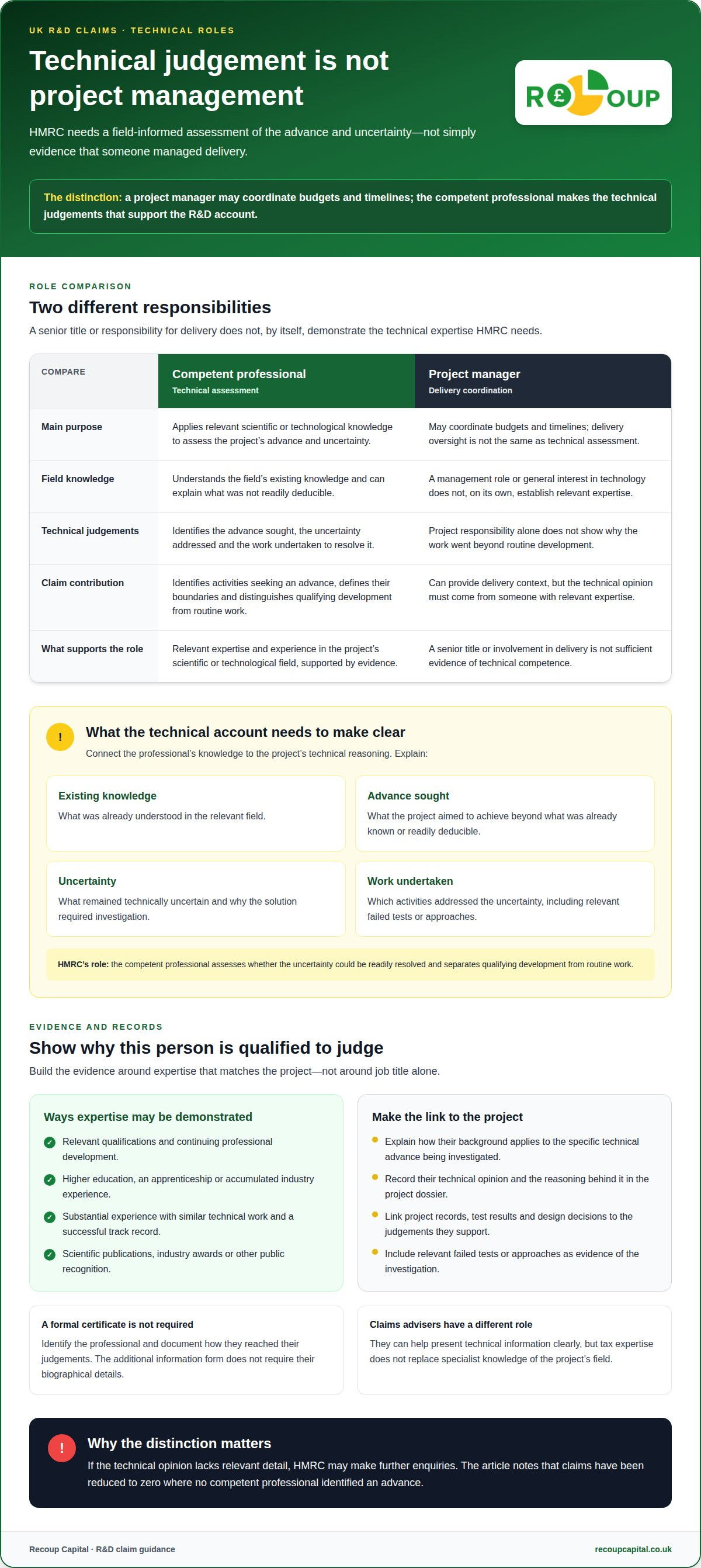
The person managing an R&D project isn’t automatically the person whose technical judgement HMRC needs. What HMRC considers a ‘competent professional’ for R&D is someone with relevant expertise and experience who can assess the field’s current knowledge, identify a genuine technical advance and explain the uncertainty the work set out to resolve. A project manager may coordinate budgets and timelines; the competent professional makes the technical judgements.
It’s understandable to assume that a senior title or responsibility for delivery is enough. The key is whether the person can explain why the work went beyond what was already known or readily deducible, and distinguish it from routine development.
This article explains the competent professional’s role in a UK R&D claim, the evidence that can demonstrate their expertise and how their responsibilities differ from a project manager’s. You’ll also learn what their technical account should cover, so the claim clearly links the person’s knowledge to the advance sought and the work undertaken.
Key Takeaways
- Choose someone whose expertise matches the project’s technical field; seniority or project oversight alone isn’t enough.
- Support their judgement with relevant experience, qualifications or other evidence of expertise.
- Make the technical account clear about the field’s existing knowledge, the advance sought and the uncertainty the work addressed.
- Keep a record of the professional’s reasoning and the evidence behind it to help explain how the project’s R&D activities were identified.
How do you show evidence of competency for your CP?
Build the evidence around the professional’s expertise in the project’s scientific or technological field. Relevant qualifications can help, but they aren’t the only route. Higher education, an apprenticeship or accumulated industry experience may each provide the knowledge needed. Show how their background relates to the specific advance being investigated, rather than relying on a senior job title or general interest in technology.
Support this connection with practical evidence. This might include relevant qualifications and continuing professional development, substantial experience with similar technical work, scientific publications, industry awards or other public recognition. For example, an engineer’s experience developing specialist materials may help demonstrate their ability to assess a materials project. Make clear what the person has worked on and how their expertise applies to the claim.
Record the professional’s technical opinion in a project dossier, alongside the evidence behind it. Capture the knowledge available in the field, the uncertainty encountered, the advance sought and the work undertaken to resolve it. Include failed tests or approaches where relevant: they can show how the team investigated an uncertainty, not just describe a successful outcome. Link project records, test results and design decisions to the judgements they support.
Explain why the outcome wasn’t readily deducible from existing knowledge. The Department for Science, Innovation and Technology discusses whether a solution is readily deducible in paragraph 20 of the DSIT Guidelines. The professional’s account should relate that principle to the project: identify what was already understood, what remained uncertain and why the solution required investigation. A clear, field-specific explanation is stronger than a conclusion without its technical reasoning.
A formal competent professional certificate isn’t required. Identify the person and document how they reached their judgements. The additional information form doesn’t require their biographical details, but the claim’s technical narrative can explain their relevant experience and qualifications. This helps HMRC follow the evidence: the professional is identifiable, their expertise is connected to the work, and their reasoning can be traced through project records.
What is a competent professional in relation to R&D claims and what are their responsibilities?
For an R&D claim, the competent professional applies relevant technical knowledge to assess the project’s advance and uncertainty. Their expertise should match the field, not simply their seniority or involvement in delivery.
There’s no requirement for a particular academic qualification. Relevant scientific or technological expertise may come from higher education, an apprenticeship or accumulated industry experience, supported by a successful track record. The person must understand the field’s knowledge and explain why the development went beyond it; an intelligent interest alone isn’t enough.
Limits of claims advisers’ technical expertise
A claims adviser can help present technical information clearly in an R&D claim, but tax expertise doesn’t replace specialist knowledge of the project’s field. The technical opinion must come from someone able to assess the science or technology involved.
For example, an adviser may help structure an account of software development, but can’t make technical judgements without relevant expertise. The project’s specialist should explain what was known, what remained uncertain and why the work sought an advance.
Risks of relying on non-experts
A non-expert may struggle to show how activities sought an advance or distinguish development from routine work. This can weaken a claim’s technical basis, even if an employee or adviser has prepared the paperwork.
HMRC may make further enquiries if the opinion lacks relevant detail, and claims have been reduced to zero where no competent professional identified an advance. The risk is not simply a missing job title: the account may fail to connect the person’s expertise with the project’s technical reasoning.
Projects spanning disciplines may need input from more than one specialist. For example, a new medical device could involve materials engineering and software, with each expert assessing uncertainties in their own field. Their combined knowledge helps explain how the separate activities contributed to the development.
The professional should identify relevant activities and explain the advance sought, the uncertainty and the work undertaken. Their track record and technical account should support these judgements.
HMRC's competent professional requirement for R&D claims
HMRC looks for technical judgement grounded in the project’s field, not simply a person’s job title. The competent professional links the claimed activities to the advance sought and the uncertainty addressed.
The competent professional’s role in a claim
HMRC’s Guidelines for Compliance, Part 3, set out HMRC’s view of this role. The professional judges whether an advance in science or technology was needed, identifies the activities seeking it and defines their boundaries. They also assess whether the uncertainty could be readily resolved and distinguish qualifying development from routine work.
This judgement shapes the technical account supporting the claim. The professional should identify the advance and uncertainty, then explain the work undertaken to address them. Their assessment also informs the amount claimed by linking eligible activities to the project’s development work.
Documenting the competent professional
Record how the professional contributed to the claim, including their technical decisions and the evidence supporting them. Identify which project activities they assessed and how their knowledge informed the account of the advance and uncertainty.
If an external specialist is involved, document their engagement terms and decision-making role. Identify the professional early enough for their judgement to inform the technical narrative, rather than asking them to endorse a completed account. This creates a clear link between their expertise, the project work and the claim submitted.
Competence compared with ordinary skill
HMRC distinguishes a competent professional by their ability to assess an advance against current knowledge in the relevant field. Ordinary skill or experience in a job isn’t enough on its own; the person needs relevant expertise, awareness of the field and a successful track record.
For example, a director experienced in wholesale trade may understand stock operations but lack the specialist knowledge to assess an advance in stock-management IT. A technically experienced owner could be suitable if their relevant expertise supports an objective assessment of the project. The key test is whether they can explain why the work went beyond what was already known.
Competent professionals compared with project managers
A project manager and a competent professional make different contributions to an R&D project. The manager coordinates delivery; the competent professional assesses technical uncertainty and whether the work sought an advance.
Project managers typically organise budgets, timelines, people and milestones. They can explain when development activities started, how tasks were allocated and whether deadlines changed. These details help describe project delivery, but don’t establish that the work addressed a scientific or technological uncertainty.
The competent professional focuses on the technical question. They assess what was achievable in the particular field, what remained uncertain and whether the solution could be readily deduced. A successful track record in that field helps them make and explain this judgement.
Consider a software project. Its project manager may coordinate a team developing a new system, monitor delivery and report milestones. A software specialist, such as an engineer with relevant experience, can assess whether the technical challenge went beyond routine implementation. If the manager also has the necessary expertise and makes those technical judgements, one person could perform both roles. The distinction is about responsibilities, not job titles.
This matters because a project’s schedule or complexity doesn’t, by itself, demonstrate qualifying R&D. A competent professional should explain the advance sought and how the team tackled the uncertainty. For instance, records showing extended development time won’t replace a technical account explaining why the solution wasn’t readily deducible in the field.
In practice, use project management evidence to show how the work was organised, and technical evidence to explain why it sought an advance. The project manager can provide timelines, decisions and delivery records; the competent professional can interpret the underlying technical challenge. Where their roles overlap, make clear which judgements relied on relevant technical expertise.
That separation helps keep the R&D tax relief narrative grounded in technical reasoning rather than administrative oversight. For support connecting project activities to an R&D claim, explore R&D tax credit claims.
Recoup Capital
Recoup Capital helps businesses understand how competent professional evidence fits into an R&D claim. If you’re preparing a claim or reviewing its technical account, Recoup Capital’s specialists and chartered tax accountants can guide you through the claims process and help present the relevant information clearly.
The technical judgement must still reflect expertise in the project’s scientific or technological field. A tax adviser can help communicate that judgement, but shouldn’t replace the professional who understands the work. Recoup Capital supports limited companies seeking R&D Tax Credits, alongside other business tax reliefs, with guidance tailored to their circumstances.
If you’d like support with an R&D claim, contact Recoup Capital to discuss your situation.
Put your technical evidence to work
Understanding what HMRC considers a ‘competent professional’ for R&D is only the starting point. Strong technical evidence can also create a clearer business record, explaining how innovation decisions were reached and informing future development planning. This gives the work behind a claim value beyond the submission itself. Keeping this reasoning visible may also help teams recognise when a future project warrants closer assessment.
For support with your wider position, Recoup Capital offers R&D Tax Credits, Capital Allowances and Land Remediation Relief. Each relates to different business circumstances, so a focused discussion about your project can help clarify how its technical account fits a claim and what information to bring together.
Explore your next step with Contact Recoup Capital about your R&D claim. A well-supported account can help you move forward with clarity and confidence.
Frequently Asked Questions
How does HMRC interpret who would be a competent professional?
HMRC looks for someone with expertise relevant to the project’s scientific or technological field who can make informed technical judgements. A person’s title or general interest in the subject isn’t enough on its own. For example, experience managing a business doesn’t automatically qualify someone to assess specialist software development. Their opinion should explain the technical basis for identifying an advance, and HMRC may ask for more detail if the reasoning is unclear.
Do they need formal qualifications?
No. A relevant degree or professional qualification can support competence, but practical experience may also establish it. In Get Onbord Ltd v HMRC, the tribunal accepted a professional without formal qualifications, based on his experience and up-to-date knowledge of software capabilities. The important question is whether the person can demonstrate expertise in the project’s field, not whether they hold a particular certificate or academic title.
Can I be the CP for my own company?
Yes, if your technical expertise is relevant to the project and you can support your judgement with evidence. Being the owner or director doesn’t automatically make you suitable. For instance, a founder with a strong engineering background may be able to assess an engineering advance, while sales experience alone may not equip them to judge a specialist technical uncertainty. Explain how your expertise relates to the work.
Can an R&D competent professional be a non-employee or external consultant?
Yes. A competent professional can work outside the claimant company, including as a subcontractor or externally provided worker. Their role must involve relevant technical judgement, not simply preparing tax paperwork. For an external specialist, keep a record of their engagement and decision-making responsibilities, and show how their input relates to the project. This clarifies who assessed the technical work and the basis for that assessment.
How do I put together a strong technical narrative for HMRC?
Build the account around the technical problem, not just the product or project timetable. Explain what the team tried to achieve, what prevented a straightforward solution and how its investigation developed. For example, describe why a prototype failed a performance test and how that result shaped the next design attempt. Link technical decisions to contemporaneous project records so the account reflects the work actually undertaken.
How does HMRC define a competent professional for R&D tax relief?
For R&D tax relief, the person must be able to judge whether the work sought an advance beyond what was readily deducible in the field. Their assessment should identify which activities pursued that advance and distinguish them from routine tasks. For example, creating and testing an unproven design may involve technical uncertainty, while standard commissioning may not. The distinction depends on the technical challenge and the professional’s informed assessment.


