

The cheapest way to prepare an R&D tax claim can carry hidden costs. The risks of using a cheap R&D tax adviser include a shallow technical assessment, overlooked evidence and a claim that doesn’t reflect the work your team actually did. Software or a DIY approach may suit a straightforward claim when you have the technical knowledge and time to prepare it carefully; complex projects or limited in-house capacity may call for specialist support.
It’s understandable to focus on the fee: you want to retain more of any tax benefit and avoid paying for work you could do yourself. But price alone won’t tell you how much staff time a claim needs, whether the technical case is sound or what support is included if HMRC asks questions.
This comparison looks at adviser fees and incentives, compliance exposure, staff time and the quality of technical assessment. You’ll see how consultant-led, software and DIY approaches differ, followed by a practical guide to choosing a route that fits your claim and your team.
Key Takeaways
- Compare adviser, software and DIY options by more than the initial fee: consider the expertise and support each approach includes.
- Plan for the staff time involved in gathering project information, evidence and cost records, not just completing the claim.
- Assess whether each project’s technical uncertainties are properly understood and explained, rather than relying on a generic template.
- Understand how a success-based fee is calculated and how the adviser’s incentives could shape the scope of the claim.
What about compliance and risk?
HMRC compliance checks and claim corrections can affect payment, finance and the time available for innovation. In 2023-24, HMRC opened checks on 17% of R&D claims, while 6.5% were estimated to be erroneous or fraudulent.
HMRC Enquiries, Rejection and Penalties
An enquiry may delay a tax credit; a rejected claim can require repayment with interest, and inaccuracies may lead to penalties. HMRC can investigate a claim for up to 12 months after submission. This differs from an adviser’s fee: the exposure comes from the claim’s accuracy and evidence, not simply the price of preparing it.
For periods of account no longer than 18 months, claims may be amended up to two years beginning with the period’s last day, according to UK Government. For a separate property-tax matter, stamp duty land tax is distinct from R&D claim compliance.
Warning Signs of Poor Advice
Warning signs include an adviser who promises a particular outcome, recommends costs without understanding the project or cannot explain the technical basis for a claim. The concern is not simply a low fee, but whether the work supports an accurate claim under the scheme. A generic assessment that skips project discussions can miss relevant evidence or include activities that don’t qualify.
Ask how HMRC questions are handled and whether enquiry support is included in the agreed work. A clear explanation of the claim’s assumptions, supporting evidence and support arrangements makes it easier to understand what the fee covers.
Correcting an Incorrect Claim
If you discover an error, gather the submitted claim, cost calculations and project records, then identify precisely what is incorrect. Ask a suitably qualified tax professional to assess whether the claim needs correcting and what action is appropriate. Don’t assume that an accepted payment means HMRC has approved every detail.
Amendment timing matters. The UK Government’s window for periods of account no longer than 18 months runs up to two years beginning with the period’s last day. Promptly addressing an error can help establish what happened and support a clear response if HMRC raises questions.
| Option | Compliance exposure | Enquiry support |
|---|---|---|
| DIY | Depends on your team’s knowledge and evidence | Handled in-house |
| Software | Depends on inputs and technical judgement | Depends on the service |
| Adviser | Depends on assessment and claim quality | Set by the engagement |
Choose by weighing the claim’s complexity, the quality of your evidence and the support you need if HMRC asks questions.
Hidden staff-time and opportunity costs
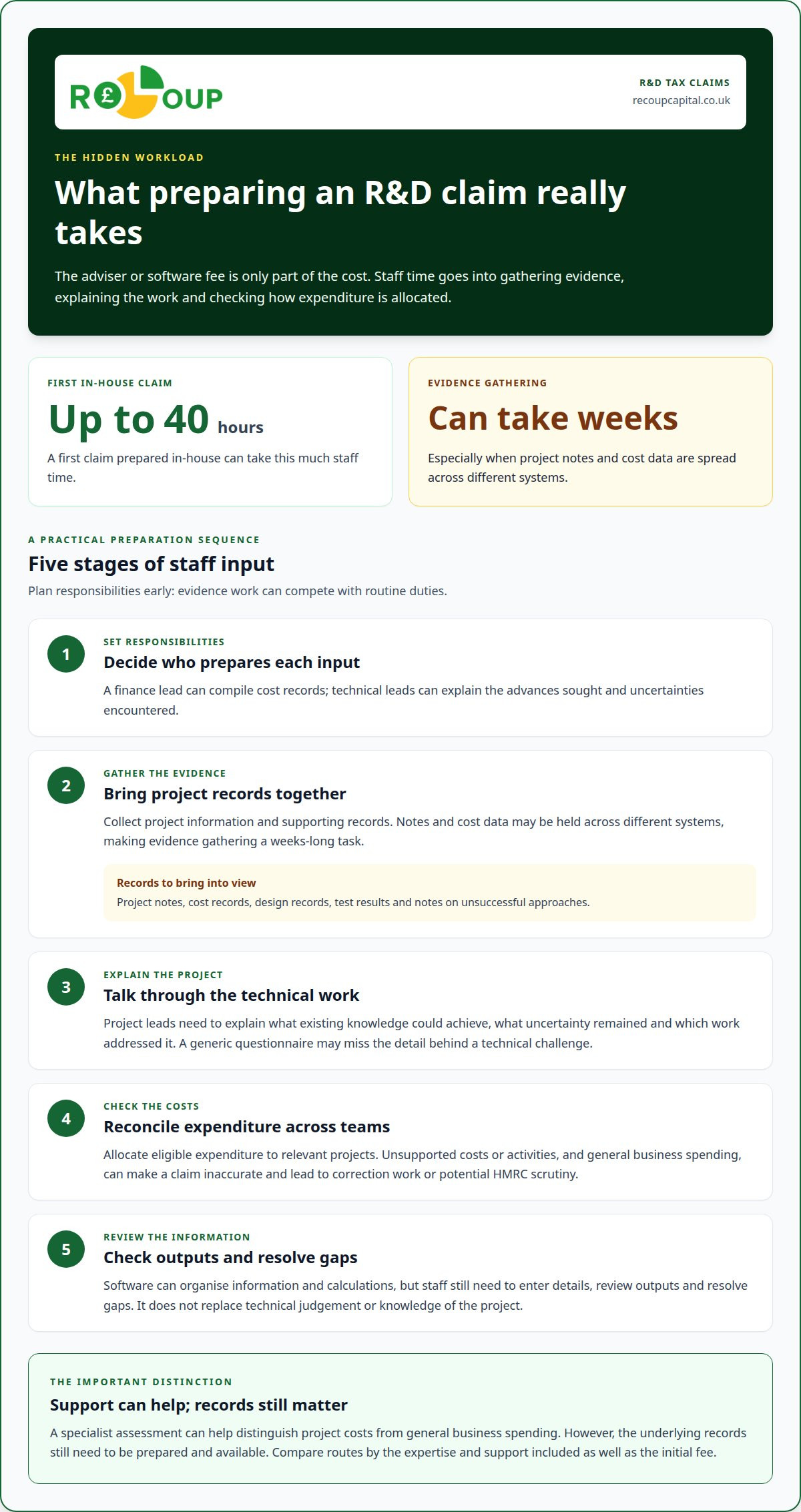
The fee is only part of an R&D claim’s cost. A first in-house claim can take up to 40 hours of staff time, diverting finance and technical teams from planned work.
That time covers more than entering figures. Staff may need to gather project records, interview project leads and reconcile expenditure across departments. Evidence collection can take weeks, especially when project notes and cost data are spread across different systems.
Decide who will prepare each input before choosing DIY or software. For example, a finance lead can compile cost records, while technical leads explain the advances sought and uncertainties encountered. Delays often arise when evidence gathering competes with routine work.
Eligible expenditure needs careful allocation to relevant projects. Unsupported costs or activities can make a claim inaccurate, leading to avoidable correction work and potential HMRC scrutiny. A specialist assessment can help distinguish project costs from general business spending, but the underlying records still need to be prepared and available.
Software can organise information and calculations, but it doesn’t replace technical judgement. Its cost may depend on the pricing model and claim complexity; staff time is still needed to enter details, review outputs and resolve gaps. A tool can support the process, but it cannot replace knowledge of the project.
UK R&D advisers may hold recognised tax qualifications such as CTA, ACA or ATT. Relevant experience also means knowing how to explain technical projects and connect evidence to claimed expenditure.
To assess an adviser’s credentials and track record, review professional qualifications, sector experience and examples of claim work. Look for a clear explanation of how project information is gathered, calculations are prepared and technical questions are handled.
Inaccurate or unsupported claims can delay processing and expose a company to repayment or penalties. For a clearer view of the R&D claim preparation process, consider how evidence, eligible costs and staff responsibilities fit together before deciding which route suits your team.
Insufficient technical assessment of projects
UK R&D tax relief depends on the work itself, not a project’s label or commercial success. According to UK Government, a qualifying project must seek an advance in science or technology by resolving scientific or technological uncertainty. A project that fails may still qualify if the work meets that test.
A sound assessment starts with discussions between the adviser and technical staff. They should identify what existing knowledge could achieve, what uncertainty remained and which work addressed it. A generic questionnaire may miss why an engineering redesign or software development involved a genuine technical challenge.
The project narrative should connect those uncertainties to the work performed and the evidence retained. For example, design records, test results and notes on unsuccessful approaches can explain how the team tried to resolve a technical obstacle. A vague description of routine improvement doesn’t show why the activity qualified.
Grant-funded projects need careful treatment too. Record the grant’s source, terms and the expenditure it supported before preparing a submission. Don’t assume funding alone determines eligibility or the tax-relief route: the applicable scheme and funding arrangements matter. State Aid considerations can also affect how a project and its costs should be assessed, so keep relevant funding documents with the project evidence.
Before claiming, map each candidate project to its technical uncertainty, work undertaken, staff involved and related costs. Then check that the narrative and calculations describe the same activity. This can expose gaps, such as costs assigned to a project without evidence of qualifying work, or technical advances asserted without explaining the uncertainty overcome. Clear records help distinguish eligible activity from ordinary development and give HMRC a coherent account of the claim.
Success-based adviser fees and incentives
A success-based fee links an adviser’s payment to the tax credit achieved. That can align payment with results, but may also create an incentive to increase the claimed benefit. One risk of using a cheap R&D tax adviser is that the fee structure may reward a larger claim, even when some expenditure needs closer scrutiny. The quality of the assessment and evidence matters as much as the payment model.
Compare a percentage-based fee with a fixed fee for defined work or a blended arrangement. Before agreeing, establish what the percentage applies to: the amount claimed, the credit received or another measure. Clarify how the calculation treats rejected or amended claims, later repayments, VAT and HMRC enquiry support. These details show what the fee actually covers.
For example, if expenditure has uncertain eligibility, a fee tied to the claim total could reward including it. A careful adviser should explain why each cost qualifies and how the evidence supports the narrative. Accountants and technical specialists should have clear roles, so you know who assessed the projects and prepared the figures.
Referral arrangements can also shape incentives. Some R&D advisory firms share 10% to 30% of their fee with a referring accountant or introducer. This doesn’t prove a claim is unsuitable, but it makes transparency about referrals and responsibilities useful. Ask how the adviser calculates the fee and whether another party receives part of it.
Read the engagement terms alongside the proposed scope. Check whether the fee covers project discussions, cost analysis, submission and responses to HMRC, or whether any of these are separate. A headline percentage can obscure exclusions, while a lower fixed fee may cover less work. Assess the risks of using a cheap R&D tax adviser by comparing the work and accountability, not just the payment trigger.
For a clearer picture of preparation stages and evidence, explore how R&D tax claims are prepared before weighing the fee models.
Recoup Capital
Recoup Capital helps businesses weigh the practical demands of an R&D claim against the time and expertise available in-house. Its specialists and chartered tax accountants support limited companies in identifying and claiming relevant tax incentives, including R&D Tax Credits, Capital Allowances, Land Remediation Relief and Patent Box. This can be a useful next step when project eligibility, technical evidence or claim preparation needs closer attention, or when you’re deciding whether to manage the work internally or seek specialist support. The aim is to help you understand the claim and its supporting case, so any potential tax benefit can be considered alongside your wider business plans. Contact Recoup Capital to discuss your circumstances.
Choose a claim route that supports your next stage
Your choice should fit the people, project records and technical knowledge available in your business. DIY may work when your team can explain the development process and prepare the supporting details. Software can help organise information, while an adviser may be more suitable when technical questions, evidence or claim preparation need specialist attention.
The risks of using a cheap R&D tax adviser are best judged by the work behind the fee, not the price alone. Consider who assesses eligibility, how the claim is supported and what happens if HMRC asks questions. A clear understanding of those responsibilities can help you protect staff time and give your business a sound basis for planning.
If you’d like to discuss the right approach for your circumstances, contact Recoup Capital. A considered next step can help turn your innovation activity into a more confident plan for growth.
Frequently Asked Questions
Should I Use a Consultant, Software, Or DIY my R&D Tax Credit Claim?
Choose the route that matches the claim’s complexity and your team’s skills. DIY can suit a well-documented project when finance and technical leads can coordinate; software helps structure records but depends on accurate inputs. A consultant can be useful when projects span teams or technical reasoning is difficult to explain. Some businesses combine software for organising records with specialist input on project assessment.
Do I need an accountant for R&D tax credits?
You don’t necessarily need to engage a separate accountant just to prepare an R&D claim. However, an accountant’s name has been required on UK R&D tax relief claims since 1 April 2023. Clarify who is named and what responsibility they take for the figures and supporting submission. If an adviser prepares the claim, your company’s finance records and project evidence still need to be accurate.
What penalties can HMRC impose for incorrect R&D tax relief claims?
HMRC can require a company to repay relief with interest and impose penalties for inaccuracies in an incorrect claim. The claim may also attract closer scrutiny in future. If a cost is challenged, keep the original calculation, invoices and explanation of its connection to the project together. A clear audit trail helps explain the figures and identify what needs correcting.


