

Your accountant can submit an R&D tax relief claim, but if they’re not an R&D expert, specialist support can help with the technical case and qualifying costs. Since August 2023, companies must submit an Additional Information Form for every R&D claim, according to HM Revenue & Customs. If you’re weighing up what to do when your accountant is not an R&D expert, the practical answer is to agree who will prepare each part of the claim.
It’s understandable to expect your accountant to manage the whole process, especially when they already handle your company’s tax affairs. But identifying qualifying R&D, explaining technical uncertainties and building a clear claim can require different expertise from preparing accounts or tax returns. This article explains what your accountant can handle, when an R&D specialist may help and what to do if a claim was missed. It also shows how to coordinate technical evidence, cost calculations and tax filing.
Key Takeaways
- Ask whether your accountant can assess R&D eligibility and qualifying costs, not just prepare the tax figures.
- Describe the technological challenges and advances in a project, rather than relying on a general claim that you developed a new product.
- Agree responsibilities early: a specialist can prepare the technical report and cost schedule, while your accountant reviews the figures and handles the tax return.
- If a claim may have been missed, review the relevant accounting periods and notification requirements promptly to understand what options remain.
Do accountants need support with R&D tax relief claims?
An accountant can handle tax calculations and filing, while specialist input can help strengthen the technical case. The right division depends on the project evidence and each adviser’s R&D experience.
Specialist eligibility and cost expertise
Eligibility is not always clear-cut. An R&D specialist assesses whether project work addressed scientific or technological uncertainty and which costs relate to qualifying activities, rather than treating every project expense as eligible. An accountant’s broader tax work may focus on company accounts, tax computations and returns. Clear project records help connect the technical work to the costs claimed.
Technical case and cost preparation
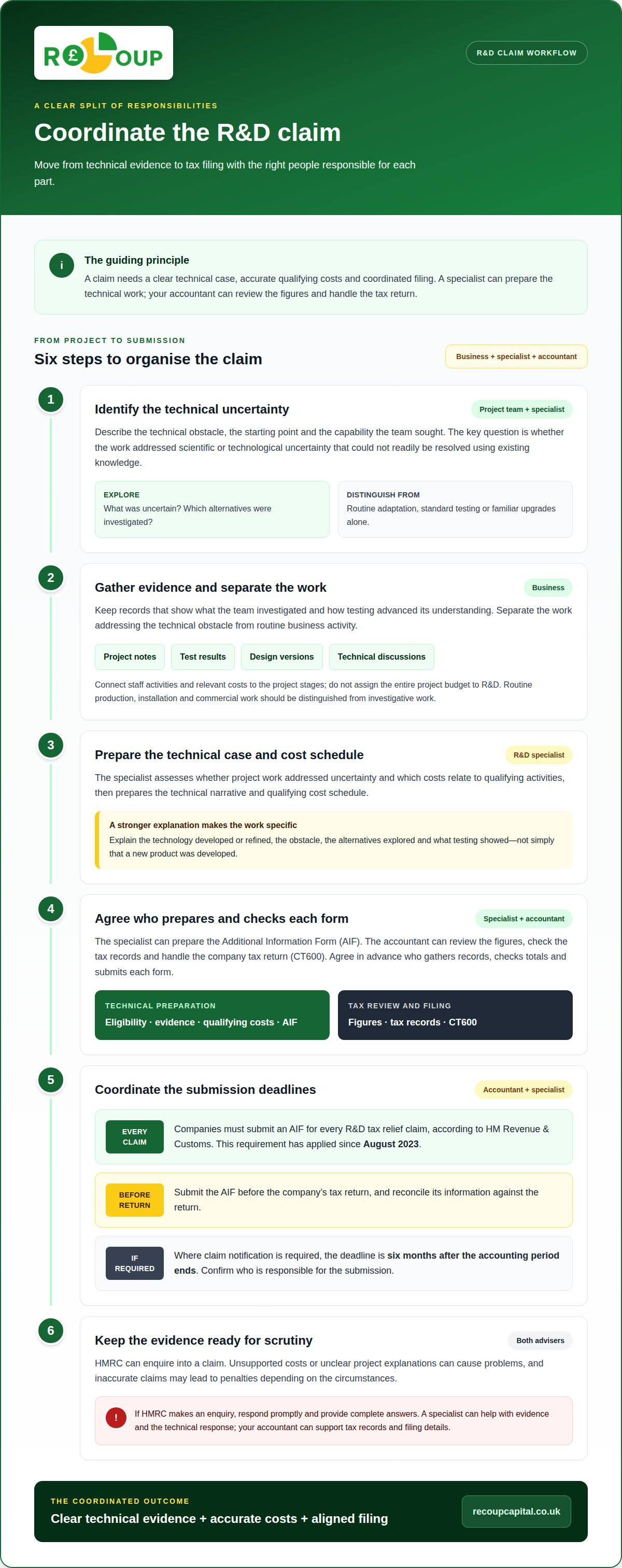
A specialist can prepare the technical narrative, qualifying cost schedule and Additional Information Form (AIF). Since August 2023, companies must submit an AIF for every R&D tax relief claim, according to HM Revenue & Customs. The AIF should be submitted before the company’s tax return, with its information reconciled against the return. Where claim notification is required, the deadline is six months after the accounting period ends. Confirm who is responsible for each submission.
Joint work with an accountant
Using both advisers separates technical preparation from tax filing. The specialist can explain the project’s uncertainties and calculate qualifying costs; the accountant can review the figures and handle the CT600. Agree responsibilities early, including who gathers project records, checks totals and submits each form. This approach keeps the accountant involved without expecting them to write a technical case outside their expertise.
Risks of inaccurate claims
HMRC can enquire into an R&D claim, so unsupported costs or unclear project explanations can cause problems. Inaccurate claims may also lead to penalties, depending on the circumstances. A specialist can help prepare evidence and respond to an enquiry, while your accountant can support the tax records and filing details. Respond promptly and provide complete answers to HMRC’s requests.
| Option | Eligibility and costs | Technical case | Tax filing |
|---|---|---|---|
| Accountant | Reviews financial records | May have limited specialist expertise | Can handle the return |
| R&D specialist | Assesses qualifying work and costs | Prepares technical evidence | Can coordinate with accountant |
| Both together | Combines project and tax knowledge | Responsibilities agreed in advance | Accountant reviews and files |
Choose an arrangement that gives your claim clear technical evidence, accurate cost calculations and coordinated filing.
Separating qualifying R&D from routine improvements
A project doesn’t qualify simply because a business created a new product or improved an existing one. The key question is whether the work addressed scientific or technological uncertainty that couldn’t readily be resolved using existing knowledge. Work may qualify even if the challenge is part of a competent professional’s daily work. Routine adaptation, standard testing or familiar upgrades alone don’t establish qualifying R&D.
Start by identifying the technical obstacle. For example, a construction company might adapt a familiar material for a new use. The claim depends on whether resolving the material’s performance challenge involved technological uncertainty, not simply changing dimensions or following an established process. A technical assessment should explain what was uncertain, which alternatives the team explored and how testing advanced its understanding. A specialist can help distinguish this work from routine delivery.
Describe the technology developed or refined, rather than relying on a broad statement such as “we developed a new product”. Explain the starting point, the capability the team sought and the obstacle that prevented a straightforward solution. For instance, records might show successive design changes after testing revealed that a component failed under particular operating conditions. This gives a clearer basis for assessing qualifying activities.
Evidence makes the explanation more precise. Project notes, test results, design versions and technical discussions can help connect the uncertainty to the work performed. Separate activities that investigated or resolved the technical obstacle from routine production, installation or commercial work. This distinction matters particularly when a project combines experimental development with ordinary business operations.
For each potential project, record the technical objective, the uncertainty, the investigations and the outcome. Then connect staff activities and relevant costs to those stages, rather than assigning the entire project budget to R&D. A specialist review can clarify the technical case before filing and help ensure the additional information describes the work accurately. Explore how R&D claim preparation works if you need support turning project evidence into a clear account.
Coordinating with an external R&D adviser
Agree responsibilities and deadlines before preparing the claim. Clear communication between your business, accountant and adviser helps align the technical narrative, figures and filing.
Checking adviser credentials and experience
Assess professional standing and R&D experience separately. Membership of a relevant professional body can indicate that an adviser follows professional standards, but it doesn’t establish specialist claim expertise on its own. The Professional Conduct in Relation to Taxation (PCRT) sets out standards for members undertaking tax work. Ask who will lead the technical assessment and whether they have handled projects like yours.
An engineering project, for example, may raise different technical questions from software development. Ask how the adviser identifies uncertainty and supports the costs claimed. Their answers can show practical experience beyond general tax credentials.
Questions before hiring an adviser
Ask what the adviser will prepare, what your accountant will review and who will submit each form. Clarify how they will gather project evidence, calculate qualifying costs and check the final narrative against company records. Ask who will manage correspondence if HMRC opens an enquiry and how they will help prepare a response.
Ask how the adviser will communicate with your accountant and document their work. A clear explanation of responsibilities and review steps helps you judge how the process will fit your company’s existing tax arrangements.
Finding a reputable adviser
Use professional-body directories to identify members, then verify membership with the relevant body. Treat membership as one part of your assessment, alongside evidence of R&D claim experience and a clear explanation of the adviser’s role. Membership alone doesn’t show how well someone can explain your project’s technical work.
Before appointing an adviser, agree on a named contact and a way to share records. Make sure the accountant’s and adviser’s roles are clear when preparing the claim.
Set a shared timetable for gathering evidence, reviewing it and submitting the claim. The adviser, accountant and business should agree who checks figures against the technical narrative, who handles HMRC correspondence and how updates are shared. This coordination matters if an enquiry arrives: prompt, complete responses depend on accessible project records and a consistent account from everyone involved.
Can a company use a specialist R&D tax adviser alongside its existing accountant?
Yes. You can keep your accountant for accounts, payroll and wider tax work while an R&D specialist prepares the claim. This lets each adviser focus on their area of expertise, with agreed responsibilities for figures, technical evidence and submissions.
A practical split could look like this:
- The specialist assesses potential projects, prepares the technical report and calculates qualifying costs.
- The accountant reviews the figures, checks how they fit the company’s tax records and handles the CT600.
- The company shares project evidence and financial records with both advisers, then resolves any differences before submission.
Agree on the workflow early. Decide who gathers project information, reviews the cost schedule and submits each required form. Make sure both advisers’ roles are clear in the claim paperwork. Keep a shared timetable for drafts, accountant review and filing, and appoint one contact to resolve queries.
The scale of R&D spending can help guide the decision. Businesses with more than £50,000 in R&D costs are advised to use an experienced specialist; where spending was below £50,000 in the previous financial year, an accountant or self-filing may be suitable. The complexity of the technical work and the accountant’s relevant expertise also matter. A threshold is a useful prompt, not a substitute for assessing the claim’s evidence and preparation needs.
If a claim was missed, bring your accountant and an R&D specialist together promptly to review the accounting period, earlier submissions and available project records. Claim time limits and notification requirements depend on the period and company history, so establish the relevant dates before deciding what action remains. Clear coordination can also help everyone respond consistently if HMRC raises an enquiry.
If you want specialist input alongside your existing accountant, discuss support with your R&D claim and how the work can fit your current tax process.
Recoup Capital
Recoup Capital supports companies whose accountant handles the tax return but lacks specialist R&D expertise. Its team helps UK-registered limited companies assess innovation projects, prepare R&D tax credit claims and identify qualifying costs, working alongside the accountant responsible for the wider tax relationship.
Consider specialist support when eligibility is unclear, the technical narrative needs development or you want to review a potentially missed claim. Recoup Capital also advises on Capital Allowances, Land Remediation Relief and Patent Box when those incentives are relevant to your business. The right support depends on the work and evidence, so start with a focused discussion about your company’s projects and existing arrangements.
Contact Recoup Capital to discuss your R&D claim and how specialist support could work alongside your accountant.
Make your next claim a coordinated decision
Deciding what to do when your accountant is not an R&D expert starts with a practical conversation about who can best handle each part of the work. Keep your accountant involved in the wider tax relationship, while ensuring that technical assessment and claim preparation receive appropriate specialist input. This shared approach can help turn a complex project into a clearer, evidence-led decision for your business.
In your next discussion, set out the projects you want assessed, the records available and any concerns about earlier claims. If you’re unsure how specialist input could fit alongside your current arrangements, speak with Recoup Capital about your options.
Contact Recoup Capital to discuss your claim and plan a considered next step for your business.
Frequently Asked Questions
Should I get my accountant to file my R&D tax credits?
Yes, your accountant can file the claim if they’re comfortable with the work and supporting evidence. Filing and specialist preparation are separate decisions: an accountant can submit a claim prepared with R&D expertise. Before agreeing, ask what their engagement covers, who will review the technical basis and how questions about the claim will be handled. Clear responsibilities help prevent gaps between preparation and filing.
Accountant vs R&D Tax Specialist: Which Do You Need?
Choose based on the work required, not the adviser’s job title alone. An accountant may be the right lead for routine tax calculations and filing; an R&D specialist can help when technical eligibility or project evidence needs closer assessment. For example, a technology project involving unfamiliar engineering challenges may need relevant technical insight. If your accountant has that expertise, they may be able to cover both aspects.
How can I change accountants or resolve disagreements about an R&D tax claim?
First, pinpoint the disagreement: is it about project facts, eligible activities, cost treatment or how the claim is presented? Ask your accountant to explain their reasoning, then compare it with the project records. If the technical assessment remains disputed, seek a specialist view. If confidence in the wider relationship has broken down, arrange a clear handover of relevant tax and claim records before changing accountants.


