

There’s no single fee structure that suits every R&D claim. When justifying R&D consultant fees to a CFO, compare how the fee is calculated, what work it covers and when it is payable. A success-based fee links the charge to the tax benefit recovered, while a fixed fee is agreed for a defined scope of work.
It’s understandable to focus on the headline cost, especially when a percentage can make a successful claim seem expensive. But the fee alone doesn’t show the full value or risk. Scope, records, claim complexity and payment terms all affect the comparison.
This article explains how percentage-based pricing, specialist consultancy fees and success fees differ in cost and incentives. You’ll see what to compare in the engagement terms, how to frame the decision for your finance team and why the right measure is the work delivered relative to the claim’s value and risk.
Key Takeaways
- Compare percentage-based pricing with fixed and time-based fees by looking at how each links payment to the claim’s value and the work involved.
- Assess the scope behind a specialist fee, including the records, technical analysis and claim preparation it covers.
- Build an ROI view that accounts for the expected tax benefit, consultancy fee, internal effort and timing of the benefit.
- Use the decision guide to identify when specialist R&D tax credit support can help your finance team assess a claim and its commercial value.
Percentage-based R&D consultant fees
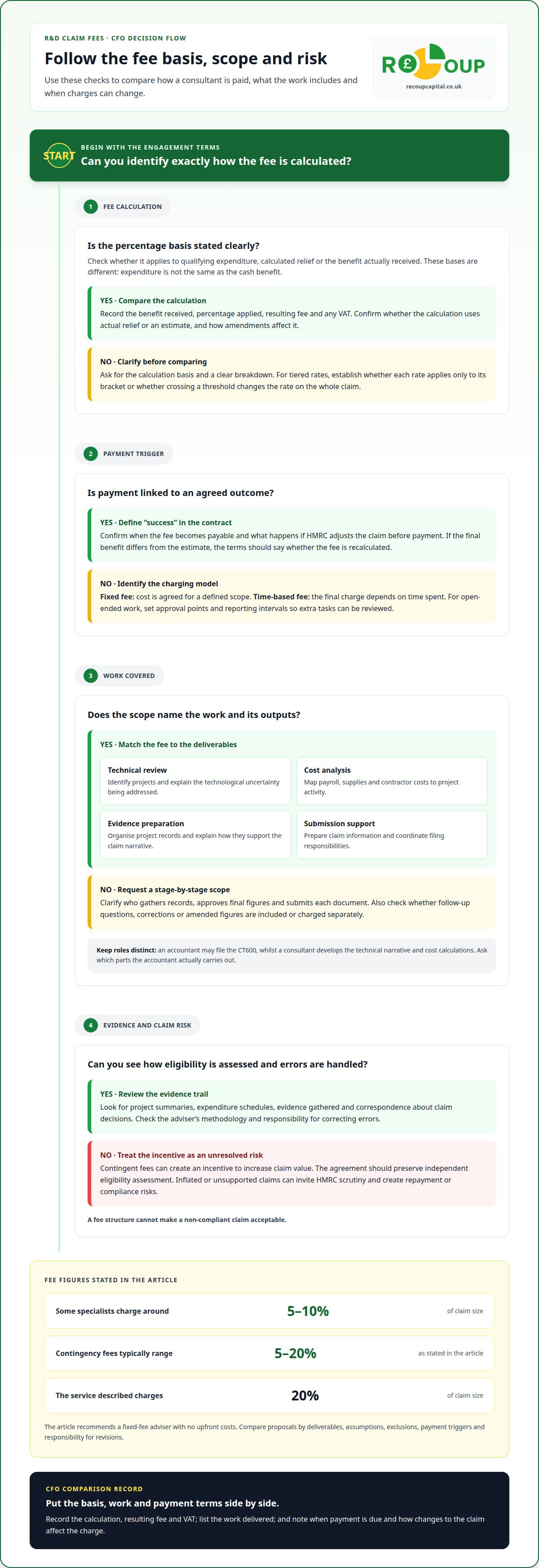
A percentage-based fee links the consultant’s charge to the value of an R&D claim. The agreement should state whether the percentage applies to qualifying expenditure, calculated relief or the benefit actually received. These are different bases: expenditure is not the same as the cash benefit, so the calculation affects the final fee.
With success-based pricing, payment depends on an agreed outcome, such as a successful claim. The contract should define “success” and explain when the fee becomes payable. If HMRC adjusts a claim before payment, the terms should clarify whether the fee is recalculated against the reduced benefit.
A percentage-of-benefit model can align the fee with the value reaching the business. For justifying R&D consultant fees to a CFO, record the calculation in a simple schedule: benefit received, percentage applied, resulting fee, and any VAT. Clarify whether the calculation uses actual relief received or an estimated figure, and how amendments affect it.
Tiered percentage pricing applies different rates to separate portions of a claim’s value. Check whether each rate applies only to its bracket or whether crossing a threshold changes the rate on the entire claim. That distinction can materially change the charge. Ask for both interpretations to be modelled using the same claim assumptions.
To assess the fee, request a clear scope, calculation basis and breakdown of the work. Supporting records might include project summaries, expenditure schedules, evidence gathered and correspondence about claim decisions. These show how the consultant connected technical activity to qualifying work and prepared the submission.
Contingent fees can create an incentive to increase claim value, so the agreement should preserve independent assessment of eligibility. Inflated or unsupported claims can invite HMRC scrutiny and create repayment or compliance risks. Review the adviser’s methodology, evidence trail, and responsibility for correcting errors; a fee structure cannot make non-compliant claims acceptable.
Specialist consultancy fees and success-fee pricing
A fixed specialist fee pays for an agreed scope of work, rather than a share of the credit. The scope might cover technical discussions, cost analysis, evidence review and claim preparation. Ask for each stage to be set out in the engagement terms so the finance team can relate the charge to the work delivered.
A success fee ties payment to an agreed outcome, such as tax relief being received. The agreement should explain what counts as success, when the fee becomes due and how amended claims affect the calculation. For example, if the final benefit differs from the estimate, the terms should state whether the percentage is recalculated.
Fixed and time-based fees allocate risk differently. A fixed fee makes the cost for the agreed scope clearer, while hourly billing means the final charge depends on time spent. For open-ended work, define approval points and reporting intervals. This lets a CFO review progress before additional tasks increase the cost.
Fees can also reflect claim complexity, the number of projects and the quality of existing records. Strong project documentation may make evidence review more straightforward; fragmented records can require additional analysis. Expertise matters too: assess whether the team can interpret technical activity, connect it to the scheme’s criteria and explain how its work supports the claim.
Software can help organise project notes and expenditure records, but it doesn’t replace specialist judgement. Compare proposals by listing deliverables, assumptions, exclusions, payment triggers and responsibility for revisions. A CFO justifying R&D consultant fees can then show how the chosen structure relates to the work, rather than treating the percentage alone as a measure of value.
For a clearer view of how claim preparation fits together, explore the R&D claim process alongside the proposed scope and fee terms.
Some specialists charge around 5-10% of claim size; contingency fees typically range from 5% to 20%. The described service charges 20%. The page recommends a fixed-fee advisor with no upfront costs.
What services should an R&D tax relief consultant fee include?
Define the deliverables before comparing fees. An R&D claim service can cover project discussions, technical assessment, qualifying-cost analysis, evidence collation and submission preparation. Each stage should have a clear output, such as a project narrative or expenditure schedule, so the finance team can see what the fee covers.
The filing itself may be a smaller part of the work. Preparing an R&D tax credit claim can involve completing tax-return information and providing supporting documents. A company’s accountant should probably include filing a claim in its normal service at no extra charge. If the accountant says they handle R&D claims, ask which parts they carry out.
- Technical review: identify the projects and explain the technological uncertainty being addressed.
- Cost analysis: map payroll, supplies and contractor costs to the relevant project activity.
- Evidence preparation: organise project records and explain how they support the claim narrative.
- Submission support: prepare the claim information and coordinate filing responsibilities.
These tasks help separate specialist analysis from routine tax return work. For example, an accountant may file the CT600, whilst a consultant develops the technical narrative and cost calculations. The engagement should specify who gathers records, who approves the final figures and who submits each document. That division prevents duplicated work and unclear accountability.
The scope should also cover follow-up. State whether the fee includes responding to questions about submitted information, correcting errors or preparing amended figures. If those tasks are charged separately, identify the approval process and billing basis before signing. This lets the CFO compare proposals on equivalent deliverables, not just headline fees.
Before appointing an adviser, read the terms of business and record the agreed scope in writing. A practical comparison is a deliverables table showing the responsible party, output and any separate charge for each stage. This makes fee approval easier to explain and gives the company and adviser a shared reference point.
How can a CFO calculate the ROI of hiring an R&D tax relief consultant?
Start with the net value, not the headline claim. Subtract the consultant’s fee and the company’s internal costs from the tax benefit actually received. Then compare that net value with the total cost of obtaining it. This gives the CFO a consistent basis for comparing proposals with preparing a claim internally.
Separate cash flow from tax savings. A forecast should treat potential relief as an adjustment to tax liabilities, not cash already received. Record the expected benefit as a forecast, then update the calculation when HMRC confirms the outcome and the company receives it. This avoids presenting a possible tax reduction as available cash.
Include internal effort in the calculation. Finance, technical and project staff may spend time locating records, explaining development work and reviewing drafts. Record those hours as an internal cost using the company’s usual costing method. Compare the total with the staff time required to prepare a claim internally.
Use a repeatable model:
- Estimate the qualifying tax benefit, using the evidence and claim assumptions.
- Deduct the agreed adviser fee and internal staff costs.
- Calculate net value as benefit received minus total costs.
- Compare net value with the total cost to show return on investment.
Run a sensitivity analysis for different outcomes. Model a reduced claim, a delayed benefit and additional work following an HMRC enquiry. Keep each scenario separate and state its assumptions. This shows how changes to the claim or timing affect cash planning, rather than relying on one optimistic forecast.
Finally, record non-financial value separately. A clearer evidence trail, consistent project records and less disruption to finance staff can support future decisions, but shouldn’t be counted as tax benefit. An R&D claim review can help your team assess the claim inputs behind its ROI calculation. Explore support with preparing an R&D claim.
Recoup Capital: R&D Tax Credits
Recoup Capital supports UK-registered limited companies assessing and preparing R&D tax credit claims. Its R&D specialists and chartered tax accountants help businesses identify qualifying activity and prepare claims, giving finance teams a clearer basis for considering scope, evidence and value.
Consider turning to Recoup Capital when your team is weighing adviser fees against the work involved, or needs support connecting technical projects with claim evidence. A structured discussion can help frame the questions that matter to a CFO: what activity is being assessed, which costs relate to it, and how the claim fits your business’s financial planning.
R&D relief is not the right fit for every project; the activity must meet the relevant criteria. To explore support for your business, visit the Recoup Capital website.
Make your next claim decision with confidence
Use the fee review as a starting point for stronger investment decisions. Set clear approval criteria for future claims, assign responsibility for technical evidence and agree how finance will track the benefit against the work involved. That creates a repeatable process rather than treating each claim as an isolated tax task.
For justifying R&D consultant fees to a CFO, connect the proposed work to your company’s priorities and the evidence available to support it. Recoup Capital offers R&D Tax Credits, Capital Allowances and Land Remediation Relief, helping businesses assess relevant tax incentives alongside their wider growth plans.
Discuss your options with Recoup Capital and take the next step towards a clear, well-supported decision. Discuss your options with Recoup Capital. Your finance team can move forward with a stronger basis for action.
Frequently Asked Questions
What do UK R&D tax relief consultants charge, and how are fees calculated?
UK consultants may use percentage-based success fees, fixed fees or hourly billing. A percentage fee is usually calculated against an agreed claim benefit, so clarify whether it uses the amount estimated or actually received. The amount depends on the case and is provided after a quote request; relevant factors include claim scope, project complexity and record quality. Recoup Capital works on a contingency basis, with fees payable only for a successful claim.
What UK rules and HMRC guidance govern R&D tax relief claims and adviser fees?
A claim must involve seeking an advance in science or technology by resolving technological uncertainty, and qualifying costs must be supported by evidence. Advisers should follow the Professional Conduct in Relation to Taxation guidance and HMRC’s agent strategy guidelines. Fee terms should clearly define the scope, calculation basis and payment trigger.


