

If you’re unhappy with Kene Partners’ service, set out the specific issue in writing and ask what can be done to resolve it. Keep records of payments and work completed, and review your agreement for notice requirements or final payment terms before ending the arrangement. A calm, documented complaint gives both sides a practical basis for addressing the concern.
It’s understandable to feel frustrated when a professional relationship falls short of your expectations. Before a difficult conversation with a business partner, decide what you want to achieve. Explain the concern, listen to their perspective and work towards agreed actions or a compromise.
This guide explains how to prepare for that conversation, raise a complaint constructively and consider your options before changing providers or ending an arrangement. It also covers the limits of company-register information and practical steps to protect your business interests while seeking a fair resolution. You’ll have a clearer way to discuss the problem, assess possible remedies and decide what to do next, before dissatisfaction grows into a larger dispute.
Key Takeaways
- Set out your complaint clearly, keep a record of the service provided and what you paid, and review your agreement before deciding whether to end the arrangement.
- Compare consultants using practical criteria such as how they explain their approach, communicate with you and address your concerns, rather than relying on assumptions.
- Prepare for a difficult business conversation by stating the issue calmly, listening to the other perspective and agreeing specific next steps.
- If your concern relates to an R&D tax credit claim, Recoup Capital can help you understand the support available and how the claim may fit your business needs.
3. How to escalate a Kene Partners complaint in the UK?
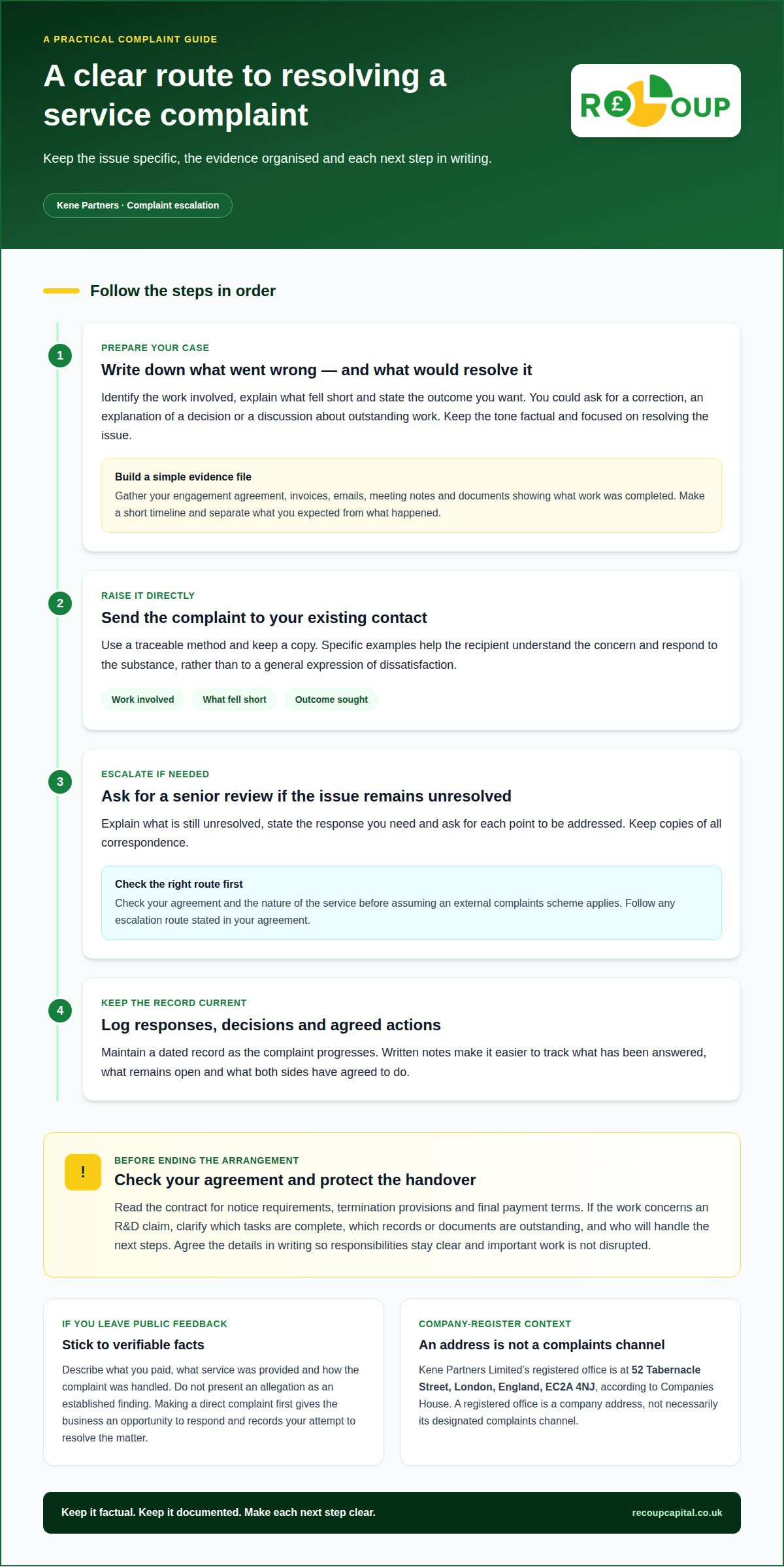
If you’re unhappy with Kene Partners’ service, start by sending a clear written complaint to your usual contact. Identify the work involved, explain what fell short and say what outcome you’re seeking. You might request a correction, an explanation of a decision or a discussion about outstanding work. Keep the tone factual and focused on resolving the issue.
Gather relevant records before sending your complaint. These might include your engagement agreement, invoices, emails, meeting notes and documents showing what work was completed. Make a short timeline and distinguish what you expected from what happened. Specific examples help the recipient understand the concern and address the substance, rather than respond to a general expression of dissatisfaction.
Ask for the complaint to be reviewed by someone senior if your usual contact cannot resolve it. State the response you need, request that the response address each point, and keep copies of all correspondence. Avoid assuming that a particular external complaints scheme applies: first check the agreement and the nature of the service, then identify any stated escalation route. Kene Partners Limited’s registered office is at 52 Tabernacle Street, London, England, EC2A 4NJ, according to Companies House. A registered office is a company address, not necessarily its designated complaints channel.
Use this sequence to keep the escalation organised:
- Write down the issue, supporting evidence and outcome you want.
- Send the complaint to your existing contact using a traceable method.
- If the reply does not address your concerns, ask for a senior review and explain what remains unresolved.
- Keep a dated record of responses, decisions and any agreed actions.
Before ending the arrangement, read the contract for notice requirements, termination provisions and final payment terms. If the work concerns an R&D claim, clarify which tasks are complete, what records or documents are outstanding and who will handle the next steps. Agree the details in writing so a change of provider does not leave responsibilities unclear or disrupt important work.
If you plan to leave public feedback, stick to verifiable facts: what you paid, what service was provided and how the complaint was handled. Don’t present an allegation as an established finding. Making a direct complaint first gives the business an opportunity to respond and records your attempt to resolve the matter. If the dispute remains unresolved, use your contract and gathered evidence to assess the appropriate options.
4. How does Kene Partners compare with other UK R&D tax credit consultants?
A fair comparison focuses on the service you need, not broad claims about which consultant is “best”. Without comparable evidence about each firm’s work, fees and client outcomes, a ranking would be unreliable. Instead, compare what each consultant proposes to do, how they explain the work and what support they provide throughout the claim process.
Start with the proposed scope. Ask what information the consultant needs from your team, who will discuss the company’s research and development activity, and how technical details will shape the claim. A software business, for example, may need to explain how its project tackled technical uncertainty. A manufacturer may need to describe the engineering work and the challenges it addressed. The consultant should clarify how your records and staff input fit into the process.
Next, assess communication and accountability. Find out who your main contact will be, how progress updates will work and who will explain key decisions. Compare the clarity of each firm’s written proposal: does it set out responsibilities, deliverables and next steps? If it’s unclear who will prepare or review a document, ask for that responsibility to be put in writing before work proceeds.
Compare the support provided around the claim, too. Consider how each consultant handles questions, explains what information your team needs to provide and responds when project records are incomplete. Ask what happens after submission, including how queries about the work will be handled. HMRC may review a claim, so understand what assistance is included and what your business must provide. These details are more useful than a confident sales presentation.
Use the same checklist for every proposal:
- Technical understanding: Can the team explain your project’s challenges in clear, accurate terms?
- Scope: Are the work, responsibilities and deliverables described plainly?
- Communication: Do you know who your contact is and how updates will be shared?
- Ongoing support: Is the process for handling follow-up questions explained?
Compare the written answers with your priorities. If responsiveness matters most, consider how promptly and clearly each firm has answered your questions. If technical understanding is central, compare how each consultant summarises your project and identifies the evidence needed. This gives you a practical basis for deciding whether the current arrangement still suits your business, without relying on unsupported claims about other UK providers.
Company information offers one point of context: Kene Partners Limited is classified in the UK under SIC code 70229 for management consultancy activities other than financial management. Companies House does not check the accuracy of information filed with it, so that classification alone does not settle whether a consultant’s work fits your needs. Treat it as a prompt for questions, not a substitute for discussing scope and support.
If an issue arises with a business partner, make the discussion a two-way conversation: share the concern, remain open to each other’s perspectives, seek to understand them and agree on next steps or a compromise. Consumers who feel they are being treated unfairly can turn to the Better Business Bureau as a resource. Chelle Neff said that a good company will make a complaint right in Nine times out of 10. These points offer ways to approach concerns, rather than a basis for ranking consultants.
With your
A difficult conversation with your business partner works best when you first decide its purpose. Identify what needs to change, what outcome would resolve the concern and which facts support your view. If an agreed task was missed, for example, note when it was due and how the delay affected the business. A clear example gives the discussion something practical to address.
Raise the issue before frustration builds. Use open, collaborative language rather than accusations. Try, “Can we talk about how we’re sharing this work?” instead of, “You never do your part.” The first invites a response and keeps the focus on a specific responsibility. If the concern is about a service arrangement affecting both partners, explain its impact on the business and invite your partner to assess it with you.
Keep the conversation two-way. Describe what you’ve observed, then ask an open question such as, “How do you see the situation?” Listen before deciding what the answer means. Your partner may know something you don’t, such as a competing deadline or a different understanding of who owned the task. Hearing their perspective doesn’t mean dismissing your concern.
Agree on specific next steps. Rather than ending with “we’ll communicate better”, decide who will do what and when you’ll review progress. If you disagree about whether work was completed, compare the relevant emails, records or agreed responsibilities. A brief written note afterwards can capture decisions and prevent different recollections from taking hold.
When discussing a supplier or consultant, separate the business decision from any disagreement between partners. Each person can identify the main concern, such as an unclear deliverable, a missed update or uncertainty about responsibilities. Then decide whether the issue calls for clarification, a change to the working process or ending the arrangement. Review the agreement before committing Recoup Capital to a course of action.
Try this simple structure for the meeting:
- Set the purpose: Explain the decision or concern you need to discuss.
- Share an example: Describe what happened, using relevant records rather than assumptions.
- Hear their view: Ask what they understand and listen without interrupting.
- Agree a next step: Record the action, who owns it and when you’ll revisit it.
Be direct, but leave room for discussion. Raising a concern early gives both partners a chance to address it before it becomes a wider dispute. If the same issue keeps recurring, bring the earlier agreement and progress notes to your next conversation. This makes it easier to identify what remains unresolved and choose a constructive response together.
Don’t rely on hints or expect your partner to notice unspoken dissatisfaction. Raise the concern instead of letting it fester. If the issue involves a customer complaint or feedback, stick to facts and document what was paid and what services were provided. A specific record can help both partners assess the concern together.
Recoup Capital: R&D Tax Credits
Recoup Capital can help UK businesses assess and prepare R&D tax credit claims, making it a practical next step if you need specialist support with innovation-related tax relief. Its team works with limited companies across sectors, including construction and engineering, to identify relevant incentives and support claims. If you’re reviewing an existing arrangement, bring together a clear summary of your projects, records and outstanding questions. That gives you a useful starting point for discussing your business’s needs and understanding how claim support could fit. R&D tax credits may not suit every project, so the focus should be on the company’s actual development work and supporting evidence. For a considered discussion about your R&D tax credit needs, contact Recoup Capital.
Move forward with a clearer plan
If you’re unhappy with Kene Partners’ service, use the concerns you’ve identified to decide what your business needs next. You might need clearer communication, a different approach to a claim or support assessing tax relief opportunities. Set out your priorities before taking the next step, so any new discussion stays focused on your objectives.
Recoup Capital supports businesses with R&D Tax Credits, Capital Allowances and Land Remediation Relief. These specialist services may be relevant if you’re assessing innovation-related claims, qualifying expenditure or land affected by remediation. The right focus depends on your business activities and the question you need resolved. A conversation can help you understand the support available and whether it fits your circumstances.
Discuss your options with Recoup Capital and take a considered step towards the right outcome for your business.


