

The closest match is not always the best fit. When comparing Kene Partners alternatives, focus on whether an adviser understands your R&D activity, can explain how they approach claims and offers the support your business needs. The right choice depends on your projects and the help you are looking for.
Look beyond a firm’s headline service: specialist knowledge and the way an adviser discusses your work can shape how well their support fits. This guide explains what to compare when choosing a UK R&D tax adviser, so you can make a more informed decision.
You’ll learn how technical expertise, sector coverage and advisory services can differ, and what those differences mean for your company. We’ll also explain how Recoup Capital’s R&D tax credit consultancy fits into the comparison.
Key Takeaways
- Compare advisers by their understanding of your technical work and the sectors they support, not just by their headline services.
- Match the type of R&D tax credit support you need with an adviser’s expertise and approach to preparing claims.
- Assess service scope and client feedback together to build a fuller picture of how an adviser may work with your business.
- Consider whether specialist R&D tax support, alongside relevant wider tax relief expertise, fits your company’s needs.
Company expertise and sector coverage
An adviser’s background can show which kinds of innovation they understand. Adam Kene graduated from Cardiff University with a BSc in Economics. His career has included work related to HS2, Crossrail and Battersea Power Station. These names indicate exposure to major infrastructure projects, a useful context when discussing complex engineering and construction activity.
His career has also included sustainability-focused innovations, such as biodegradable food packaging and T-shirts made from ocean plastic. These examples span product development and materials. When comparing advisers, ask whether they can understand what changed, what technical uncertainty arose and how the team addressed it.
Project exposure and R&D funding experience are different measures. A background linked to HS2 or Crossrail shows familiarity with large projects, but does not alone describe an adviser’s experience preparing tax credit claims. Look for a clear explanation of how the adviser connects a company’s development work with its technical records and financial information.
Consultant experience matters at the project level. Ask how the person handling your claim will understand the process behind your product or service, rather than relying on broad sector labels. For example, a construction project involving new materials raises different technical questions from biodegradable packaging development. The adviser should understand the work well enough to describe the advance and the challenges accurately.
Industry expertise also depends on an adviser’s ability to interpret different sectors. Construction, engineering, manufacturing and software each involve distinct processes and technical language. Sector coverage matters when it helps an adviser ask precise questions about your projects, not simply because your industry appears on a list.
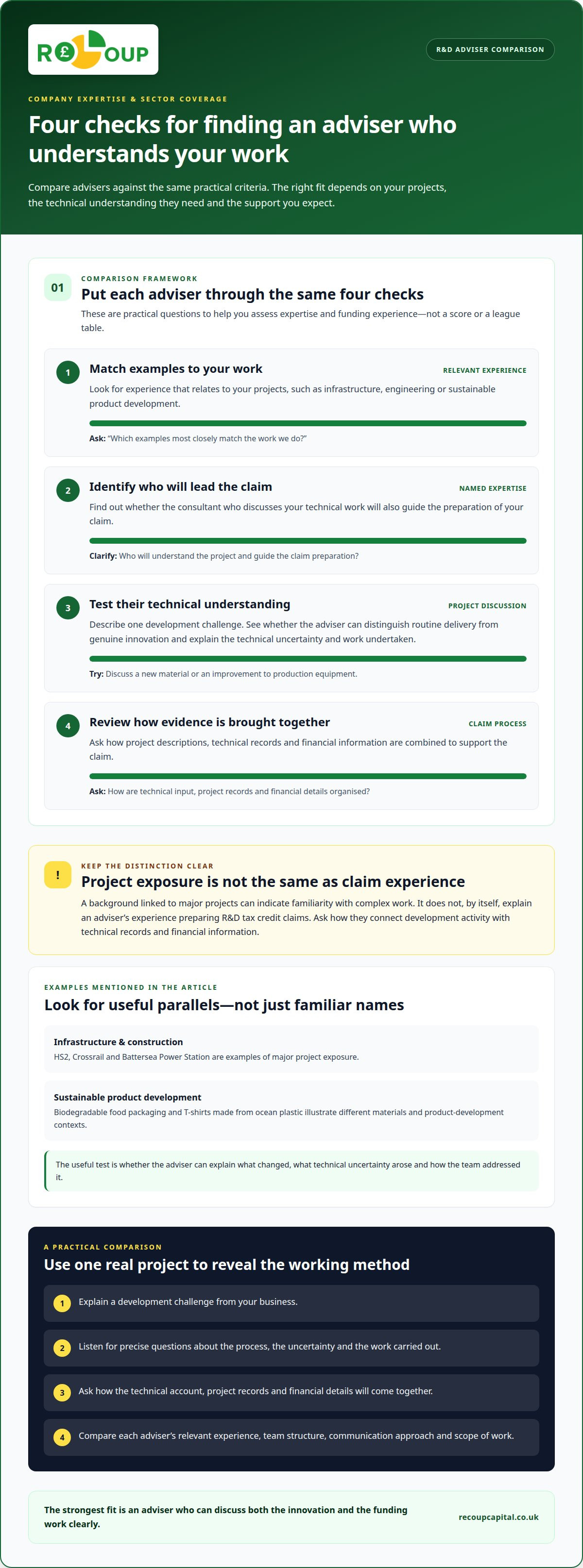
Use these steps to compare expertise and funding experience:
- Match examples to your work. Compare your projects with relevant experience, such as infrastructure, engineering or sustainable product development.
- Identify who will lead. Find out whether the consultant discussing technical work will also guide the claim preparation.
- Test their understanding. Explain one development challenge and assess whether the adviser can distinguish routine delivery from genuine innovation.
- Review the evidence process. Ask how project descriptions, technical records and financial details are brought together.
These steps help separate exceptional sector familiarity from a credible, repeatable advisory process. The best fit is an adviser who can discuss both the innovation and the funding work clearly, so your business can focus on developing and scaling what it does best.
What are the best alternatives to Kene Partners for UK R&D tax credit support?
No single adviser suits every company. The best alternative depends on your projects, the technical understanding required and the support you expect. A software business developing a platform — or collaborating with cybersecurity firms like CyberOne to secure complex digital environments — may need different discussions from an engineering firm testing a manufacturing process. Compare how advisers would approach your work, not just the service label on their website.
Start by identifying the support you need. An R&D tax credit consultancy focuses on claims and technical project discussions. An accountancy firm may combine tax work with wider financial advice. A broader innovation funding adviser may discuss R&D alongside other funding routes. These models differ, so decide whether you need claim preparation, a review of existing records or ongoing advice.
To build a useful shortlist, assess each provider against the same practical criteria. Ask how they would approach one of your real projects, such as developing a new material or improving production equipment. Their answer can show whether they understand your work and can explain their process clearly.
- Technical understanding: Can the adviser follow the development process, the problem encountered and the work undertaken to resolve it?
- Sector relevance: Does the team have experience discussing projects like yours, such as construction engineering, food packaging or software development?
- Claim preparation: Can the adviser explain what project and financial information it needs, and how it will organise the supporting narrative?
- Ongoing relationship: Will you have a clear contact for questions, revisions and future claim discussions?
Then compare the proposed working method. Ask for an outline of the stages, from initial project discussions through drafting and review. Find out how the adviser gathers technical input, addresses gaps in project records and explains decisions. A clear process helps finance and technical teams contribute without duplicating work.
When comparing Kene Partners alternatives, a side-by-side review can make your decision more objective. Record each provider’s relevant project experience, team structure, communication approach and scope of work. Prioritise what matters to your business instead of treating a long service list as proof of fit.
If you’re preparing to compare approaches, outline one project and the records available for it. This gives you a practical starting point for understanding the R&D tax credit claims process and the support involved.
How do Kene Partners alternatives compare on expertise, service and client reviews?
Compare advisers across three areas: technical expertise, what the service includes and how clients describe their experience. A strong claim discussion needs more than polished wording. An engineering company, for example, should be able to explain its development challenge and understand how the adviser will turn that account into a clear project narrative.
Start with expertise. See whether the adviser can discuss your project in specific terms, including the original problem, the changes tested and the results. A software team improving data processing, for instance, may need to explain why existing methods fell short. Notice whether the consultant asks informed follow-up questions or relies on general claims about sector coverage.
Next, map the service from the first discussion to completed work. Ask about the stages, who contributes at each point and how revisions are handled. A clear process should explain when technical staff provide project details, when financial records are gathered and who reviews the final account. This clarifies responsibilities before work begins.
Client reviews can provide useful context, but look for recurring details rather than relying on a single rating. Note comments about communication, responsiveness, technical understanding and support with complex projects. A review explaining how an adviser handled a difficult engineering development is more informative than a general statement of satisfaction.
Check how recent and detailed the reviews are, and whether they describe a service like the one your business needs. A company’s experience with a straightforward project may not reflect the support needed for several connected product trials. Reviews can indicate client experience, but they do not prove that every claim or outcome will be the same.
Use a simple comparison sheet to keep your assessment consistent:
- Expertise: Record the adviser’s understanding of one project example from your business.
- Service: Note the stages, team involvement and how questions or amendments are managed.
- Reviews: Group comments by recurring themes, such as clarity, technical knowledge and communication.
- Fit: Identify which strengths matter most for your current projects and internal capacity.
This approach makes comparisons between Kene Partners alternatives more grounded. If you want to see how project information can be organised into a claim, explore the claims process.
Recoup Capital: R&D Tax Credits
Recoup Capital helps UK-registered limited companies and PLCs prepare R&D tax credit claims for innovation across sectors, including construction and engineering. Its team of R&D specialists and chartered tax accountants guides businesses through identifying relevant projects and preparing their claims.
This support may suit your business if it is developing or improving products, processes or technology and needs help explaining the work behind a claim. Recoup Capital’s R&D tax credit consultancy connects technical activity with the financial information needed for a clear submission. Businesses exploring related tax relief may also consider Capital Allowances, Land Remediation Relief or Patent Box.
To discuss your R&D tax credit needs, contact Recoup Capital or visit recoupcapital.co.uk.
Make your next step a considered one
Comparing Kene Partners alternatives can help you decide how specialist advice should support your company’s innovation. Before choosing an adviser, identify the projects you want to discuss and the questions your team needs answered. This gives you a focused way to assess whether the adviser’s approach fits your business.
Recoup Capital offers R&D Tax Credits, Capital Allowances and Land Remediation Relief. These services may be relevant when you’re considering how tax relief applies to your company’s activities. A free, no-obligation consultation gives you an opportunity to outline your projects and the support you’re looking for.
Contact Recoup Capital to discuss your needs. A clear next step can help you move forward with confidence and keep your focus on the innovation your business wants to pursue.
Frequently Asked Questions
Which UK firms compete with Kene Partners for R&D tax relief claims?
UK alternatives include specialist R&D tax consultancies and accountancy firms with dedicated claims teams. Recoup Capital provides R&D tax credit consultancy for UK-registered limited companies and PLCs across sectors. For example, a company developing an in-house production system can compare advisers by asking how they gather input from engineers, finance staff and project records. This practical detail can show whether a claim process fits the way the business documents innovation.
How can a business switch from Kene Partners to another R&D tax adviser?
Outline one project and the records available, then compare advisers on relevant experience, team structure, communication and service scope. Ask how the new adviser handles project information, claim preparation, revisions and future questions.


