

Impressive recovery figures are a useful starting point, not a verdict on service quality. Recoup Capital’s case studies describe a £6 million recovery for a UK engineering group and more than £450,000 in R&D Tax Relief for a synthetic surfacing specialist, offering concrete evidence to consider when deciding whether Recoup Capital is any good.
When asking whether Recoup Capital is any good, headline figures alone are not enough. Testimonials and case studies can show what customers say about their experience and the types of businesses the firm has supported. They can help you assess the evidence, but they cannot determine whether a particular provider suits your company.
Key Takeaways
- Use client testimonials to understand the length and nature of working relationships, not just whether a customer is satisfied.
- Compare case studies for the context behind reported claim changes, including the type and scale of the business involved.
- Look at specialist experience across sectors and business structures to judge how relevant it may be to your own R&D projects.
- See how Recoup Capital’s R&D Tax Credits support could fit when you’re assessing potential claims and planning your next steps.
Client testimonials and case studies
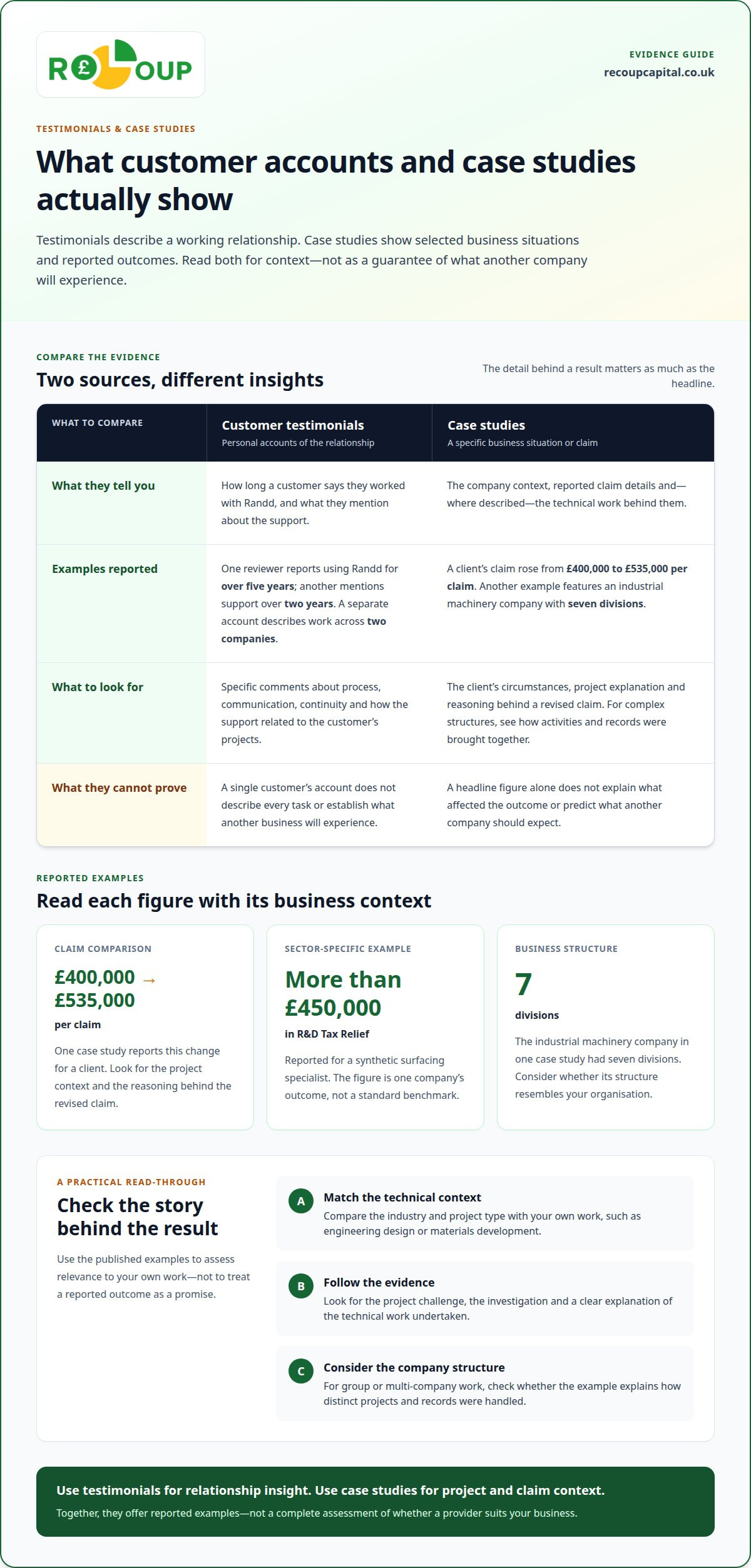
Randd UK testimonials and case studies offer different kinds of evidence. Customer accounts describe aspects of the working relationship, while case studies illustrate specific business situations. Read them together, rather than treating a positive comment or headline result as a complete assessment.
One reviewer says they had used Randd for over five years, describing a relationship that extended beyond a single claim. Another customer mentions support over two years, and a separate testimonial describes work across two companies. These accounts suggest experience with repeat engagements and different business contexts. They do not detail every task, so focus on what each customer says about the support they received.
A case study reports a client’s claim increasing from £400,000 to £535,000 per claim. The figures offer a specific example of a reported change, but the result belongs to that client’s circumstances. To understand its relevance, look for the explanation of the company’s projects and the reasoning behind the revised claim. The amount alone cannot show which details affected the outcome.
A Randd case study features an industrial machinery company with seven divisions, offering an example of a complex organisational structure where teams may hold separate project information. Look for an explanation of how the company’s activities and records were brought together. The seven divisions describe that business’s structure, not the result another company should expect.
Use these three checks to assess the evidence:
- Read relationship accounts closely: note the reported periods of over five years and two years, then identify what the customer says about ongoing support.
- Look behind the claim figure: examine the £400,000-to-£535,000 example for context about the client and the change.
- Compare business structures: consider whether the seven-division machinery example resembles your organisation’s operations.
Testimonials and case studies can help answer “Is Randd UK any good?”, but they cannot replace an assessment of your own needs. A testimonial recounts one customer’s experience; a case study presents a selected business situation. Together, they offer reported examples of relationships, claim outcomes and organisational contexts. Their usefulness depends on the detail they provide about the work. Compare that detail with your priorities to judge whether Randd UK may suit your business.
One reviewer said they had used Randd for over 5 years, while a randd case study describes a client’s claim increasing from £400k to £535k per claim. Keep the two kinds of evidence distinct: the reviewer’s statement concerns duration, and the case study gives a claim comparison. Neither detail, by itself, explains the work or establishes what another client would experience. When considering either example, focus on what further context is provided and whether it answers the questions relevant to your own decision.
R&D specialist experience and claim statistics
Specialist experience matters when a business needs to explain technical work in financial terms. R&D claim support requires understanding how a project developed, what obstacles arose and why the work was not straightforward. Randd’s case studies feature businesses in different technical settings. This breadth is relevant evidence, though no single case study can represent every company’s circumstances.
A synthetic surfacing specialist is one example of sector-specific work. Its case study reports more than £450,000 in R&D Tax Relief. The figure shows the scale of one reported outcome, not a standard benchmark. For readers, the useful detail is the connection between the company’s technical activity and the claim presented. Sector knowledge can help make that explanation clearer and more specific.
Experience with claims involving multiple companies may also be relevant. One Randd customer describes receiving support across two companies, an example of work spanning separate business contexts where project records and financial information may be held in different places. If you are assessing similar support, look for a clear approach to gathering evidence, distinguishing activities and keeping the claim explanation consistent across each company.
When reviewing an R&D Tax Relief claim, assess the project explanation, not just the total shown. A clear account connects the technical aims, uncertainties encountered and work undertaken to address them. For example, an engineering business might explain why a standard component could not meet a design requirement, then show how testing informed its development work.
Use these practical checks when weighing specialist experience:
- Match the technical context: compare the case study’s industry and project type with your own work, such as engineering design or materials development.
- Follow the evidence: look for a clear account of the project challenge, the investigation and the resulting technical explanation.
- Consider company structure: for a group or multi-company claim, see whether the example explains how distinct projects and records were handled.
- Read the outcome in context: treat a reported recovery as one case’s result, then examine the work behind the claim.
These checks help distinguish relevant expertise from impressive figures alone. A large outcome may attract attention, but a claim’s quality depends on how well the project is understood and evidenced. Randd’s published examples provide material to assess, particularly for technical businesses. Look for a project narrative relevant to your situation that explains the work and the reasoning behind it.
With randd
Assessing a working relationship involves more than reading a testimonial. In Randd’s customer accounts, look for details about the process, communication and continuity. A useful account explains how the support related to the company’s projects, rather than offering general praise. For instance, a description of how technical questions were handled gives more practical insight than a simple endorsement.
Look for a clear connection between project discussions and the claim explanation. For a product redesign, for example, the account should explain the technical objective, the problem encountered and the investigation undertaken. This helps show whether the claim reflects the actual work. A compelling outcome without an understandable explanation of the project reveals less about the support itself.
Communication is another useful measure. Look for accounts explaining who gathered project information, how technical details were turned into a clear explanation, and how questions were addressed. A manufacturing company may have engineering notes, test results and financial records held by different teams. An account of how those details came together can reveal more about the working experience.
Use these practical questions when reading Randd’s customer accounts:
- Project understanding: does the example explain the technical challenge, such as improving a material or redesigning a component?
- Evidence handling: does it describe how project records and staff knowledge informed the claim narrative?
- Communication: does the customer give a specific example of advice, clarification or follow-up?
- Outcome context: can you see how the reported result relates to the company’s work, rather than standing alone?
These questions distinguish evidence of a positive relationship from evidence about claim preparation. A testimonial may describe responsive communication, while a case study may demonstrate technical understanding. Each contributes a different part of the assessment. Together, they give a more rounded picture of working with Randd than a brief rating or headline result.
Fit also depends on how closely an example resembles your projects. Software development and a construction materials trial may involve different technical records and explanations. Compare the type of work, the people involved and the challenge described. This helps you use published examples as indicators of relevant experience, not as templates for predicting another company’s claim or working relationship.
Recoup Capital: R&D Tax Credits
Recoup Capital helps UK-registered limited companies and PLCs across sectors assess R&D projects and prepare R&D Tax Credit claims. Its R&D tax credit consultancy may suit businesses seeking expert help to connect technical evidence with a claim. Engineering and construction companies, for example, can draw on support that considers project details alongside financial information.
A useful first discussion can cover the projects you want to assess, the technical challenges involved and the records your teams hold. Recoup Capital’s specialists can help connect project evidence with a potential claim. The service is provided on a contingency basis, with no upfront fee and a fee payable only if the claim is successful. Recoup Capital also offers Capital Allowances, Land Remediation Relief and Patent Box for businesses considering other forms of tax relief.
If you’d like to discuss R&D claim support, contact Recoup Capital.
Turn your assessment into a practical next step
To decide whether Randd UK is any good for your business, focus on how clearly a provider can connect your technical work, project records and claim rationale. Your own projects deserve that same careful assessment. Bring together a concise outline of the work, the challenges your team addressed and the records that explain how it developed. This gives you a useful starting point for a focused discussion about potential R&D support.
Recoup Capital supports businesses with R&D Tax Credits, Capital Allowances and Land Remediation Relief. If your next step is to explore how R&D claim support could relate to your company’s work, contact Recoup Capital for R&D advice. A clear conversation can help you consider the relevant questions and decide how to proceed with confidence.


