

Can you buy and sell intellectual property? Yes, but selling a business with valuable IP involves more than agreeing a price: you need to identify the assets, assess their value and transfer the rights clearly. Understanding how to sell a business with significant IP assets starts with establishing what the company owns and how those rights contribute to its value.
It’s understandable to focus on the business’s products, customers and financial performance. But patents, trade marks, software, designs and confidential know-how can also shape what a buyer is acquiring. Unclear ownership or licensing terms can complicate a sale.
This guide explains how to prepare IP records, assess intellectual property and plan its transfer as part of a UK business sale. You’ll also learn how the chosen approach can affect future control and income, helping you make informed decisions as the sale progresses.
Key Takeaways
- Build a clear inventory of IP, ownership records, registrations, licences and relevant agreements before sale discussions begin.
- Prepare for buyer due diligence by bringing together the legal, financial, technical and commercial picture of your IP assets.
- Choose a valuation approach that reflects the asset’s costs, comparable market evidence or expected income, and explain how it contributes to the business.
- Plan the transfer around existing licences, ownership rights and any future use or income you intend to retain.
Preparing IP registrations and documentation before a sale
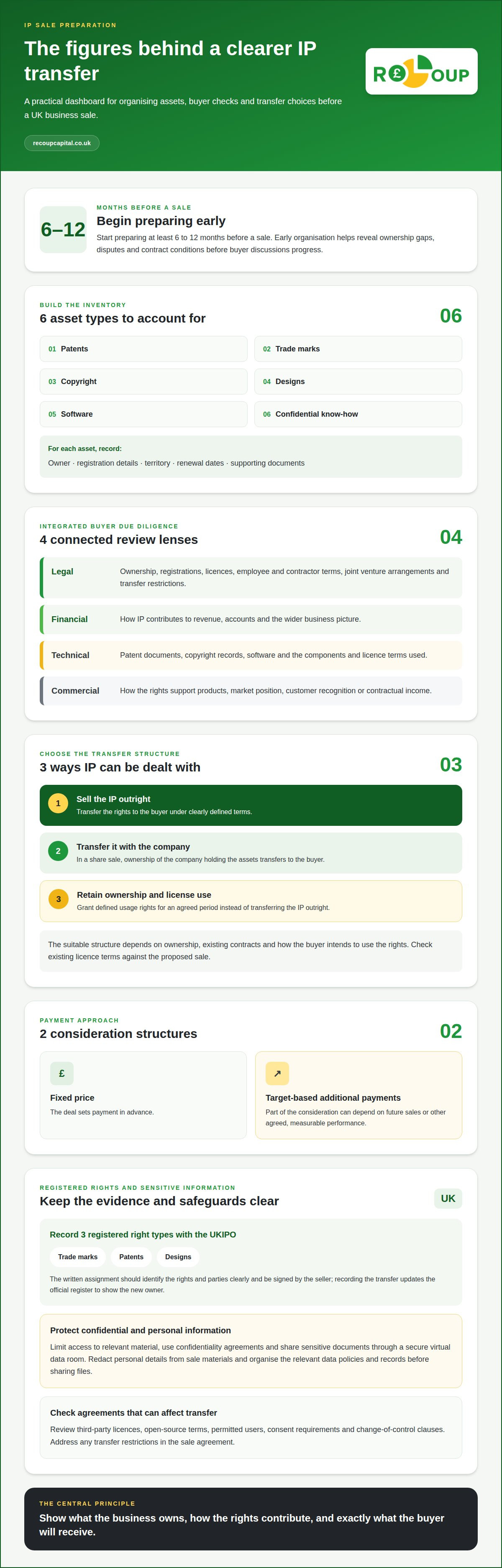
Begin preparing at least 6 to 12 months before a sale. Create an inventory of patents, trade marks, copyright, designs, software and confidential know-how. For each asset, record its owner, registration details, territory, renewal dates and supporting documents. This gives buyers a clearer view of what the business controls and where evidence may need attention.
Match the inventory against ownership records and agreements. Include employee and contractor terms, licences, joint venture arrangements and any documents governing how an asset can be used. For example, if a developer created software for the company, locate the agreement that establishes who owns the rights. Flag gaps or disputes early, and keep a dated audit trail of correspondence and resolutions.
Prepare data records alongside the IP documents. Buyers may ask how customer or employee information is collected, used, stored and deleted, so organise relevant policies and records before sharing files. According to the UK legislation register, the Privacy Electronic Communications Regulations (EC Directive) 2003 are among the legislation applying to data in the United Kingdom. Redact sensitive personal details from sale materials and control access to the data room.
To strengthen the case for a sale price, make the asset’s commercial contribution easier to assess, not simply add paperwork. Explain, for example, how a registered trade mark supports product recognition or how software licences generate revenue. Clear evidence of ownership, active use and contractual income helps buyers understand the opportunity and identify risks sooner.
Agreements can set a fixed price or include additional payments tied to agreed targets. A target-based structure may link part of the consideration to future sales or other measurable performance, while a fixed-price deal sets payment in advance. If retaining ownership matters, licensing may be an alternative: the seller grants defined usage rights for an agreed period instead of transferring the IP outright. Review existing licence terms against the proposed sale so permissions and obligations are clear.
Can You Buy and Sell Intellectual Property?
Yes. A business can sell IP outright, transfer it with the company, or retain ownership and license its use. The right structure depends on ownership, existing contracts and the buyer’s intended use.
Integrated buyer due diligence
Integrated buyer due diligence brings legal, financial, technical and commercial reviews together. For IP, the buyer examines whether the company owns each right and whether it supports revenue, products or market position. Patent documents, copyright records, software and licence contracts may be considered alongside accounts and business plans. This joined-up review helps reveal how rights, liabilities and future income connect.
Advisers and costs of selling
A UK business sale may involve legal, accounting, tax, IP valuation and corporate finance advisers. Their roles cover ownership and contract terms, financial records, asset value and the wider transaction. Professional fees depend on the transaction’s scope, asset complexity and adviser roles, with costs provided after a quote request. The mix of expertise matters because an IP issue can affect both the purchase price and the deal structure.
Trade secrets and confidential information
Trade secrets include confidential information such as customer lists and distinctive production processes. Limit access to relevant material, use confidentiality agreements, and share sensitive documents through a secure virtual data room. Redact personal details, such as employee medical information, from buyer-facing files. The UK GDPR applies alongside the Data Protection Act 2018, according to the Information Commissioner’s Office; personal data handling therefore belongs in due diligence too.
Third-party licences and sale conditions
Third-party licences, open-source components and change-of-control clauses can affect what the buyer receives. Review each software contract for transfer restrictions, consent requirements, permitted users and continuing obligations. For open-source software, document the components used and their licence terms. The buyer needs to understand whether those terms fit its planned use. If a contract restricts transfer, address that condition in the sale agreement.
Selling and transferring intellectual property
The transfer terms should match the rights being sold, the business structure and any continuing use by the seller. The agreement also needs to address evidence of ownership, personal data and any sector-specific review.
Transaction structuring and customisation
Transaction structuring sets out which rights transfer, what the buyer pays and which risks each party accepts. An asset sale identifies the intellectual property included in the purchase; a share sale transfers ownership of the company holding those assets. The contract can also include warranties about ownership, indemnities for defined claims and escrow arrangements that retain funds against specified risks. These terms shape how buyers assess exposure and future revenue.
Transfers involving sensitive sectors need another check: under the UK National Security and Investment Act 2021, certain intellectual property deals in sensitive sectors may be subject to government review, according to the UK legislation register.
Recording IP transfers with the UKIPO
Recording a transfer updates the official register to show the new owner of registered rights. For registered trade marks, patents and designs, record the transfer with the UK Intellectual Property Office so the change is recognised and enforceable. The written assignment should identify the rights and parties clearly, and the seller must sign it. A complete record helps buyers connect the transaction documents with each registered asset.
If the transaction involves personal data moving outside the UK or EEA, the UK GDPR requires the transfer to be managed in compliance with the regulation.
Asset sales and share sales for IP
An asset sale transfers specified assets, so the agreement needs to identify each IP right, related licence and obligation included. In a share sale, the buyer acquires the company that owns the rights, rather than selecting each asset for transfer. That distinction affects which contracts need attention and how the buyer assesses liabilities. Choose a structure that reflects the rights the buyer needs and the obligations the seller intends to transfer.
IP assignments, employee-created IP and moral rights
An IP assignment transfers ownership from the seller to the buyer, while employment terms and moral-rights provisions affect how particular works can be used. In the UK, an IP sale requires a legally binding assignment in writing, signed by the seller. For employee-created work, review the relevant employment and contractor agreements to establish ownership and any usage conditions. Address moral rights explicitly in the transaction documents, along with any permissions the buyer needs to commercialise the work.
Why businesses may need to value IP assets
A valuation estimates the economic contribution of intellectual property to a business or transaction. For owners considering how to sell a business with significant IP assets, it can explain the commercial basis for the proposed deal and inform discussions with buyers.
Reasons to value intellectual property
Businesses may value IP when selling assets, negotiating a merger or joint venture, seeking funding or dealing with insolvency. An assessment helps owners distinguish rights that support income from assets with little commercial use. During due diligence, a clear rationale helps a buyer understand why a patent, copyright work or trade mark matters to the company’s products and market position.
Ways to value intellectual property
Cost, market and income methods offer different ways to assess value. The cost method estimates the expense of creating or recreating an asset, including labour, materials and research, but doesn’t account for future value. The market method compares similar sales or licences, although comparable patent transactions can be difficult to find. The income method considers expected revenue, costs and risks; relief from royalties estimates the payments avoided through ownership.
IP assets and business value
IP can contribute to competitive position and cash flow, so its importance may extend beyond a standalone asset price. A trade mark may distinguish products, while software rights can support a licensed service. Understanding how to sell a business with significant IP assets means showing how those rights support operations and future income. Without that connection, buyers may find it harder to assess the business’s commercial strength.
Factors affecting IP value
Value depends on ownership, protection, scope, commercial use and the asset’s ability to support cash flow. The appropriate method also depends on available evidence, such as development records, licence income or comparable transactions. There is no single tax answer for every business sale; the transaction structure and circumstances affect the analysis, and an IP valuation alone doesn’t determine tax due. To discuss sale planning, explore support for business sale planning.
Recoup Capital
Recoup Capital helps limited companies identify and claim government tax incentives for innovation, which can be relevant when reviewing the financial position around a business sale. Its specialists can assess whether R&D Tax Credits, Capital Allowances, Land Remediation Relief or Patent Box may apply to the company’s circumstances. These incentives are separate from valuing or transferring IP, but may form part of wider financial planning.
Consider speaking with Recoup Capital when you’re reviewing innovation-related expenditure or planning how the business can fund future growth. The team can help clarify which claims may apply and how potential returns could support business decisions. Contact Recoup Capital to discuss your company’s circumstances.
Make your next business decision with clarity
Planning how to sell a business with significant IP assets also means considering what comes next for the company and its owners. A sale can mark a new direction, while a clear financial plan keeps future investment and growth in view. The right support can connect eligible innovation-related incentives with wider business priorities, without confusing those claims with the valuation or transfer of IP.
Recoup Capital offers R&D Tax Credits, Capital Allowances and Land Remediation Relief. These may be relevant to a company’s wider financial position, depending on its activities and circumstances. Discuss your plans with Recoup Capital to see how these services could support your business.
Contact Recoup Capital to discuss your options. With considered advice and a well-planned next move, you can approach the transition with greater confidence.
Frequently Asked Questions
How do you value a UK business with significant intellectual property assets?
Value the IP using evidence suited to each asset: creation or replacement costs, comparable transactions or expected income. For example, a software right generating licence revenue may suit an income-based assessment, while a trade mark with few comparable transactions may need another method. Consider the costs, risks and commercial contribution involved, then explain how the valuation relates to the wider business.
How do you identify and document all IP assets before selling a UK business?
Build an asset register that connects each item to evidence, use and ownership. Include registered rights, software, designs, copyright materials, confidential know-how, licences and relevant agreements. For example, a product entry could list its associated patent, brand, design files and third-party software components. Add renewal information, revenue links, disputes and restrictions so a buyer can follow each asset’s history and role.
How do you verify ownership of patents, trade marks, copyright, software and trade secrets in the UK?
Match registered patents and trade marks to official register records, then compare those details with assignment documents and company records. Copyright generally has no registration record to rely on, so identify who created the work and review employment or contractor agreements. For software, examine development contracts and third-party components. For trade secrets, keep evidence of confidential handling, such as access controls and confidentiality terms.
What IP due diligence do buyers conduct when acquiring a UK business?
Buyers commonly request evidence of registrations, licences, ownership arrangements and ongoing IP-related legal matters. They may also examine whether the rights support current products, revenue or competitive advantage, and whether contracts restrict use or transfer. A buyer’s legal and technical teams can compare software records with source materials and licence terms, while finance teams assess the commercial contribution reflected in forecasts and accounts.
How do you transfer or license intellectual property in a UK business sale?
To transfer ownership, identify the rights in a written assignment agreement signed by the seller, then record relevant registered transfers with the UK Intellectual Property Office. Check what notification or record-updating steps may be needed when transferring registered IP. Licensing instead grants defined usage rights while the owner retains the IP. Set out permitted uses, territory, duration, payment and conditions in the agreement.
What warranties, indemnities and escrow arrangements are common for IP risks in UK sale agreements?
A sale agreement can include warranties about ownership, indemnities for defined claims and escrow arrangements that retain funds against specified risks.


