

In 2026, a standard R&D tax credit claim is no longer just a bit of extra paperwork; it is a high-stakes technical document that HMRC is scrutinising with unprecedented rigour. You have likely felt the growing pressure of tighter compliance or the frustration of trying to explain complex engineering projects to a generalist accountant who doesn't quite grasp the technical nuances of your work. It is a common worry, especially as the distinction between the merged scheme and Enhanced R&D Intensive Support (ERIS) becomes central to your financial strategy.
This guide identifies the most common R&D tax credit mistakes UK businesses fall foul of, whilst demonstrating how specialist insight protects you from the stress of an HMRC enquiry. You will learn how to navigate the 30% intensity threshold for ERIS and the mandatory claim notification rules to ensure your innovation is rewarded with the maximum possible cash injection. We will show you how to turn these complex regulations into a streamlined, strategic asset that provides complete peace of mind and fuels your future business growth.
Key Takeaways
- Understand why the 2026 HMRC landscape requires a specialist approach to navigate increased scrutiny and mandatory reporting requirements effectively.
- Identify and avoid the common R&D tax credit mistakes UK companies make, ensuring your technical projects are described with the precision HMRC expects.
- Learn how technical analysts uncover hidden qualifying costs by bridging the gap between complex engineering work and rigorous tax legislation.
- Use our five-point selection framework to distinguish between high-value chartered tax specialists and sales-led consultancies.
- Discover how a success-based partnership secures your capital recovery whilst providing complete peace of mind regarding compliance.
Why Your Business Needs R&D Tax Credit Specialists in the 2026 UK Landscape
Success in 2026 requires more than a simple spreadsheet. An R&D tax credit specialist acts as a vital bridge between your technical innovation and the rigid complexities of the tax code. These professionals are not just accountants; they are technical translators who convert engineering breakthroughs into the specific language of tax legislation. This partnership ensures that every hour of technical uncertainty your team faces is accurately captured, documented, and defended against potential scrutiny.
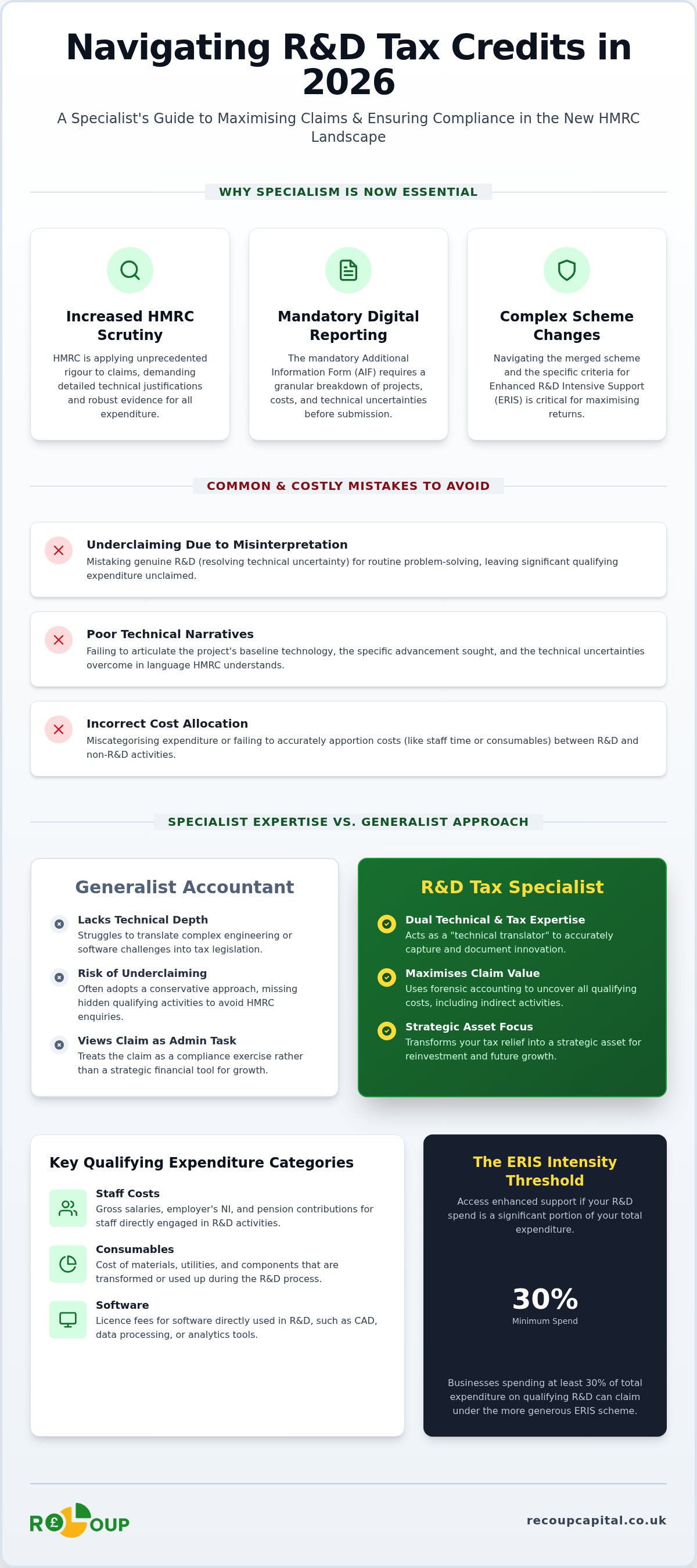
The UK's regulatory environment has undergone a significant shift. HMRC now demands a mandatory Additional Information Form (AIF) for every submission, reflecting a move toward much higher levels of compliance. Without specialist guidance, it is easy to fall into common R&D tax credit mistakes UK businesses often make, such as failing to articulate the technical "how" of a project or missing the strict six-month claim notification deadline for new claimants. Specialists provide a protective layer, ensuring your filing meets the latest standards before it ever reaches an inspector's desk.
It is time to reframe your tax relief as a strategic asset. Rather than viewing it as a mere administrative task or a yearly "bonus," treat it as capital ready for reinvestment. Using a specialist ensures this asset is maximised. Relying on non-specialists often leads to undervalued claims because they lack the technical depth to spot qualifying activity within your day-to-day operations. This missed capital could have funded your next senior hire or a critical piece of new equipment.
In addition to recovering tax capital, maintaining a strong financial profile is vital for growth; you can discover Koval Investments to learn about interest-free funding solutions and credit repair services designed to optimise your business's financial standing.
The Evolution of Research and Development Tax Credits
The transition to the merged scheme, which began for accounting periods after 1 April 2024, has fundamentally changed how companies claim. Innovation in 2026 is defined more broadly than in previous decades, moving beyond traditional laboratories into software, construction site challenges, and manufacturing floor optimisations. To qualify, a project must seek to achieve an advancement in science or technology through the resolution of technical uncertainty. Understanding the UK's R&D Tax Credit scheme is the first step in realising that your routine problem-solving might actually be high-value innovation.
Why Generalist Accountants Often Underclaim
Most generalist accountants are experts at bookkeeping but lack the industry-specific background to interview your lead developers or site managers. This often leads to a "fear factor" where they leave money on the table to avoid HMRC attention. Specialists use technical forensic accounting to uncover hidden costs, such as indirect activities or specific software licences, that generalists frequently overlook. You can find more details on these mechanics in our guide to R&D tax credits explained. This depth of analysis transforms a modest refund into a robust financial tool for your future growth.
The Technical Difference: How Specialists Uncover Hidden Qualifying Costs
Distinguishing between routine commercial problem-solving and genuine technical uncertainty is the pivot point of a successful claim. Many businesses mistakenly assume that if they have found a solution to a problem, it was just "part of the job." However, if the solution wasn't readily deducible by a competent professional in the field, you have likely encountered technical uncertainty. A specialist's forensic approach ensures you don't overlook these moments of innovation, which often represent the most valuable parts of your claim.
HMRC has recently highlighted several common errors in R&D claims, often stemming from a failure to correctly categorise expenditure. To avoid being one of the common R&D tax credit mistakes UK firms make, you must meticulously track three primary categories of qualifying expenditure:
- Staff costs: This includes gross salaries, employer NI, and pension contributions for those directly involved in R&D activity.
- Consumables: Materials or utilities transformed or "used up" during the R&D process, such as prototype components or power.
- Software: Licences for software used directly in the R&D activity or specifically to support the innovative work.
Identifying Qualifying Activities in Construction and Engineering
In the construction sector, R&D isn't always found in a laboratory; it's often buried in bespoke structural solutions or overcoming unique site-specific challenges. Whether you're developing a novel method for foundation stabilisation in difficult terrain or integrating complex renewable energy systems into an existing footprint, these "unseen" technical hurdles qualify. It's also worth investigating Land Remediation Relief as a complementary claim. If your project involves cleaning up contaminated land or removing asbestos, you might be eligible for both incentives. If you're unsure how these reliefs interact, you can explore our claims process to see how we maximise both for our partners.
The Role of CTO-Level Technical Assessments
A robust HMRC submission requires a technical narrative that speaks the language of your engineers or developers. This is why having an advisor with a technical background, rather than just an accounting one, is vital. Specialists conduct deep-dive interviews with your project leads to extract the technical nuances that a generalist might miss. This technical narrative forms the bedrock of your claim, providing the evidence needed to survive modern HMRC scrutiny. It transforms your daily hurdles into a strategic financial asset, ensuring your technical staff aren't bogged down in tax jargon whilst your claim value is protected.
Specialist Tax Consultants vs. Generalist Accountants: Making the Right Choice
Your generalist accountant is likely excellent at managing your annual accounts, payroll, and VAT returns. However, R&D tax relief is a highly niche area of corporate finance that requires a specific blend of technical and tax expertise. One of the common R&D tax credit mistakes UK businesses make is assuming their accountant has the capacity or sector-specific knowledge to draft the detailed technical reports now required by HMRC. Specialists spend their entire year immersed in these regulations, ensuring they stay ahead of shifting thresholds and compliance standards that generalists might only encounter once a year.
The difference in technical depth is significant. A generalist might provide a surface-level summary of your projects, whereas a specialist produces a robust technical narrative that pre-emptively answers HMRC’s likely questions. This depth not only maximises the claim value but also drastically reduces the time commitment required from your internal team. Instead of your CTO spending days explaining technical nuances to a generalist who doesn't understand the engineering, a specialist’s technical analyst speaks their language. This results in a more efficient process that protects your staff's time and prevents another common R&D tax credit mistakes UK occurrence: the misidentification of qualifying work.
The Success-Based Fee Model Explained
Choosing a specialist often means moving to a success-based fee model. This approach aligns the consultant’s interests directly with yours. They are motivated to uncover every pound of qualifying expenditure because their fee depends on the result. It is a partnership that eliminates financial risk for your business; if there is no successful claim, there is no fee. Contrast this with hourly rates or fixed fees from generalists. Those costs can spiral quickly, especially if an HMRC enquiry requires dozens of hours of additional work to defend a poorly prepared claim that was undervalued from the start.
HMRC Enquiry Support and Compliance
Modern HMRC scrutiny is focused on the precision of the mandatory Additional Information Form (AIF). Specialists handle this filing with a level of accuracy that generalists often struggle to match. Having chartered tax accountants on your side provides a critical layer of defence. If HMRC does raise an enquiry, a dedicated specialist manages the entire response process on your behalf, using their experience to resolve queries quickly. This level of professional protection is a primary reason why claim through a specialist rather than attempting a DIY approach. It ensures your innovation is rewarded whilst providing complete peace of mind regarding 2026 compliance standards.
How to Evaluate an R&D Consultancy: A 5-Point Selection Framework
Selecting the right partner is the most effective way to insulate your business from the common R&D tax credit mistakes UK firms often encounter. In a 2026 regulatory environment defined by heightened HMRC scrutiny, your choice of consultant determines whether your claim is a robust strategic asset or a compliance liability. You need a partner who offers more than just a signature on a form. They must act as a protective guide, blending technical sector knowledge with high-level tax expertise to ensure your innovation is fully and safely rewarded.
Start by evaluating technical expertise. Does the firm employ individuals with industry-specific backgrounds, such as engineers or software developers? A consultant who understands the technical hurdles of a construction site or a coding sprint is far better equipped to identify qualifying activity than a generalist. Pair this with a check for chartered status. Ensure you are working with qualified tax professionals, such as chartered tax accountants, rather than a sales-led organisation that may lack the professional rigour required to defend a claim during an audit.
Sector experience and enquiry track records are equally vital. A consultancy should be able to demonstrate a history of successful claims within your specific industry, as the technical uncertainties in manufacturing differ vastly from those in life sciences. Transparency regarding fees and processes is the final pillar. Your consultant should clearly outline how they will handle your data, their fee structure, and exactly how they will support you if HMRC raises a query. To ensure you are making an informed choice, you can review our frequently asked questions regarding our methodology and standards.
Questions to Ask During Your Initial Consultation
- Who will actually write the technical report for my projects? Ensure it is a technical expert, not an administrator using a template.
- What is your success rate with HMRC enquiries in my sector? A high-quality specialist should have a proven record of defending claims successfully.
- How much time will you require from my lead engineers? A streamlined process should minimise disruption to your core technical team.
Red Flags to Avoid in R&D Tax Specialists
Beware of firms that promise instant payouts or guaranteed amounts before they have even conducted a technical review. These claims often bypass the necessary due diligence, leaving you exposed to common R&D tax credit mistakes UK inspectors are trained to spot. Avoid consultants who lack a physical UK presence or professional indemnity insurance. Finally, flag the danger of template-based claims. Every project is unique; if a consultant isn't interested in the specific technical uncertainties your team solved, they aren't providing the forensic level of detail HMRC now demands. For a partnership built on transparency and technical depth, start your technical assessment with Recoup Capital today.
Partnering with Recoup Capital: Maximising Claims through Success-Based Expertise
Recoup Capital operates on a fundamental principle: a successful claim is built on technical reality, not just financial estimations. Our methodology prioritises a technical-first approach, where we identify the core of your innovation before we ever touch a calculator. This ensures that every pound claimed is backed by a robust, defensible narrative. By positioning ourselves as a long-term partner rather than a one-off service provider, we help you transform tax relief into a strategic engine for continuous business growth. Our national presence allows us to provide this specialised support to innovative firms across the United Kingdom.
We believe that professional rigour is the only way to safeguard your business. This is why we employ a professional team of chartered tax accountants who are experts in the 2026 regulatory standards. We handle the entire HMRC liaison process from start to finish, acting as your protective guide through the complexities of the merged scheme and ERIS. This proactive stance is designed to eliminate the common R&D tax credit mistakes UK companies face when their claims lack the necessary technical depth or professional oversight. Because we operate on a success-based fee model, our confidence is directly tied to your success; we only succeed when you secure the capital recovery you deserve.
Our Process: From Discovery to Reinvestment
The journey begins with a low-friction discovery call that typically takes under 30 minutes. During this session, our specialists identify potential qualifying activity without disrupting your daily operations. Once we have established eligibility, we move into the technical assessment phase to prepare a robust narrative and your financial CT600 filing. Our goal is to ensure your technical staff can focus on their projects whilst we handle the heavy lifting of compliance. For a deeper dive into the mechanics of this incentive, you can read our guide on R&D Tax Credits Explained.
Beyond R&D: A Holistic Approach to Corporate Tax
While R&D tax credits are a powerful tool, they are often just one part of a 360-degree tax strategy. We look beyond a single incentive to identify synergies with other reliefs, such as Patent Box or Land Remediation Relief. We also specialise in identifying Capital Allowances on commercial property, which can provide significant additional cash flow for reinvestment. This holistic approach ensures that no stone is left unturned in your quest for capital recovery. If you are ready to secure your financial future and avoid the common R&D tax credit mistakes UK businesses make, book a no-obligation consultation with our specialists today.
Future-Proof Your Innovation with Strategic Tax Relief
Navigating the 2026 tax landscape requires more than just ticking boxes; it demands a forensic understanding of how your technical breakthroughs align with HMRC's evolving standards. By prioritising technical discovery and choosing a partner with chartered tax expertise, you can confidently avoid the common R&D tax credit mistakes UK firms often face. This strategic approach ensures your claim is not only maximised but also fully protected against scrutiny, allowing you to reinvest capital into your next phase of growth.
At Recoup Capital, our national team of technical analysts and chartered tax accountants operates on a success-based fee model. We only win when you do, which means our interests are perfectly aligned with your financial success. It's time to transform your innovation into a powerful business asset with a partner who understands your sector's unique challenges. Start your no-obligation R&D assessment today and discover how our expertise can fuel your long-term success. Your next breakthrough deserves the best possible financial foundation.
Frequently Asked Questions
What do R&D tax credit specialists actually do?
Specialists bridge the gap between technical innovation and tax legislation by identifying qualifying projects that generalists might miss. They conduct deep-dive interviews with your engineers to translate complex technical hurdles into robust narratives for HMRC. Beyond writing reports, they handle precise financial calculations and act as your protective guide during any regulatory scrutiny or compliance checks.
How much do R&D tax credit specialists charge in the UK?
Most reputable UK specialists operate on a success-based fee model, which means you only pay a percentage of the actual tax credit or cash refund secured. This approach aligns the consultant's interests with yours and eliminates the financial risk of high upfront costs. It's best to avoid firms that demand significant fixed fees before a thorough technical assessment is even completed.
Can my regular accountant claim R&D tax credits for me?
While your regular accountant can submit a claim, they often lack the technical industry background needed to identify every qualifying cost. This is where common R&D tax credit mistakes UK businesses make occur, as generalists might play it too safe and leave money on the table. Specialists work alongside your accountant to handle the complex technical reporting they aren't specifically trained for.
How long does an R&D tax credit claim take to process in 2026?
In 2026, most standard claims are processed by HMRC within 28 to 40 days, though complex cases under the merged scheme can take longer. HMRC's increased focus on compliance means that while the timeline is relatively stable, the quality of the initial submission is more important than ever. A well-prepared claim from a specialist often moves through the system more smoothly than a generic filing.
Is my business too small to work with an R&D specialist?
No business is inherently too small, provided you are a limited company with qualifying R&D expenditure. The key factor is whether your innovative activity meets the 2026 intensity thresholds, particularly for the Enhanced R&D Intensive Support (ERIS) scheme. If your R&D spend is at least 30% of your total expenditure, even a smaller firm can secure a significant and transformative cash injection.
What happens if HMRC opens an enquiry into my R&D claim?
If HMRC opens an enquiry, your specialist takes the lead in defending the claim by providing the necessary technical evidence and justifications. They handle all correspondence and meetings with tax inspectors, using their expertise to resolve queries efficiently. This professional protection is vital for peace of mind, as specialists understand the specific nuances of the 2026 compliance landscape and mandatory reporting.
Which sectors benefit most from hiring an R&D specialist?
Sectors with high technical uncertainty, such as construction, engineering, and software development, see the greatest benefit from specialist support. These industries often involve bespoke problem-solving that generalists might mistake for routine commercial work. A specialist identifies the "unseen" innovation in site-specific challenges or complex manufacturing processes that would otherwise go unrewarded by standard accounting methods.
Do I need to pay anything upfront to start an R&D claim?
You don't need to pay anything upfront when working with a specialist who employs a success-based model. This "no win, no fee" structure ensures that the initial discovery call and technical assessment are conducted at no risk to your current cash flow. It demonstrates the consultant's confidence in their ability to identify qualifying costs and secure a successful outcome for your long-term growth.


