

Could the bespoke engineering solution you developed to overcome a complex site constraint actually be a hidden financial asset? For many UK building firms, the innovative work required to solve technical uncertainties is often dismissed as standard practice, even when it qualifies for construction r&d tax relief. You likely feel the pressure of HMRC compliance and simply don't have the time to document every new process. However, leaving this money on the table is no longer necessary.
This 2026 guide demonstrates how your firm can successfully recover significant capital by identifying qualifying innovation within your everyday projects. We’ll explore the mechanics of the merged RDEC scheme and the Enhanced R&D Intensive Support (ERIS) rates, whilst providing a clear roadmap to ensure your documentation stands up to scrutiny. By the end of this article, you will understand exactly which project costs are eligible. It is time to transform technical challenges into a strategic business tool for capital recovery and reinvestment.
Key Takeaways
- Understand how the latest 2026 HMRC updates impact your eligibility to claim construction r&d tax relief on innovative site work.
- Learn to distinguish between routine construction and qualifying bespoke engineering solutions, such as novel ground condition fixes or green technology integration.
- Discover how to pair your R&D claims with Land Remediation Relief to maximise capital recovery on contaminated or derelict sites.
- Identify the specific project costs that qualify for relief, transforming technical challenges into strategic assets for your firm's future growth.
- Explore a streamlined, success-based process for managing the complex technical narratives and HMRC compliance required for a robust claim.
What is Construction R&D Tax Relief?
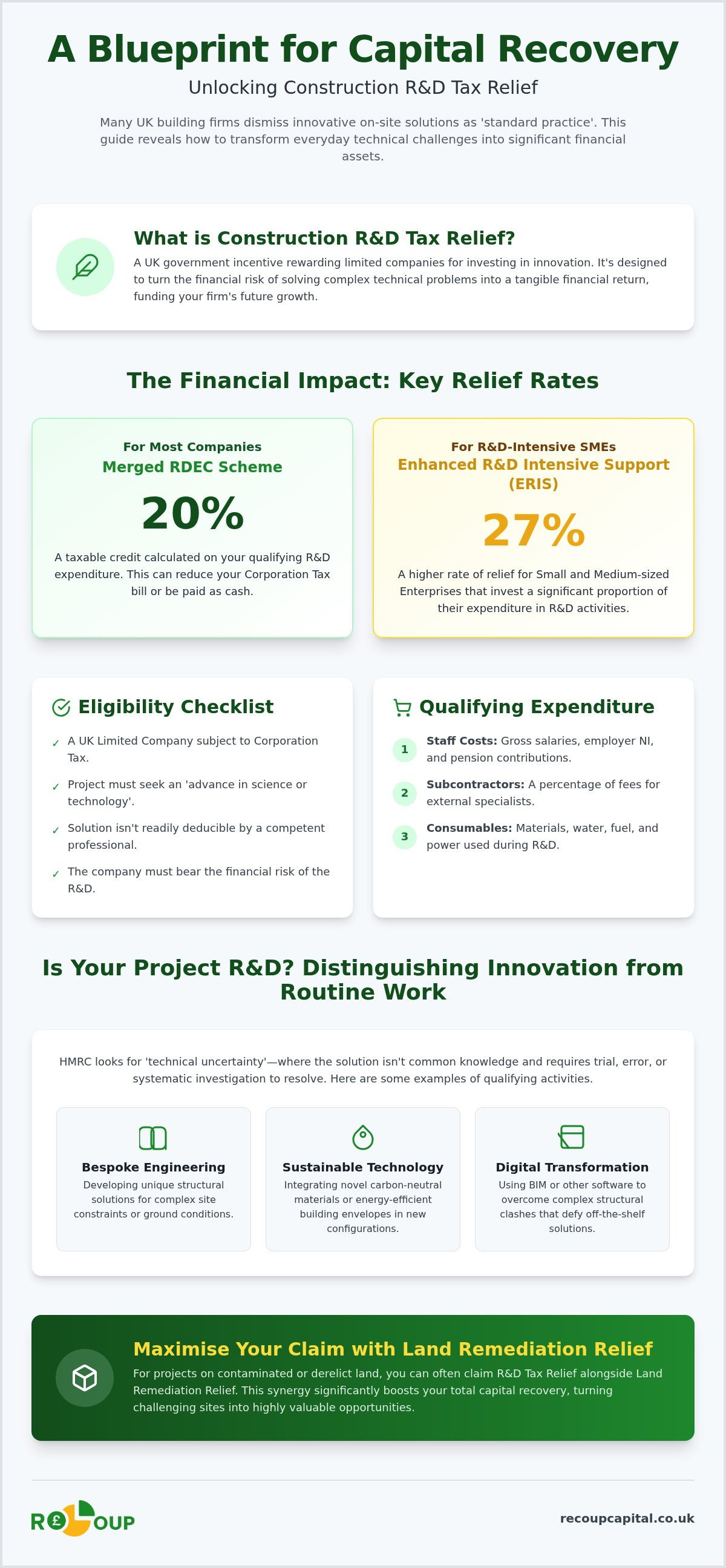
At its core, construction r&d tax relief is a robust government incentive designed to reward UK limited companies for investing in innovation. Whilst many directors assume their projects are simply "standard work", the reality is that the bespoke engineering required to navigate modern sustainability mandates often meets the necessary innovation criteria. The Research and Development (R&D) Tax Credits scheme serves as a pillar of the UK's industrial strategy, encouraging firms to take technical risks that ultimately benefit the wider economy.
Many firms still operate under the misconception that R&D is reserved for pharmaceutical labs or high-tech software houses. In the building sector, innovation rarely happens in a sterile environment; it happens on-site. Whether you are developing a new method to stabilise precarious ground conditions or engineering a novel carbon-neutral building envelope, you are likely engaging in qualifying research. As material costs and labour shortages continue to squeeze profit margins, these tax incentives have evolved into a vital strategic asset for maintaining a competitive edge.
Eligibility for UK Limited Companies
To access these incentives, your business must be registered as a UK limited company and subject to Corporation Tax. The scheme is specifically structured to support entities that take on the financial risk of resolving technical uncertainties. For a project to qualify, it must seek an "advance in science or technology" that isn't easily deducible by a competent professional in your field. For a deeper dive into the foundational rules, you can find R&D tax credits explained on our dedicated resource page. By 2026, the distinction between the old SME and RDEC schemes has largely aligned under a merged model, though specialised support remains for R&D-intensive firms.
The Financial Impact: Cash Credits vs. Tax Reductions
The relief is typically delivered in one of two ways: as a reduction in your Corporation Tax bill or as a payable cash credit for loss-making firms. This flexibility ensures that even if your project hasn't yet turned a profit, you can still recover the capital invested in innovation. Under the HMRC Guidelines 2026, an advance is defined as an increase in the overall knowledge or capability in a field of science or technology that goes beyond what is already available in the public domain. To maximise your claim, you must identify all qualifying expenditure, including:
- Staff Costs: Gross salaries, employer NI, and pension contributions for those directly involved in the R&D process.
- Subcontractors: A percentage of the fees paid to external specialists who contributed to the technical resolution.
- Consumables: Materials, water, fuel, and power used or transformed during the R&D activity.
The current merged scheme offers a taxable credit of 20% of qualifying expenditure, whilst R&D-intensive SMEs may access the Enhanced R&D Intensive Support (ERIS) at a higher rate of 27%. This capital recovery allows firms to reinvest in their next project, effectively turning technical challenges into a self-funding cycle of growth.
Identifying Qualifying R&D Activities in Building and Engineering
Innovation in the building sector rarely looks like a traditional laboratory experiment. Instead, it's found in the pragmatic, high-stakes problem-solving that occurs on-site every day. When your team develops a bespoke engineering solution to navigate unique ground conditions or precarious site constraints, they're often engaging in activities that qualify for construction r&d tax relief. These aren't just "part of the job"; they're technical advances that involve significant financial and professional risk.
Digital transformation is another fertile ground for claims. Whilst many firms use Building Information Modelling (BIM) for standard coordination, using these tools to solve complex structural clashes that defy off-the-shelf software is a clear indicator of R&D. Similarly, the push for sustainability often requires innovating with carbon-neutral materials or designing energy-efficient building envelopes that haven't been tested in specific climates or configurations. These projects move the industry forward, and the tax system is designed to reward that progress.
Overcoming Technical Uncertainties
HMRC defines technical uncertainty as a situation where the solution to a problem isn't readily deducible by a competent professional in the field. If your engineers are forced to use "trial and error" to develop new acoustic insulation methods or fire-safety systems that exceed current standards, you're likely meeting the R&D threshold. Documenting these iterations is vital for a successful claim. For a detailed breakdown of the criteria, you can consult the official HMRC guidance on R&D relief. If you suspect your recent projects involved this type of technical hurdle, it's worth taking the time to explore how to start claiming to ensure no capital is left on the table.
Modern Methods of Construction (MMC)
The rise of Modern Methods of Construction (MMC) has opened new avenues for innovation. Designing 3D-printed components, developing robotic assembly techniques, or testing the structural integrity of novel composite materials all involve high levels of technical risk. It's a common misconception that a project must be successful to qualify. In fact, "failed" projects are often the most robust examples of R&D, as they demonstrate that a genuine technical uncertainty existed which couldn't be overcome. Whether you're refining modular assembly or experimenting with new site-based robotics, these efforts represent a significant investment in the future of UK building. To understand how these technical risks translate into financial returns, you can request a specialist project review to identify your qualifying expenditure.
Technical Uncertainty vs. Routine Construction
Distinguishing between everyday building work and qualifying innovation is the primary hurdle for firms seeking construction r&d tax relief. It isn't enough to simply complete a complex or high-value project. HMRC’s threshold requires you to demonstrate that your team faced technical uncertainties that couldn't be resolved through standard professional services. Whilst a project might be difficult, it only qualifies as R&D if the solution wasn't readily deducible by a competent professional working in that field.
Routine construction involves applying established building codes and using off-the-shelf solutions to achieve a predictable result. If your engineers followed a well-trodden path to reach the project goals, the costs associated with that work won't qualify. However, when you're forced to deviate from standard practice because existing methods fail to meet a specific requirement, you've likely crossed the line into innovation. To stand up to scrutiny, you must document the "trial and error" phase, showing exactly where standard knowledge ended and experimentation began.
Case Study: Foundation Engineering
Consider the difference between standard piling and bespoke ground engineering. Routine work might involve standard piling in known ground conditions where the load-bearing capacity is well-documented. In contrast, R&D occurs when you're forced to develop a bespoke foundation solution for a site with unprecedented contamination or extreme instability. Solving a site-specific problem constitutes a technological advance because it requires your team to create new technical knowledge or techniques that didn't previously exist in the public domain. This shift from "applying knowledge" to "creating knowledge" is the heart of a successful claim.
The Role of Subcontractors
Construction projects are rarely solo endeavours, which makes the role of subcontractors a critical factor in your claim. The key question HMRC asks is: "Who holds the financial risk?" If your firm is directing the innovation and will suffer the financial loss if the solution fails, you're generally the one entitled to claim the relief. It's essential to ensure your contracts are structured to reflect this reality. When working with specialist engineering subcontractors, you should keep detailed project logs that track their technical contributions under your direction. If you're unsure how your current contracts impact your eligibility, it's worth reviewing the process for claiming r&d tax credits to ensure your documentation aligns with the latest 2026 regulations. Clear communication and robust records are your best protection against HMRC inquiries.
Maximising Relief: R&D and Land Remediation Synergies
Successful developers rarely view tax incentives as isolated events. Instead, they adopt a multi-incentive approach that looks beyond construction r&d tax relief to identify every available avenue for capital recovery. Whilst you might be focused on structural innovation, the very ground you're building on could hold significant financial potential. Land Remediation Relief (LRR) is a powerful tool in this regard, allowing companies to claim up to 150% tax relief on the costs associated with cleaning up contaminated or derelict land. When these incentives are managed together, they transform a site’s technical challenges into a strategic business asset.
The intersection between these two reliefs is where the most significant value is often found. For instance, if a site presents unprecedented contamination that standard methods cannot resolve, your team may be forced to develop a novel remediation technique. In this scenario, the baseline costs of the clean-up qualify for LRR, whilst the additional expenditure linked to the "trial and error" of the new method triggers a claim for R&D. This joined-up strategy ensures that your firm is rewarded for both the environmental restoration and the technical innovation required to achieve it.
Cleaning Up Contaminated Sites
Qualifying costs for Land Remediation Relief often include the removal of hazardous materials such as asbestos and radon, or the eradication of invasive species like Japanese Knotweed. You can review the full eligibility criteria for Land Remediation Relief to see how these rules apply to your current portfolio. It's vital to differentiate between a standard clean-up, which uses established industry practices, and an R&D-heavy remediation process. If your engineers are forced to innovate because the level of contamination defies "off-the-shelf" solutions, you are likely sitting on a dual-claim opportunity that many competitors overlook.
Integrating Capital Allowances
The synergy doesn't end when the ground is cleared. As the build progresses, forensic surveying can identify embedded plant and machinery within the commercial structure that qualify for Capital Allowances. These allowances provide long-term tax savings on fixtures such as specialised lighting, heating systems, and lifts. By integrating these into your overall tax strategy alongside R&D claims, you ensure that no capital is left on the table. This holistic view of project finance allows you to reinvest recovered funds directly back into your firm's growth. If you are ready to identify the hidden value in your current projects, you can request a comprehensive tax relief assessment to ensure every qualifying cost is captured and documented correctly.
Navigating the HMRC Claims Process with Recoup Capital
Securing construction r&d tax relief shouldn't be an administrative burden that pulls your team away from the site. We've refined a streamlined, four-step process designed to transform your innovative projects into strategic assets with minimal disruption to your daily operations. Our approach is built on transparency and technical precision, ensuring that every claim is robust enough to withstand the increased scrutiny of 2026 compliance standards.
- Step 1: The Initial Assessment; We begin with a discovery phase to identify qualifying projects. This assessment is conducted without any upfront cost, allowing you to explore your eligibility risk-free.
- Step 2: Technical Narrative; Our industry specialists draft the detailed technical reports HMRC requires. We translate your on-site engineering challenges into the specific language of innovation that regulators expect.
- Step 3: Cost Identification; Our team of chartered tax accountants performs a forensic analysis of your expenditure. We capture every eligible pound spent on staff, subcontractors, and consumables to maximise your capital recovery.
- Step 4: Submission & Liaison; We manage the entire submission process, including the mandatory Additional Information Form (AIF). Our experts handle all correspondence with HMRC until the claim is successfully settled.
Why a Specialist Advisor is Essential
The regulatory landscape has shifted significantly. With HMRC now exceeding its target by processing 90% of payable claims within 40 days, the speed of the system is matched by an increase in compliance activity. Attempting a DIY claim or relying on a generalist accountant can lead to significant risks, including lengthy inquiries and potential penalties for technical inaccuracies. Specialist R&D consultants offer a level of technical depth that generalists often lack; we don't just look at the numbers, we understand the engineering behind them. You can explore the broader strategic benefits of capital recovery by visiting our page on why claim, which highlights how these funds can fuel long-term business growth.
The Recoup Capital Partnership
We view ourselves as a protective guide through the complexities of UK tax legislation. Our success-based fee model means we're fully invested in your outcome; we only succeed when you successfully recover capital. This partnership-oriented style ensures that you receive proactive, confident advice tailored to the unique needs of the building sector. Rather than delivering a traditional sales pitch, we focus on demonstrating value through measurable results and a solid track record of compliance. If you're ready to see how much your firm could recover, start your R&D assessment today and let our specialists handle the details.
Unlocking Your Firm’s Strategic Growth Potential
The UK building sector is evolving at a rapid pace. From bespoke engineering solutions to the integration of green technology, the innovation occurring on your sites is a powerful asset for capital recovery. By identifying the technical uncertainties within your everyday projects, you can access construction r&d tax relief to offset rising material costs and reinvest in your firm's future. It's no longer just about completing a build; it's about capturing the financial value of the professional risks you take on every project.
Recoup Capital acts as your protective guide through the complexities of the 2026 regulatory landscape. Our team of chartered tax accountants brings sector-specific expertise to every technical narrative, ensuring your submission is both robust and compliant. We operate on a success-based fee model with no upfront costs, and our service includes full HMRC inquiry support as standard. This partnership-oriented approach transforms a complex tax process into a streamlined opportunity for innovation. Book a No-Cost R&D Assessment with our Specialists today and discover how we can turn your technical challenges into strategic returns. Your next breakthrough project deserves to be rewarded.
Frequently Asked Questions
Can I claim R&D tax relief for standard residential house building?
Standard residential house building rarely qualifies for construction r&d tax relief if it relies on established building codes and off-the-shelf materials. To claim, you must demonstrate that your project sought to resolve a scientific or technological uncertainty. This might include developing novel modular assembly techniques or engineering bespoke structural solutions for highly constrained sites. Routine construction, whilst complex, doesn't meet the "advance in technology" threshold required by HMRC.
What is the deadline for making a construction R&D claim?
You generally have two years from the end of your relevant accounting period to amend a Company Tax Return and submit a claim. However, under current 2026 regulations, first-time claimants or those who haven't claimed in three years must submit a claim notification to HMRC within six months of the end of the period. Missing this notification window can invalidate your ability to recover capital for that specific financial year.
How much is construction R&D tax relief worth to my business?
The value depends on your specific qualifying expenditure and company status. Most firms now use the merged RDEC scheme, which offers a taxable credit of 20% on qualifying R&D costs. For loss-making, R&D-intensive SMEs, the Enhanced R&D Intensive Support (ERIS) can provide a payable credit of up to 27%. These returns act as strategic assets, allowing you to reinvest recovered capital directly into your next innovative building project.
Can I claim if my construction project was a technical failure?
Yes, you can absolutely claim if your project was a technical failure. In fact, a failed attempt often provides the strongest evidence that a genuine technical uncertainty existed. HMRC's criteria focus on the attempt to achieve a technological advance, not the commercial success of the outcome. As long as you can document the systematic investigation and the uncertainties your competent professionals couldn't resolve, the associated costs remain eligible for relief.
Do I need to be a limited company to claim Land Remediation Relief?
Yes, you must be a UK limited company subject to Corporation Tax to claim Land Remediation Relief. This incentive isn't available to individuals, partnerships, or sole traders. The relief is designed to encourage companies to bring derelict or contaminated land back into productive use by allowing them to deduct 150% of qualifying clean-up costs from their taxable profits. This remains a vital tool for developers tackling brownfield sites.
What happens if HMRC opens an inquiry into my construction R&D claim?
If HMRC opens an inquiry, they'll request additional technical evidence or a more granular breakdown of your qualifying costs. This isn't necessarily a sign of wrongdoing but reflects the increased compliance activity seen in 2026. Having a specialist partner means you won't face this alone. We provide full inquiry support, managing all correspondence and defending the technical merits of your claim to ensure your recovered capital is protected.
Can I claim R&D tax relief and Capital Allowances on the same project?
You can claim both R&D tax relief and Capital Allowances on the same overall building project, but you cannot claim for the same specific pound of expenditure twice. Whilst R&D focuses on the innovation and technical problem-solving during the design and build phase, Capital Allowances target the embedded plant and machinery within the finished structure. A joined-up strategy ensures you capture the maximum tax benefit from every distinct phase of development.
How long does it take for HMRC to process a construction R&D claim?
HMRC has significantly improved its efficiency, currently processing 90% of payable construction r&d tax relief claims within 40 days. This ensures that innovative firms receive their cash credits or tax reductions relatively quickly. To avoid delays, it's essential that your Additional Information Form (AIF) is submitted correctly alongside your Company Tax Return. Accurate documentation from the outset is the best way to ensure a streamlined experience.


