

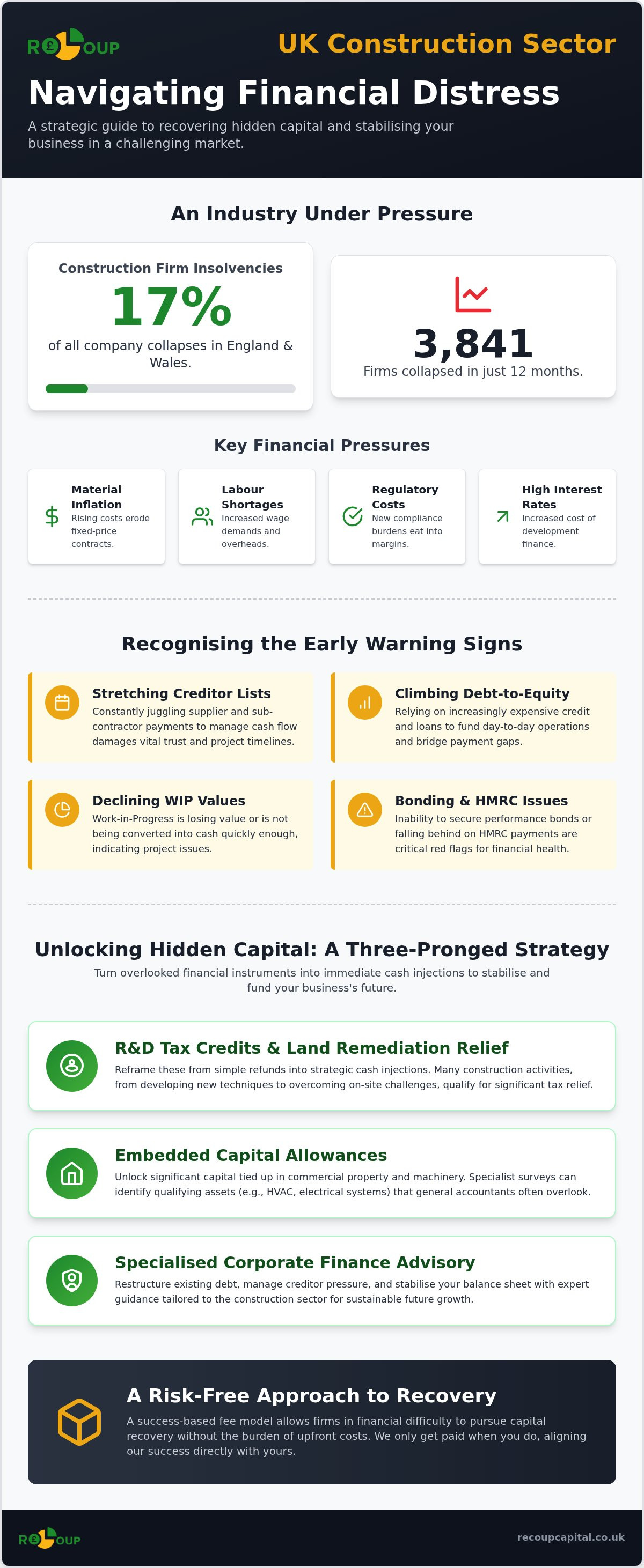
Did you know that the construction industry accounted for 17% of all company insolvencies in England and Wales in the year leading up to July 2026? With 3,841 firms collapsing in just twelve months, it's clear that the sector is facing an unprecedented squeeze. You're likely feeling the pressure of dwindling cash reserves whilst material costs continue to climb and late payments become the norm rather than the exception. It's an exhausting cycle to manage, especially when unexpected HMRC liabilities threaten your project timelines.
However, your balance sheet might hold more potential than you realise. This guide explores how uk construction companies financial distress can be mitigated through strategic capital recovery, turning overlooked tax incentives into immediate cash injections. We'll examine how specialist R&D tax credits, capital allowances, and expert corporate finance advisory can stabilise your business and fund the innovation needed to thrive in a challenging market. By reframing these financial returns as strategic assets, you can protect your firm's future without the burden of high-interest debt.
Key Takeaways
- Identify the early warning signs of insolvency, such as stretching creditor lists or HMRC payment delays, to implement recovery strategies before a crisis escalates.
- Discover how uk construction companies financial distress can be mitigated by reframing R&D tax credits and Land Remediation Relief as strategic cash injections rather than mere refunds.
- Learn to unlock significant capital tied up in commercial property and machinery by identifying qualifying assets that general accountants often overlook.
- Understand how specialised corporate finance advisory can help restructure existing debt and stabilise your balance sheet for sustainable future growth.
- Explore the advantages of a success-based fee model, allowing firms in difficulty to pursue capital recovery without the burden of upfront costs or financial risk.
The Landscape of UK Construction Companies in Financial Distress
The current climate for uk construction companies financial distress is defined by a volatile mix of rising costs and stagnant margins. In the twelve months leading to July 2026, the sector witnessed 3,841 company insolvencies, accounting for 17% of all business collapses in England and Wales. This crisis is often fuelled by several converging factors:
- Material Inflation: Unexpected spikes in the cost of raw materials mid-contract that erode fixed-price agreements.
- Labour Shortages: Rising wage demands and a lack of skilled tradespeople increasing project overheads.
- Regulatory Costs: New compliance burdens that eat into already thin project margins.
Unlike other sectors, construction is uniquely vulnerable because of its reliance on long-term, fixed-price contracts. When the price of steel or timber spikes mid-project, the contractor often absorbs the loss. Legislative shifts have added further weight to these burdens. The Building Safety Regulator (BSR) became an independent body in January 2026, and the upcoming Building Safety Levy, scheduled for October 2026, represents a new tax on residential developments that many firms haven't fully provisioned for.
External Pressures vs. Internal Financial Health
"Higher-for-longer" interest rates have fundamentally changed the cost of development finance, making it significantly harder to bridge the gap between project commencement and final payment. Supply chain disruption continues to erode project profitability, as delays in material delivery lead to liquidated damages and increased site costs. Whilst these external factors are daunting, internal financial health often suffers because traditional accounting methods fail to capture industry-specific opportunities. Many firms miss out on capital allowances or R&D tax credits simply because their generalist advisors don't recognise construction innovation as a qualifying activity. This oversight leaves vital capital on the table at a time when it's needed most.
The Ripple Effect: When One Firm Fails
The industry operates as an interconnected web. When a sub-contractor fails, the main contractor faces immediate project delays and the unexpected cost of procuring a replacement at short notice. Managing the risk of bad debt amongst your client base is now a survival skill, especially as late payments continue to plague the sector. Understanding the nuances of UK insolvency law is essential for directors who need to distinguish between a temporary cash-flow dip and the terminal structural issues that define uk construction companies financial distress.
In the construction sector, financial distress is the critical stage where a company's liquid assets and projected cash inflows are insufficient to meet its immediate obligations to creditors, HMRC, and the supply chain. Recognising this state early is the first step toward recovery through specialised corporate finance advisory.
Recognising the Warning Signs of Financial Instability
For a UK limited company, financial distress occurs when the business can no longer pay its bills on time or when its total liabilities outweigh its assets. It's a spectrum, not a single event, and identifying the slide early is the only way to protect your firm's future. Insolvency Service statistics consistently show the construction sector at the top of the failure list, often because directors ignore the subtle shifts in liquidity until they become a crisis.
One of the first red flags is "stretching" the creditor list. Whilst paying sub-contractors a few days late might solve a cash-flow gap this week, it damages the vital supply chain trust required to finish projects. If you're constantly juggling which supplier to pay just to keep the site gates open, you're already in the danger zone. Other structural and operational indicators include:
- Climbing Debt-to-Equity Ratios: Relying on increasingly expensive credit to fund day-to-day operations.
- Declining WIP Values: Your Work-in-Progress is losing value or isn't being converted into cash fast enough.
- Bonding Issues: An inability to secure performance bonds for new contracts because sureties have lost confidence in your balance sheet.
- Staff Turnover: Losing key site managers or surveyors to competitors who offer more perceived stability.
HMRC Liabilities as a Primary Indicator
Using VAT or PAYE reserves as an unofficial overdraft is a high-risk gamble. These funds aren't your working capital; they're held in trust for the Crown. Falling behind on these payments is often the catalyst for uk construction companies financial distress to become terminal. Whilst a Time to Pay (TTP) arrangement can offer temporary breathing space, it's also a formal signal to HMRC that your liquidity is compromised. Maintaining transparency with the tax office is essential, but it must be backed by a clear plan for capital recovery.
Project-Level Profitability Erosion
In a desperate bid for cash flow, some firms start "buying work." They take on low-margin projects just to keep the wheels turning, but these often turn into "zombie projects" that consume vast amounts of labour and material capital without returning a profit. Identifying this margin creep requires forensic attention to detail. If your project pipeline is draining your reserves rather than replenishing them, exploring corporate finance strategies can help you restructure your debt and stabilise the business before the next project begins.
Unlocking Hidden Capital: R&D and Capital Allowances
When facing uk construction companies financial distress, the immediate instinct is often to cut costs or take on high-interest debt. A more sustainable strategy involves reframing tax incentives as strategic capital assets for recovery. These aren't merely retrospective refunds; they are powerful tools for injecting liquidity into a struggling business. Many directors overlook these opportunities because they believe relief is reserved for high-tech laboratories. Our success-based fee model ensures that firms in difficulty can explore these options without any upfront cost, removing the barrier to entry for businesses with limited cash reserves.
R&D Tax Credits in the Building Sector
Innovation in the building sector rarely happens in a lab; it happens on-site. Whether you're designing bespoke modular assemblies, testing sustainable materials, or solving complex structural engineering challenges, you're likely performing qualifying work. Under the government's R&D tax relief scheme, you can claim back a significant portion of these costs. For a deeper dive into the mechanics, see our guide on R&D tax credits explained.
Eligible innovation often includes:
- Developing more efficient modular construction techniques to reduce site time.
- Overcoming unique ground condition problems through bespoke engineering solutions.
- Testing and integrating new fire-safe or energy-efficient materials.
By claiming R&D tax credits for construction projects, companies can often recover up to 33% of their qualifying expenditure. This immediate cash boost is vital for stabilising operations and funding the next phase of growth.
Capital Allowances on Commercial Property
Commercial properties are frequently goldmines of unclaimed capital. Capital allowances enable you to claim tax relief on embedded fixtures such as air conditioning, security systems, and electrical wiring. These are often missed by generalist accountants because they require forensic surveying expertise to identify. Uncovering these assets effectively reduces your corporation tax burden and strengthens your balance sheet. It provides a non-debt route to alleviate uk construction companies financial distress and establishes a foundation for long-term collaboration and business stability.
Strategic Steps to Manage and Mitigate Financial Distress
Mitigating uk construction companies financial distress requires a transition from reactive firefighting to proactive structural repair. Whilst uncovering hidden capital through R&D or capital allowances provides an essential cash injection, long-term survival depends on a rigorous financial and operational audit. This process identifies exactly where margins are leaking and which projects are actually contributing to your overheads. It's about stripping away the "zombie" elements of the business to protect the healthy core.
Debt Restructuring and Cash Management
If your firm is struggling under the weight of historical debt or expensive development finance, restructuring is often the most viable alternative to insolvency. Negotiating with creditors to improve payment terms can provide the immediate liquidity needed to keep sites operational. In the high-inflation environment of 2026, static cash-flow forecasts are no longer sufficient. You need dynamic, stress-tested models that account for material price volatility and shifting labour costs. Specialist corporate finance advisory for mid-market construction firms can open doors to alternative lending platforms that traditional high-street banks often overlook, providing more flexible capital structures.
Land Remediation Relief: A Developer’s Lifeline
For firms involved in site preparation, land remediation relief represents a significant, often untapped, strategic asset. If you're developing on contaminated or derelict land, you may be eligible for tax relief on the costs associated with making the site safe. This incentive is specifically designed to encourage the redevelopment of difficult brownfield sites. By correctly identifying qualifying expenditure, such as asbestos removal or treating ground pollutants, you can trigger a substantial reduction in your corporation tax bill, effectively turning a project liability into a cash-flow benefit.
The Role of Success-Based Consultancy
Engaging an advisor whilst in financial difficulty can feel counterintuitive because of the perceived cost. However, a result-driven fee structure aligns the consultant’s success directly with your firm’s survival. This model reduces the risk of mounting professional fees when cash is tight. It ensures you receive expert guidance on maintaining HMRC compliance and transparency, which is vital when managing Time to Pay arrangements. A protective guide can help you navigate these regulatory complexities, transforming a period of instability into an opportunity for operational refinement and growth.
To discover how we can help you restructure your liabilities and recover vital capital, explore our specialised corporate finance services today.
Recoup Capital: Your Partner in Construction Recovery
Recovering from uk construction companies financial distress is not a journey you need to take alone. Whilst generalist accountants provide essential bookkeeping, they often lack the forensic industry knowledge required to uncover the complex tax incentives hidden within construction projects. Recoup Capital acts as your protective guide, identifying capital utility where others see only overheads. Our nationwide office network ensures that regardless of where your sites are located, you have access to specialists who understand the local market and specific regulatory frameworks.
We reject traditional sales tactics in favour of a client-centric, evidence-based approach. Our core philosophy is built on demonstrating value through results, ensuring that our interests are perfectly aligned with your firm's survival and future growth. We don't just look at the numbers; we look at the potential of your business to innovate and thrive despite the current economic headwinds. This commitment to long-term collaboration is what sets us apart as a partner rather than a mere service provider.
Expertise in Construction and Engineering
Our team consists of specialist chartered tax accountants and sector experts who speak your language. We understand the technicalities of bespoke engineering and the nuances of site-specific challenges. This expertise allows us to interrogate project data with a level of detail that generalists simply cannot match. We handle the end-to-end process, from the initial technical assessment to the final HMRC submission. This comprehensive management saves you time and ensures that every claim is robust, compliant, and maximised for your benefit.
Get Started with a No-Cost Assessment
Taking the first step toward recovery should be effortless. We offer a time-limited, no-cost introductory review to assess your qualification for R&D tax credits, capital allowances, or land remediation relief. This low-friction process allows us to identify immediate opportunities to inject cash into your business without any upfront financial risk. We reframe your financial return as a strategic business tool, turning what was once "lost" capital into a catalyst for debt reduction and operational stability. To mitigate the effects of uk construction companies financial distress and secure your firm's future, Contact Recoup Capital to explore your recovery options today.
Securing Your Firm's Future Through Strategic Capital Recovery
Overcoming uk construction companies financial distress requires more than just reactive cost-cutting. It demands a proactive approach to identifying hidden assets within your balance sheet. By recognising early warning signs and unlocking specialised tax incentives like R&D tax credits and capital allowances, you can inject the immediate liquidity needed to stabilise your operations. These returns aren't just refunds; they're strategic tools that fund innovation whilst protecting your workforce during market volatility.
Our team of chartered tax accountants and construction specialists is here to act as your protective guide. As no-win, no-fee R&D specialists, we ensure you can explore every recovery option without upfront financial risk. We're committed to long-term collaboration and helping your business thrive. Book a free capital recovery assessment with Recoup Capital to discover the capital you've already earned. With the right partnership, you can transform today's challenges into a foundation for sustainable growth.
Frequently Asked Questions
Can a construction company claim R&D tax credits if they are in financial distress?
Yes, as long as the company is a going concern. Mitigating uk construction companies financial distress often involves identifying R&D tax credits as a vital cash injection. If the firm is in liquidation, the claim is typically disallowed; however, for those in restructuring or facing temporary liquidity issues, it remains a valid recovery tool. Recoup Capital helps identify these qualifying activities to improve your cash position and fund your ongoing project commitments.
What is the difference between debt restructuring and insolvency?
Debt restructuring is a proactive strategy to avoid insolvency by renegotiating terms with creditors to manage liabilities more effectively. Insolvency is the formal state of being unable to pay debts, which can lead to administration or liquidation. Restructuring aims to preserve the business as a going concern, whilst insolvency often involves a formal legal process under UK law to settle with creditors. It's about finding a sustainable path forward.
How long does it take to receive a cash payment from an R&D tax claim?
HMRC typically aims to process R&D tax credit claims within 28 to 40 days of submission, though complex cases can take longer. For firms facing financial difficulty, this timeline is a critical factor in cash-flow forecasting. Our specialists handle the end-to-end process to ensure your submission is accurate and robust. This helps prevent unnecessary delays and ensures the capital reaches your balance sheet as quickly as possible to support your immediate needs.
Does my construction firm need to be "innovative" to qualify for tax relief?
You don't need a laboratory to be considered innovative in the eyes of HMRC. In construction, innovation often looks like solving technical uncertainties on-site, such as developing bespoke engineering solutions for difficult ground conditions or testing new sustainable materials. If your team is overcoming challenges where the solution wasn't immediately obvious to a competent professional, you likely qualify for R&D tax relief. It's about the technical advancement you've achieved during your projects.
What are capital allowances, and how can they help my cash flow?
Capital allowances are a form of tax relief on "plant and machinery" assets, including embedded fixtures like heating, lighting, and security systems within commercial buildings. By identifying these often-overlooked items through forensic surveying, you can significantly reduce your corporation tax liability. This process keeps more cash within the business, providing a non-debt route to alleviate uk construction companies financial distress and support long-term stability. It turns your physical assets into strategic financial tools.
What happens if HMRC investigates our tax credit claim whilst we are struggling?
HMRC enquiries are a standard part of the compliance landscape and don't necessarily signal an error. If an investigation occurs, our chartered tax accountants manage the entire liaison process on your behalf. We provide the necessary technical documentation and evidence to support the claim's validity. Having specialist representation ensures the enquiry is handled professionally, allowing you to focus on your core operations during a challenging period. We act as your protective guide throughout.
Are success-based fees better for companies facing financial difficulties?
Success-based fees are ideal for distressed firms because they eliminate the risk of upfront costs. You only pay a fee once the tax benefit or cash credit has been successfully recovered. This model ensures that exploring capital recovery doesn't drain your remaining reserves. It aligns our interests with yours, as we only succeed when we deliver a tangible financial result for your business. It's a low-risk way to access specialist financial expertise.
Can we claim Land Remediation Relief on projects already completed?
You can typically claim Land Remediation Relief for expenditure incurred in the previous two to three years, depending on your accounting periods. This means you can often recover capital from completed projects where you dealt with contaminated or derelict land. It's a powerful retrospective tool that can trigger a substantial tax refund, providing an unexpected but welcome cash injection for your current operations. We can review your past projects to find these hidden recovery opportunities.


