

In the current innovation climate, your software stack isn't just a utility; it's a strategic financial asset that could be worth thousands in tax relief. Many UK businesses feel overwhelmed by the complexity of HMRC's evolving rules, especially when it comes to separating routine operational tools from genuine R&D infrastructure. Claiming for software licences in R&D has become more intricate following the 2024 scheme merger, leading to widespread concern over incorrect apportionment and the risk of enquiries. We understand the pressure to maximise your return whilst maintaining absolute compliance.
This guide provides a clear roadmap for identifying qualifying software types, mastering the apportionment process, and ensuring your documentation stands up to the highest levels of scrutiny. You'll discover how to transform your cloud and licensing costs into capital for growth, backed by the latest 2026 regulatory standards. By the end of this article, you'll have the confidence to submit a robust claim that reflects the true value of your technological investment. We're here to help you turn these complex regulatory procedures into an approachable opportunity for business innovation.
Key Takeaways
- Identify the specific criteria HMRC applies to determine if your software tools directly support the resolution of technological uncertainties.
- Navigate the complexities of claiming for software licenses in R&D with a robust, evidence-based approach to cost apportionment.
- Uncover the full potential of cloud computing and data costs, which have become vital components of modern R&D tax relief claims.
- Learn how to distinguish between qualifying innovation and routine maintenance to protect your business from the risk of HMRC enquiries.
- Gain insights into why specialist technical assessments are essential for maximising capital recovery in the face of stricter compliance standards.
Understanding Software Licences as Qualifying R&D Expenditure
Software licences represent a significant overhead for innovative firms, covering everything from specialised engineering suites to cloud-based development environments. Within the framework of the UK tax incentive for R&D, these costs are recognised as a core category of qualifying expenditure. However, the eligibility hinges entirely on the software's role in your specific innovation journey. It isn't enough to simply own the licence; the software must be an active participant in your quest to overcome technical challenges.
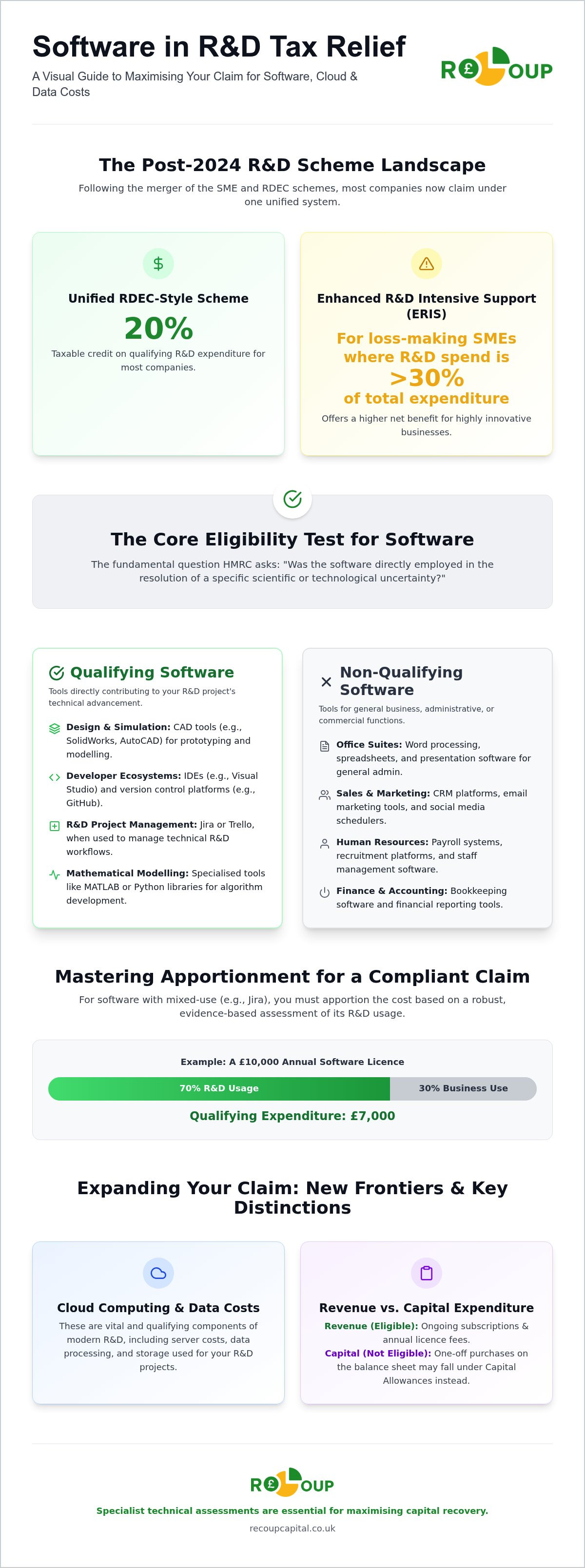
As of 2026, the landscape for claiming for software licenses in R&D has been transformed by the merging of the SME and RDEC schemes. Most companies now operate under a single RDEC-style system providing a taxable credit of 20% on qualifying spend. For loss-making, R&D-intensive SMEs, the Enhanced R&D Intensive Support (ERIS) remains a vital lifeline, offering a higher net benefit for those whose R&D spend exceeds 30% of total expenditure. Understanding which scheme applies to your accounting period is the first step in accurate capital recovery.
The Core Eligibility Criteria for Software
To qualify, software must be directly employed in the resolution of scientific or technological uncertainty. This means the tool is used by your technical team to perform calculations, run simulations, or develop code that pushes the boundaries of your industry. While software used for qualifying indirect activities (QIAs), such as project administration or training, can sometimes be included, HMRC applies strict limits here. The fundamental question remains: would your R&D project be technically viable without this specific software? If the answer is no, it's likely a qualifying cost.
Software vs. Capital Expenditure
A common pitfall in claiming for software licenses in R&D is the distinction between revenue and capital expenditure. Generally, licences paid as ongoing subscriptions or annual fees are treated as revenue expenditure in your Profit and Loss account, making them eligible for R&D tax relief. If your software has been capitalised on the balance sheet, it may instead fall under Capital Allowances. At Recoup Capital, we perform a deep dive into your nominal ledger to identify these hidden costs. We ensure your accountant's treatment of these fees aligns with HMRC's expectations, transforming everyday operational expenses into strategic business assets.
Qualifying vs Non-Qualifying Software: Where is the Line?
Drawing a clear boundary between operational overhead and innovation assets is essential for a compliant submission. HMRC defines qualifying expenditure based on the software's direct contribution to technical problem-solving. According to the official HMRC guidance, the cost must be attributable to the R&D activity itself. This creates a distinct divide; software you "own" as a long-term capital asset is treated differently than the "licences" you pay for through subscriptions or annual fees. When claiming for software licenses in R&D, focus on your revenue expenditure, such as SaaS subscriptions, which are now the industry standard for innovation tools.
Examples of Qualifying Software
Qualifying software is typically defined by its role in facilitating technical advancement. If your team uses a tool to model complex physics, manage code deployments, or simulate stress tests, it likely sits on the right side of the line. Common examples include:
- Design and Simulation: Computer-Aided Design (CAD) tools like SolidWorks or AutoCAD used for prototyping.
- Developer Ecosystems: Integrated Development Environments (IDEs) such as Visual Studio, alongside version control platforms like GitHub.
- Project Management: Jira or Trello, provided they're used specifically to manage R&D sprints and technical workflows.
- Mathematical Modelling: Specialised data analysis tools like MATLAB or specific Python libraries used for algorithmic development.
Examples of Non-Qualifying Software
HMRC explicitly excludes software used for purely administrative, commercial, or general business purposes. Even if your R&D team uses these tools, they don't qualify if the software's primary function is non-technical. Exclusions generally include:
- Office Suites: Microsoft 365, Google Workspace, and standard email clients.
- Commercial Systems: Customer Relationship Management (CRM) platforms like Salesforce or HubSpot.
- Business Operations: Accounting software such as Xero or Sage, and HR platforms like Workday.
HMRC is increasingly vigilant regarding these "grey areas." With a 26% fall in the number of R&D claims reported in recent statistics, the importance of precise categorization cannot be overstated. If you're unsure where your developer stack sits, you might want to review your software stack with a specialist. We handle the technical heavy lifting, ensuring that your claiming for software licenses in R&D remains fully compliant whilst capturing every pound of eligible spend. Identifying these nuances transforms a standard tax filing into a strategic opportunity for capital recovery.
Cloud Computing and Data Costs: The New Frontier
For years, the UK's tax framework struggled to keep pace with the rapid shift towards cloud-native development. Historically, hosting and data acquisition were often viewed as general overheads, forcing innovative firms to absorb these massive costs. This changed for accounting periods beginning on or after 1 April 2023. HMRC now recognises that the laboratory for many businesses is a virtual environment. Consequently, cloud computing costs, including Software as a Service (SaaS), Platform as a Service (PaaS), and Infrastructure as a Service (IaaS), have become foundational elements of modern R&D tax credits.
The inclusion of these costs reflects a pragmatic approach to how software is built today. However, this expansion comes with increased scrutiny. When claiming for software licenses in R&D, you must ensure that your cloud spend is directly linked to resolving technological uncertainties. Purely commercial usage, such as hosting a finished product for customers or running standard business operations, remains strictly ineligible. Distinguishing between these two worlds is where many businesses falter, often leaving significant capital on the table or risking an enquiry through over-claiming.
Claiming for Cloud Hosting and Compute Power
Success in modern claims depends on your ability to separate R&D server costs from production environments. HMRC accepts expenditure for major providers like AWS, Azure, and Google Cloud, but the "compute" element is the priority. High-performance GPU instances used for heavy algorithmic processing or stress-testing a new architecture are classic examples of qualifying spend. Storage costs are more complex. While storage used temporarily during the R&D process is generally acceptable, long-term archival storage for commercial data is not. Precise tagging of your cloud instances is the most robust way to justify these costs during an assessment.
Data Licences and Artificial Intelligence
The 2023 rule changes also opened the door for data licences, a vital update for firms working with Artificial Intelligence and Machine Learning. Training a sophisticated model requires vast, high-quality datasets. The cost of acquiring this data is now a qualifying expense, provided it's used to achieve a technological advancement. There is a catch: you cannot claim for data that can be resold or that has an ongoing, independent value to the business after the R&D phase. As highlighted in techUK's R&D guide, navigating these definitions requires a specialist eye to ensure your claim is both maximised and compliant. We act as your protective guide through these nuances, ensuring your data investments are treated as strategic business assets.
How to Apportion Software Costs for a Compliant Claim
Identifying qualifying software is only half the battle. The real challenge lies in calculating the "appropriate proportion" of costs that truly belong to your innovation projects. HMRC expects a robust, logical methodology rather than a broad-brush estimate. When you're claiming for software licenses in R&D, every pound must be justified by usage data. Over-claiming is a major red flag. It frequently triggers lengthy enquiries that can delay your capital recovery for months. Precision is your best protection against regulatory scrutiny.
Step-by-Step Apportionment Methodology
A compliant claim requires a structured approach to splitting dual-use costs. Follow these four steps to build a defensible calculation:
- Step 1: Scour your nominal ledger to identify every software payment, from monthly SaaS subscriptions to annual renewals.
- Step 2: Assign a "primary use" category to each tool. Is it for the dev team, the sales team, or the whole company?
- Step 3: Calculate the R&D percentage. For developer tools, this might be based on the percentage of time staff spend on R&D projects. For cloud hosting, use CPU hours or instance tagging.
- Step 4: Draft a Technical Narrative. This document must explain the logical link between the software expenditure and the resolution of technical uncertainty.
Evidence and Documentation Requirements
The days of "finger-in-the-air" percentages are over. Since the introduction of the mandatory Additional Information Form (AIF), HMRC requires granular evidence to support your figures. You should maintain logs from Jira to track project-specific tasks, server resource reports from AWS or Azure, and clear user lists for seat-based licences. These records transform a vague estimate into a verifiable fact.
At Recoup Capital, we help you organise this data into a bulletproof submission. We handle the complex calculations so your team can stay focused on building the future. Scrutiny is rising; whilst HMRC processed 90% of payable claims within 40 days in 2025-26, they're increasingly focused on the quality of the underlying evidence. If you want to ensure your methodology is robust, request a technical assessment to secure your claim's compliance.
Maximising Your Software R&D Claim with Recoup Capital
Software costs are often the most under-utilised category in R&D tax credits. Whilst staff costs are usually the primary focus, the nuanced reality of claiming for software licenses in R&D requires a deep understanding of modern development workflows. Many businesses leave thousands of pounds on the table simply because they don't realise their technical stack qualifies as a strategic R&D asset. We transform these potentially intimidating regulatory procedures into an approachable opportunity for significant capital recovery.
Our role is to act as your protective guide through the complexities of the current tax landscape. We don't just process paperwork; we partner with you to ensure your innovation is fully recognised by HMRC. By identifying and validating every qualifying software expenditure, we help you turn your historical spend into a strategic asset for future growth. This relationship-first approach ensures that your claim is both maximised and fully compliant with the latest 2026 standards.
Why Generalist Accountants Might Miss Software Costs
Generalist accountants are indispensable for day-to-day compliance, but they often lack the technical vocabulary needed to navigate modern cloud architecture. They might see a consolidated AWS bill and struggle to isolate the R&D compute time from production hosting. This technical gap often leads to a "safety-first" approach where qualifying expenditure is omitted to avoid potential friction with HMRC. Our specialist technical assessments bridge this gap, ensuring that every qualifying line item is identified and documented. We possess the sector-specific expertise to distinguish between a standard utility and a core R&D tool, preventing you from leaving eligible capital behind.
Your Next Steps: A No-Obligation Review
Securing your innovation funding shouldn't be a source of stress. Recoup Capital provides end-to-end management, from the initial nominal ledger audit to final HMRC liaison. Our success-based fee structure means our interests are perfectly aligned with yours; we demonstrate our value through the results we deliver. We handle the technical heavy lifting, allowing your team to stay focused on what they do best: innovating.
The process begins with a streamlined review of your software stack. We identify the "hidden" costs that generalists frequently overlook, such as specialised data licences or niche developer tools, and build a robust technical narrative to support them. This evidence-based approach provides the peace of mind that comes from knowing your claim is bulletproof. Contact Recoup Capital today to discover how we can help you maximise your claiming for software licenses in R&D and secure the funding your business deserves.
Secure Your Innovation Funding for 2026 and Beyond
Transforming your software overheads into strategic business assets requires more than just basic bookkeeping. The line between operational tools and qualifying R&D infrastructure is increasingly fine; it requires precise apportionment and robust technical narratives to survive HMRC scrutiny. By mastering the nuances of cloud compute power and data licensing, your business can unlock significant capital that generalist approaches often overlook. Success in claiming for software licenses in R&D depends on this level of granular detail and professional rigour.
At Recoup Capital, our team of chartered tax accountants and technical specialists provide the expert-led guidance you need to navigate these complexities with confidence. Our success-based fee structure ensures our goals are perfectly aligned with your growth, backed by a proven track record in the high-tech sector. Whilst the regulatory landscape continues to evolve, we act as your protective guide to ensure you never leave qualifying costs behind. Speak to an R&D Specialist about your software costs today and take the next step toward maximising your innovation potential. Your future breakthroughs deserve the support of a partner invested in your long-term success.
Frequently Asked Questions
Can I claim for the full cost of my Microsoft 365 licences?
Standard office tools like Microsoft 365 are typically excluded from your claim. HMRC views these as general administrative expenditure rather than costs directly employed in resolving technological uncertainty. Even if your developers use these tools for communication, they don't facilitate the R&D process itself. Focus your efforts on specialised tools, IDEs, or simulation software where the technical necessity is clear and documented within your project narrative.
Does cloud hosting like AWS or Azure qualify for R&D tax credits?
Cloud hosting costs from providers like AWS, Azure, or Google Cloud are eligible for tax relief. Since April 2023, HMRC has recognised that virtual environments are essential for modern innovation. You can claim for compute power and temporary storage used during the R&D phase. However, costs associated with hosting a live commercial product or long-term data storage for customers must be excluded through a precise apportionment exercise.
How do I apportion software costs if my team uses the same tools for R&D and support?
You must calculate a reasonable "appropriate proportion" based on verifiable data. When claiming for software licenses in R&D for dual-use tools, most businesses use staff time as a primary metric. If your developers spend 60% of their time on R&D projects, you can typically apply that same percentage to their software seat costs. Documenting this methodology is vital for ensuring your claim remains compliant during an HMRC review.
Are data licences qualifying expenditure for AI development?
Data licences are now a qualifying category of expenditure, particularly for teams training Artificial Intelligence or machine learning models. This change, effective for accounting periods starting on or after 1 April 2023, allows you to claim for the acquisition of datasets used to achieve technological advancement. You cannot claim for data that has an ongoing commercial value or can be resold to third parties after the project ends.
What happens if I cannot provide exact usage logs for my software?
HMRC expects granular evidence, but you can still submit a claim using a robust estimation methodology. If exact logs are missing, you must provide a clear, logical explanation of how you arrived at your apportionment figures. This might involve using project timelines or representative sampling periods. At Recoup Capital, we help you formalise these estimations into a defensible technical narrative to mitigate the risk of an enquiry.
Can I claim for software licences paid to an overseas provider?
Yes, software licences and cloud computing costs paid to overseas entities remain eligible for relief. Whilst HMRC introduced new restrictions on overseas subcontracted R&D and externally provided workers in April 2024, these rules do not apply to software. Whether your SaaS provider is based in the UK or Silicon Valley, the expenditure is claimable as long as the software is used for qualifying R&D activities within your UK limited company.
Is the cost of bespoke software development claimable as a licence fee?
Bespoke software development costs are usually claimed under staff or subcontractor categories rather than as licence fees. A licence fee is a payment for the right to use existing software owned by a third party. If you are paying a developer to build a custom tool, those costs should be categorised as labour or externally provided workers. Correct categorisation is essential for claiming for software licenses in R&D accurately.
How have the 2023/24 HMRC rule changes affected software claims?
The 2023/24 updates significantly expanded the scope of qualifying expenditure to include cloud computing and data costs. These changes also introduced the mandatory Additional Information Form (AIF), requiring more detailed project documentation before submission. Additionally, the merger of the SME and RDEC schemes into a single taxable credit of 20% has simplified the landscape for most firms, whilst maintaining enhanced support for R&D-intensive loss-making businesses.


