

The R&D tax relief pathway you've used for years might now be the least efficient way to recover your innovation costs. Since the transition to the Merged Scheme, the old boundaries have blurred, leaving many directors asking, "SME vs RDEC scheme which is right for me?" It's a valid concern; between the strict 30% R&D intensity threshold and the looming fear of HMRC compliance checks, the landscape can feel intimidating. We understand the uncertainty regarding how grants impact your claim or whether you still qualify for the most generous rates whilst attempting to maintain business growth.
This guide provides the clarity you need to secure either the 16.2% net benefit or the enhanced 27% recovery available to R&D Intensive SMEs. We'll explore the specific eligibility for the Enhanced R&D Intensive Support (ERIS) and the technical requirements of the mandatory Additional Information Form. By the end of this article, you'll have the confidence to choose your pathway and the knowledge to maximise your tax benefit with professional precision.
Key Takeaways
- Master the transition from legacy systems to the Merged Scheme to ensure your innovation strategy remains aligned with current HMRC regulations.
- Identify if your business meets the 30% intensity threshold to unlock the 27% recovery rate, finally answering the question: SME vs RDEC scheme which is right for me?
- Understand the real-world impact of the 16.2% net benefit under the Merged Scheme and how to calculate your return with professional precision.
- Navigate the complexities of subcontracted R&D and grant funding with updated rules that clarify who is entitled to claim for project costs.
- Ensure total compliance by mastering the mandatory Additional Information Form requirements, protecting your claim from potential HMRC inquiries.
The Evolution of UK R&D Tax Relief: From SME and RDEC to the Merged Scheme
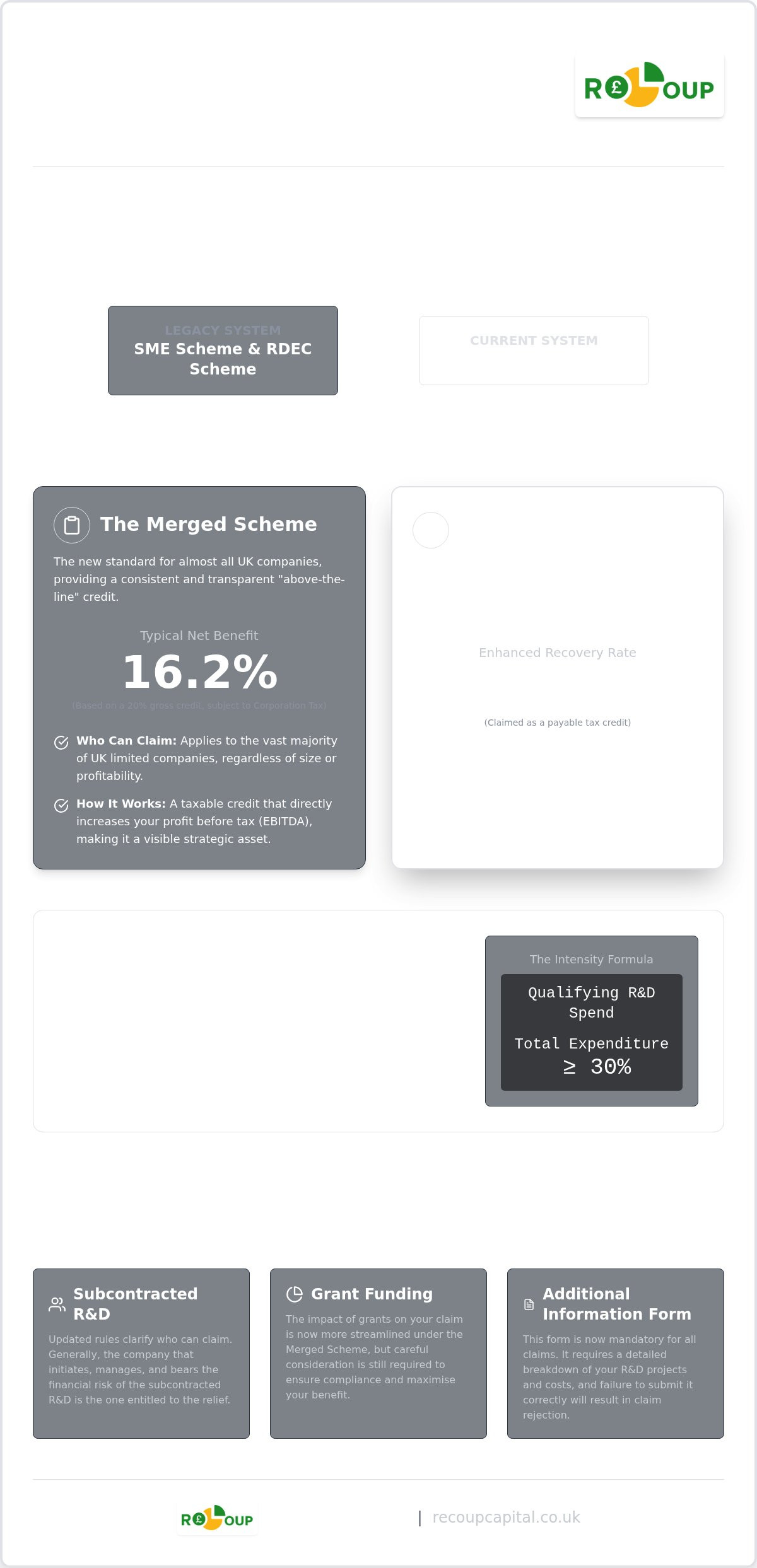
The landscape of UK innovation funding has undergone its most significant transformation in a generation. For years, the history of UK R&D tax relief was defined by a rigid split between the SME and RDEC schemes. This binary choice often left directors asking, "SME vs RDEC scheme which is right for me?" especially when projects involved complex subcontracting or grant funding. By 2026, this distinction has largely vanished. The government unified these pathways to create a streamlined, "above-the-line" system that mirrors the old RDEC model. This shift aims to provide greater visibility of the credit's value within a company's accounts, making it easier for directors to factor innovation incentives into their financial planning.
HMRC moved to this single system to reduce administrative friction and improve compliance across the board. Under the legacy 2023 rules, SMEs used an enhanced deduction system that reduced taxable profit, whilst larger firms used the RDEC taxable credit. Now, almost all UK limited companies operate under the Merged Scheme. This means the benefit is a taxable credit, which has a direct, positive impact on your EBITDA. It is no longer just a tax reduction; it is a strategic asset that sits clearly on the balance sheet.
The End of the Traditional SME vs RDEC Binary
If you're still wondering, "SME vs RDEC scheme which is right for me?" you should know that the choice is now technically obsolete for the vast majority of businesses. The Merged Scheme has effectively adopted the RDEC methodology as the national standard. By treating the credit as taxable income "above-the-line," it provides a clearer picture of R&D investment for stakeholders. While the old SME scheme provided a deduction, this unified approach offers a consistent 20% gross credit rate, ensuring that innovation is rewarded regardless of company size. You can find more detail on how these mechanics function in our guide on R&D tax credits explained.
Key Dates and Transition Periods to Remember
The Merged R&D Scheme is a unified tax relief framework that applies to accounting periods beginning on or after 1 April 2024. Transitioning hasn't been a simple overnight switch for every firm. If your accounting period straddles the commencement date, you might need to navigate two sets of rules within a single claim. It's vital to identify exactly when your period started to avoid applying the wrong rates. For those filing in 2026, the new rules are now the established standard, but maintaining historical accuracy remains a priority for HMRC compliance checks.
Understanding the Merged Scheme: A Unified Approach to Innovation Incentives
The Merged Scheme represents a fundamental shift in how the UK rewards corporate innovation. By establishing a headline gross credit of 20%, HMRC has created a more transparent incentive for companies across all sectors. However, many directors still find themselves asking, "SME vs RDEC scheme which is right for me?" when looking at the headline figures. It's vital to remember that the 20% is a gross amount. Because this credit is taxable, the actual cash benefit is lower than the headline rate suggests. This "above-the-line" credit improves your EBITDA, making it a powerful financial tool for reinvestment rather than just a year-end tax adjustment.
One of the most encouraging aspects of the Merged Scheme is the consistent treatment of profit-making and loss-making entities. Previously, the legacy SME and RDEC schemes had vastly different mechanisms for cash payouts. Now, the process is harmonised. Whether your firm is currently in the black or investing heavily at a loss, the pathway to capital recovery is clearer and more predictable. This simplification helps businesses in construction and engineering plan their long-term project lifecycles with greater financial certainty.
Calculating Your Net Benefit in 2026
To understand the true value of your claim, you must look past the gross rate. Let's take a company with a qualifying R&D spend of £100,000. Under the Merged Scheme, the gross credit is £20,000. This credit is treated as taxable income. If your company pays the main rate of Corporation Tax at 25%, the net benefit is actually 15%. However, for many claimants, the real-world net benefit settles at 16.2% after technical adjustments. You can see a more granular breakdown of these calculations in our guide to R&D tax credits explained.
Who Still Qualifies for the Merged Scheme?
Eligibility remains broad, but the technical bar is high. Any UK limited company can qualify, provided they are attempting to resolve a scientific or technological uncertainty. This isn't just for scientists in lab coats. In construction and engineering, this often involves:
- Developing new materials to meet stricter environmental regulations
- Finding novel ways to integrate complex mechanical systems into existing structures
- Designing bespoke software to solve specific logistical or structural challenges
A general accountant might see these as standard project costs, whilst a specialist identifies the underlying R&D expenditure. If you're unsure if your technical challenges meet the HMRC criteria or you're still wondering, "SME vs RDEC scheme which is right for me?" it's worth taking a moment to check your eligibility with a specialist team. This ensures you don't miss out on qualifying costs that are often overlooked in the Merged Scheme transition.
The R&D Intensive SME Threshold: Identifying the 27% Credit Opportunity
Whilst the Merged Scheme has unified the majority of UK claims, a specialized pathway remains for the nation's most research-heavy businesses. This is where the modern answer to "SME vs RDEC scheme which is right for me" truly lies. If your company is loss-making and dedicated to high-level innovation, you may qualify for Enhanced R&D Intensive Support (ERIS). This isn't merely a legacy holdover; it's a targeted incentive designed to protect the cash flow of firms where research is the primary driver of expenditure. For these businesses, the recovery rate is significantly higher than the standard unified credit.
The R&D Intensive threshold is a specific regulatory requirement where a loss-making SME's qualifying R&D expenditure must constitute at least 30% of its total relevant expenditure for the accounting period. This 30% ratio acts as a gateway. If you exceed it, your business transitions from the standard 16.2% net benefit to a much more substantial 27% recovery. This difference can provide the vital capital needed to bridge the gap between development and commercialisation. Understanding why claim R&D tax credits becomes even more critical when you realize that over a quarter of your qualifying spend could be returned as a cash credit.
Are You an R&D Intensive SME?
Determining your intensity requires a precise calculation. The formula involves taking your qualifying R&D expenditure, including any costs for connected subcontractors, and dividing it by your total relevant expenditure. It's a rigorous test. However, HMRC provides a safety net known as the "one-year grace period." If your company met the 30% threshold in the previous accounting period but has temporarily fallen below it, you can still claim the enhanced 27% rate for the current year. This prevents businesses from being penalised for natural fluctuations in their research cycles or sudden increases in general operational costs.
Standard Merged Scheme vs R&D Intensive SME
The choice of pathway depends entirely on your financial position and spending ratio. For most profitable companies or those with lower R&D intensity, the Merged Scheme is the mandatory route. This offers a reliable 16.2% net benefit that sits "above-the-line" on your balance sheet. In contrast, loss-making intensive SMEs in sectors like biotech, life sciences, or deep-tech software are the primary beneficiaries of ERIS. By securing the 27% rate, these firms receive a higher cash bypass, ensuring that HMRC support scales alongside their technical ambition. If you're unsure which category your current project falls into, identifying the right pathway early is essential for accurate financial forecasting.
Navigating Complexities: Subcontracted R&D and Grant Funding in 2026
The Merged Scheme has fundamentally rewritten the rules for projects involving external partners. For many directors, the puzzle of "SME vs RDEC scheme which is right for me" was often complicated by how they used subcontractors or received innovation grants. In the past, these factors could force an SME into the less generous RDEC scheme. Today, the framework is more intuitive, though it places a heavy emphasis on the "intended" nature of the work at the point of contract. This shift requires a proactive approach to project documentation from the very beginning.
Subcontracting Rules in the Merged Scheme
The 2026 rules follow a "customer-led" approach. Generally, the company that makes the decision to undertake the R&D and bears the financial risk is the one entitled to claim. If you hire a third party to solve a specific technical uncertainty you've identified, you are the claimant. The contractor, who is simply performing the task, usually cannot claim for the same work. This prevents the "double-claiming" issues that occasionally plagued the legacy system. It ensures that the entity driving the innovation receives the financial reward.
Exceptions exist if the customer is an "ineligible body" or if the R&D was not intended by the customer but was initiated by the contractor to fulfil the brief. To protect your claim, you must audit your supply chain. Ensure your contracts clearly state who owns the intellectual property and who is directing the technical resolution. A common error involves misclassifying Externally Provided Workers (EPWs). Whilst subcontractors work independently to deliver a result, EPWs are typically integrated into your team and supervised by you. HMRC scrutinises these distinctions closely, so your record-keeping must be impeccable to avoid compliance checks.
The Impact of Grants and Subsidies
One of the most significant victories for UK innovators is the removal of the "subsidised expenditure" rule. Under the legacy SME scheme, receiving even a small grant could prevent you from claiming SME relief on the entire project spend. In the Merged Scheme, this restriction has been abolished. You can now combine innovation grants with R&D tax relief without the grant "poisoning" the claim. This represents a major win for SMEs who previously felt forced to choose between upfront funding and back-end tax recovery.
This change allows for a more robust innovation strategy. You can secure upfront funding through a grant and still recover the 16.2% net benefit on your remaining expenditure. This synergy transforms tax relief into a proactive strategic asset for business growth. If your project involves complex supply chains or multiple funding sources, speak with our chartered tax accountants to ensure your contract wording protects your right to claim. Determining "SME vs RDEC scheme which is right for me" is now less about your funding and more about your project's technical leadership.
Strategic R&D Planning: Maximising Your Claim with Recoup Capital
The shift to a unified system has finally answered the question, "SME vs RDEC scheme which is right for me," but it has also raised the bar for technical evidence. Recoup Capital acts as your proactive guide. We transform complex regulatory procedures into a strategic opportunity for innovation and business growth. Our team of chartered tax accountants specialises in uncovering qualifying expenditure that generalist firms often overlook. In sectors like construction and engineering, this often includes the costs of bespoke material testing, failed prototypes, or the technical hours spent resolving unforeseen structural uncertainties.
HMRC's 2026 compliance environment demands more than just numbers. It requires a robust technical narrative that explains the "why" behind your research. Because we operate on a success-based fee model, our goals are perfectly aligned with yours. We don't just process paperwork; we identify every legitimate penny of your investment to ensure you receive the maximum tax benefit possible. This relationship-first approach ensures we're invested in your long-term success, acting as a protective guide through the complexities of current regulations.
Our End-to-End Claim Process
Our approach is designed to be low-friction and highly efficient, mirroring the streamlined experience our clients expect. We begin with a deep-dive technical assessment to identify your qualifying projects. From there, we handle the entire claiming R&D tax credits journey, including the preparation of the mandatory Additional Information Form. If HMRC has questions, we lead the liaison. This protects your time and gives you the confidence to focus on your next breakthrough whilst we secure your capital recovery and ensure full compliance with the latest 2026 standards.
The Value of Specialist Expertise
A generalist accountant provides essential services for your day-to-day books, but they may struggle with the intricate 30% intensity calculations required for the enhanced SME rate. Our specialists bring a deeper level of insight. We integrate our findings into your broader corporate finance advisory strategy, ensuring your R&D claim isn't just a refund, but a strategic tool for scaling. By choosing a partner who understands the technical nuances of "SME vs RDEC scheme which is right for me," you ensure your business is positioned for long-term growth and a solid track record of successful innovation claims.
Securing Your Innovation Strategy for 2026
The transition to a unified system has simplified the landscape, but the technical requirements for a successful claim are higher than ever. Whether you're aiming for the standard 16.2% net benefit or trying to secure the 27% enhanced rate for intensive firms, accuracy is your best protection against HMRC scrutiny. Determining SME vs RDEC scheme which is right for me no longer requires choosing between two separate schemes, but rather identifying your position within the new Merged Scheme framework and the 30% intensity threshold.
Recoup Capital provides the specialist expertise needed to navigate these regulatory shifts. Our team of chartered tax accountants focuses specifically on construction and engineering R&D, ensuring that every qualifying technical challenge is documented with precision. We operate on a success-based fee model, aligning our commitment with your capital recovery goals. If you're ready to transform your innovation costs into a strategic business asset, Speak with a Specialist at Recoup Capital Today. We look forward to helping your business thrive through long-term collaboration and expert guidance.
Frequently Asked Questions
What is the current R&D tax credit rate for SMEs in 2026?
The standard net benefit for most UK companies under the Merged Scheme is 16.2% after Corporation Tax is applied to the 20% gross credit. However, if your firm qualifies as R&D Intensive, the recovery rate increases to a 27% net benefit. Understanding "SME vs RDEC scheme which is right for me" involves identifying if your loss-making business hits the 30% intensity threshold required for this enhanced support.
Can I still claim under the old SME scheme if my project started in 2023?
Eligibility for the legacy SME scheme depends on when your accounting period began rather than when the project started. The Merged Scheme is mandatory for all accounting periods beginning on or after 1 April 2024. If your period started before this date, you might still use the old rules. For claims filed in 2026, most businesses will have transitioned fully to the new unified framework.
How is the 30% R&D intensity threshold calculated?
HMRC calculates R&D intensity by dividing your qualifying R&D expenditure, including costs for connected subcontractors, by your total relevant expenditure for the period. This ratio must be at least 30% for a loss-making SME to qualify for the Enhanced R&D Intensive Support (ERIS). It's a rigorous financial test that requires precise accounting to ensure every qualifying cost is captured correctly to meet the threshold.
What happens if my R&D intensity falls below 30% for one year?
You can still benefit from the higher 27% rate through a one-year grace period if your intensity temporarily dips. If your business met the 30% threshold in the immediately preceding accounting period, HMRC allows you to remain in the intensive scheme for the current year. This provides vital stability for firms whose research spending might fluctuate due to project lifecycles or unexpected operational cost increases.
Can I claim for subcontracted R&D work under the Merged Scheme?
Under the Merged Scheme, the right to claim usually sits with the customer who intended for the R&D to take place. If you hire a subcontractor to solve a technical uncertainty, you are typically the claimant. The contractor can only claim in specific circumstances, such as when the customer is an ineligible body. This "customer-led" approach simplifies ownership and prevents multiple companies from claiming for the same work.
How do government grants affect my R&D tax credit claim in 2026?
Government grants no longer prevent you from claiming the full rate of tax relief under the Merged Scheme. Previously, a grant could "poison" an SME claim, forcing the entire project into the less generous RDEC system. Now, you can combine innovation grants with R&D tax credits on the same project expenditure. This change makes it much easier for SMEs to secure multiple layers of funding for their innovation.
Is the RDEC scheme still available for large companies?
The standalone RDEC scheme has been replaced by the single Merged R&D Scheme for all accounting periods starting after 1 April 2024. Large companies and SMEs now operate under the same set of "above-the-line" taxable credit rules. Whilst the name RDEC is often used to describe the mechanism, the specific legacy RDEC rules are now part of this unified framework designed to simplify the UK tax landscape.
What are the new HMRC compliance requirements for R&D claims?
HMRC has introduced stricter reporting requirements, most notably the mandatory Additional Information Form (AIF) which must accompany every claim. This form requires detailed technical narratives and a breakdown of costs across specific projects. Additionally, first-time claimants must submit a Claim Notification Form within six months of the end of their accounting period. These measures ensure that only genuine innovation receives the intended financial support.


