

The difference between a standard tax return and a specialist-optimised ct600 could be the difference between a simple 'filed' status and a six-figure reinvestment into your next innovation. For many UK businesses, the annual filing process is often viewed with a sense of trepidation, especially as HMRC intensifies its scrutiny of R&D tax credit claims and supplementary pages like the CT600L. It's a high-stakes environment where the fear of an enquiry often leads companies to play it too safe, inadvertently leaving thousands of pounds on the table. You shouldn't have to choose between compliance and capital recovery.
We understand that the complexity of the 2026 merged R&D scheme and the nuances of Enhanced R&D Intensive Support (ERIS) can feel overwhelming for even the most diligent financial directors. This guide will show you how to navigate these regulatory shifts whilst ensuring your business maximises every available tax relief and remains fully compliant with HMRC standards. We'll explore the latest corporation tax rates, break down the critical changes to capital allowances, and provide a clear roadmap for a professional submission that turns your tax liabilities into strategic opportunities.
Key Takeaways
- Understand why the ct600 is more than a compliance burden; it is your primary tool for securing capital recovery through R&D and other reliefs.
- Identify the specific supplementary pages, such as the CT600L, that are essential for reporting innovation-led activities correctly.
- Learn why relying on generalist accounting can lead to 'conservative filing' and how a specialist review uncovers overlooked incentives.
- Prepare for increased HMRC scrutiny by mastering the Additional Information Form (AIF) and meeting the latest transparency standards.
- Discover how a partnership with tax specialists bridges the gap between basic bookkeeping and transforming financial returns into strategic assets.
Understanding the CT600: More Than Just a Company Tax Return
The ct600 is often viewed as a mere administrative hurdle, a yearly box-ticking exercise required by HMRC. However, viewing it through this narrow lens misses the broader strategic opportunity. While it is the formal document used by UK limited companies to report income and calculate Corporation Tax, it also serves as the primary gateway for claiming essential tax reliefs that can transform your balance sheet. Filing is a statutory requirement, but the way you file dictates whether you are simply paying a bill or reclaiming vital capital to fuel your next stage of growth.
What is a CT600 and Who Must File It?
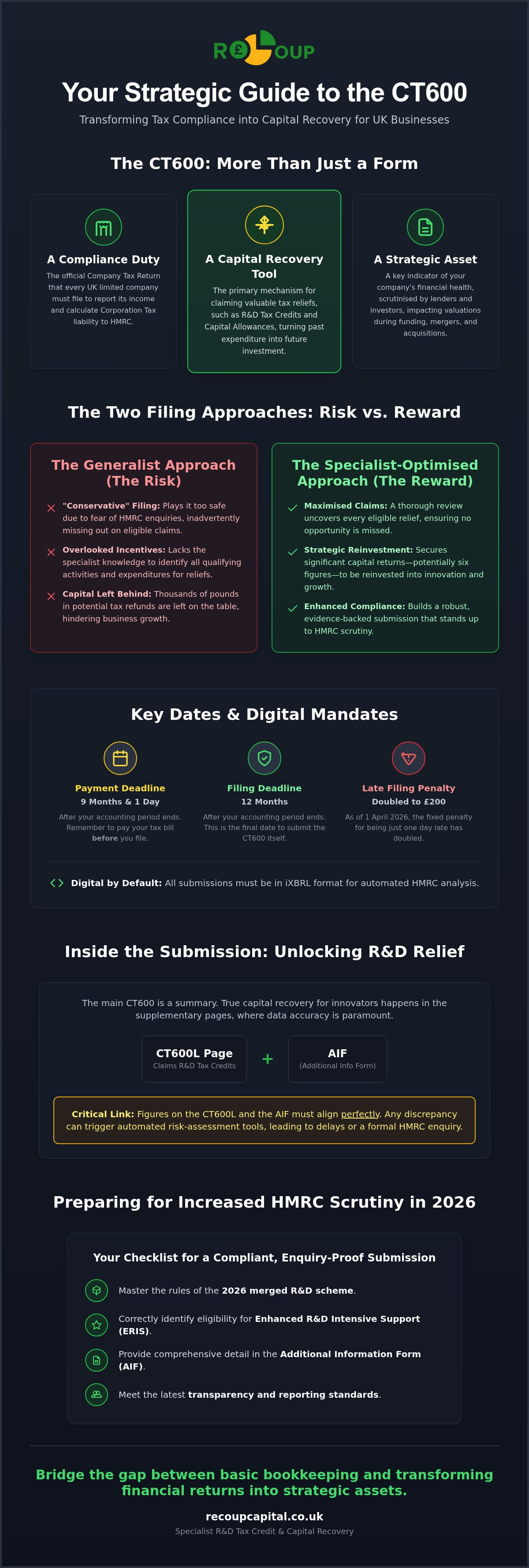
Every UK limited company has a legal obligation to submit this return, even if the business is currently dormant or operating at a loss. Under the UK Corporation Tax legislation, the filing must be completed within 12 months of the end of your accounting period. It's vital to remember that the deadline for paying your tax bill is actually earlier, usually nine months and one day after the period ends. Missing these dates can be costly; as of April 1, 2026, the fixed penalty for filing just one day late has doubled to £200.
In 2026, the shift towards 'digital by default' is absolute. HMRC requires submissions to be formatted using iXBRL (Inline eXtensible Business Reporting Language) tagging. This digital standard allows HMRC's systems to read and analyse your financial data instantly. Accuracy isn't just about avoiding penalties; it's about ensuring your data is transparent enough to move through HMRC’s automated checks without triggering unnecessary enquiries. A clean submission signals a well-managed organisation, reducing the likelihood of manual intervention from tax inspectors.
The Strategic Importance of the Company Tax Return
When you reframe the ct600 as a tool for capital recovery, the filing process becomes a proactive business strategy. It isn't just a report of what you owe; it's a declaration of what your business is entitled to receive back. For innovation-led companies, this return is the mechanism used to claim R&D tax credits and capital allowances, effectively turning past expenditure into future liquidity. The return acts as the final validation of your eligibility for these incentives.
A precisely filed return also impacts your company’s broader financial standing. Lenders and investors scrutinise these documents to gauge a business's fiscal health and compliance history. A history of clean, well-optimised filings can significantly enhance your outcomes in corporate finance, providing a solid foundation for valuations during mergers, acquisitions, or funding rounds. By treating the return as a strategic asset, you move beyond simple compliance and start building long-term value for your shareholders.
Navigating the CT600 Structure: Supplementary Pages and R&D Credits
The main ct600 form acts as a high-level summary, but the real work of capital recovery happens within its various supplementary pages. For businesses investing in innovation, these schedules are where the technical details of your claims are formalised and justified. It's vital that the data in your underlying tax computation matches the entries on the form exactly. Even a minor discrepancy can trigger HMRC's automated risk-assessment tools, leading to processing delays or formal enquiries. Consistency isn't just a best practice; it's your first line of defence against regulatory scrutiny.
Supplementary Page CT600L: The Key to R&D Tax Relief
The CT600L is the specific page used to claim R&D tax credits under the merged scheme or Enhanced R&D Intensive Support (ERIS). Since the 2024 reforms, this page has become more technically demanding. You must ensure that the qualifying expenditure figures align perfectly with the Additional Information Form (AIF) that you've submitted. According to the HMRC R&D relief guidance, failing to correctly categorise costs can result in significant processing delays. We often see errors where companies forget to adjust for the 'above-the-line' nature of the credit, which impacts the final tax liability calculation. These mistakes often stem from using software without the oversight of a specialist who understands the nuances of the 20% gross credit.
Integrating Capital Allowances and Land Remediation Relief
Beyond R&D, the ct600 is the primary vehicle for claiming Capital Allowances. This is particularly relevant for businesses with significant investments in commercial property. Many companies overlook 'embedded' plant and machinery within their buildings, such as air conditioning or electrical systems, which can be claimed. From April 1, 2026, the main rate for writing down allowance on plant and machinery is 14%. Identifying every eligible asset is essential to maximise your deduction. For those in construction or property development, Land Remediation Relief offers a 150% tax deduction for cleaning up contaminated sites. If you aren't sure how these reliefs interact with your R&D claims, you can find R&D tax credits explained in our detailed guide.
If your current filing process feels like a missed opportunity, a specialist review of your supplementary pages could reveal significant unclaimed capital for your business.
Common Pitfalls in CT600 Filing: Why Generalist Approaches Often Fail
Many companies view their ct600 as a standard compliance task best handled by their general accountant. While generalists are excellent at managing day-to-day bookkeeping and statutory accounts, they often lack the specialist technical knowledge required to identify every eligible innovation incentive. This often leads to 'conservative filing'. In an attempt to avoid HMRC enquiries, a generalist might overlook complex R&D activities or specialist Capital Allowances, effectively leaving your capital in HMRC's accounts rather than your own. Playing it too safe doesn't just reduce your tax refund; it starves your business of the liquidity needed to scale.
The risk isn't just about missing out on cash. It's also about consistency. If your technical R&D report describes a highly complex engineering project, but your ct600 entries don't reflect that level of technical depth or cost allocation, you've created a red flag. HMRC's automated systems are designed to spot these discrepancies instantly. A specialist review ensures that every figure on your return is backed by technical substance, providing a cohesive narrative that stands up to scrutiny. This alignment is essential for maintaining the transparency standards HMRC now expects from limited companies.
The Difference Between Compliance and Optimisation
Compliance is the floor, not the ceiling. It ensures you aren't hit with penalties, but it doesn't guarantee you aren't overpaying. Optimisation requires a different skill set. At Recoup Capital, we use specialist forensic surveying to uncover allowances within commercial properties that standard bookkeeping simply misses. This might include identifying qualifying plant and machinery embedded in your building's infrastructure. Getting a second opinion on your year-end position isn't a sign of distrust in your accountant; it's a strategic move to ensure your business remains as lean and well-funded as possible. To better understand these distinctions, CTC Tax & Accounting offers a detailed comparison of the roles of general and tax-focused professionals.
Under-claiming vs Over-claiming: Finding the Innovation Balance
There's a delicate balance to strike when filing your return. Over-claiming through 'aggressive' entries without technical evidence is a fast track to a stressful HMRC enquiry. However, under-claiming is just as detrimental to your long-term growth. It limits your ability to reinvest in the very innovation that drives your competitive advantage. We help you find that equilibrium by ensuring every claim is robust and defensible. Because we operate on a success-based fee structure, our goals are perfectly aligned with yours. We only succeed when we've secured a legitimate, optimised recovery for your business. This partnership approach transforms the filing process from a source of worry into a predictable opportunity for reinvestment.
Preparing Your CT600 for HMRC Scrutiny in 2026
HMRC is no longer relying on luck to spot errors. Their data analytics capabilities have reached a point where every ct600 is effectively pre-screened before a human ever looks at it. The 2026 landscape is defined by the 'Additional Information Form' (AIF), which is now a mandatory prerequisite for any R&D claim. If you submit your return without this digital accompaniment, HMRC will simply reject the claim. This isn't just a formatting rule; it's a transparency standard designed to ensure that technical narratives support the financial figures from the moment of submission.
New Transparency Standards and AI-Driven HMRC Enquiries
The 'Connect' system is HMRC's most powerful tool. It cross-references your company's filings with vast databases, including bank records and the Land Registry, to identify anomalies in real-time. We've seen a sharp rise in sector-specific enquiries, particularly in the construction and engineering industries, where R&D and Capital Allowances are frequently claimed. You might receive a 'nudge letter' suggesting that your filing doesn't match industry benchmarks. These letters aren't formal enquiries yet, but they require a proactive and technically sound response to prevent an escalation. Ignoring these subtle signals is often the first step toward a full-scale audit.
Evidence and Documentation Requirements for a Robust Submission
Surviving a retrospective audit starts long before you click 'submit'. You need a 'defence file' that contains the technical substance behind every entry on your ct600. This includes project records, staff time logs, and evidence of the technical uncertainties you faced during your innovation work. Proactive disclosure is always better than reactive explanation. By presenting a robust, evidence-backed narrative from the outset, you demonstrate a commitment to transparency that builds trust with tax inspectors. This documentation must be organised well enough to survive an audit whilst allowing you to maintain business as usual.
Software alone can't protect you from a manual enquiry. It can format the data, but it can't explain the 'why' behind a complex claim. This is why claiming with a specialist is vital; we provide the technical shield that software lacks. If you're concerned about your current level of documentation, speak with our specialist accountants for a protective review of your evidence before your next filing deadline.
Maximising Your Return: Partnering with Specialists for CT600 Success
Filing your ct600 shouldn't be a solitary burden for your internal finance team or your general accountant. While your existing advisors are essential for maintaining your statutory records, the technical nuances of innovation-led tax recovery require a specialist lens. Recoup Capital acts as the bridge between your standard bookkeeping and a fully optimised tax position. We don't replace the relationship you have with your current accountant. Instead, we provide a specialist technical layer that ensures your return reflects the true value of your business innovation. This collaborative approach allows us to delve into the forensic details of your projects whilst your team remains focused on day-to-day operations.
How Recoup Capital Streamlines the Filing Process
Our end-to-end process is designed to be as non-intrusive as possible. It begins with a technical assessment where our specialist chartered tax accountants identify qualifying activities within your R&D, Capital Allowances, or Land Remediation Relief. We then handle the heavy lifting of documentation, preparing the technical narratives and financial schedules required for a robust submission. Once the figures are finalised, we liaise directly with HMRC to manage any queries, providing you with a protective shield throughout the process. Our success-based fee structure means there's no upfront cost to your business. We only succeed when you successfully recover capital, creating a risk-free path to a more liquid balance sheet.
Turning Tax Compliance into a Strategic Growth Asset
When you reframe your ct600 as a strategic tool, the recovered capital becomes more than just a refund. It becomes a catalyst for growth. Whether you choose to reinvest those funds into further research, use them to facilitate an acquisition, or improve your cash flow, the impact on your long-term strategy is significant. Our Corporate Finance advisory team can help you manage these recovered assets, ensuring that your tax strategy aligns perfectly with your broader commercial goals. We believe in building long-term collaborations that transform regulatory requirements into approachable opportunities for business innovation. Don't leave your capital recovery to chance; ensure your next filing is as efficient and rewarding as possible.
Ready to discover the hidden potential in your next return? Book a no-obligation consultation to review your CT600 potential with our specialist team today.
Transform Your Tax Return into a Strategic Reinvestment Engine
We've explored how a standard ct600 filing can be elevated from a compliance chore to a powerful recovery tool. By mastering supplementary pages like the CT600L and ensuring your Additional Information Form (AIF) stands up to AI-driven scrutiny, you protect your business whilst unlocking essential capital. Relying on a generalist approach often means missing the technical nuances of construction or tech R&D that a specialist eye would catch. It's about moving beyond simple filing and towards a strategy that rewards your business innovation.
Our team of specialist chartered tax accountants is dedicated to ensuring you don't overpay or under-claim. With our success-based fee model, you can explore your eligibility for R&D credits and capital allowances without any upfront financial risk. We bring deep expertise in complex engineering and technology sectors to every review. Maximise your capital recovery with a specialist CT600 review from Recoup Capital and turn your tax liabilities into a growth asset. Your innovation deserves to be funded; let's ensure your next return reflects the true value of your work.
Frequently Asked Questions
What is the deadline for filing a CT600 in the UK?
The statutory deadline to file your ct600 is 12 months after the end of your company's accounting period. It's vital to remember that the deadline for paying your Corporation Tax is actually earlier, usually nine months and one day after the period ends. Missing these dates can lead to automatic penalties and interest charges, so keeping a strict internal calendar is essential for compliance.
Can I amend my CT600 after it has been submitted to HMRC?
You can generally amend your company tax return within 12 months of the original filing deadline. This provision is particularly useful if you discover you've overlooked eligible tax reliefs, such as Capital Allowances or Land Remediation Relief, after the initial submission. Amendments are handled digitally, and any resulting overpayment of tax can be reclaimed as a refund or offset against future liabilities.
How do I claim R&D tax credits on my CT600 return?
To claim R&D tax credits, you must complete the CT600L supplementary page and ensure you've submitted the mandatory Additional Information Form (AIF) to HMRC. The AIF must be filed before or at the same time as your ct600. For accounting periods beginning on or after April 1, 2024, most companies will use the merged R&D scheme, which provides a 20% gross credit on qualifying expenditure.
What happens if I miss the Corporation Tax filing deadline?
Missing the filing deadline triggers immediate and escalating financial penalties from HMRC. As of April 1, 2026, the fixed penalty for filing just one day late is £200. If the return remains outstanding after three months, an additional £200 penalty is applied. For delays exceeding six months, HMRC will estimate your tax bill and add a penalty of 10% of the unpaid tax, with further charges for repeat offenders.
Do I need a specialist to file my CT600 if I have an accountant?
Whilst your general accountant is perfectly capable of handling statutory accounts, a specialist provides the technical depth required to optimise niche incentives. Working with established firms like Stewart Accounting Services ensures your core financial reporting is accurate, which then allows specialists to identify 'embedded' tax savings in commercial property or complex engineering projects that might otherwise be missed. We act as a partner to your existing accountant, adding a layer of technical expertise to ensure no capital is left unclaimed.
What are the common reasons for an HMRC enquiry into a CT600?
HMRC enquiries are frequently triggered by data inconsistencies identified by their AI-driven 'Connect' system. Common red flags include claiming R&D credits without the required technical narrative, figures that deviate significantly from industry benchmarks, or discrepancies between the main return and supplementary pages. Ensuring your filing is transparent and backed by a robust evidence file is the best way to mitigate this risk.
How does the CT600L supplementary page work for innovation claims?
The CT600L is the formal schedule used to calculate and report R&D tax credits and Expenditure Credits (RDEC). It acts as a bridge between your technical R&D report and the main tax return, showing exactly how the credit is applied against your liability or surrendered for a cash payment. Accuracy here is critical, as the figures must align perfectly with your submitted Additional Information Form to avoid processing delays.
Is there a penalty for making an error on my Company Tax Return?
Penalties for inaccuracies are based on the nature of the error and how it was disclosed to HMRC. If an error is deemed 'careless', the penalty can range from 0% to 30% of the potential lost revenue, whilst 'deliberate and concealed' errors can result in penalties up to 100%. Making an unprompted disclosure and demonstrating that you took 'reasonable care' through specialist review can significantly reduce or even eliminate these charges.


