

Your most valuable business asset isn't the secret recipe sitting in your vault; it's the technical struggle your team went through to perfect it. If you've spent months battling ingredient instability or scaling a prototype for mass manufacturing, you already know that food tech innovation is both expensive and unpredictable. It's easy to feel overwhelmed by the high costs of laboratory testing and the constant pressure of ingredient trials.
We understand the frustration of trying to decipher what HMRC actually considers a "scientific advancement" whilst fearing the risk of a potential enquiry. This guide will show you how to turn those technical hurdles into a strategic financial asset through the UK's 2026 R&D tax credit framework. You'll discover which activities qualify for the 20% standard credit or the enhanced 27% ERIS rate, and learn how a specialist partner can manage the complex digital submission process on your behalf.
Key Takeaways
- Understand how the multi-billion pound food tech sector is redefining innovation through the intersection of food science and digital engineering.
- Learn why "failed" recipe trials and technical hurdles actually serve as the foundation for a successful R&D tax credit claim.
- Identify specific qualifying activities in your pipeline, from developing alternative proteins to pioneering sustainable, preservative-free packaging solutions.
- Master the 2026 HMRC transparency standards and discover the essential record-keeping habits that protect your claim from scrutiny.
- Discover how a success-based partnership can transform your technical R&D costs into strategic business assets without the burden of upfront fees.
What is Food Tech? Defining the UK’s Innovation Revolution in 2026
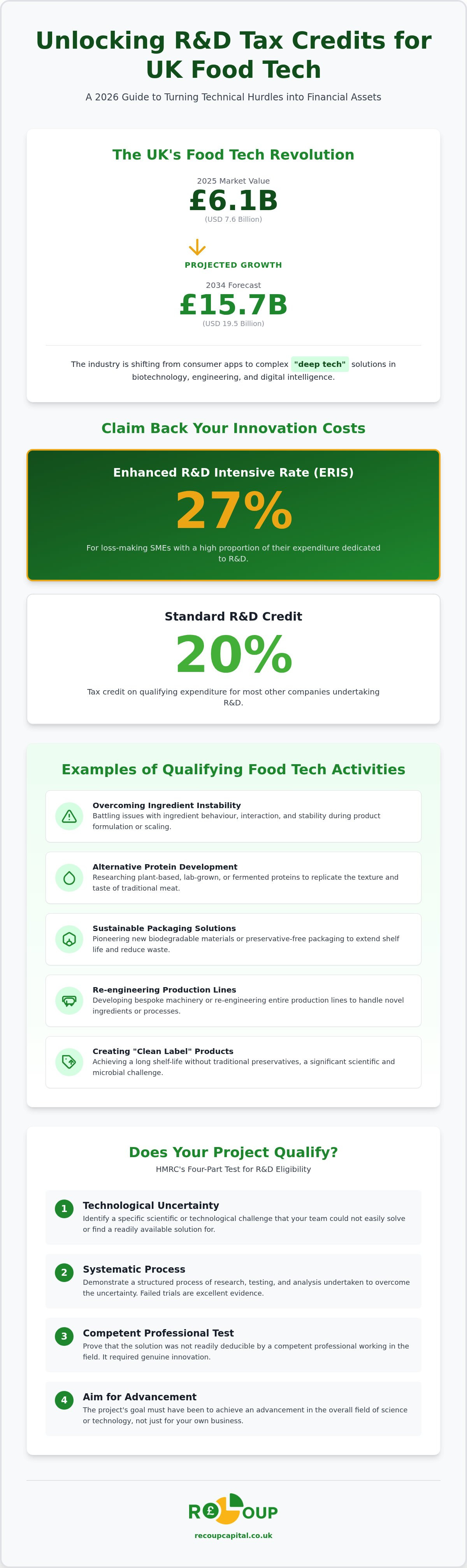
The term food tech has evolved far beyond the delivery apps on your smartphone. In 2026, it represents a sophisticated intersection of biotechnology, mechanical engineering, and digital intelligence. This industry isn't just growing; it's exploding. The UK food tech market was valued at USD 7.6 billion in 2025, and forecasts suggest it will reach a staggering USD 19.5 billion by 2034. This rapid expansion is driven by a fundamental shift toward "deep tech" solutions that address global food security and sustainability.
The UK government recognises this sector as a cornerstone of the national economy. By offering generous R&D tax credits, they incentivise businesses to tackle the high-risk, high-reward challenges of modern manufacturing. We've seen a decisive shift away from consumer-facing delivery apps toward complex, deep-tech manufacturing solutions. This involves re-engineering entire production lines to accommodate new ingredient behaviours or developing bespoke machinery that didn't exist a year ago. To understand the full scope of these advancements, one must look at What is Food Technology? and how it bridges the gap between raw agricultural output and the finished consumer product.
The Core Pillars of Food Technology
Innovation in this sector typically falls into three categories. Biotechnology is perhaps the most high-profile, covering precision fermentation and the development of lab-grown meats. Then there is the crucial distinction between AgTech and food tech. Whilst AgTech focuses on everything before the farm gate, food technology takes over the moment a raw ingredient enters the factory for processing. Finally, digital transformation is revolutionising the factory floor. AI-driven systems now handle recipe formulation and supply chain optimisation with a level of precision that was impossible five years ago. These aren't just software upgrades; they are fundamental changes to how food is designed and produced.
Why 2026 is the Year for Food Innovation
The pressure to innovate has never been higher. UK businesses are currently navigating strict "Novel Foods" regulations and updated health labelling requirements. These aren't just administrative hurdles; they are catalysts for technical uncertainty. Creating a "clean label" product that maintains a six-month shelf life without traditional preservatives is a significant scientific challenge. It requires a deep understanding of molecular interactions and microbial behaviour. Additionally, the drive to meet Sustainable Development Goals (SDGs) is forcing manufacturers to find new ways to reduce waste throughout the production cycle. For many, these technical struggles are the exact activities that qualify for significant tax relief. This makes 2026 a pivotal moment for companies to recoup their investment through specialised tax incentives.
The Intersection of Food Tech and R&D Tax Credits
Innovation in the food sector is often a quiet, messy process. It happens in test kitchens and on factory floors, far removed from the polished boardrooms of finance. Yet, the UK government recognises that this technical struggle is the engine of national growth. By seeking an advancement in science or technology, your business is doing more than just launching a new product; it's contributing to the UK's global standing in food tech. This contribution is exactly what R&D tax credits are designed to reward.
Food tech R&D is the process of overcoming technical challenges that a competent professional cannot easily resolve. This definition is the bedrock of any successful claim. It shifts the focus from the finished product to the systematic investigation required to create it. When you encounter "technical uncertainty", you've found the heart of R&D. Many businesses mistakenly believe that a failed trial is a waste of resources. In reality, a failure often provides the most robust evidence for a claim. It proves that the solution was not obvious and that you were pushing the boundaries of current knowledge. Industry insights from the Institute of Food Technologists' Food Technology magazine frequently highlight how these technical hurdles lead to the breakthroughs that define the modern market.
Does Your Project Qualify? The Four-Part Test
HMRC applies a rigorous framework to determine eligibility. First, you must identify a specific scientific or technological uncertainty. Second, you must demonstrate a systematic attempt to overcome that uncertainty through research and testing. Third, you must prove the project was not easily resolvable by a professional in the field. Finally, the goal must be an overall advancement in the sector, not just a routine update. These criteria can feel intimidating, but they are simply a way to categorise the hard work your team already does. For a deeper dive into these specific requirements, you can explore our guide on R&D tax credits explained.
Common Misconceptions in the Food Industry
A common trap is dismissing food tech as "just cooking". In reality, what looks like a simple kitchen trial is often complex thermal processing or chemical stabilisation. Routine product development, such as substituting one brand of sugar for another, does not qualify for relief. However, if you are developing a new sugar-reduction method that requires altering the molecular structure of the food to maintain texture, you are performing R&D. Aesthetic changes, like changing the colour of a packaging label, are never qualifying activities. Technological improvements, such as inventing a new biodegradable film that reacts to oxygen levels, certainly are. Distinguishing between these categories is essential for a compliant submission.
These tax credits aren't just rebates; they are strategic assets. They provide the vital capital needed to reinvest in specialised laboratory equipment or to hire expert food scientists. By reclaiming these costs, you fuel a cycle of continuous innovation that keeps your business competitive. If you're unsure which of your recent trials meet the HMRC threshold, Recoup Capital can help you identify the hidden value within your manufacturing processes.
Qualifying Activities: From Alternative Proteins to Sustainable Packaging
Identifying qualifying R&D in the food sector requires looking past the final product to the underlying science. Many businesses assume that creating a new flavour is enough to trigger a claim, but HMRC requires a deeper level of technical challenge. In the food tech landscape of 2026, eligibility often hinges on the molecular and structural changes required to meet modern consumer demands. Whether you are developing plant-based alternatives or re-engineering packaging, the costs associated with these trials are often reclaimable.
Alternative proteins represent a significant area of innovation. Moving beyond basic plant burgers involves overcoming complex texture and flavour profile challenges. Replicating the "mouthfeel" of animal fat using plant-derived lipids requires extensive experimentation with emulsification and thermal stability. Similarly, nutritional optimisation is a major driver of R&D. Reducing sugar or salt whilst maintaining the structural integrity of a baked good isn't a simple swap. It often requires a fundamental redesign of the food matrix to ensure the product doesn't collapse or spoil prematurely. These technical hurdles, and the staff time spent resolving them, form the core of a robust claim.
- Shelf-life extension: Developing new preservative-free methods for longevity, such as high-pressure processing or active packaging.
- Sustainable packaging: Engineering biodegradable materials that can withstand the rigours of high-heat sealing and long-distance transport without compromising food safety.
- Clean label initiatives: Replacing synthetic stabilisers with natural alternatives that behave differently under manufacturing stress.
Manufacturing and Process Innovation
The transition from a successful kitchen trial to mass production is rarely seamless. Scaling up often introduces new technical uncertainties that didn't exist at a small scale. You might need to develop bespoke machinery or modify existing production lines to handle non-Newtonian fluid behaviours in new sauces. We often see qualifying R&D in waste reduction technology, where companies invent processes to convert manufacturing by-products into high-value ingredients. These factory-floor improvements are frequently overlooked, yet they represent a significant portion of a company's eligible expenditure.
This focus on technical precision is essential for any producer looking to scale without losing quality; for instance, you can check out Kilted Dragon Distillery to see how small-batch expertise translates into award-winning spirits.
Software and Digital Food Solutions
Modern food tech is increasingly reliant on digital infrastructure. Developing bespoke ERP systems to handle the complexities of 2026 food safety traceability is a qualifying activity if it involves overcoming significant software engineering challenges. Many firms are now using machine learning to predict ingredient stability and shelf-life under various environmental conditions. Integrating Internet of Things (IoT) sensors into cold-chain logistics to provide real-time, automated responses to temperature fluctuations also falls within the remit of R&D tax relief. These digital assets are just as valuable as the physical products they support.
Navigating HMRC Compliance for Food Tech Claims
In 2026, the regulatory environment for R&D tax relief has undergone a significant transformation. HMRC now mandates that all claims must be submitted digitally, accompanied by exhaustive technical narratives and granular cost breakdowns. For a food tech business, this means your lab notes, trial logs, and ingredient invoices are no longer just internal records; they are the essential evidence that protects your claim. Justifying "Technical Uncertainty" in a narrative report requires more than just describing a new recipe. You must clearly articulate the scientific gap you attempted to bridge and why the solution was not readily available to a competent professional in the field.
Relying on a non-specialist accountant for these complex submissions is a growing risk. Whilst generalists are excellent at standard corporation tax, they often lack the industry-specific knowledge to identify "hidden" R&D or to defend a claim against a technical challenge from HMRC. A specialist partner ensures that your narrative is phrased in the precise language HMRC expects, reducing the likelihood of a time-consuming enquiry. This proactive approach transforms a potentially intimidating regulatory procedure into a manageable opportunity for business growth.
Identifying Qualifying Expenditures
Under the merged R&D tax relief scheme effective for periods starting on or after 1 April 2024, profitable companies can access a taxable credit of 20% on qualifying spend. This expenditure includes staff costs for chefs, food scientists, and factory engineers directly involved in the R&D process. Consumables are particularly relevant in the food sector; the ingredients and materials used, and often wasted, during trial runs represent reclaimable capital. You can also include subcontracted R&D costs when working with external laboratories or universities, alongside specific software licences used for modelling or traceability. If your business is loss-making and R&D-intensive, you may even qualify for the Enhanced R&D Intensive Support (ERIS) scheme, which offers a payable credit of up to 27%.
Preparing for an HMRC Enquiry
The food sector is under increased scrutiny in 2026 as HMRC seeks to eliminate speculative claims. To protect your business, your submission must be forensically sound before it ever reaches an inspector's desk. This involves a robust internal audit of all technical documentation to ensure every claim is backed by physical proof of experimentation. If you are concerned about the strength of your current documentation, our team can provide a detailed review of your R&D processes to ensure full compliance. When HMRC asks for clarification on a specific technical advancement, having a specialist who can speak their technical language is invaluable. We act as a protective guide, handling the technical heavy lifting whilst you focus on your next breakthrough. To ensure your innovation is fully rewarded without the fear of an enquiry, secure your 2026 claim with our expert team.
Maximising Your Claim with Recoup Capital
Recoup Capital acts as a protective guide through the complexities of the UK tax system. We specialise in identifying the technical uncertainties that often remain hidden within complex manufacturing processes. Whilst a generalist accountant might see a standard production line, we see the engineering breakthroughs and the scientific trials that define modern food tech. Our expert team of chartered tax accountants understands the nuances of the food sector, ensuring that every hour of staff time and every kilogram of wasted trial ingredients is accounted for in your submission.
Our partnership-led approach is built on a foundation of transparency and shared success. We operate on a success-based fee model, meaning there are no upfront costs for your business. This removes the financial risk of exploring a claim and transforms the process into a low-barrier opportunity for capital recovery. By choosing a specialist, businesses often identify significantly higher qualifying costs than they would through a routine assessment, as we know exactly where to look for the "hidden" R&D that generalists frequently overlook.
Our Process: From Discovery to Reinvestment
We've streamlined our methodology to ensure minimal disruption to your daily operations. It begins with an initial no-cost consultation to determine your eligibility and identify potential projects. Following this, we conduct a forensic analysis of your food tech expenditures, gathering the necessary lab notes and technical documentation required for the 2026 digital submission standards. We handle the entire technical heavy lifting, including the ongoing liaison with HMRC, to ensure your claim is processed efficiently. You can learn more about why claim to understand how this recovered capital can be used as a strategic tool for future innovation.
Beyond R&D: A Holistic Financial Strategy
Our expertise extends beyond tax credits to cover your entire operational footprint. If you are investing in a new production facility or upgrading existing machinery, you may be eligible for Capital Allowances. For those repurposing brownfield sites for new factory developments, Land Remediation Relief can provide further significant tax savings. We don't just process paperwork; we act as long-term partners invested in your bottom line. To find the hidden value in your business, book your free food tech R&D assessment with Recoup Capital today.
Fueling the Future of Food Innovation
The technical challenges your team faces today are the building blocks of tomorrow's industry standards. Whether you are perfecting meat-free textures or digitising a complex supply chain, these hurdles represent significant financial opportunities rather than just operational costs. By reframing your innovation spend as a strategic asset, you can secure the vital capital needed for your next phase of growth in the multi-billion pound food tech sector. The 2026 regulatory landscape demands forensic precision, but it doesn't have to be a barrier to your success.
Maintaining a strong sense of team identity during these complex innovation cycles is also vital; for organisations looking to celebrate their technical milestones with bespoke group apparel, you can discover Adorb Custom Tees.
Our team of chartered tax accountants brings specialist technical knowledge of food manufacturing to every claim. We act as your proactive guide, ensuring your submission is robust whilst you focus on your next breakthrough. With our success-based fee model, you can explore your eligibility with total confidence and zero upfront risk. We're committed to long-term collaboration, helping you navigate the complexities of HMRC compliance with ease and transparency. Start your no-risk food tech R&D assessment today and discover how we can transform your technical struggles into a powerful engine for reinvestment. Your next innovation is waiting, and we're here to help you fund it.
Frequently Asked Questions
What exactly is considered food tech for R&D tax purposes?
It is the application of science and engineering to overcome technical uncertainties in food production, processing, or preservation. This includes developing novel ingredients, improving shelf-life without synthetic additives, or re-engineering factory processes to handle new ingredient behaviours. HMRC looks for an advancement in the field that isn't easily resolvable by a competent professional working in the sector.
Can I claim R&D tax credits for new recipe development?
You can claim provided the development involves overcoming a scientific or technological uncertainty. Simple recipe tweaks for flavour or aesthetics don't qualify. However, if you're reformulating a product to reduce sugar whilst maintaining structural integrity, or stabilising a plant-based protein that separates under heat, those technical struggles are eligible for relief. It's the "how" of the process that matters most.
How much is a typical food tech R&D claim worth in the UK?
Under the 2026 merged scheme, companies receive a taxable credit of 20% on qualifying expenditure. For a profitable company paying the 25% corporation tax rate, this delivers a net benefit of 15p for every £1 spent. Loss-making, food tech intensive SMEs can claim up to 27% through the Enhanced R&D Intensive Support (ERIS) scheme if their R&D spend exceeds 30% of total operational costs.
Do I need to have a laboratory to claim R&D tax relief?
A dedicated laboratory is not a requirement for a successful claim. Much of the qualifying food tech innovation happens directly on the factory floor during trial runs or within test kitchens. As long as you can document the systematic investigation and the technical uncertainties you were trying to resolve, the physical location of the work is secondary to the scientific intent.
What happens if my food tech project failed to produce a viable product?
You can still claim for failed projects as failure is often the strongest proof of technical uncertainty. HMRC rewards the attempt to achieve a scientific or technological advancement, regardless of the commercial outcome. If your trial didn't work, it demonstrates that the solution was not obvious. This is a core requirement for a robust R&D tax credit submission.
Can I claim for ingredients and materials used during production trials?
The cost of consumables used during the R&D process is a qualifying expenditure. This includes the raw ingredients and energy used during trial batches that are subsequently scrapped or destroyed. If the final product is sold, you may need to adjust the claim. However, any materials wasted during the experimental phase are fully eligible for recovery.
How far back can I claim R&D tax credits for my food business?
You can typically claim for your two most recent completed accounting periods. This means you have a two-year window from the end of the accounting period in which the R&D expenditure was incurred to submit your claim to HMRC. It's vital to review your past technical projects early to ensure you don't miss these statutory deadlines and lose out on potential capital.
What is the difference between an R&D specialist and my regular accountant?
An R&D specialist focuses exclusively on identifying technical uncertainties and navigating complex tax legislation, whilst a regular accountant handles broader compliance and bookkeeping. Specialists have the industry-specific knowledge to uncover hidden R&D in your manufacturing processes. They also provide a protective layer during HMRC enquiries by speaking the technical language of both food science and taxation.


