

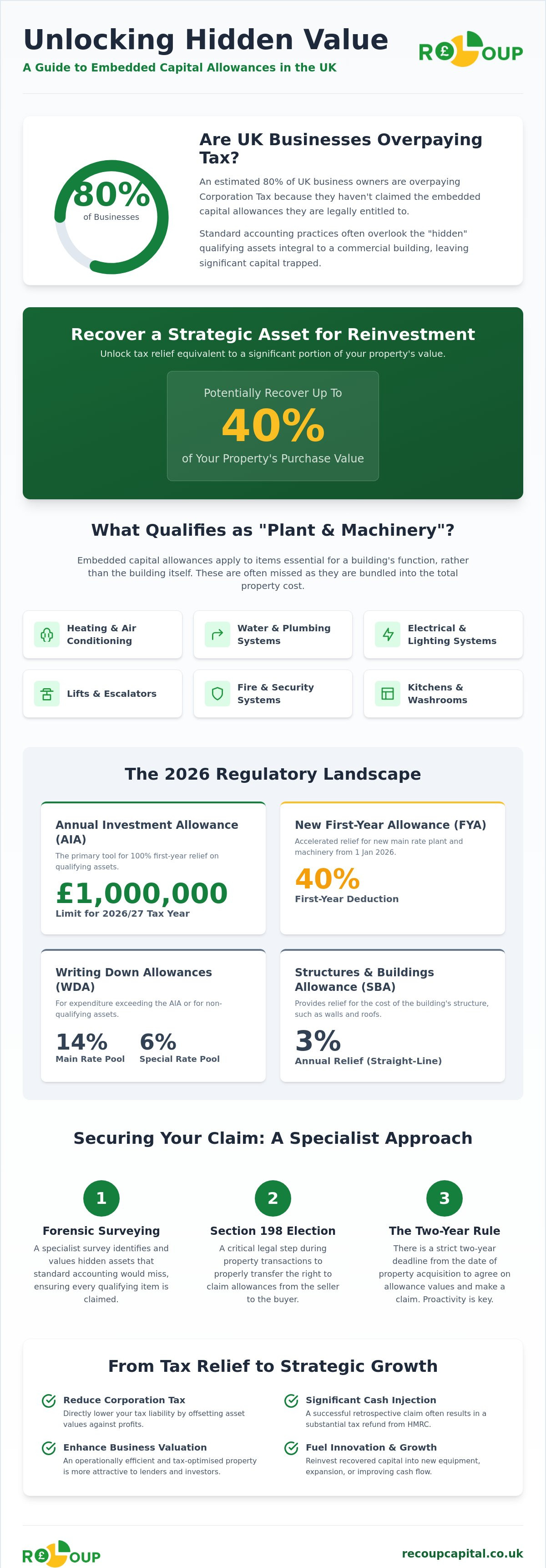
Did you know that approximately 80% of UK business owners are currently overpaying their tax because they haven't claimed the embedded capital allowances uk they're legally entitled to? It's a common misconception that your general accountant has already captured every available penny. In reality, standard accounting often misses the "hidden" assets within your building's structure, leaving significant capital trapped in the fabric of your commercial property.
You might feel uncertain about what qualifies as an "integral feature" or worry about the complexities of HMRC navigation, but these are hurdles we can help you clear. This guide will show you how to unlock this hidden tax relief through specialist forensic surveying, potentially recovering up to 40% of your property's purchase value as a strategic asset for reinvestment. We'll explore the updated 2026 regulations, including the new 40% first-year allowance and the crucial Section 198 election rules, to ensure your claim is both maximised and fully HMRC-compliant.
Key Takeaways
- Learn why standard accounting often overlooks the "hidden" fixtures within your building fabric and how to identify these missed opportunities.
- Discover how to unlock embedded capital allowances uk to potentially recover up to 40% of your property's purchase value as a strategic asset.
- Understand the 2026 regulatory landscape, including the new 40% first-year allowance and the updated 14% writing down allowance for main rate expenditure.
- Master the critical Section 198 election process and the two-year deadline to protect your tax relief during commercial property transactions.
- See how forensic surveying and a success-based partnership can turn complex tax compliance into a low-risk opportunity for business innovation.
Unlocking Hidden Value: Embedded Capital Allowances UK in 2026
Commercial property owners often view their buildings as static overheads, but this perspective overlooks a substantial financial opportunity. Hidden within the walls, floors, and ceilings of your premises are qualifying fixtures that represent significant tax relief. These embedded capital allowances uk apply to the "plant and machinery" elements that are essential for a building to function. We're talking about everything from sophisticated air conditioning systems and lifts to the intricate electrical and plumbing networks that power your operations.
A Capital allowance is essentially the UK tax system's method of providing relief for the depreciation of business assets. Most generalist accountants are highly skilled at claiming for items with clear, individual invoices, such as office furniture or laptops. However, they frequently miss embedded items because these assets are usually bundled into the total purchase price or construction cost of the building. Identifying them requires a combination of tax expertise and forensic surveying to disaggregate the costs effectively.
At Recoup Capital, we don't view this recovered capital as a mere tax refund. Instead, we frame it as a strategic asset. This is liquidity that was previously trapped in your building fabric, now released to fuel business innovation, fund new equipment, or improve your cash flow position. It's about turning a passive physical asset into an active driver of growth.
This newfound liquidity can be used for anything from infrastructure upgrades to rewarding your hard-working team with a holiday break; for those looking at international travel options, platforms like primatour.sk provide a wealth of inspiration for your next corporate getaway.
The Core Benefits for UK Limited Companies
The most immediate impact of a successful claim is a direct reduction in your Corporation Tax liability. By offsetting the value of qualifying fixtures against your profits, you retain more of your hard-earned revenue. This often results in a significant cash injection, especially when we conduct retrospective reviews of past property expenditure. Beyond the immediate tax saving, a robust claim enhances your business valuation. An operationally efficient building with optimised tax records is a far more attractive prospect for lenders and potential investors alike.
The 2026 Legislative Landscape
The tax environment for 2026 has introduced specific mechanisms that make this a critical year for portfolio reviews. As of 1 January 2026, a new 40% first-year allowance (FYA) is available for qualifying new main rate plant and machinery expenditure. This allows businesses to accelerate their relief significantly compared to previous years. Whilst the main rate Writing Down Allowance (WDA) has transitioned to 14% for businesses subject to Corporation Tax, the special rate for integral features remains at 6%. Understanding how these rates interact with capital allowances is vital for any company looking to maximise its return on property investment this year.
The Three Pillars of Property Tax Relief: Plant, Machinery, and Structures
Understanding the hierarchy of tax relief is the first step toward effective capital recovery. For most UK businesses, the Annual Investment Allowance (AIA) remains the primary tool for accelerating relief. For the 2026/27 tax year, the AIA limit is maintained at £1,000,000, allowing for 100% first-year tax relief on qualifying expenditure. This means you can deduct the full cost of qualifying assets from your taxable profits in a single year, significantly boosting your immediate cash flow.
When expenditure exceeds the AIA limit or doesn't qualify for first-year incentives, it falls into the Writing Down Allowance (WDA) pools. From April 2026, the main rate WDA has been reduced to 14% for companies, whilst the special rate pool remains at 6%. For elements of the building that don't qualify as plant or machinery, such as the walls and roof, the Structures and Buildings Allowance (SBA) provides a steady 3% relief on a straight-line basis. Identifying where your embedded capital allowances uk sit within these categories is essential for accurate long-term financial planning.
Plant and Machinery: Identifying Qualifying Assets
Main pool assets are those that perform a specific function within your business premises rather than simply being part of the setting. To distinguish these, we apply the "function test" to see if the item is a tool of the trade. Qualifying items often include security systems, fire alarms, and even specialised flooring designed for industrial use. The UK Government Capital Allowances guidance provides a framework for these claims, but applying it to embedded fixtures requires a forensic eye. Without a specialist survey, these 14% relief opportunities are frequently lost within the general construction costs of a property.
Integral Features: The Special Rate Pool
The special rate pool covers "integral features" that are essential to the building's operation but have a slower rate of depreciation. This category includes electrical systems, cold water networks, and climate control installations like air conditioning. Lifts, escalators, and thermal insulation also sit here, qualifying for 6% annual relief. It's common for expenditure to blur the lines between main and special rates; for instance, a complex lighting system might have components in both. If you're unsure how to categorise your property assets, a specialist review of your capital allowances can provide the clarity needed to maximise your claim safely.
Forensic Surveying: Identifying Assets Your Accountant Might Miss
Many business owners assume their tax position is fully optimised. It's a logical conclusion; after all, you employ a professional accountant to handle your filings. However, generalist accountants typically work from purchase invoices and profit and loss statements. Whilst they're excellent at identifying capital expenditure on movable items like computers, they rarely have the technical engineering background to unbundle the "hidden" costs within a property purchase or refurbishment. This is where the specialist process of recovering embedded capital allowances uk becomes essential.
A standard invoice for a £500,000 office fit-out might simply list "construction works" as a single line item. To HMRC, this looks like a capital improvement with limited relief. A forensic surveyor, however, deconstructs that figure. They identify the specific value of the cabling, the climate control systems, and even the specialised floor finishes. By moving from a desk-based review to a physical site inspection, we uncover assets that simply don't appear on a standard balance sheet. This physical verification provides the robust documentation required to satisfy HMRC inquiries and secure your claim.
The Gap Between Accounting and Forensic Surveying
The primary limitation of traditional accounting in this field is the reliance on existing documentation. If the original builder's invoice didn't break down the cost of the fire suppression system, most accountants will simply treat it as part of the non-qualifying building structure. Forensic surveying serves as the vital bridge between complex tax legislation and the physical identification of qualifying assets. By using land registry data, historical construction costs, and detailed site surveys, we can reconstruct the qualifying expenditure even when original records are missing or vague. This ensures that no legitimate relief is left on the table due to poor paperwork.
Case Study: Common Hidden Assets
Modern commercial spaces are filled with technology that qualifies for relief but is often overlooked. In high-end office environments, acoustic glazing and specialised lighting systems are frequently missed. For those in the hospitality or manufacturing sectors, the complexity of drainage and plumbing systems hidden beneath the floors represents a massive area of potential recovery. By identifying hidden savings, businesses can transform these invisible fixtures into tangible cash flow. This isn't about aggressive tax avoidance; it's about ensuring you receive the full benefit of the incentives the UK government has put in place to encourage property investment and business innovation.
Navigating Transactions: Section 198 Elections and the Two-Year Rule
Identifying qualifying fixtures is only half the battle. The legal transfer of these rights during a property transaction is where many embedded capital allowances uk claims are won or lost. In the UK, the "Fixed Value" and "Pooling" requirements dictate that a buyer can only claim allowances if the seller has already "pooled" that expenditure in their own tax computations. To formalise this, both parties must enter into a Section 198 election. This document fixes the value of the fixtures being sold, providing certainty for both the buyer's future claims and the seller's tax position.
Timing is everything. You have a strict two-year window from the date of the property transfer to submit a Section 198 election to HMRC. If this deadline passes without an agreement, the opportunity to claim these allowances on those specific fixtures can be lost forever. This is a common trap for businesses that rely solely on standard conveyancing without specialist tax input. Recoup Capital acts as a protective guide during these negotiations, ensuring that your right to capital recovery is explicitly protected in the sale contract.
Buying a Commercial Property: Due Diligence
When you're in the process of acquiring a new asset, your solicitor will use Commercial Property Standard Enquiries (CPSE) to gather information. It's vital to scrutinise these forms for prior claim history. If the seller hasn't pooled the allowances, you may need to negotiate a requirement for them to pool the allowances and enter into a Section 198 election with you.
From Tax Relief to Strategic Growth: The Recoup Capital Approach
Securing embedded capital allowances uk shouldn't be a source of stress or an endless administrative burden. Our approach is built on a success-based fee model, which means there's no upfront cost or financial risk to your business. We're committed to demonstrating value through results rather than traditional sales pitches. This result-driven philosophy ensures our interests are perfectly aligned with yours; we only succeed when we've successfully identified and recovered capital for you to reinvest.
Our end-to-end process is designed to be as low-friction as possible. It begins with a specialist forensic assessment where our surveyors physically inspect your property to identify qualifying assets that standard accounting methods often miss. Once the data is gathered, our team of chartered tax accountants takes over the technical heavy lifting. We handle the entire HMRC liaison process, providing the robust, compliant documentation needed to secure your claim and protect your business from future inquiries.
A Partnership, Not a Pitch
We don't aim to replace your existing accountant; we're here to support them. Most accounting firms welcome our involvement because we provide the niche forensic surveying expertise that isn't typically found in a standard practice. By working in collaboration with your current advisors, we ensure that every available pound of relief is captured without disrupting your established financial workflows. Recoup Capital transforms tax compliance into a strategic growth opportunity by unlocking the hidden capital within your building fabric.
The Holistic Tax Recovery Strategy
For many of our clients, capital allowances are just one part of a broader innovation and growth strategy. We often work with developers to combine these claims with Land Remediation Relief, particularly on sites where historical contamination or derelict structures have increased construction costs. This joined-up thinking ensures you aren't leaving money on the table across different tax incentives.
The capital we recover isn't just a refund; it's a strategic asset. Many businesses use this cash injection to fund future innovation, which in turn can create new opportunities for R&D tax credits. It's a virtuous cycle of reinvestment that fuels long-term business evolution. If you're ready to see what's hidden in your property portfolio, we invite you to start a conversation with a no-obligation specialist property review to explore your potential for recovery.
Secure Your Financial Future Through Strategic Capital Recovery
The 2026 tax landscape offers a unique opportunity for commercial property owners to unlock significant liquidity. By identifying embedded capital allowances uk within your building's fabric, you transform a passive physical asset into a strategic tool for business innovation. We've seen that standard accounting often overlooks these fixtures; true recovery requires the precision of forensic surveying combined with specialised tax expertise to ensure no value is left behind.
Our approach focuses on long-term partnership rather than a traditional sales pitch. We provide a specialist team of chartered tax accountants and forensic surveyors to deliver HMRC-compliant forensic reporting that stands up to scrutiny. Because we operate on a success-based fee model, you can explore your potential for tax relief with complete peace of mind. There's no upfront risk to your business; we prefer to demonstrate value through results and tangible capital recovery.
Don't let your hard-earned capital remain trapped in your property's infrastructure. It's time to reclaim what's yours and fuel your next phase of growth. Book your no-obligation capital allowance review with our specialists and discover how a partnership-oriented approach can protect your bottom line and support your future ambitions.
Frequently Asked Questions
What are embedded capital allowances for commercial property?
Embedded capital allowances are tax reliefs on the qualifying items fixed to a building's structure, such as heating, lighting, and security systems. Whilst the building itself might not qualify for the same level of relief, these "integral features" do. They're called "embedded" because their cost is usually hidden within the total purchase price or construction invoice of the property rather than being listed separately.
Can I claim capital allowances on a property I have owned for years?
Yes, you can claim on a property you've owned for many years provided you still own the assets and they are still in use by your business. There's no statutory time limit for making a claim on historical expenditure in the UK. However, the value of the claim will depend on whether any previous owners have already utilised the allowances or if a Section 198 election was signed at the point of purchase.
What is the difference between fixtures and chattels in UK tax law?
Fixtures are assets that are permanently attached to the building, such as lifts or air conditioning, whereas chattels are movable items like office chairs or laptops. UK tax law treats them differently; chattels are easy to identify on invoices, but fixtures require specialist valuation. Identifying embedded capital allowances uk focuses specifically on those fixtures that have become part of the building fabric but still qualify as plant and machinery.
Is my accountant already claiming these allowances for my business?
Most generalist accountants only claim for items with clear, separate invoices, such as machinery or furniture. They rarely have the technical surveying expertise required to identify and value the assets hidden within a building's construction or purchase price. It's common for a specialist review to uncover significant relief that has been missed for years, even when a business has a highly competent accounting team in place.
How much does a specialist capital allowance claim cost?
We operate on a success-based fee model, meaning there's no upfront cost or financial risk to your business for the initial assessment. Our fees are only payable if we successfully identify and secure tax relief for you. This approach ensures our goals are perfectly aligned with your business's capital recovery, and we only demonstrate our value through the actual results we achieve for your bottom line.
What happens if I sell my commercial property after making a claim?
If you sell the property, you must enter into a Section 198 election with the buyer within two years to fix the value of the fixtures. This allows you to retain the benefit of the allowances you've already claimed whilst passing any remaining value to the new owner. It's a critical part of the transaction process that protects your tax position and can even be used as a negotiation tool during the sale.
Can I claim capital allowances on a leased commercial building?
How long does the forensic surveying process typically take?
The forensic surveying process is efficient and typically takes a few weeks from the initial site visit to the delivery of the final HMRC-compliant report. The physical inspection of the property usually only takes a few hours, causing minimal disruption to your daily operations. Most of the work happens behind the scenes as our specialists analyse construction costs and land registry data to build a robust claim for your business.


