

Most UK businesses treat their prototype waste and utility spikes as unavoidable overheads; however, these "lost" costs often represent a significant untapped asset within R&D tax credits for materials and consumables. If you've ever struggled to decide whether a material was truly "consumed" or merely "transformed", or felt a wave of anxiety whilst trying to split a massive electricity bill between the lab and the office, you aren't alone. HMRC's shifting definitions can make even the most seasoned financial director hesitate, especially as the 2026 landscape brings increased scrutiny to every claim submission.
This guide will show you exactly how to navigate these complexities to ensure you're capturing every qualifying pound without inviting an enquiry. We'll provide a clear list of qualifying items under the 2024 merged scheme, offer a robust framework for apportioning utilities, and explain how to satisfy the mandatory Additional Information Form (AIF) requirements. You'll discover how to accurately calculate your claim to secure the 15% net benefit or the 27% ERIS rate, transforming your technical uncertainties into a strategic financial advantage for your business growth.
Key Takeaways
- Understand the vital distinction between materials that are "consumed" or "transformed" during innovation to ensure your claim remains fully compliant.
- Learn how to apply defensible apportionment methods for power, water, and fuel to maximise your R&D tax credits for materials and consumables without over-claiming.
- Explore real-world examples from construction and engineering to uncover hidden qualifying costs in scrap materials and demolished prototypes.
- Navigate the complexities of the "First Sale" rule to avoid common pitfalls when your R&D projects result in a commercial product.
- Discover how a forensic approach to ledger tracking can transform your utility spikes and material waste into strategic financial assets for your business.
What are Qualifying Consumables in R&D Tax Credits?
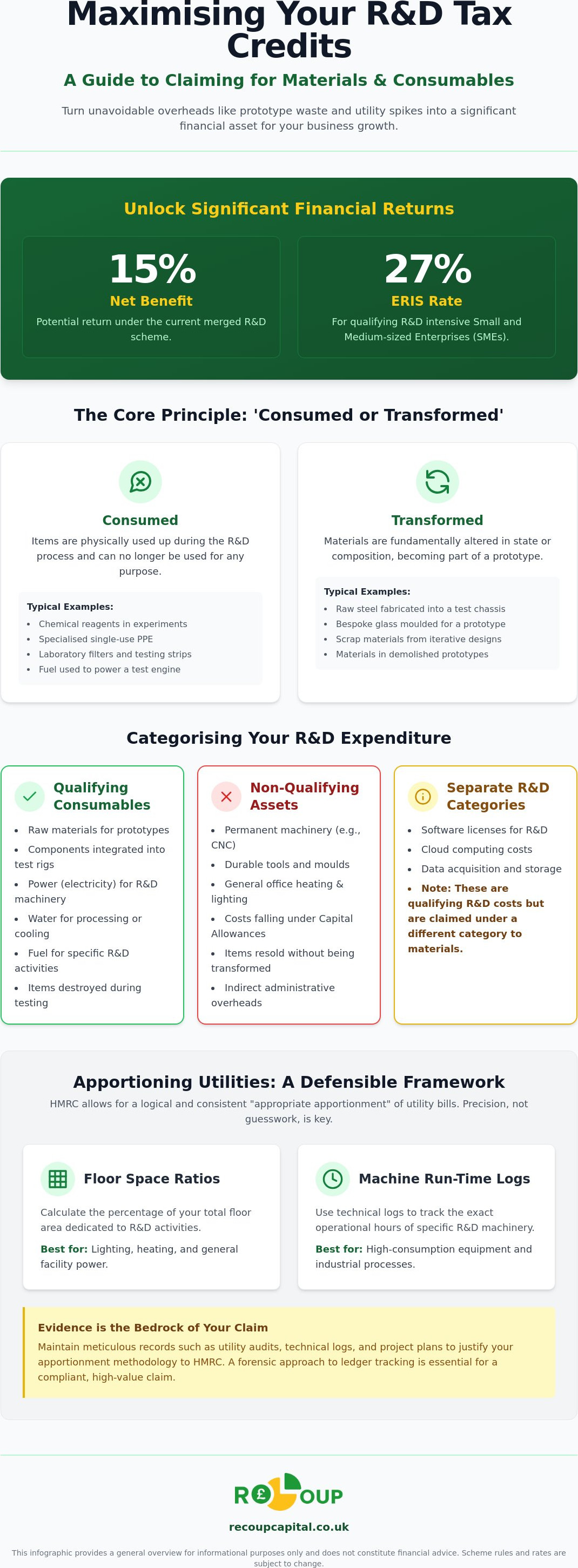
Identifying qualifying expenditure starts with a simple question: did the item survive the process? Within the framework of the UK's R&D tax incentive, consumables are defined as physical items that are either used up or fundamentally altered during your technical journey. This includes raw materials, components, and the utilities required to power your innovation, such as water, fuel, and electricity. Securing R&D tax credits for materials and consumables requires a granular understanding of how HMRC views this physical waste versus your long-term assets.
It's vital to distinguish between revenue and capital expenditure. Only revenue-based costs, those appearing on your profit and loss account, qualify under this specific relief. If you've purchased a permanent asset, like a high-grade CNC machine or a laboratory centrifuge, these costs usually fall under Capital Allowances instead. Your focus should remain on the 'direct' inputs of the R&D activity. Whilst indirect support costs, like general administrative heating or office lighting, are often excluded, the specific energy used to run a prototype test rig or maintain a sterile lab environment is a prime candidate for recovery.
The 'Consumed or Transformed' Rule
HMRC applies a strict test: the item must be 'consumed' or 'transformed'. Consumed items are those discarded after a single use, such as chemical reagents, laboratory filters, or specialised single-use PPE. Transformed materials are more common in manufacturing and construction. This occurs when raw materials, perhaps high-tensile steel or bespoke glass, change their physical state during prototyping. If an item remains in its original, reusable state, like a hand tool or a durable mould, it won't qualify as a consumable. The key is that the material no longer exists in its original form once the R&D project concludes.
Software Licences vs. Consumables
Modern innovation often relies as much on code as it does on chemicals. While software licences are indispensable for technical resolution, HMRC categorises them separately from physical consumables. Recent legislative updates have expanded this to include cloud computing and data costs, reflecting the digital nature of current R&D projects. For a deeper dive into how these various expenditure types interact, you can consult the Recoup Capital guide to R&D tax credits explained. Keeping these categories distinct in your ledger is the first step toward a defensible, high-value claim that stands up to scrutiny.
Apportioning Utilities: Power, Fuel, and Water
HMRC recognises that few businesses maintain separate meters for their research laboratories or prototyping workshops. To facilitate a fair claim, they allow for an "appropriate apportionment" of your utility bills. This process transforms a standard overhead into a qualifying expenditure, provided you can demonstrate a logical and consistent methodology. When calculating R&D tax credits for materials and consumables, your goal is to isolate the energy and water specifically consumed during your technical resolution phase. It's about precision rather than guesswork.
Commonly accepted methods for this split include floor space ratios or machine run-time logs. If your R&D projects take place in a dedicated facility, the percentage of total floor area is often the most defensible metric for lighting and heating. However, for industrial processes involving high-consumption machinery, using technical logs to track run-time provides a much higher degree of accuracy. The "Trivial Use" rule also comes into play; if the non-R&D usage of a specific utility is so small it's effectively negligible, you may be able to claim the full amount. Conversely, if the R&D use is trivial, it should be excluded entirely to maintain compliance.
Evidence is the bedrock of a successful claim. You should maintain utility audits or technical logs that justify your chosen percentages for HMRC inspectors. For deeper insights into the broader eligibility criteria, you may wish to see how we help clients maximise their R&D tax credits through forensic ledger analysis. We focus on the details so you can focus on the next breakthrough.
Directly Employed vs. Indirectly Employed Power
Direct power refers to the electricity used by specific R&D rigs, laboratory equipment, or testing units. This is the most straightforward cost to justify. Indirect power covers the heating and lighting of the R&D facility itself. This qualifies as long as it directly supports the innovation project. You must exclude any power used for general staff canteens, administrative offices, or storage areas unrelated to the R&D work. Following the HMRC guidance on consumable items ensures your split remains within the bounds of current tax law.
Water and Fuel in Industrial R&D
In sectors like engineering or chemical processing, fuel and water often act as primary consumables rather than just ambient utilities. Fuel used in furnaces for metal stress testing or for powering experimental engines is highly eligible. Similarly, water used as a reactant in chemical synthesis or as a primary coolant in a bespoke manufacturing process counts toward your total. Appropriate apportionment is defined as a defensible estimate based on logical usage metrics that reflect the physical reality of your R&D environment.
Materials in Practice: Sector-Specific Examples
Theory only takes you so far. To truly maximise R&D tax credits for materials and consumables, you must look forensicly at the physical waste generated on your workshop floor or in your laboratory. Different sectors produce vastly different types of qualifying expenditure. In engineering, for instance, you might focus on scrap metal from failed prototypes or the high volumes of specialised welding gases consumed during iterative testing. These gases, such as argon or CO2 mixes, are frequently overlooked because they are invisible, yet they are fundamentally used up in the pursuit of a technical resolution.
Manufacturing firms often encounter significant costs in prototype moulds. If a mould is rendered useless after a single trial run or destroyed to examine the internal structure of a cast, it qualifies as a transformed material. Similarly, the food and drink industry relies heavily on trial batches. Ingredients used in these experimental runs are often discarded due to spoilage, safety testing, or flavour profile failures. These costs are fully eligible because the materials no longer exist in their original, saleable state. Identifying these "hidden" costs is where many businesses find the greatest uplift in their claim value.
Construction and Engineering Materials
In construction, innovation often involves building full-scale trial structures, such as bespoke wall sections or foundation designs, to test load-bearing capacities. If these structures are demolished after the test, the concrete, timber, and steel used are qualifying consumables. This also applies to specialised alloys used in destructive stress testing. If your project involves innovative cleaning or decontamination processes, you may also be eligible for land remediation relief alongside your R&D claim. Capturing the cost of "wasted" materials during this trial-and-error phase is essential for a robust submission.
Prototypes and Scale Models
Modern prototyping relies heavily on 3D printing. The filaments and resins used for iterative design are classic examples of items consumed during the R&D process. In electronics, components integrated into breadboard circuits that cannot be reclaimed or reused also qualify. For organisations looking to responsibly manage or recover value from surplus hardware, you can learn more about 億鑫鴻景電子 (Yixin Hongjing Electronics). It is vital to understand the difference between a "test prototype" and a "commercial prototype". A test prototype is built solely for technical evaluation and is often destroyed. A commercial prototype might eventually be sold to a customer. This distinction is critical because it triggers the "First Sale" rule, which we will explore in the next section.
The 'First Sale' Rule and HMRC Compliance
The landscape for R&D tax credits for materials and consumables changed significantly following the Finance Act 2015. Before this shift, businesses could often claim for all materials used in a prototype, even if that prototype was eventually sold to a client. Today, the "First Sale" rule dictates that if an item is sold or transferred for value in the ordinary course of business, the cost of the materials within it cannot be included in your R&D claim. This prevents companies from receiving a "double dip" of both tax relief and commercial revenue on the same physical components.
Understanding the "Ownership" test is equally vital. HMRC asks a simple question: who owned the materials at the point they were consumed or transformed? If you are performing R&D as a subcontractor and your client provides the materials, you cannot claim those costs. In hybrid projects where production and innovation happen on the same line, you must separate "innovation materials" (those used for testing and trials) from "production materials" (those destined for the final product). Keeping these distinct in your accounting software using specific project codes is the most effective way to protect your claim from scrutiny whilst maintaining a clear audit trail.
When the Prototype is Sold to a Client
The First Sale rule can drastically reduce the total value of your claim if you don't account for it early. However, exceptions do exist. If your R&D was conducted on a specific component that was subsequently discarded, destroyed, or replaced before the final product was sold, those specific material costs may still qualify. This is a complex area where the "transformed" rule meets commercial reality. Because the stakes are high, you should consult an R&D tax specialist if your business model relies on bespoke client builds or high-value prototypes.
Preparing for an HMRC Enquiry
Compliance is no longer optional; it's a structural requirement. The mandatory Additional Information Form (AIF) requires you to detail exactly how your material costs were calculated and why they qualify. HMRC often looks for red flags, such as "round-number" apportionments or claims that include 100% of a factory's material spend without accounting for standard production. To build a defensible case, you should document your "wastage rates" as physical proof of technical uncertainty. High wastage often signals that you were pushing the boundaries of what is possible. If you need a partner to help you secure a compliant R&D tax credit claim, our forensic approach ensures every material cost is backed by robust evidence.
Maximising Your Claim with Recoup Capital
Securing R&D tax credits for materials and consumables requires more than a cursory glance at your ledger. It demands a forensic investigation into how every component was utilised. At Recoup Capital, our technical specialists and chartered tax accountants work in tandem to uncover hidden costs that generalist firms often overlook. Whether it's a specific alloy transformed during stress testing or a complex utility split that requires a "just and reasonable" apportionment, we ensure your claim is both maximised and fully defensible. We take the weight of HMRC compliance off your shoulders, allowing you to focus on your next breakthrough.
Our success-based fee model ensures that our interests are perfectly aligned with yours. We only win when you recover capital. This partnership-oriented approach means we're invested in the long-term success of your innovation, providing end-to-end support from the initial technical report to direct HMRC liaison. We don't just process paperwork; we act as a protective guide through the complexities of the UK's evolving tax landscape. By reframing your financial returns as strategic assets, we help you transform past expenditure into future growth opportunities.
Why Specialised Consultancy Matters
General accountants are excellent at standard compliance, but they often lack the technical engineering background to identify "transformed" materials. Our team bridges this gap. We understand the specific nuances of how R&D tax credits for materials and consumables interact with your physical prototyping waste. This dual expertise protects you from the risks of over-claiming whilst ensuring you don't leave valuable capital on the table. Having a partner who understands both tax law and technical uncertainty is the most effective way to withstand the increased scrutiny of a 2026 HMRC enquiry.
Start Your Capital Recovery Journey
The journey to capital recovery begins with organisation. Start by collating your material receipts and utility statements for the relevant accounting periods. Having a clear audit trail of your "wastage rates" and machine run-times will significantly streamline the claim process. Once your data is organised, we can assist with the heavy lifting of forensic apportionment and technical report writing. We invite you to book a no-obligation consultation to assess your project's eligibility and discover the true value of your innovation. Speak to Recoup Capital today to see how much your materials are worth.
Transform Your Innovation Costs Into Strategic Capital
Mastering the distinction between consumed and transformed materials is the first step toward a robust and compliant claim. Whether you're apportioning utility bills through floor space metrics or documenting scrap metal from failed engineering prototypes, precision remains your best defence against HMRC scrutiny. These physical costs aren't just overheads; they are tangible evidence of your technical journey and a vital component of your business growth strategy.
At Recoup Capital, our expert chartered tax accountants specialise in high-expenditure sectors like construction and engineering. We handle the forensic tracking required for R&D tax credits for materials and consumables, ensuring every qualifying pound is captured whilst protecting your business from the risks of an enquiry. Our success-based fee structure means our goals are perfectly aligned with your recovery, providing a low-friction path to reinvesting in your next breakthrough. Claim your R&D tax credits with Recoup Capital today and turn your technical waste into a strategic asset. Your future innovation deserves a partner as invested as you are.
Frequently Asked Questions
Can I claim for materials used in a prototype I later sold?
You generally cannot claim for materials incorporated into a prototype that is subsequently sold to a customer. HMRC's "First Sale" rule prevents businesses from receiving tax relief on materials that have also generated commercial revenue. However, you can still claim for materials used in earlier, discarded iterations or components that were destroyed during the testing phase before the final version was completed and sold to your client.
What is the 'First Sale' rule and how does it affect my R&D claim?
The "First Sale" rule is a legislative provision that excludes the cost of materials from an R&D claim if the resulting product is sold in the ordinary course of business. This rule ensures that tax relief is only applied to the costs of genuine innovation waste. It affects your claim by requiring a careful separation of production costs from experimental expenditure, ensuring that only materials consumed or transformed during research are included.
How do I calculate the percentage of electricity used for R&D?
You must use a "just and reasonable" apportionment method to calculate R&D electricity usage when separate metering is unavailable. Common strategies include using the ratio of floor space dedicated to R&D activities or tracking the specific run-times of experimental machinery. Maintaining detailed technical logs or utility audits is essential to justify your calculations to HMRC. This ensures your claim for R&D tax credits for materials and consumables remains accurate and defensible.
Are software licences considered a consumable cost?
Software licences are not categorised as physical consumables; they fall under a distinct qualifying expenditure category. While software is vital for technical resolution, it's treated separately from items like chemicals or raw materials. Modern rules also allow for cloud computing and data costs, but these must be listed individually on your Additional Information Form (AIF) rather than being bundled with your physical material spend in the consumables section.
Can I claim for the cost of water and fuel in my R&D project?
You can claim for water and fuel costs if they are directly consumed or transformed during your R&D activities. This includes water used as a reactant in chemical synthesis or fuel consumed in furnaces for engine stress testing. General heating for administrative areas does not qualify. You must provide a logical basis for apportioning these utilities, ensuring that only the volume supporting the innovation project is included in your total.
What evidence does HMRC require for material wastage in R&D?
HMRC requires robust documentation such as technical logs, material receipts, and internal wastage reports to verify your claim. You should be prepared to show how materials were transformed or consumed during the pursuit of a technical resolution. Providing specific data on wastage rates acts as physical proof of technical uncertainty. This evidence should be clearly summarised in your mandatory Additional Information Form (AIF) to demonstrate full compliance with current tax regulations.
Is there a limit on how much I can claim for consumables?
There is no fixed monetary limit on the amount you can claim for consumables, provided the expenditure is revenue-based and directly related to qualifying R&D. The key requirement is that the costs must be just and reasonable and accurately apportioned. HMRC focuses on the legitimacy of the technical uncertainty rather than the scale of the spend. However, unusually high material costs relative to your sector may trigger an enquiry, making robust record-keeping vital.
Do materials used in unsuccessful R&D projects still qualify?
Materials used in unsuccessful R&D projects are fully eligible for tax relief. HMRC recognises that innovation often involves failure and technical uncertainty; therefore, the outcome of the project does not dictate its qualification. In fact, materials consumed in a failed prototype are often easier to claim because they clearly satisfy the consumed or transformed rule. This makes R&D tax credits for materials and consumables a valuable tool for recovering capital from high-risk ventures.


