

Your R&D claim is far more than a simple accounting exercise; it's a narrative justification of your company's innovation. For many UK businesses, the apportionment of costs in R&D claims remains the most daunting hurdle in the entire tax cycle. You know your team is pushing boundaries, but translating those technical breakthroughs into precise financial figures often feels like guesswork. It’s a delicate balance between claiming what you’re entitled to and avoiding the red flags that trigger an HMRC enquiry.
We understand the frustration of trying to track time for employees who wear multiple hats or deciding which indirect activities truly qualify under the 2026 Merged Scheme. This guide will help you master these complexities to ensure your claim is both maximised and fully compliant with the latest standards. We’ll provide a clear framework for allocating expenditure, giving you the confidence that your claim will withstand an audit whilst delivering the financial return your innovation deserves. From territorial restrictions to software licensing splits, we’ll cover exactly how to turn your qualifying costs into strategic assets for growth.
Key Takeaways
- Understand the "Just and Reasonable" test to ensure your cost-splitting methodology aligns perfectly with HMRC's 2026 expectations.
- Learn to distinguish between direct engagement and "Qualifying Indirect Activities" to ensure every minute of eligible staff time is captured.
- Navigate the complexities of the 65% rule for subcontractors and the specific apportionment of costs in R&D claims for software and cloud computing.
- Establish a two-step record-keeping process that maps technical innovation directly to financial expenditure for a bulletproof audit trail.
- Discover how to move from conservative guessing to professional precision, allowing you to maximise capital recovery whilst maintaining full compliance.
Understanding the Apportionment of Costs in R&D Claims
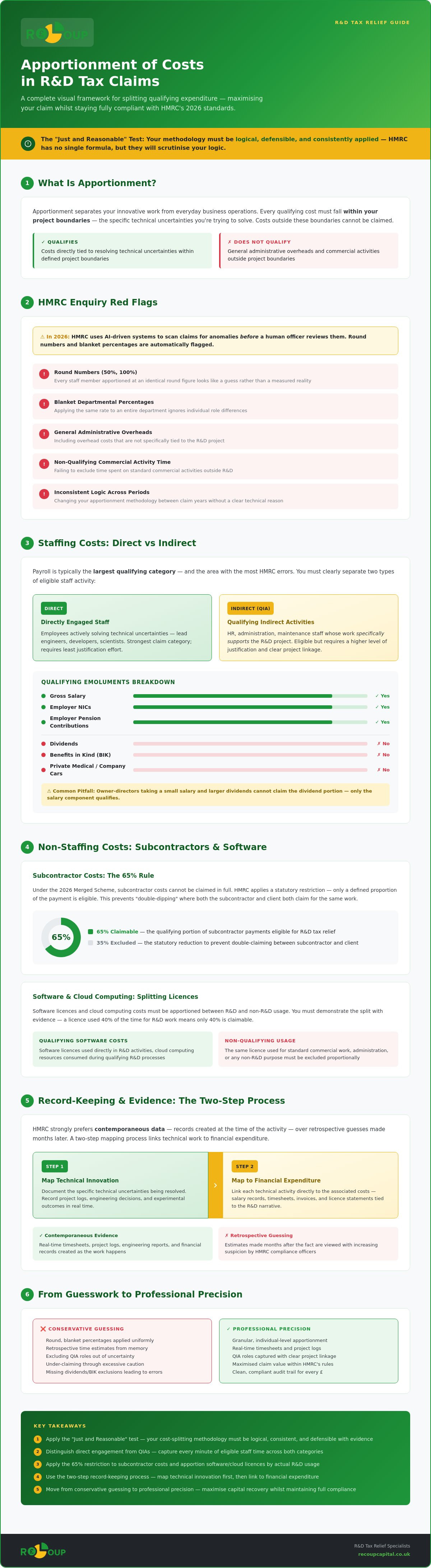
Apportionment is the mechanism that separates your innovative efforts from your everyday business operations. It's not just about splitting a bill; it's about identifying exactly where your capital is driving technical advancement. In the context of the UK R&D tax incentive, getting the apportionment of costs in R&D claims right is the difference between a successful return and a stressful enquiry. Before diving into the spreadsheets, you should ensure you have the foundational project context by reviewing how R&D tax credits are explained. Everything starts with "Project Boundaries." These define the specific technical uncertainties you're trying to solve. If a cost falls outside these boundaries, it simply cannot be claimed.
The Just and Reasonable Requirement
HMRC doesn't provide a rigid formula for cost allocation. Instead, they apply the "Just and Reasonable" test. This means your methodology must be logical, defensible, and consistently applied across your business. There's no single "correct" way to split a salary or a software licence, but there are certainly ways that will trigger an auditor's interest. Subjective estimates made months after the fact are increasingly viewed with suspicion by compliance officers. HMRC prefers contemporaneous data, such as real-time timesheets or project logs, over retrospective guesses. Consistency is also vital. If you change your apportionment logic between claim periods without a clear technical reason, you invite unnecessary scrutiny.
Why Apportionment is an HMRC Enquiry Trigger
In 2026, HMRC has significantly advanced its compliance toolkit. They now use AI-driven systems to scan claims for anomalies before a human officer even sees them. One of the biggest red flags is the use of "round numbers." If every staff member in your claim is apportioned at exactly 50% or 100%, the system flags it as potential "claim padding." It looks like an estimate rather than an accurate reflection of reality. HMRC officers are looking for granularity. They want to see that you've considered the specific activities of each individual. The shift towards more rigorous reporting requirements means you must justify your logic with evidence. Common pitfalls that trigger enquiries include:
- Applying blanket percentages across entire departments.
- Including general administrative overheads in the R&D pot.
- Failing to exclude time spent on non-qualifying commercial activities.
- Inconsistent apportionment between similar roles within the same project.
The goal is to build a claim that is both ambitious and bulletproof. By moving away from "best guesses" and towards a structured, evidence-based framework, you protect your business whilst ensuring you receive every penny of the tax relief you've earned through your innovation.
Apportioning Staffing Costs: Direct vs Indirect Activities
Staffing costs are the engine room of your claim. For most UK businesses, payroll expenditure represents the largest qualifying category, yet it's also the area where HMRC finds the most errors. The apportionment of costs in R&D claims requires a meticulous look at your payroll data to separate qualifying innovation from standard commercial operations. You must distinguish between staff who are "Directly Engaged" in solving technical uncertainties and those performing "Qualifying Indirect Activities" (QIAs). QIAs are activities that support the R&D process but do not directly resolve technical uncertainty. This includes roles in HR, administration, or maintenance, provided their work specifically supports the R&D project. Whilst these support roles are eligible, they require a different level of justification than your lead engineers.
Qualifying Staffing Emoluments
To build a compliant claim, you must understand exactly what constitutes a "qualifying emolument." This includes gross salary, employer National Insurance contributions (NICs), and employer pension contributions. You should refer to the HMRC guidance on staffing costs to ensure your calculations align with their manual. It's vital to remember that dividends are strictly excluded. This is a common pitfall for owner-directors who take a small salary and larger dividends. Similarly, bonuses and benefits in kind (BIK), such as private medical insurance or company cars, are generally excluded from the apportionment logic. We focus on the core, payroll-processed costs that directly relate to the period of innovation.
Calculating the Percentage of R&D Time
The "split-role" challenge is where many claims falter. Very few employees spend 100% of their time on R&D. Most juggle project work with sales, general management, or customer support. To handle this, you need a robust methodology for determining time splits. Retrospective staff interviews are a common starting point, but they must be backed by evidence like project logs or meeting minutes. HMRC applies a "100% rule" in specific cases; if an employee spends 95% or more of their time on R&D, you can usually allocate 100% of their cost to the claim. Conversely, if their R&D involvement is less than 5%, it's often safer to exclude them entirely to maintain the integrity of the total figure.
If you're unsure how to split the time of a director who manages both innovation and business development, our team can help you professionalise your R&D claim to ensure every minute is accounted for accurately. Professionalising this process transforms a daunting administrative task into a streamlined opportunity for capital recovery.
Apportioning Non-Staffing Costs: Subcontractors and Software
Whilst staffing costs often form the backbone of a claim, the apportionment of costs in R&D claims for non-staffing items is where technical precision truly pays off. In modern innovation cycles, expenditure on external expertise and digital infrastructure can be substantial. However, these costs are subject to specific statutory restrictions and apportionment rules that differ significantly from payroll. Failing to apply these correctly doesn't just risk an enquiry; it often means leaving thousands of pounds in unclaimed relief on the table.
Subcontractors and Externally Provided Workers (EPWs)
Distinguishing between a subcontractor and an EPW is essential for accurate apportionment. A subcontractor is typically a third-party entity hired to perform a specific technical task or deliver a defined outcome. For unconnected subcontractors, you can generally only claim 65% of the relevant expenditure. If a subcontractor provides an invoice covering both R&D and standard commercial work, you must first apportion the invoice to find the R&D element before applying the 65% statutory reduction. Conversely, EPWs are individuals provided by a staff provider (like an agency) who work under your direct supervision. Whilst the 65% rule also applies to unconnected EPWs, the logic for their inclusion is based on their time spent on qualifying activities rather than a specific project deliverable. For connected parties, the rules shift; the claim is limited to the lower of the payment made or the actual cost incurred by the connected entity, requiring "arm's length" pricing transparency.
Software, Cloud Computing, and Consumables
The 2026 compliance landscape places a heavy emphasis on digital infrastructure. Software licences used for CAD, simulation, or project management must be apportioned based on their usage split between R&D and general business operations. A primary focus for HMRC now involves cloud computing and data costs. You can claim for data, compute, and storage costs, but you must have a defensible methodology for splitting these. For instance, an AWS or Azure bill should be apportioned by separating development environments (qualifying) from production environments (non-qualifying).
Beyond the digital realm, you must also consider the apportionment of consumable items. This includes materials, fuel, and utilities that are "consumed or transformed" during the R&D process. If you use a prototype material that later becomes part of a commercial product, it's no longer considered a consumable. For businesses in manufacturing or engineering, these costs can be significant. Whilst R&D claims cover these revenue expenditures, don't forget that physical assets like machinery or specialised labs may qualify for capital allowances, providing another vital route for capital recovery. Balancing these different tax reliefs ensures your business maximises its financial return across every facet of its innovative activity.
Record-Keeping and Evidencing Your Apportionment
Evidence is the bridge between your technical innovation and your financial return. Without a robust trail of documentation, even the most legitimate apportionment of costs in R&D claims can crumble under HMRC scrutiny. In 2026, the burden of proof rests firmly on the claimant. You must demonstrate that your cost-splitting methodology isn't just a convenient estimate but a logical reflection of your business reality. Building this evidence doesn't have to be an administrative nightmare if you follow a structured, five-step framework:
- Step 1: Identify Project Boundaries – Clearly define the start and end dates for every R&D project to ensure costs aren't claimed for periods of standard production.
- Step 2: Map Resources – Assign specific staff members, subcontractors, and software licences to the relevant technical work streams.
- Step 3: Establish Apportionment Logic – Choose a defensible metric for splitting costs, such as time spent (for staffing), headcount (for certain overheads), or floor space (for specific utilities).
- Step 4: Formalise the Technical Report – Document the technical uncertainties and how the apportioned costs directly contributed to resolving them.
- Step 5: Annual Review – Re-evaluate your logic at the end of each financial year to account for changes in staff roles or project directions.
Contemporaneous Records vs Retrospective Estimates
HMRC considers real-time records the "gold standard" of evidence. Whilst timesheets aren't a strict legal requirement, they are incredibly difficult for compliance officers to challenge. If your business doesn't use traditional timesheets, you can leverage project management logs from platforms like Jira, Trello, or Azure DevOps. These provide a digital footprint of activity that mirrors your technical timeline. For businesses where tracking every minute is impractical, "sampling" can be an effective alternative. This involves using a representative period, perhaps one month per quarter, to establish a credible annual apportionment. This data-driven approach carries far more weight than a retrospective guess made months after the work was completed.
Dealing with HMRC Enquiries into Apportionment
If HMRC challenges your claim, they'll focus heavily on your cost splits. They're looking for inconsistencies or "claim padding" where general business expenses have been swept into the R&D pot. The best defence is a pre-prepared Methodology Document. This internal paper should outline exactly why you chose your apportionment percentages and what evidence supports them. Common pitfalls that trigger enquiries include a total lack of granular detail or claiming high percentages for indirect staff without clear justification. By preparing for an enquiry before you even file, you ensure your claim is both ambitious and resilient.
If you're worried that your current record-keeping wouldn't survive a compliance check, you can professionalise your R&D claim process with our specialist support. We help you build the "just and reasonable" frameworks that HMRC expects to see in 2026, transforming your documentation into a strategic asset.
Maximising Claim Value Whilst Maintaining Compliance
Mastering the apportionment of costs in R&D claims is ultimately a strategic balancing act. You want to capture the full value of your innovation without stepping outside the bounds of HMRC’s evolving 2026 regulations. While it's tempting to take a cautious approach to avoid scrutiny, being overly conservative often results in significant amounts of capital being left on the table. This missed funding could otherwise be reinvested into your next project, used to scale your operations, or even to support community initiatives like the Rohingya Association UK. Professionalising your claim ensures that you aren't just guessing, but are instead using a defensible, evidence-based methodology.
The Risk of Over-claiming vs Under-claiming
Generalist accountants often play it too safe. Because they lack the deep technical knowledge required to understand complex engineering or software uncertainties, they often under-claim to stay "safe." This caution comes at a high price for your bottom line. Conversely, over-claiming without a robust rationale can lead to rejected claims and heavy financial penalties from HMRC. The Apportionment Gap is the discrepancy between the conservative costs a business believes it can claim and the actual qualifying expenditure identified by a technical specialist. Bridging this gap requires an external audit of your logic to ensure every eligible penny is captured whilst maintaining absolute compliance. An external review provides the reassurance that your apportionment of costs in R&D claims will withstand the most rigorous HMRC enquiry.
How Recoup Capital Professionalises the Process
Recoup Capital acts as your protective guide through these regulatory complexities. We provide an end-to-end service that moves beyond simple data entry to conduct deep-dive technical interviews with your team. This allows our specialists to identify "hidden" qualifying indirect activities amongst your staff that are frequently overlooked by those less familiar with the nuances of R&D legislation. Our approach transforms an intimidating procedure into an approachable opportunity for business growth. We handle the onerous record-keeping and apportionment logic, ensuring your claim is both ambitious and resilient.
The reassurance of our success-based fee model means there is no upfront risk for your business; we only win when you do. This aligns our outcomes perfectly with yours, focusing on delivering a high-quality, compliant result that reflects the true scale of your innovation. Our proven track record in managing HMRC enquiries means you can move forward with confidence, knowing your claim is backed by chartered tax accountants and technical specialists. Ready to transform your innovation into a strategic business asset? You can claim R&D tax credits with the professional support needed to maximise your return whilst staying fully compliant.
Securing Your Innovation with Precise Cost Allocation
Precision in the apportionment of costs in R&D claims is no longer optional; it's a strategic necessity for UK businesses aiming for growth in 2026. By moving away from "round-number" estimates and adopting a defensible, evidence-based methodology, you protect your capital and your reputation. Whether you're splitting cloud computing bills or mapping the time of multi-functional staff, the goal is a claim that is both ambitious and bulletproof.
This need for professional rigour is mirrored in other specialist fields; for instance, when property assets are involved in estate administration, an RICS-compliant valuation from winfieldssurveyors.co.uk ensures the figures are accurate and defensible.
We specialise in professionalising this process for high-compliance sectors like construction and engineering. Our team of expert chartered tax accountants and technical specialists handles the onerous record-keeping on your behalf, ensuring your logic meets the "just and reasonable" test. With our success-based fee model, there's no upfront risk to your business. You can book a free R&D assessment with Recoup Capital today to identify your "Apportionment Gap" and secure the funding your innovation deserves. Let's transform your technical breakthroughs into long-term strategic assets.
Frequently Asked Questions
Is there a standard percentage I can use for R&D apportionment?
No standard percentage exists because HMRC requires every claim to be "just and reasonable" based on your specific business activities. Using a blanket figure like 50% across a department is a primary trigger for an enquiry. Instead, you must calculate percentages based on individual activity and technical project involvement to ensure the apportionment of costs in R&D claims is accurate and defensible.
Can I claim 100% of a director’s salary if they only work on R&D?
You can claim 100% of a director’s salary, but it's exceptionally difficult to justify to HMRC. Even the most technical directors usually spend time on statutory duties, business development, or general administration. HMRC generally accepts a 100% allocation only if the individual spends at least 95% of their time on qualifying activities; otherwise, a split is necessary to reflect their non-R&D responsibilities.
How do I apportion costs for staff who were furloughed or on sick leave?
Staff costs for periods where an employee wasn't working, such as furlough or extended sick leave, are typically excluded from the R&D calculation. For standard holiday or short-term sick pay, you usually apply the same apportionment percentage as their active working time. The key is ensuring you only claim for emoluments paid for the performance of R&D duties rather than general absence.
What evidence does HMRC expect for software cost apportionment?
HMRC expects clear evidence that links software expenditure to your technical projects. This could include licence assignments for specific R&D staff or usage logs for development environments. For cloud computing, a common methodology involves splitting your AWS or Azure invoices by isolating development and testing servers from those used for commercial production. Clear documentation of this logic is vital for compliance.
Can I apportion rent and utility bills in my R&D claim?
You cannot claim for rent or rates, as these aren't qualifying expenditures under UK R&D rules. However, you can apportion utility bills like water, fuel, and power if they're consumed during the R&D process. This is often calculated using a floor-space methodology for the specific area where the innovation takes place, such as a lab or workshop, rather than the entire office.
How far back can I go to correct an apportionment error in a previous claim?
You generally have two years from the end of the relevant accounting period to amend a Corporation Tax return. If you discover you've made an error in the apportionment of costs in R&D claims, you should act quickly to file an amendment. Correcting these errors proactively is always better than waiting for HMRC to uncover them during a compliance check, which could lead to penalties.
Do I need timesheets for every employee included in the claim?
Timesheets aren't a strict legal requirement, but they're the most effective way to evidence time allocation. If you don't use them, you must provide alternative evidence like project management logs, meeting minutes, or periodic management assessments. HMRC needs to see a logical trail that proves your cost splits aren't just retrospective guesses made at the end of the year.


