

Could a simple "guesstimate" of your engineering team's hours be the single biggest trigger for an HMRC enquiry this year? With the R&D tax landscape shifting toward the new merged scheme and its 20% taxable credit, the margin for error has vanished. We understand that your technical staff often resist traditional timesheets, viewing them as a barrier to actual innovation. It's a common frustration to feel that you're losing out on significant capital recovery simply because the line between routine commercial work and qualifying research feels blurred.
This guide will show you how to implement time tracking for R&D tax credits that satisfies the most rigorous HMRC standards whilst actually increasing your total claim value. You don't need to choose between compliance and productivity. We'll explore the latest 2026 evidentiary requirements and provide a practical roadmap for capturing every qualifying minute without creating an administrative burden. By the end of this article, you'll have a clear strategy to protect your business and transform your R&D records into a strategic financial asset.
Key Takeaways
- Understand why HMRC views staff costs as the most critical element of your claim and how precise records prevent costly enquiries.
- Distinguish between direct R&D tasks and qualifying indirect activities to ensure no eligible hour is left unclaimed.
- Master the "Gold Standard" of time tracking for R&D tax credits by choosing the right methodology between contemporaneous logs and retrospective apportionment.
- Learn how to use your time records as robust defensive evidence to meet the legal burden of proof during an HMRC audit.
- Discover how expert data validation can transform your raw time logs into a strategic asset that maximises your total capital recovery.
The Role of Time Tracking in HMRC R&D Tax Credit Compliance (2026)
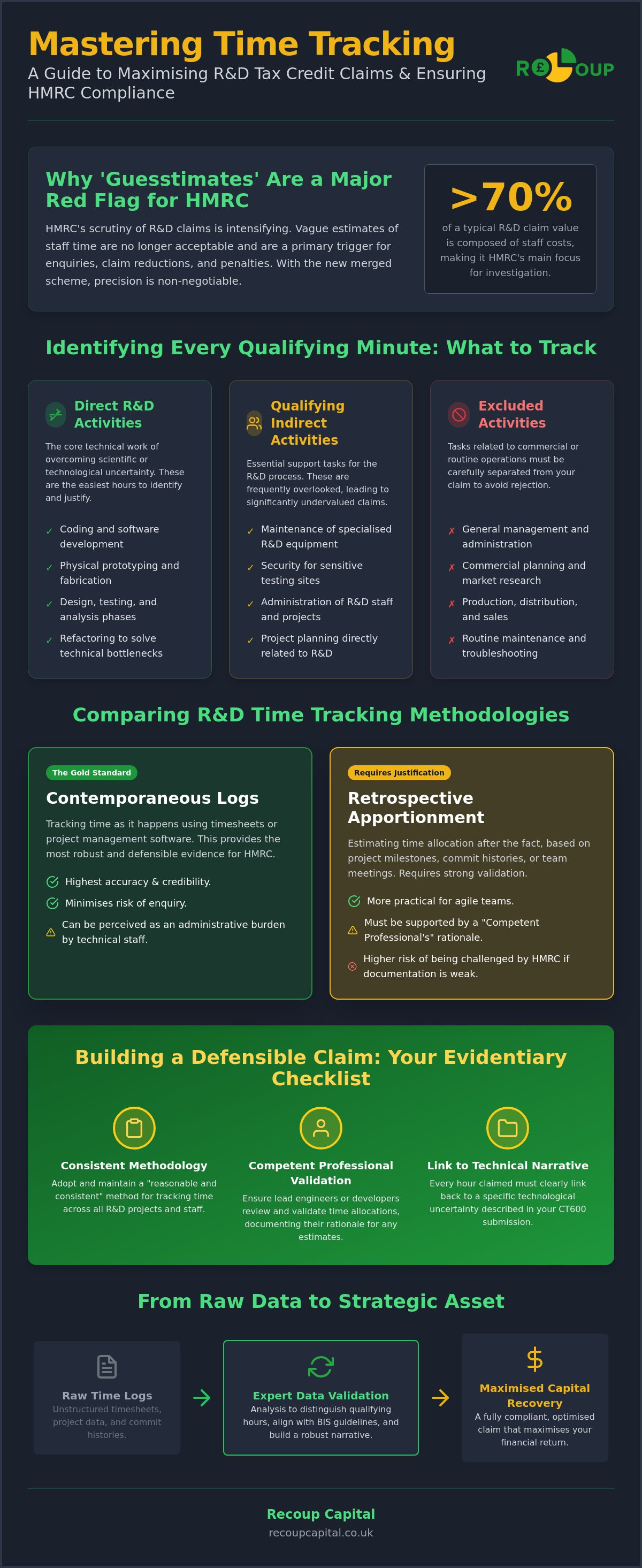
HMRC views time tracking for R&D tax credits as the evidentiary bedrock of a robust claim. It is the formal process of documenting exactly how many hours your team dedicated to projects aimed at overcoming scientific or technological uncertainty. Since staff salaries typically represent the largest portion of any claim, often exceeding 70% of the total value, HMRC focuses its scrutiny here. The UK's R&D tax incentive remains one of the most generous in the world, but its continued utility for your business depends entirely on transparency.
HMRC expects a "reasonable and consistent" methodology. This doesn't mean every second must be logged in a stopwatch app, but it does require a logical, evidence-based approach that can withstand a formal enquiry. When you are claiming R&D tax credits, the accuracy of your apportionment determines your risk profile. Poor record-keeping is no longer a minor administrative oversight; it's a primary trigger for claim reductions and significant financial penalties. In the current 2026 regulatory environment, "guesstimates" are often viewed as a red flag for non-compliance.
Understanding the BIS Guidelines and Staff Apportionment
The Department for Business, Innovation and Skills (BIS) provides the framework for what constitutes qualifying work. Success depends on your ability to distinguish between "direct" R&D, such as coding or physical prototyping, and "indirect" activities like project planning or essential maintenance. Every hour logged must link back to the technical narrative of your CT600 submission. If your records don't clearly demonstrate how a developer's time was spent resolving a specific technological bottleneck, HMRC may exclude those costs entirely. This connection ensures your financial data matches the technical reality of your innovation.
The "Competent Professional" Test in Time Allocation
HMRC places significant weight on the judgement of your lead engineers or developers. These individuals are often the best placed to determine which tasks were routine and which were truly experimental. If contemporaneous logs are incomplete, documenting the rationale behind their estimates becomes vital. This documentation should explain the methodology used to reconstruct hours, such as reviewing commit histories or project milestones. A competent professional is an individual with relevant technical expertise who possesses the knowledge to judge whether a specific task involved resolving technological uncertainty. Their validation provides the professional authority that transforms a simple spreadsheet into a compliant audit trail.
Identifying Qualifying Activities: What Time Can You Actually Claim?
Determining which hours to log is where many businesses inadvertently leave money on the table. Effective time tracking for R&D tax credits requires a granular understanding of which activities meet the statutory definition of innovation. Direct activities are often the easiest to identify; these include the core design, testing, coding, and physical prototyping phases where your team is actively battling a technical challenge. When a developer spends three days refactoring code to handle an unforeseen data throughput bottleneck, every one of those seconds is a strategic asset for your claim.
However, the real opportunity often lies in Qualifying Indirect Activities (QIAs). These are support tasks essential to the R&D process but not part of the core technical work. Think of the maintenance of specialised R&D equipment, security for a sensitive testing site, or the administrative effort required to manage R&D staff. Whilst general management and commercial planning are strictly excluded, these QIAs are frequently overlooked, leading to undervalued claims. Identifying these shifts is why we often suggest businesses evaluate your qualifying projects with a specialist eye to ensure no eligible hour is ignored.
Excluded time is just as important to document as qualifying hours. Costs associated with general management, commercial planning, and the eventual production or distribution of the finished product must be filtered out. HMRC is particularly vigilant regarding "blended" roles where an employee might move between R&D and commercial tasks throughout the day. This is why a simple percentage split without a documented rationale is often challenged. The "Substantial Modification" rule also provides a pathway for claimable time; if a standard product requires a fundamental technical rewrite to function in an unprecedented environment, those routine hours can transform into qualifying R&D.
Capturing Technical Uncertainty vs. Routine Development
Staff need to be trained to recognise the moment they move from "business as usual" to resolving technical uncertainty. In the construction sector, this might be the time spent developing a bespoke structural solution for an unstable site that defies standard building codes. In engineering, it could be the hours lost to failed iterations of a high-tolerance component. You can find more details on these sector-specific distinctions in our guide to R&D tax credits explained.
Capturing Support Staff and Supervisory Time
Can your project managers claim? The answer depends on the "Direct Supervision" rule. HMRC allows for the inclusion of time spent by first-line supervisors who are directly engaged in the technical direction of the project. This is distinct from higher-level management which focuses on budgets or HR. According to the HMRC guidance on staffing costs, even administrative staff can have their time apportioned if their work specifically supports the R&D function, such as managing the specific payroll or resource scheduling for a dedicated research team.
Comparing R&D Time Tracking Methodologies: Logs vs. Apportionment
Choosing the right methodology for time tracking for R&D tax credits is a strategic decision that balances administrative ease with audit resilience. HMRC doesn't mandate a specific software or format, but they do require a clear, logical trail that connects staff costs to technical innovation. Contemporaneous logs, where time is recorded as the work occurs, remain the "Gold Standard" for compliance. These logs provide the most robust defence during an enquiry because they eliminate the "memory fade" that often leads to undervalued or over-inflated claims. According to HMRC guidance on qualifying staffing costs, the burden of proof rests entirely on the claimant to justify the apportionment of every hour.
If your business hasn't maintained real-time records, you can still build a compliant claim using retrospective apportionment. This method involves reconstructing a "reasonable" estimate of time spent on qualifying projects after the period has ended. Some firms also employ sampling methods, tracking time meticulously during "representative periods", such as one month per quarter, to calculate a reliable annual percentage. To strengthen these estimates, we recommend using project management software like Jira or Trello as secondary evidence. These tools provide a digital footprint of technical challenges, commit histories, and task durations that validate the "why" behind your staff cost allocations.
Pros and Cons of Real-Time vs. Weekly Timesheets
Real-time timers offer the highest accuracy and often capture "lost" hours that staff forget by Friday afternoon. However, they can create a high administrative burden that technical teams sometimes resist. Weekly timesheets are a common middle ground, though they carry a higher risk of estimation errors. To streamline this, consider implementing "R&D-only" flags in your existing payroll or HR systems. This allows staff to tick a box when a task involves resolving technical uncertainty, making the final data extraction far more efficient for your tax submission.
Building a Robust Retrospective Methodology
When logs are missing, you must rely on a forensic reconstruction using calendars, sent emails, and software commit logs. The "Interview Method" is particularly effective here; it involves documenting formal testimony from your technical leads about the time their teams dedicated to specific R&D milestones. This qualitative evidence, when paired with a logical quantitative breakdown, creates a defensive shield for your claim. For more on how digital evidence is evolving, you may find our insights on HMRC R&D Tax Claim Transparency and AI useful for your 2026 planning.
Preparing for an HMRC Enquiry: Using Time Records as Defensive Evidence
An HMRC enquiry doesn't have to be a daunting prospect if your data is prepared. In 2026, HMRC is applying a higher level of scrutiny to R&D claims to combat system abuse; this means your records must be more than just persuasive. They must be bulletproof. During a record check, an inspector will typically ask for a granular breakdown of staff costs to understand how your financial figures translate into technical reality. They want to see the specific hours that correspond to the resolution of technical uncertainties you've described in your narrative.
The burden of proof rests entirely on your shoulders. You must be able to justify every hour claimed. Proof is your best protection. This involves cross-referencing your time tracking for R&D tax credits with payroll data and internal technical project reports. If an inspector sees that a lead engineer's time is split between a qualifying R&D project and a routine commercial contract, they will expect to see the logic behind that split. Without a documented rationale, HMRC may default to a lower qualifying percentage, significantly reducing your capital recovery.
Managing "mixed-role" employees requires a proactive approach. These individuals often perform both R&D and commercial duties, making their time logs a primary target for HMRC questions. We recommend maintaining a contemporary record of their shifting responsibilities to prevent any ambiguity. If you are concerned about how your current records might hold up under inspection, it may be time to review your claim's defensive strength with a specialist who understands the 2026 regulatory landscape.
The Technical Narrative and Time Log Alignment
Your technical narrative and your time logs must tell the same story. If you describe a project as a breakthrough in engineering but only log a handful of hours, an inspector will likely flag the discrepancy. Conversely, claiming thousands of hours for a project described as a minor technical adjustment will trigger an enquiry. You should ensure that the hours claimed match the complexity described in your technical reports. Understanding why claim R&D tax credits with such precision is essential for long-term compliance and peace of mind.
Common Red Flags in HMRC Time Audits
HMRC looks for specific patterns that suggest "guesstimated" data. Claiming 100% R&D time for multiple staff members is a major red flag, as it's rare for employees to have no commercial or administrative duties. Round numbers are another warning sign; an inspector will be suspicious of any log that shows exactly 10 or 20 hours every single week. Finally, using the same apportionment percentages year-on-year suggests that you haven't actually reviewed the technical work performed during the period. Real innovation is rarely that predictable.
How Recoup Capital Maximises Claims through Data Validation
Recoup Capital takes a forensic approach to time tracking for R&D tax credits. We don't simply accept a spreadsheet of hours; we validate the technical truth behind every entry. Our team includes chartered tax accountants who understand how to translate complex engineering or software milestones into the specific language HMRC requires. This ensures your claim is both maximised for capital recovery and robustly protected against potential enquiries. By identifying hours that internal teams often overlook, such as qualifying indirect activities or first-line supervision, we transform your raw data into a high-value strategic asset.
Our success-based fee structure ensures our goals are perfectly aligned with yours. We only benefit when your claim is accurately maximised and successfully processed. This partnership-oriented model removes the financial risk of exploring a claim and demonstrates our confidence in delivering results. We possess specialised knowledge in high-complexity sectors, including construction, engineering, and food technology. Whether you're navigating the merged R&D scheme or managing intensive projects, we handle the heavy lifting of the technical assessment and HMRC liaison.
The Recoup Capital Methodology: Beyond Simple Timesheets
Our specialists bridge the gap between your technical team and the tax office. We begin by reviewing your existing systems to identify compliance gaps that could trigger an enquiry. We don't suggest replacing your current tools; we show you how to optimise them for HMRC standards. You can learn more about Claiming R&D Tax Credits with Recoup to see how our validation process secures your innovation funding without disrupting your daily operations.
Next Steps: Securing Your Innovation Funding
The journey toward capital recovery begins with a clear understanding of your qualifying work. You can book a no-obligation consultation with our chartered tax accountants to assess your eligibility and the strength of your current records. When you're ready for your first assessment, simply bring a high-level overview of your recent technical challenges and any existing time records. We'll provide the expert guidance needed to navigate the 2026 regulatory landscape with confidence. Speak to an R&D Specialist today to discover how we can help you turn your technical uncertainties into business growth.
Transform Your Technical Data into a Strategic Financial Asset
Precision is no longer optional in the 2026 tax landscape. By moving beyond guesstimates and adopting a robust methodology for time tracking for R&D tax credits, you protect your business from the risks of an HMRC enquiry whilst ensuring every qualifying hour is recovered. We've explored how identifying indirect activities and aligning your logs with a technical narrative creates a defensive shield for your claim. This transition from administrative burden to strategic asset isn't just about compliance; it's about securing the capital your business needs to continue innovating.
At Recoup Capital, our team of Chartered Tax Accountants acts as your protective guide through these regulatory complexities. We specialise in construction and engineering sectors, providing the forensic oversight required to HMRC-proof your data. Our success-based fee model ensures that we are long-term partners in your growth, focused entirely on your bottom line. You don't have to handle the heavy lifting alone. Maximise your R&D claim with an expert technical assessment from Recoup Capital and turn your technical uncertainties into a catalyst for future success.
Frequently Asked Questions
Is time tracking a legal requirement for R&D tax credits?
No, there's no specific statutory requirement to use a stopwatch or formal timesheets for R&D tax relief. However, the burden of proof rests entirely on your business to justify the costs claimed. Without some form of time tracking for R&D tax credits, defending your figures during an HMRC enquiry becomes significantly harder. HMRC expects you to demonstrate a logical, evidence-based foundation for your staff cost allocations.
Can I claim R&D tax credits if I do not use timesheets?
Yes, you can still submit a claim without formal timesheets, but you must use a robust retrospective apportionment methodology. This involves reconstructing hours using secondary evidence such as calendar entries, project milestones, and technical lead testimony. Whilst this is common for first-time claimants, we usually recommend moving toward contemporaneous records for future periods to minimise your risk profile during an audit.
What counts as a "reasonable" method for estimating R&D time?
A "reasonable" method is one that is logical, consistent, and based on verifiable facts rather than guesswork. This might involve using a representative sampling period to determine an annual percentage or conducting formal interviews with engineers to document their time allocation. The key is to provide a clear rationale that explains exactly how you separated qualifying technical work from routine commercial duties.
Can I claim for the time spent on unsuccessful R&D projects?
Absolutely. R&D tax credits are awarded for the process of seeking an advance in science or technology, regardless of whether the project succeeds or fails. In fact, unsuccessful projects often provide the best evidence of technological uncertainty. They prove that the solution wasn't easily deducible by a competent professional, making every hour spent on those attempts a valid qualifying cost.
How far back can I go to track time for a retrospective R&D claim?
You can generally make a retrospective claim for up to two years after the end of the accounting period in which the expenditure occurred. This window allows you to look back at previous projects and reconstruct the necessary time tracking for R&D tax credits. Remember that for accounting periods starting after April 2023, you must notify HMRC of your intention to claim within six months of the period's end.
Does HMRC prefer specific time tracking software?
HMRC is software-agnostic and doesn't officially endorse any specific time-tracking platform. They value the quality and reliability of the data over the tool used to generate it. Whether you use specialised R&D software, project management tools like Jira, or simple spreadsheets, the focus remains on the accuracy and contemporaneous nature of the records you provide as evidence.
Can directors claim 100% of their time for R&D tax relief?
It's extremely rare for a director to spend 100% of their time on qualifying R&D activities. Directors inevitably handle commercial strategy, HR, and general administration, which are non-qualifying tasks. Claiming a full 100% is a frequent red flag for HMRC inspectors. A more realistic apportionment usually reflects the director's dual role in both technical leadership and business management.
What evidence should I keep alongside time logs for an HMRC audit?
You should maintain a technical evidence pack to support your logs. This includes project plans, emails discussing technical bottlenecks, minutes from design meetings, and version control logs for software developers. These documents provide the "technical why" that supports the "financial how much" in your time logs, creating a comprehensive and defensive audit trail for any HMRC record check.


