

What if the difference between a successful R&D claim and a stressful HMRC enquiry isn't the quality of your innovation, but the precision of your spreadsheets? With a 23% decline in SME claims following stricter compliance measures, it's clear that the "estimate and hope" approach no longer works for UK businesses. You likely feel that tracking every minute of technical uncertainty is a distraction from the real work of development. You aren't alone; many technical leaders find the administrative burden of HMRC compliance both daunting and disruptive to their teams. Learning how to track R&D project costs effectively is no longer just a bookkeeping exercise; it's a strategic necessity to protect your business and your bottom line.
By mastering the art of cost allocation, you can transform your financial records into a robust shield against regulatory scrutiny whilst unlocking the maximum reinvestment capital your innovation deserves. This guide provides a clear roadmap for the 2026 tax landscape, covering the mandatory Additional Information Form (AIF) and the nuances of the merged R&D scheme. We'll explore how to implement a system that captures every eligible penny without slowing down your engineers, ensuring your next claim is both maximised and bulletproof.
Key Takeaways
- Understand why the 2026 regulatory landscape demands a shift from general bookkeeping to precise, project-level reporting for all R&D activities.
- Master how to track R&D project costs effectively by using dedicated project codes to isolate qualifying expenditure at the point of purchase.
- Identify the most reliable methods for apportioning staff time and overheads whilst maintaining the "just and reasonable" standard required by HMRC.
- Prepare for the mandatory Additional Information Form (AIF) by learning how to bridge the gap between technical uncertainty and financial documentation.
- Explore how to leverage professional expertise to convert your tracked data into maximised tax credits, ensuring your innovation remains a sustainable driver for growth.
The Strategic Importance of Tracking R&D Project Costs Effectively
Is your current accounting system a strategic asset or a compliance liability? Effective R&D cost tracking is the systematic isolation of innovation-related expenditure from your general daily operations. It involves identifying the specific resources consumed whilst pushing the boundaries of what constitutes R&D within your specific industry. In the 2026 tax landscape, this level of precision isn't optional. It's the foundation of a successful claim.
HMRC has moved the goalposts. With the mandatory Additional Information Form (AIF) now a standard requirement for all claims, the tax office expects a granular breakdown of every project. They aren't looking for broad estimates or round numbers. They want to see the direct link between a specific technical challenge and the pounds spent solving it. Knowing how to track R&D project costs effectively ensures that your claim stands up to this increased transparency and survives the scrutiny of a modern audit.
There's also a direct link between tracking and your innovation runway. When you miss eligible costs because your record-keeping is loose, you're effectively leaving capital on the table. This is money that could have funded your next prototype or a new lead developer. Precise tracking transforms your R&D tax credits from a year-end bonus into a predictable, strategic stream of reinvestment capital. It provides the financial clarity needed to scale with confidence.
The Cost of Inaccuracy: Why General Bookkeeping Isn’t Enough
Lumping everything into a single "R&D Expenses" bucket in your ledger is a red flag for HMRC. Their current focus is on reducing error and fraud; vague entries suggest a lack of internal control. If you can't provide a verifiable evidence trail for every pound claimed, you risk a full enquiry. These investigations are draining. They pull your focus away from growth and can lead to financial penalties that far outweigh the original claim value. Accuracy is your best defence.
Shifting from Retrospective to Real-Time Tracking
Reconstructing a claim twelve months after the work has finished is a recipe for disaster. Memories fade, and the specific technical nuances that justify a claim are often lost. Moving to a real-time model allows you to capture data as it happens. It fosters a culture of documentation amongst your technical team, where tracking becomes a natural part of the development lifecycle. This proactive approach makes the entire process more efficient and ensures no qualifying activity is overlooked during the busy year-end period.
Building a Robust R&D Cost-Tracking Framework
Establishing a framework isn't just about data entry. It's about creating a language that both your lead developers and your finance director understand. To master how to track R&D project costs effectively, you must move beyond basic spreadsheets and into a structured system that captures data at the point of origin. This prevents the "memory gap" that often leads to under-claimed expenses or technical inaccuracies during an HMRC review.
A structured approach to daily bookkeeping is the best foundation for this; for example, you can visit Radius Regnskab to learn how professional accounting services use fixed-price models to keep financial records consistent and audit-ready.
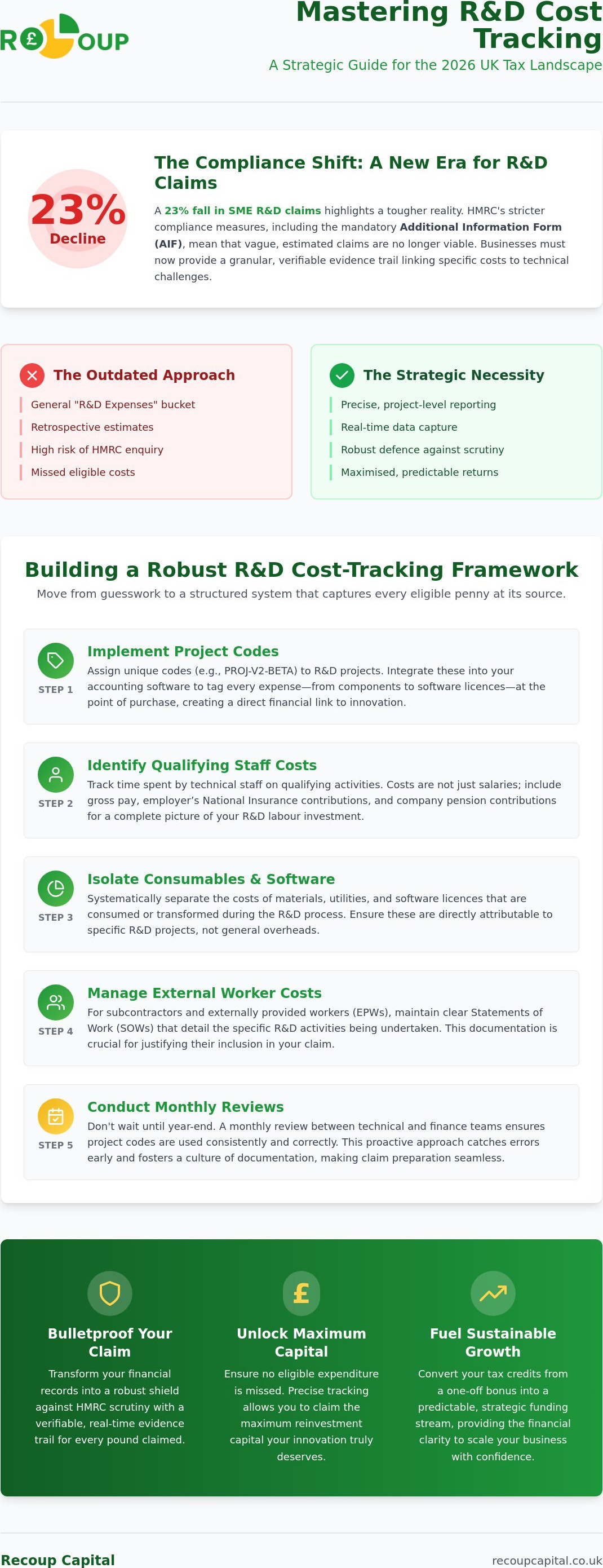
- Step 1: Implement a project code system to tag every expense at the point of purchase.
- Step 2: Identify qualifying staff costs, including gross pay, employer’s NICs, and pension contributions.
- Step 3: Separate consumables and software licences used specifically for R&D projects.
- Step 4: Manage subcontractor and externally provided worker (EPW) costs with clear Statements of Work (SOWs).
- Step 5: Conduct monthly reviews to ensure project codes are being used consistently amongst all departments.
Project Code Architecture for Innovation
Your codes should reflect the technical milestones of your project rather than just financial quarters. Using a structure like PROJ-V2-BETA allows you to link specific costs to the technical uncertainties you are trying to resolve. It's vital that your technical leads and finance team use the same nomenclature. Integrating these codes directly into your ERP or accounting software ensures that when an engineer buys a specific component or a software licence, it's automatically attributed to the correct innovation stream from day one.
Capturing Direct vs. Indirect Qualifying Costs
Direct costs are often the easiest to identify; they include the materials used in prototypes and the salaries of staff directly engaged in the research. However, many businesses overlook the broader support structure. Qualifying Indirect Activities (QIAs) are activities that support R&D but do not directly resolve the uncertainty. This might include project management, administration, or maintenance specifically tied to the R&D function. If you're unsure whether a specific expense qualifies, looking into how R&D tax credits work can clarify the boundary between standard operations and innovation.
According to HMRC guidelines on eligible R&D costs, you must also be precise with your subcontractor management. Ensure your SOWs explicitly detail the technical uncertainty the subcontractor is hired to address. This documentation is essential for justifying the claimable portion of these costs. Regular monthly reviews act as a final safety net, catching misallocated costs before they become permanent fixtures in your year-end accounts and ensuring your technical narrative remains perfectly aligned with your financial data.
Navigating Complexities: Apportioning Staff Time and Overheads
One of the most significant hurdles in a claim is the "multi-hat" employee. In many UK SMEs, a director might spend Monday morning solving a complex engineering bottleneck and Monday afternoon reviewing sales targets. HMRC understands this reality, but they require a "just and reasonable" method to separate these activities. If you are wondering how to track R&D project costs effectively when roles are fluid, the answer lies in the methodology of apportionment. You must be able to demonstrate exactly what portion of a salary relates to qualifying technical work versus general commercial administration.
While retrospective "best guesses" were once common, they are now a major liability. HMRC significantly prefers contemporaneous records created at the time the work was performed. According to the official HMRC guidance on qualifying R&D costs, the burden of proof rests on the company to justify the percentages used. Without a clear trail, you risk having your claim reduced or rejected entirely during an enquiry. This isn't just about salaries; it extends to shared resources like lab space, utilities, and even cloud computing credits used for testing environments.
The Timesheet Debate: Accuracy vs. Efficiency
Should your technical team track every minute? Daily timesheets offer the highest level of compliance, but they can be a friction point for engineers focused on deep work. Mastering how to track R&D project costs effectively often involves project-based sampling or monthly "look-back" sessions where technical leads validate the time spent against specific milestones. This ensures consistency amongst your technical leads whilst maintaining focus on development. The goal is to ensure your records don't just show "hours worked," but specifically capture the time spent grappling with technical uncertainty. This level of detail is what transforms a standard payroll report into a robust R&D evidence file.
Apportioning Overheads and Shared Expenses
Overheads like light, heat, and power can be included in your claim, but only the portion directly attributable to R&D activities. If your innovation happens in a dedicated lab, the split is straightforward. If it occurs in a shared office, you'll need a logical basis for your calculation, such as floor space or headcount. Software licences also fall into this category; if a tool is used for both R&D and standard production, you must apportion the cost accordingly. For a detailed list of what can be included, see our guide on R&D tax credits explained to ensure no eligible overhead is missed.
Documentation and Compliance: Preparing for the HMRC Additional Information Form
The 2026 regulatory environment has transformed the Additional Information Form (AIF) into the most critical component of your submission. Since August 2023, HMRC has mandated this digital form to accompany all claims, requiring a granular link between your financial figures and your technical journey. It isn't enough to simply state how much you spent; you must explain exactly why that expenditure was necessary to overcome a specific scientific or technological uncertainty. Understanding how to track R&D project costs effectively means ensuring every pound on your ledger is backed by a corresponding technical milestone in your documentation.
Generic descriptions are now a primary trigger for HMRC enquiries. Phrases like "optimising code" or "improving manufacturing efficiency" are far too vague for a modern inspector. They want to see the "Why" behind the "How much." If your records show a spike in consumable costs in July, your project logs should reflect a failed prototype or a series of rigorous trials during that same period. This alignment turns your financial data into a credible story of innovation rather than a list of abstract expenses.
The Technical Narrative: Justifying Your Spend
Your technical narrative is the defensive shield for your claim. It must document the baseline technology you started with and the specific "uncertainty" that a competent professional in the field couldn't readily resolve. When writing for an HMRC inspector, you must balance technical depth with financial clarity. They need to see that the staff time you've apportioned was spent on qualifying activities like testing, trialling, or design. To understand how these narratives impact your overall success, you can explore why claim R&D tax credits to see how documentation quality correlates with capital recovery.
Building a Defensive Evidence Trail
An enquiry-ready evidence trail is built in real-time, not reconstructed months later. For software developers, this involves robust version control logs and commit histories. For manufacturers, it means maintaining CAD drawings, meeting minutes, and testing results that document the iterative process of trial and error. Organising these documents alongside your project codes ensures that if HMRC asks for proof, you can provide it instantly. Recoup Capital acts as your protective guide here; we review your documentation to ensure it meets the highest standards of compliance before any submission is made.
Precision in your record-keeping is the difference between a strategic asset and a compliance risk. If you are ready to ensure your documentation is bulletproof, speak with our specialists today to secure your innovation funding for 2026.
Translating Project Data into Innovation Capital with Recoup Capital
Once you have established how to track R&D project costs effectively, the next step is converting those meticulously recorded figures into tangible business assets. This is where Recoup Capital steps in as your strategic partner. We don’t simply process paperwork; we conduct a forensic review of your technical and financial data to ensure your claim is both maximised and fully compliant with the latest HMRC standards. By bridging the gap between engineering reality and tax legislation, we transform your project logs into a powerful tool for capital recovery.
Our success-based fee model is a core part of our client-centric philosophy. It means we only win when you recover capital, ensuring our interests are perfectly aligned with your business growth. This approach removes the financial barrier to entry for many innovation-led companies, allowing you to access specialist expertise without upfront risk. We view each claim as the start of a long-term collaboration. We help you refine your internal systems so that future claims become even more streamlined, robust, and resilient against scrutiny.
Beyond R&D: Unlocking Further Tax Incentives
Innovation doesn’t happen in a vacuum. Often, the same projects that qualify for R&D tax credits also involve significant investment in physical infrastructure. Our team looks beyond the immediate R&D claim to identify further tax incentives that might be hiding in plain sight. For instance, we can help you unlock capital allowances for plant, machinery, or embedded fixtures within your commercial property. Additionally, if your development work involves cleaning up contaminated sites, we can explore land remediation relief to further boost your reinvestment potential. Combining these incentives creates a comprehensive corporate finance strategy that fuels your entire innovation cycle.
Your Next Steps: A No-Cost Technical Assessment
What can you expect during your first consultation? Your journey begins with a no-cost technical assessment where a Recoup Capital specialist reviews your current tracking systems. We look for technical narratives that may be missing the required depth and identify any "missed" qualifying spend that your general bookkeeping might have overlooked. We’ll provide clear, actionable feedback on your existing processes and outline a roadmap for a successful, compliant submission. If you are ready to organise your R&D finances and protect your business from the complexities of the 2026 regulatory landscape, speak to our experts today.
Securing Your Innovation Future in 2026
The 2026 tax landscape offers no room for ambiguity. By shifting from retrospective estimates to a robust, real-time framework, you protect your business from the risks of HMRC scrutiny whilst ensuring no qualifying penny is overlooked. Mastering how to track R&D project costs effectively is about more than just numbers; it's about documenting the technical journey of your innovation to secure the reinvestment capital your business deserves. Precise records don't just satisfy regulators; they provide the financial clarity needed to scale your next breakthrough with confidence.
At Recoup Capital, our team of chartered tax accountants and R&D specialists bring deep expertise across the construction, engineering, and tech sectors to ensure your claim is bulletproof. We operate on a success-based fee model, which means there is no fee unless we successfully recover your capital. If you're ready to turn your technical data into a strategic business asset, book a no-cost technical assessment with Recoup Capital today. We look forward to acting as your protective guide through the complexities of innovation funding and supporting your long-term growth.
Frequently Asked Questions
Do I need specific software to track R&D project costs effectively?
You don't need bespoke software, but your current accounting system must be organised to tag expenses as they occur. Using project codes within your existing ERP or bookkeeping package is the most reliable way to isolate innovation spend from daily operations. When you understand how to track R&D project costs effectively, your system becomes a strategic tool that simplifies the year-end claim process without requiring expensive new platforms.
Can I claim for the time my Managing Director spends on R&D projects?
Yes, you can claim for a director's time, provided they are directly engaged in qualifying technical activities. This includes roles such as technical lead, architect, or project manager where they are actively resolving scientific uncertainties. You must apportion their salary, employer’s NICs, and pension contributions based on a "just and reasonable" percentage of their total working time spent on the R&D function.
What happens if I haven’t been tracking costs and want to make a retrospective claim?
Retrospective claims are possible for any accounting period ending within the statutory two-year window. If you haven't tracked costs in real-time, you'll need to conduct a "look-back" exercise to reconstruct the technical journey. This involves reviewing emails, meeting minutes, and commit histories to provide a verifiable estimate of the resources consumed. Whilst HMRC accepts these reconstructions, they require a robust methodology to prove the costs were genuinely incurred for R&D.
How does the HMRC Additional Information Form (AIF) change how I track costs?
The AIF mandates that you link every financial figure to a specific technical narrative for each project. It requires you to categorise costs by individual project rather than as a single business-wide total. This makes real-time tracking essential, as you must now provide detailed descriptions of the technical uncertainties faced for up to ten projects, covering at least 50% of your total qualifying expenditure.
Are subcontractor costs tracked differently from internal staff costs?
Yes, subcontractor costs are generally restricted to 65% of the qualifying expenditure for tax relief purposes. You must also ensure you have clear Statements of Work (SOWs) that define the technical nature of their contribution. Unlike internal staff, where you track NICs and pensions, you only track the gross invoice amount specifically related to the R&D activity. Be mindful of new 2026 restrictions regarding overseas subcontractor spend.
Can I include cloud computing and data costs in my R&D project tracking?
Yes, cloud computing and data licence costs are eligible qualifying expenditures for innovation projects. If these resources are shared across the business, you must apportion the costs based on actual usage for R&D testing or development environments. This is particularly relevant for software companies where server costs often represent a significant portion of the technical uncertainty being resolved during high-scale testing phases.
How detailed do my timesheets need to be for an R&D tax credit claim?
Your timesheets should be detailed enough to show the technical nature of the work performed. HMRC prefers records that distinguish between solving a scientific uncertainty and routine maintenance. Learning how to track R&D project costs effectively involves ensuring your team records their time against specific project milestones. This provides a verifiable evidence trail that justifies the apportioned staff costs during an enquiry.
What is the difference between direct R&D costs and qualifying indirect activities?
Direct costs include salaries and materials used directly in the resolution of technical uncertainty. Qualifying indirect activities (QIAs) support the R&D process but aren't the primary research themselves. This includes essential tasks like project administration, maintenance of R&D equipment, and certain training activities specifically required for the project. Both are claimable, but they must be tracked and apportioned with equal precision to satisfy HMRC requirements.


