

Your 2026 R&D claim isn't just a tax filing; it's a strategic narrative of innovation that must survive the most rigorous HMRC scrutiny to date. You've likely felt the weight of the shift toward the Merged Scheme or the complexities of the 30% intensity threshold for ERIS. It's natural to worry about potential enquiries or the challenge of documenting technical uncertainties in sectors where they aren't always obvious. The days of light-touch applications are over, but that doesn't mean the opportunity for growth has diminished.
This R&D tax credit claim checklist 2026 provides the clarity you need to transform that anxiety into a definitive roadmap for capital recovery. We promise a comprehensive, HMRC-aligned guide that ensures you maximise your claim whilst remaining fully compliant. We'll explore the mandatory Additional Information Form (AIF) requirements, the latest restrictions on overseas expenditure, and how to reframe your tax relief as a strategic asset for your company's long-term success.
Key Takeaways
- Understand the shift towards HMRC's evidence-led model and why the Merged Scheme is now the primary path for most UK businesses.
- Utilise our R&D tax credit claim checklist 2026 to verify that your project qualifies as a genuine scientific or technological advance rather than a purely commercial one.
- Learn how to accurately categorise qualifying expenditure and navigate the strict new limitations on overseas subcontractor costs.
- Discover how to draft a technical narrative that meets HMRC's rigorous standards, including the mandatory disclosure of AI-generated documentation.
- Reframe your tax relief as a strategic asset by exploring the powerful synergy between R&D credits and Capital Allowances for long-term growth.
Navigating the 2026 R&D Tax Landscape: Why Compliance is Non-Negotiable
The UK tax landscape has undergone its most significant shift in a generation. The focus is no longer on simply submitting a claim; it's about proving the underlying technical merit. HMRC has moved away from a process-driven approach toward an evidence-led enquiry model. This means every entry on your R&D tax credit claim checklist 2026 must be backed by robust, contemporaneous documentation. If you can't prove the technical uncertainty, the credit simply won't stand.
Inaccurate claims carry risks that extend far beyond a rejected application. HMRC can levy significant penalties for "careless" or "deliberate" inaccuracies. These financial hits can cripple the very innovation the scheme was designed to support. Instead of viewing this as a hurdle, successful firms treat the process as a strategic audit. It's a chance to map out your company's innovative capacity and ensure your technical roadmap aligns with your financial goals. A well-prepared claim is a reflection of a well-run, innovative business.
The Merged Scheme vs ERIS: Which Path for Your Business?
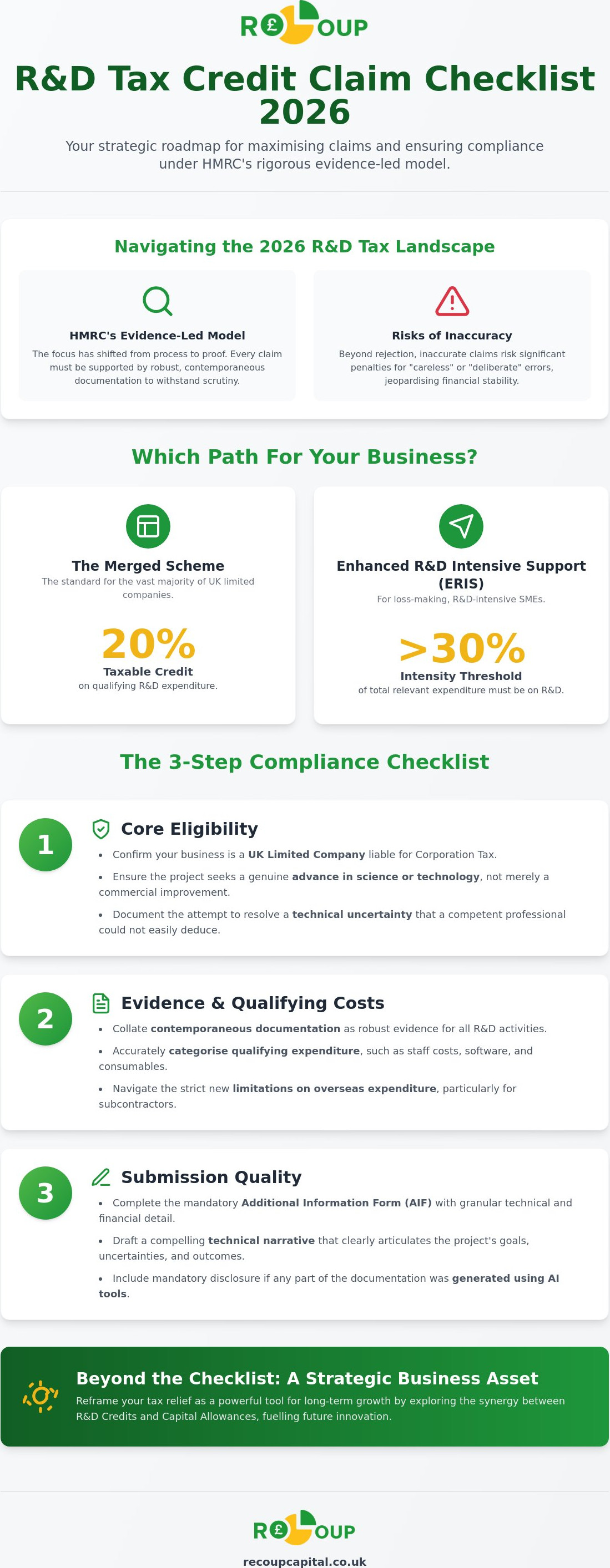
By 2026, the Merged Scheme has become the standard for the vast majority of UK limited companies. It offers a 20% taxable credit on qualifying expenditure, providing a predictable return for both large and small entities. However, loss-making SMEs with high R&D intensity may still access the Enhanced R&D Intensive Support (ERIS). To qualify for ERIS, your relevant expenditure must meet a 30% intensity threshold. Understanding which path applies is the first step in any UK R&D Tax Credits strategy, as the rates directly dictate your reinvestment potential.
HMRC’s New Transparency Standards
The Additional Information Form (AIF) is now the non-negotiable gateway for every submission. It requires granular detail that often goes beyond what generalist accountants can provide. Whilst a standard accountant is excellent for bookkeeping, they frequently lack the technical background to identify the scientific advances HMRC expects. This gap is where many claims fail. To get the full picture of the requirements, you can find R&D tax credits explained in our detailed guide. Using a dedicated R&D tax credit claim checklist 2026 ensures that no technical nuance is overlooked before the AIF is submitted.
Step 1: The Core Eligibility Checklist for UK Limited Companies
Before diving into the numbers, you must establish the legal and technical foundation of your claim. To sit on the right side of HMRC’s current standards, your business must be a UK Limited Company liable for Corporation Tax. This is a non-negotiable starting point for any R&D tax credit claim checklist 2026. However, the real challenge lies in distinguishing a commercial advance from a technological one. Simply making a product more marketable or user-friendly isn't enough; you must be pursuing a genuine advance in science or technology.
The official HMRC guidance specifies that you must be resolving a technical uncertainty. This uncertainty cannot be something that is "readily deducible" by a competent professional in your field. If your team knew exactly how to reach the finish line before they started, the project likely won't qualify. Using a structured R&D tax credit claim checklist 2026 allows you to isolate these uncertainties before they get lost in the noise of daily operations. Every project you include must relate directly to your company’s trade, whether it’s an existing revenue stream or a new venture you intend to launch.
Defining the "Competent Professional"
HMRC looks at the project through the eyes of a competent professional. This is typically your lead engineer, senior developer, or head of science. Their expertise defines the "baseline" of what is already known in the industry. Your claim’s success depends on documenting their struggle. If they had to conduct iterative testing or faced repeated failures because the solution wasn't obvious, you've found the heart of your claim. Identifying these moments is why many businesses choose to explore their eligibility with a specialist partner who understands the technical nuances.
Sector-Specific R&D Examples
The 2026 landscape requires more than generic descriptions. You need sector-specific evidence to prove your case. Consider these scenarios:
- Construction: You might be overcoming unforeseen ground conditions that require bespoke structural engineering solutions not found in standard building codes or historical data.
- Software: This isn't just building a standard app. It's scaling architectures to handle data volumes that exceed the capabilities of common libraries or creating new algorithms for real-time processing.
- Manufacturing: Developing new material compositions that can withstand extreme temperatures or corrosive environments where off-the-shelf options fail is a classic example of qualifying work.
Step 2: Collating Evidence – The Qualifying Costs and Documentation Checklist
Once you've established eligibility, the next phase of your R&D tax credit claim checklist 2026 involves a deep dive into your financial records. It isn't just about total spend; it's about attributing specific costs to specific technical work packages. Staff costs usually form the backbone of most claims. You can include gross pay, Class 1 National Insurance contributions, and pension contributions for those directly involved in resolving technical uncertainties. If you use Externally Provided Workers (EPWs), you're typically able to claim 65% of the relevant invoice costs, provided they're working under your direction and control.
Don't overlook software licences and consumables. By 2026, costs for data licences and cloud computing services directly linked to R&D are fully eligible, reflecting the digital nature of modern innovation. You can also include a proportion of heat, light, and power used during the development phase. The key is granularity. HMRC expects a clear link between the money spent and the technical "heavy lifting" described in your narrative. Speculative or "blended" percentages across entire departments will likely trigger an enquiry.
The Documentation Trail: Proving the Work
Evidence must be contemporaneous. HMRC no longer accepts retrospective "best guesses" for time allocation. You need project management logs, technical meeting minutes, or Git commits to prove the work happened when you say it did. Linking timesheets directly to "uncertainty resolution" phases is the gold standard for compliance. If you're unsure how to structure this, our guide on claiming R&D tax credits breaks down the evidentiary requirements in detail.
The 2026 Overseas Restriction Checklist
The most significant hurdle in 2026 is the restriction on overseas expenditure. Generally, subcontractor costs for work performed outside the UK are no longer qualifying. However, specific exemptions exist. If the conditions required for the R&D are unavailable in the UK, such as a specific climate, geographical feature, or a unique piece of testing equipment, you might still qualify. Documenting why the work was "unavoidably" overseas is critical. For global tech firms, this requires a meticulous audit of where every line of code is written and why that location was technically necessary for the project's success. Use your R&D tax credit claim checklist 2026 to flag these costs early, as they require specialized justification within the Additional Information Form (AIF).
Step 3: Technical Narratives and AI – The HMRC Submission Quality Checklist
The technical narrative is the most scrutinised part of your submission. By 2026, HMRC's appetite for vague, marketing-heavy descriptions has completely vanished. They want to see the specific technical challenges your team faced. Your R&D tax credit claim checklist 2026 should prioritise a technical narrative that speaks the language of engineers and scientists, not copywriters. This means moving away from buzzwords like "innovative" or "revolutionary" and focusing on the specific baseline technology you were trying to advance.
Consistency is your best defence against an enquiry. The financial data in your CT600 must be perfectly synchronised with the project details in your Additional Information Form (AIF). Any discrepancy, no matter how small, acts as a red flag for HMRC's automated risk-assessment tools. This is where the "Second Pair of Eyes" rule becomes essential. Having a specialist review your narrative ensures that the technical justifications are robust and the numbers are reconciled across all forms. To ensure your submission meets these high standards, you can review our compliance FAQs for further guidance on submission quality.
Structuring the Technical Narrative
A compliant narrative follows a clear "Problem-Process-Resolution" framework. You start by defining the technical problem that couldn't be solved with standard industry practices. Then, you detail the iterative process of experimentation and testing. Finally, you describe the resolution, or even the documented failure, of the project. Quantifying the advance is vital. Instead of saying you improved performance, state that you "reduced latency by 40%" or "increased thermal efficiency by 15%". For more on these evolving standards, read about HMRC R&D Tax Claim Transparency and AI.
The AI Disclosure Mandate
HMRC now requires explicit disclosure if AI was used to generate any part of your claim documentation. They use their own sophisticated AI tools to detect LLM-generated patterns in technical narratives. Whilst using AI as a drafting assistant is acceptable, the technical accuracy must remain human-verified. Generic narratives are a major hazard in the 2026 enquiry environment. If your description sounds like a standard AI output, it lacks the "authentic technical struggle" HMRC looks for. You must ensure every AI-assisted draft is heavily edited by a competent professional to reflect the unique technical nuances of your specific project.
Beyond the Checklist: Transforming Tax Relief into a Strategic Business Asset
Completing your R&D tax credit claim checklist 2026 is a significant milestone, but it shouldn't be the final step in your financial journey. Many businesses view the resulting credit as a one-off windfall; a simple refund to balance the books. Forward-thinking leaders reframe this capital as a strategic asset that fuels the next cycle of innovation. By reinvesting these funds directly back into your technical roadmap, you create a self-sustaining loop of growth, and for business owners with property interests, it can even provide the capital to explore Energy efficient home improvements that enhance long-term asset value. This capital isn't just a refund; it's the engine for your next breakthrough.
A history of successful, compliant claims also does wonders for your company's valuation. When it comes to corporate finance transactions, a robust R&D narrative proves to potential investors or buyers that your business has a documented culture of innovation. It shows that your technical advances are verified and that your financial risks are managed. This level of transparency is incredibly attractive during mergers or acquisitions, transforming tax relief into a powerful tool for long-term equity growth.
Integrated Tax Strategy
To truly capitalise on government incentives, you should look at how different reliefs interact. Combining R&D credits with the Patent Box can potentially reduce your Corporation Tax rate to 10% on profits derived from patented inventions. Additionally, there is a powerful synergy between R&D and capital allowances for commercial property. If you've modified your premises to accommodate specialized R&D equipment or laboratories, you may be eligible for further relief. An integrated approach ensures no capital is left on the table whilst maintaining a clean compliance record.
Your Long-Term Innovation Partner
At Recoup Capital, we don't just process paperwork; we act as a protective guide through the complexities of the UK tax landscape. Our approach is built on a calculated blend of professional authority and encouraging accessibility. We prefer to demonstrate our value through results rather than traditional sales pitches. Our team works to uncover "hidden" R&D that generalist accountants often overlook, ensuring your claim is maximised but entirely safe from HMRC scrutiny. We view ourselves as your long-term partner, invested in your future growth and committed to helping you innovate with confidence. If you're ready to see how we can transform your innovation into a strategic asset, find out why claim with Recoup Capital?
Future-Proof Your Innovation Strategy
The 2026 landscape demands a shift from simple tax filings to a robust, evidence-led narrative. By mastering the R&D tax credit claim checklist 2026, you've taken the first step toward securing your company's financial future. You now understand that compliance isn't a hurdle but a strategic opportunity to document your technical advances and reinvest in growth. Whether you're navigating the Merged Scheme or justifying complex overseas expenditure, the quality of your evidence is what defines your success.
Our team of chartered tax accountants and industry specialists in Construction, Engineering, and Tech are here to act as your protective guide. We operate on a success-based fee structure, ensuring our interests are perfectly aligned with your capital recovery goals. Don't leave your innovation to chance in this high-scrutiny environment. You can book a no-cost R&D assessment with our specialists today to ensure your claim is both maximised and secure. Let's work together to transform your technical breakthroughs into a powerful asset for long-term growth.
Frequently Asked Questions
What is the R&D tax credit deadline for 2026 claims?
The deadline for submitting a claim is exactly two years after the end of the relevant accounting period. For instance, if your accounting period ended on 31 March 2024, your submission must be finalised by 31 March 2026. This timeframe is strict and non-negotiable. Ensuring your R&D tax credit claim checklist 2026 is prepared well in advance is essential to avoid missing out on valuable capital recovery.
Can I still claim for R&D if my project was a technical failure?
Yes, you can absolutely claim for projects that ended in failure. HMRC recognises that genuine R&D is inherently risky; the relief is designed to reward the attempt to resolve a technical uncertainty, not just the successful outcome. As long as you can document the technical struggle and the iterative testing involved, the costs remain qualifying expenditure even if the project was eventually abandoned or proved unfeasible.
How does the Merged Scheme affect SME R&D tax credit rates in 2026?
Under the Merged Scheme, most SMEs now receive a 20% taxable credit on their qualifying R&D expenditure. This replaced the previous dual-scheme system for accounting periods starting on or after 1 April 2024. While the headline rate is 20%, the net benefit after Corporation Tax is typically around 15% or 16.2% depending on your company's specific tax rate, providing a predictable and transparent injection of capital for your business.
What happens if HMRC opens an enquiry into my R&D claim?
If HMRC opens an enquiry, they will typically request more detailed evidence regarding your technical narratives and cost breakdowns. It's a formal review process rather than an immediate penalty. Having a robust R&D tax credit claim checklist 2026 in place ensures you have contemporaneous records, such as project logs and meeting minutes, ready to satisfy their request and protect your claim's integrity through professional transparency.
Is my construction project eligible for R&D tax relief?
Construction projects are frequently eligible when they involve overcoming bespoke technical challenges that go beyond standard building regulations. This might include developing new material compositions for extreme environments or engineering unique structural solutions for difficult ground conditions. If your lead engineer had to innovate to solve a problem that wasn't "readily deducible" to a competent professional, the work likely qualifies for relief as a scientific or technological advance.
Do I need to disclose the use of AI in my R&D technical narrative?
Yes, you must explicitly disclose the use of AI in your technical narrative as part of the 2026 submission requirements. HMRC requires transparency regarding whether LLMs or other AI tools were used to draft your documentation. While these tools can assist in the drafting process, the technical accuracy must be human-verified to ensure the narrative reflects the authentic technical struggle and unique nuances of your specific project.
How far back can a UK company claim R&D tax credits in 2026?
You can claim for any accounting period that ended within the last two years. This means in 2026, you can typically still submit claims for periods ending in 2024 and 2025. This rolling window allows you to recover capital from previous innovative cycles. It's a vital opportunity to look back at historical expenditure and ensure you haven't missed out on relief for past technical uncertainties.
What is the difference between R&D tax credits and Capital Allowances?
R&D tax credits focus on operational expenditure, such as staff gross pay, software licences, and consumables used during the innovation process. Capital Allowances apply to tangible assets like machinery, equipment, or fixtures within a commercial property. While they're distinct mechanisms, they often work in synergy. We frequently help businesses identify where these reliefs overlap to maximise the total strategic value of their business investments.


