

Can a lead engineer with twenty years of hands-on experience but no formal degree lead your next tax relief application? Many businesses mistakenly assume a PhD is a mandatory prerequisite for compliance, yet the reality of what is a competent professional in R&D claims is far more functional and experience-led. You probably feel the weight of increased HMRC scrutiny, particularly as the 2026 regulatory landscape demands higher standards of evidence for every pound claimed. It's understandable to fear that a simple misidentification might trigger a lengthy enquiry or leave your innovation funding at risk.
We believe that complex regulations should be an opportunity for growth, not a barrier to it. This guide provides the clarity you need to select the right individual and protect your claim from the start. You'll learn the exact criteria HMRC uses to judge competency and how this role integrates into the mandatory Additional Information Form (AIF). By the end, you'll have the confidence to articulate technical uncertainties in a way that satisfies inspectors and secures the capital your business needs to scale and succeed.
Key Takeaways
- Understand why the Competent Professional is now the essential gatekeeper for every successful R&D tax relief submission under the 2026 regulations.
- Discover what is a competent professional in R&D claims by identifying the specific blend of technical qualifications and practical experience that HMRC expects.
- Learn how to effectively document technological uncertainties that a standard professional in your field could not readily resolve using public knowledge.
- Master the requirements of the Additional Information Form (AIF) to ensure your technical lead's expertise is presented with maximum clarity and compliance.
- Explore how specialist support translates complex technical achievements into robust financial narratives, protecting your claim from the risk of HMRC enquiry.
Defining the Competent Professional in the 2026 R&D Landscape
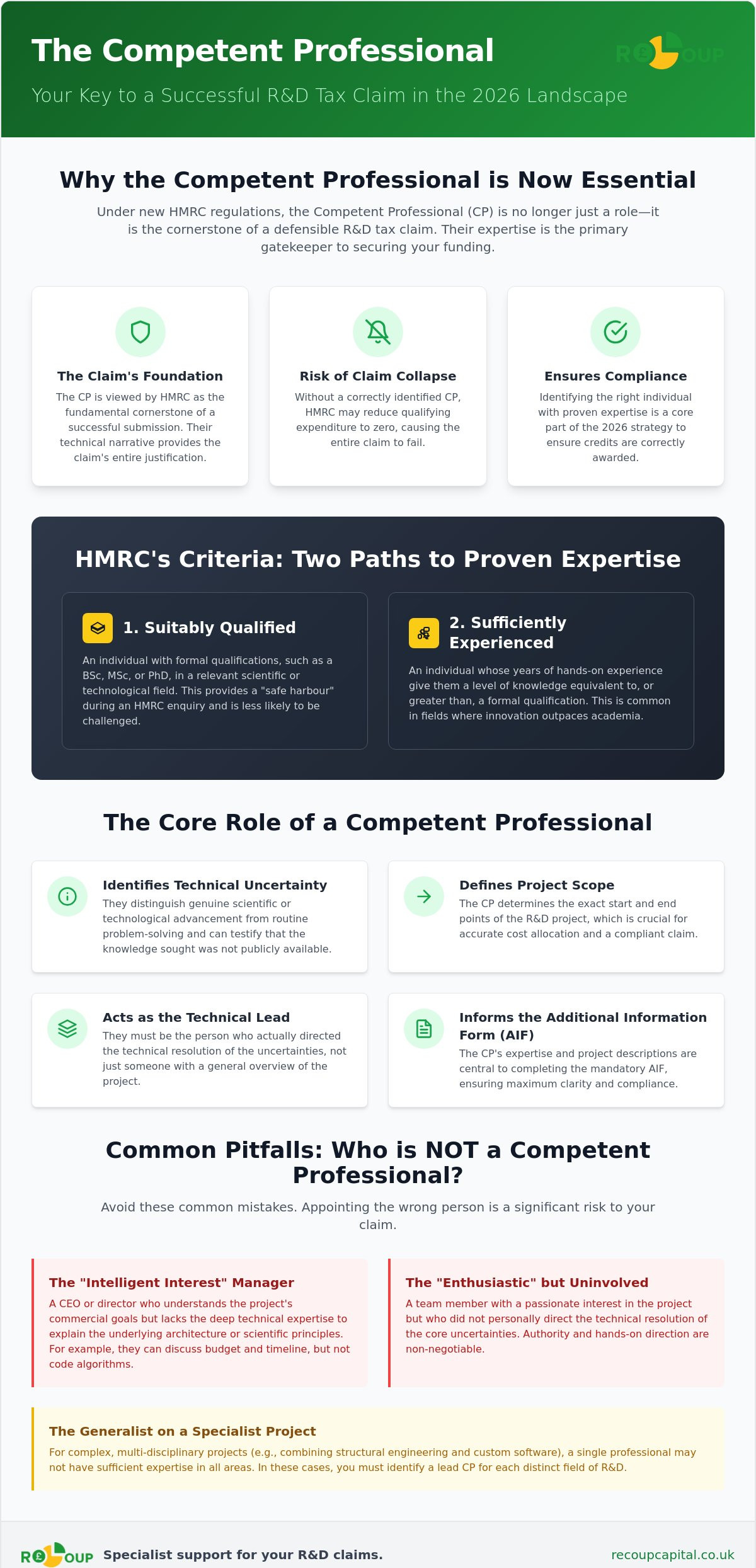
In the current regulatory environment, the role of the Competent Professional (CP) has evolved from a mere administrative checkbox to the fundamental cornerstone of a successful submission. HMRC now views the CP as the primary gatekeeper. Without a correctly identified CP, the entire narrative of a claim can collapse. If HMRC determines that the person overseeing the technical description lacks the necessary expertise, they may reduce the qualifying expenditure to zero. This shift is part of a broader 2026 strategy to ensure that Research and Development (R&D) Tax Credits are only awarded to companies pushing the boundaries of their respective fields.
Defining exactly what is a competent professional in R&D claims requires looking closely at the DSIT guidelines. HMRC's stance has sharpened significantly; they no longer accept "any manager" with a broad overview. Instead, they look for a proven technical lead who possesses the specific knowledge to distinguish between routine problem-solving and genuine scientific or technological uncertainty. It's a high bar, but it's one that ensures your claim is robust and defensible. When you identify the right individual, you're not just complying with a rule; you're building a protective shield around your claim.
The CP as the Arbiter of Innovation
The CP's most critical function is identifying where standard industry practice ends and R&D begins. They determine the exact start and end points of a project, which is essential for accurate cost allocation. Whilst a business owner might see an "innovative" new product that increases sales, the CP must identify the specific "scientific or technological advance" required to create it. They are the ones who can testify that the knowledge sought was not readily available to a competent professional working in that field. If the solution was already in the public domain or could be easily deduced by a peer, it simply isn't R&D in the eyes of the taxman.
Why General Managers Often Fail the CP Test
A common pitfall is the "Intelligent Interest" trap. A manager might be deeply interested in technology and understand the project's commercial goals, but that doesn't make them a CP. Technical authority is non-negotiable. For instance, a CEO might oversee a software project's budget and timeline, but if they cannot explain the underlying code architecture or why a specific algorithm presented a technological uncertainty, HMRC will likely reject their competency. They lack the "proven technical lead" status required in 2026. This distinction is vital because HMRC now examines whether the identified CP actually directed the technical resolution of the uncertainties. To find out more about how these roles differ, you can read our guide on R&D tax credits explained.
Suitably Qualified or Experienced: The HMRC Criteria for Competency
HMRC's definition of competency hinges on a crucial distinction: a professional must be either suitably qualified or sufficiently experienced. This flexibility is vital for industries where innovation moves faster than formal education. When asking what is a competent professional in R&D claims, you're looking for someone who can stand before an inspector and justify why a project was technically challenging. For accounting periods starting on or after 1 April 2024, the bar for this justification has risen. It's no longer enough to have a general background; the individual must possess the specific technical vocabulary of the field in question.
Complex, multi-disciplinary projects often require more than one CP. If your R&D involves both structural engineering and bespoke software integration, a single professional likely won't cover both bases. In these cases, you should identify a lead CP for each distinct area of uncertainty. This ensures that every aspect of the claim is backed by genuine authority. Managing these multiple perspectives can be tricky, but it's a necessary step to ensure your claim remains robust under 2026 compliance standards.
Evaluating Technical Qualifications
A formal degree in a relevant subject often acts as a safe harbour during an enquiry. If your lead developer holds a BSc or MSc in Computer Science, HMRC is far less likely to challenge their status as a CP. However, the qualification must map directly to the sought-after technological advance to be considered valid evidence of competency. A degree in civil engineering won't carry weight if the claim centres on chemical synthesis.
Proving Competency Through Experience
What if your most innovative mind never finished university? HMRC recognises that significant experience can be just as valid as a PhD. In 2026, the industry standard for a CP without a degree typically starts at five to ten years of hands-on experience in a senior technical role. You must be able to document their track record of solving non-trivial problems that others in the sector couldn't. Self-taught innovators are welcome, provided their peers would recognise them as an expert in the field.
To further demonstrate this expertise, some professionals opt to formalise their skills through Recognition of Prior Learning (RPL). For instance, Right Pathway assists technical specialists in converting their extensive work history into formal qualifications, providing a structured way to validate their status as an expert.
Beyond basic resumes, professional memberships and industry certifications add a layer of institutional credibility. These credentials signal that the individual remains at the cutting edge of their sector's knowledge base. According to the official government R&D relief guidance, the CP must be able to judge if a project represents an appreciable improvement. If you're unsure if your team meets these specific benchmarks, you might want to review your technical hierarchy with a specialist. This proactive approach ensures you aren't leaving your innovation funding to chance.
The Role of the CP in Determining Scientific or Technological Uncertainty
The CP’s most vital task isn't just managing a team; it's defining the specific scientific or technological uncertainty that standard professionals in the field could not resolve. This is the heart of every claim. When determining what is a competent professional in R&D claims, HMRC focuses on their ability to explain why a solution was not "readily available" in the public domain. According to HMRC's official definition of a Competent Professional, this individual must distinguish between a problem that is merely "difficult" and one that is "technically uncertain".
A difficult problem might be solved by applying existing knowledge in a time-consuming way, but a technically uncertain one requires a leap beyond the current state of the art. The CP justifies the R&D methodology, detailing the iterative process of trial, error, and rigorous testing required to overcome these hurdles. They are the ones who can look at a failed experiment and explain why that failure is actually evidence of a qualifying R&D activity. This justification is essential because it demonstrates that the project was not a routine exercise but a genuine attempt to expand technical knowledge.
The "Readily Deducible" Test
To satisfy HMRC, the CP must prove that a "competent professional working in the field" would not have found the answer easily. This requires a clear understanding of the "State of the Art" at the project's inception. Routine professional development or the simple application of trade secrets does not count towards R&D. Understanding what is a competent professional in R&D claims helps clarify why the CP must demonstrate that the path to a solution was not obvious to an experienced peer. If a standard software engineer could have coded the solution using available libraries without significant experimentation, it fails the test. The CP must show that the solution was not readily deducible to someone with the same level of expertise.
Documenting the Search for an Advance
Every successful claim starts with a clear "baseline". The CP describes the technology as it existed before their intervention, providing a snapshot of the industry's limitations. They must then articulate the specific "bottleneck" or technical barrier that necessitated an innovative leap. This isn't about marketing fluff; it's about identifying the physical or logical limits being pushed. Whether it's overcoming thermal constraints in hardware or latency issues in high-frequency trading software, the CP provides the technical evidence. Finally, the CP plays a critical role in signing off the technical narrative for the CT600 filing, ensuring that the technical reality aligns perfectly with the financial figures. This signature is their personal guarantee that the work described meets the rigorous definitions of innovation.
Avoiding the "Enthusiastic Interest" Trap: Documenting CP Evidence
HMRC's focus on compliance has intensified, and misidentifying the technical lead in the Additional Information Form (AIF) is now the most frequent trigger for a formal enquiry. It's a common pitfall. A director might have an enthusiastic interest in the company's new software, but if they cannot personally direct the technical resolution of uncertainties, they aren't a CP. Understanding what is a competent professional in R&D claims is only half the battle; you must also prove it through rigorous, real-time documentation. Precision is everything in the 2026 landscape.
To ensure your chosen lead meets the necessary threshold, use this five-point verification checklist:
- Does the individual hold a relevant technical degree or have at least five to ten years of senior industry experience?
- Can they articulate the specific technological uncertainty without relying on marketing materials or high-level summaries?
- Were they responsible for directing the technical methodology and decision-making throughout the project?
- Can they identify the exact point where standard industry knowledge reached its limit?
- Are they prepared to act as the lead signatory and defend the technical narrative under scrutiny?
Whilst innovation is often a team effort, HMRC requires a single lead signatory who takes responsibility for the technical validity of the claim. This individual must be involved throughout the project lifecycle, not just during the tax preparation phase. If your lead only reviews the project once a year, their competency may be challenged. If you're unsure about your lead's eligibility, verify your technical team's credentials before submitting your AIF.
The Additional Information Form (AIF) Requirements
The AIF requires specific details about the CP, including their role and expertise. HMRC's automated systems now flag claims where the technical lead's profile doesn't match the project's complexity. You must link the CP’s specific expertise directly to each project description. Best practice suggests highlighting their previous successes in similar technical fields to establish immediate institutional credibility. Avoid generic job titles; use "Senior Systems Architect" or "Lead Chemical Engineer" to provide the clarity inspectors expect.
Preparing for an HMRC Enquiry
Preparing for a potential technical interview is essential for any CP. HMRC inspectors often want to speak directly to the person who faced the uncertainties. Maintaining a "CP Log" is a powerful way to document real-time decisions, failed tests, and technical hurdles as they happen. This log serves as contemporary evidence that can shut down an enquiry before it escalates. You should also learn how to prepare for an HMRC R&D enquiry by ensuring your CP is comfortable translating their daily technical challenges into the specific language of tax legislation.
Partnering with Specialists to Support Your Competent Professionals
A frequent misconception in the 2026 regulatory environment is that an external tax consultant can fulfil the role of the lead technical signatory. This is a dangerous assumption. Whilst we provide the framework for a successful claim, a tax specialist cannot be your "Competent Professional". HMRC is explicit; the CP must be someone with technical authority over the project's specific scientific or technological challenges. Our role is to act as your greatest ally, protecting your CP’s time whilst ensuring their expertise is presented with the forensic detail HMRC demands.
Bridging the gap between technical reality and tax legislation is where the real value of a partnership lies. Your engineers and scientists speak the language of innovation; we speak the language of compliance. We take the raw data of your technical hurdles and translate it into R&D tax credits explained for the benefit of an HMRC inspector. This division of labour allows your team to stay focused on the next breakthrough whilst we handle the administrative burden of the Additional Information Form (AIF).
We operate on a success-based partnership model. This approach aligns our interests with yours, ensuring that we only pursue claims that are robust and defensible. By taking the pressure off your internal team, we transform the often-intimidating process of defining what is a competent professional in R&D claims into a streamlined, strategic asset for your business growth. It's about moving away from the stress of paperwork and towards the excitement of capital recovery.
The Recoup Capital Approach to Technical Assessments
Our process begins with targeted interviews of your technical leads. We don't just ask for a project summary; we extract the specific "uncertainty" narrative that makes the work qualifying R&D. Our forensic assessment often identifies qualifying activities that your CP might have overlooked as "just part of the job". We then ensure that your corporate finance strategy is fully integrated with your innovation goals, maximising the utility of every pound recovered.
Securing Your Innovation Strategy for 2026
Robust CP identification is the key to long-term R&D reinvestment. When your claim is built on a solid technical foundation, it becomes a reliable source of capital for future projects. Every claim we prepare undergoes a rigorous review by a chartered tax accountant, providing the peace of mind that your submission meets the highest standards of transparency. If you want to ensure your technical leads are correctly identified and your claim is protected from enquiry, you can book a free technical assessment with Recoup Capital today.
Future-Proofing Your R&D Tax Relief Strategy
The 2026 landscape leaves no room for ambiguity. Identifying what is a competent professional in R&D claims is the single most important decision you'll make when preparing your submission. By ensuring your technical lead possesses both the relevant qualifications and a documented track record of solving non-trivial problems, you transform your tax claim from a potential risk into a strategic business asset. The Additional Information Form (AIF) now demands a direct link between the CP’s expertise and the specific uncertainties they overcame. Precision today prevents enquiries tomorrow.
At Recoup Capital, we act as your protective guide through these complex regulatory waters. Our forensic technical assessment process is designed to extract the most robust innovation narratives whilst our in-house Chartered Tax Accountants ensure every figure is defensible. We operate on a success-based fee structure, meaning our goals are perfectly aligned with your long-term growth. Don't let administrative complexity stifle your momentum.
Speak to an R&D Specialist about your Competent Professional requirements today. We're here to help you turn technical achievements into the capital you need to scale and succeed.
Frequently Asked Questions
Can my external accountant act as the competent professional for my R&D claim?
No, an external accountant cannot fulfil this role. Whilst they are experts in tax legislation, they lack the specific scientific or technological expertise required to judge technical uncertainty within your industry. HMRC requires the CP to be a lead technical expert who possesses the authority to direct the technical resolution of the project's challenges.
Does a competent professional need to have a university degree?
A university degree is not a mandatory requirement for competency. HMRC accepts individuals who are "suitably qualified or experienced," which allows for self-taught innovators with a significant track record. Typically, five to ten years of senior experience in a technical field is sufficient to demonstrate the necessary expertise to identify qualifying R&D activities.
What happens if HMRC disagrees with my choice of competent professional?
If HMRC disagrees with your choice, they may reduce your qualifying expenditure to zero. This usually triggers a formal enquiry, forcing the company to defend its technical narrative under intense scrutiny. Correctly identifying what is a competent professional in R&D claims during the planning phase is essential to protecting your innovation funding from being clawed back.
Can a company have more than one competent professional for a single claim?
Yes, a company can name multiple professionals. This is particularly common in multi-disciplinary projects, such as those combining bespoke software development with advanced mechanical engineering. Naming a lead CP for each distinct area of uncertainty ensures that every aspect of the claim is supported by a genuine, field-specific authority.
Is the competent professional personally liable for the R&D claim data?
The company remains legally and financially liable for the claim data, not the individual professional. However, the CP must sign off on the technical narrative as an accurate reflection of the work performed. Whilst they aren't personally fined, their professional credibility with HMRC is at stake if the technical descriptions are found to be misleading or inaccurate.
How does the competent professional prove that a solution was not "readily deducible"?
The CP proves this by documenting the "state of the art" at the project's inception. They must explain why an experienced peer could not have solved the problem using publicly available knowledge or routine methods. This usually involves detailing the specific technical bottlenecks and the iterative testing process required to find a solution that didn't previously exist.
What is the "Additional Information Form" and why does the CP need to be mentioned on it?
The Additional Information Form (AIF) is a mandatory digital submission that must accompany every R&D claim. It requires the CP's contact details and professional background to verify technical authority. HMRC uses this form to ensure that a person with the right expertise has personally reviewed and approved the scientific or technological descriptions of the projects.
Can a project manager be a competent professional if they aren’t an engineer or developer?
A project manager can only qualify if they possess the technical depth to direct the resolution of uncertainties. If their role is strictly limited to commercial oversight, such as managing budgets and timelines, they won't meet the CP criteria. HMRC expects the CP to be a "proven technical lead" who understands the underlying technology well enough to explain the specific uncertainties faced.


