

Could an internal filing error be the single most significant risk to your company's relationship with HMRC this year? You likely already recognise that R&D tax credits are a vital engine for innovation, yet the sheer complexity of recent regulatory reforms makes the process feel like a technical minefield. It is understandable to feel caught between the desire to recover capital and the fear of an enquiry triggered by an incomplete internal claim. If you are currently focused on convincing my director to use an R&D specialist, you are likely looking for a way to frame the investment as a strategic necessity rather than a cost centre.
We agree that leaving "hidden" qualifying costs on the table is a frustration your board wants to avoid. This article provides the framework you need to present a robust, risk-mitigated business case that demonstrates the clear financial and compliance advantages of a specialist partnership. We will explore how to present these technical details as strategic assets, ensuring you can secure board approval whilst significantly reducing the administrative burden on your internal teams and turning your tax credit into a powerful tool for future growth.
Key Takeaways
- Understand how the shift in HMRC’s regulatory approach makes internal filing a significant compliance risk for your business.
- Recognise the "hidden" qualifying costs that technical teams often miss whilst solving everyday engineering problems.
- Learn the specific arguments for convincing my director to use an R&D specialist as a method to protect the board from potential penalties.
- Discover how a forensic specialist can translate complex engineering challenges into reports that maximise your claim's value.
Why Internal R&D Claims Often Underperform in the Current Regulatory Climate
HMRC's approach to innovation incentives has fundamentally changed. We have transitioned from an "incentive-first" era to a "compliance-first" regime where the priority is rigorous scrutiny rather than simple encouragement. In the past, the focus was on driving investment; today, it's about the forensic precision of the data provided. This shift means that internal teams, often relying on R&D Tax Credit basics, frequently miss the nuanced requirements of modern filing whilst assuming their previous methods remain sufficient. If you are currently focused on convincing my director to use an R&D specialist, it's vital to explain that what worked three years ago could now trigger a full-scale enquiry.
Technical teams often possess a "blind spot" regarding their own innovation. They view complex problem solving and iterative testing as part of their standard job description rather than qualifying R&D activity. This internal bias leads to a conservative filing approach where businesses leave thousands of pounds unclaimed simply to avoid "rocking the boat" or attracting unwanted attention. The Innovation Gap is defined as the difference between a firm’s perceived qualifying expenditure and the actual, legally claimable costs identified through forensic analysis. Recognising this gap is the first step toward reclaiming capital that is rightfully yours.
The Complexity of Modern HMRC Compliance
The introduction of the Additional Information Form (AIF) has transformed the submission process into a high-stakes documentation exercise. It's no longer sufficient to include a brief summary within a standard CT600 tax return. HMRC now utilises sophisticated AI-driven risk profiling to cross-reference claims against industry benchmarks and historical data points. When convincing my director to use an R&D specialist, I must highlight that if internal data doesn't align perfectly with these digital markers, the claim is flagged for review before a human even sees it.
The Hidden Costs of "DIY" R&D Claims
Handling claims internally often creates a significant resource drain that many boards fail to account for. When senior engineers spend dozens of hours drafting technical reports, they aren't focused on the projects that drive your bottom line. Beyond time, DIY claims often suffer from inaccurate cost attribution. Missing eligible sub-contractor costs or failing to apportion utility bills and software licences correctly can significantly diminish the claim's total value. Conversely, accidental over-claiming due to a lack of current regulatory knowledge poses a serious financial risk. One error in a DIY R&D tax credit submission can lead to years of retrospective audits and heavy financial penalties.
The Strategic Value of a Specialist: Beyond Just Processing Paperwork
A specialist’s role is often misunderstood as purely administrative. In reality, they act as technical detectives who bridge the gap between your engineering team and HMRC. When you are in the process of convincing my director to use an R&D specialist, it helps to frame their involvement as a strategic partnership rather than a simple outsourcing of paperwork. They don't just record what happened; they forensically analyse your operations to identify qualifying activities that generalist accountants frequently overlook.
The core of this value lies in technical report writing. Specialists translate complex engineering challenges into the specific, compliance-ready language HMRC expects. This reduces the risk of misinterpretation and ensures that the technical uncertainty of your projects is clearly articulated. Furthermore, a specialist acts as a robust shield. Should HMRC raise an enquiry, your partner handles the liaison and defence, providing the board with peace of mind. By reframing the tax credit as a strategic asset, you can demonstrate how this recovered capital fuels future growth and innovation. The effectiveness and complexity of the R&D tax credit system means that high-level expertise is required to navigate the nuances of qualifying expenditure successfully.
Sector-Specific Expertise
Different industries require different technical lenses. A specialist who understands the specific challenges of construction or precision engineering will recognise "uncertainty" in a foundation design or a metallurgical process that a software-focused generalist might miss. Having chartered tax accountants who are immersed in your sector’s case law ensures your claim remains compliant whilst staying aggressive enough to capture all eligible costs. Taking a moment to explore why claim with a partner can reveal significant capital opportunities you might have previously overlooked.
Maximising the Claim Value
One of the strongest arguments when convincing my director to use an R&D specialist is the "Specialist Uplift." On average, specialist-led claims are 20-30% higher than those prepared internally. This isn't through creative accounting, but through the accurate identification of "unsuccessful" projects and the meticulous categorising of staff time across complex, multi-year developments. Even a project that failed to reach its technical goal is often a goldmine for R&D tax credits, provided the attempt to overcome uncertainty is documented correctly. Specialists ensure every pound spent on genuine innovation is accounted for, from consumable materials to specific software licences.
Specialist vs General Accountant: Why Niche Expertise Wins
A common hurdle in convincing my director to use an R&D specialist is the belief that the company’s year-end accountant already has the situation under control. Whilst general accountants are indispensable for broad tax compliance and bookkeeping, they typically adopt a "generalist" approach. This is designed for high-level accuracy across a wide range of financial duties but often lacks the "forensic" depth required for a maximised R&D claim. General accountants are frequently incentivised to be overly cautious; they may purposefully under-claim to avoid any potential friction with HMRC that could complicate the rest of your company’s tax affairs. This conservative stance protects their liability but leaves your business with a significant deficit in capital recovery.
The core difference lies in the distinction between standard tax compliance and technical R&D justification. An accountant looks at invoices and payroll; a specialist looks at the underlying science and the specific technical hurdles your team overcame. To ensure the best result, it is helpful to remember that a general accountant is a partner to, not a replacement for, an R&D specialist. Even the most seasoned financial professionals can find the legislative nuances daunting, especially when considering the global standards of technical rigour found in frameworks such as Internal Revenue Code Section 41, which underscores the universal complexity of defining qualifying research activities.
The Technical Barrier
Most accountants struggle to define "scientific or technological uncertainty" in a way that satisfies a technical inspector. They lack the engineering or scientific background to conduct peer-to-peer technical interviews with your staff. A specialist, however, speaks the same language as your lead developers or site managers. They can extract the necessary detail to build a compelling narrative. For a deeper dive into these requirements, you can find R&D Tax Credits Explained in our comprehensive guide, which highlights the technical thresholds your projects must meet.
Professional Liability and Risk
When an internal team or a generalist files a claim, the burden of risk sits entirely on your shoulders. If HMRC rejects the claim or issues a penalty, it is your board that faces the financial and reputational fallout. By contrast, a specialist-led approach provides a layer of protection through dedicated enquiry support. They stand behind their technical reports, providing a robust defence if HMRC’s risk-profiling software flags your submission. Understanding the intersection of HMRC R&D tax claim transparency and AI is now a critical part of modern risk management, and it is a challenge that requires niche expertise to navigate safely.
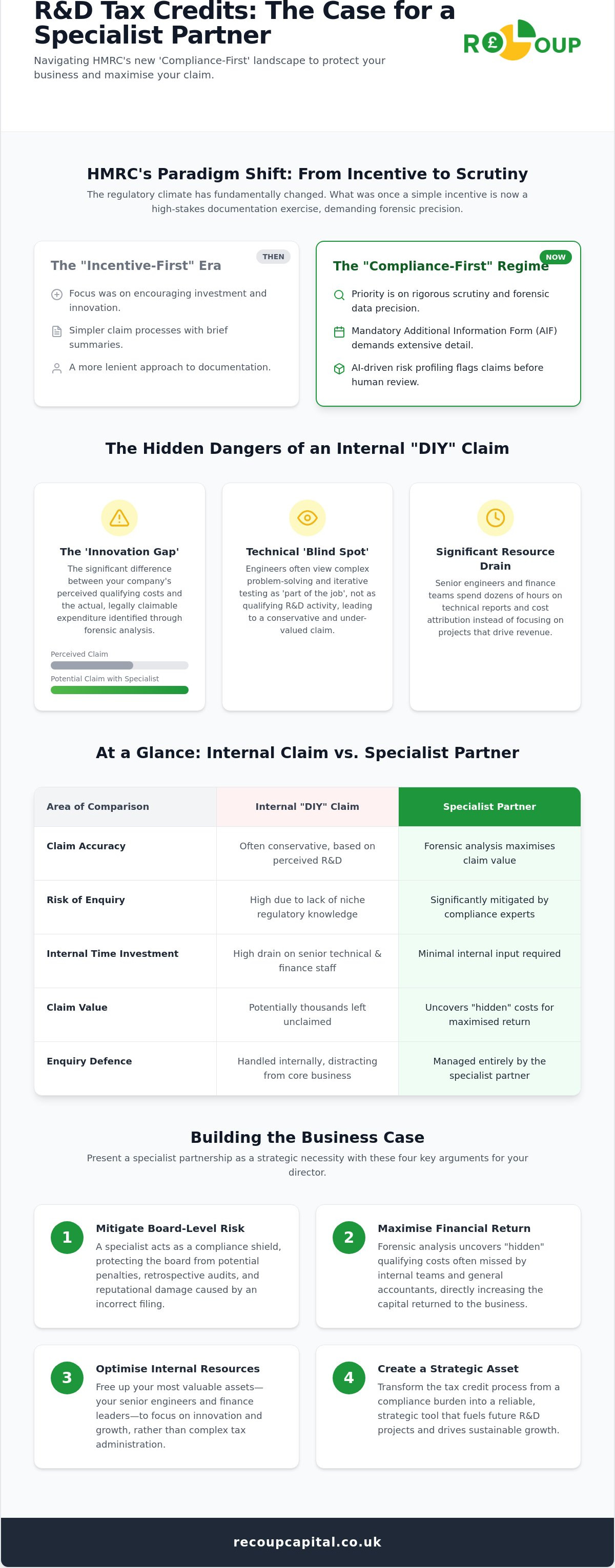
Building the Business Case: 4 Key Arguments for Your Director
Moving from the "why" to the "how" requires a structured approach that speaks the language of the boardroom. When you are tasked with convincing my director to use an R&D specialist, your proposal should focus on tangible commercial outcomes rather than just technical compliance. Directors are naturally protective of the company’s risk profile and its cash flow. By framing a specialist partnership as a strategic asset, you shift the conversation from an additional cost to a value-added investment.
There are four pillars to a successful business case:
- Risk Mitigation: With HMRC increasing its scrutiny, a specialist acts as a protective guide. They ensure every claim is robust enough to withstand a potential enquiry, protecting the board from the financial and reputational damage of penalties.
- Opportunity Cost: This is often the most overlooked factor. Every month that passes without a maximised claim is capital left on the table. Statistics from industry reports suggest that 92% of companies claiming the credit qualify for refundable cash back, meaning delayed filings are effectively interest-free loans to the government.
- Resource Efficiency: Your internal finance and technical teams are already stretched. A specialist partnership removes the administrative burden, allowing your experts to stay focused on their core responsibilities whilst we handle the forensic data gathering.
- Zero Upfront Risk: A success-based fee structure means the business only pays when the capital is recovered. This makes the partnership a self-funding initiative with no impact on existing budgets.
Addressing the "Cost" Objection
The most common pushback is the fee. It is vital to reframe this as a percentage of "new" money that the business would not otherwise have accessed. Because the fee is success-based, the specialist is directly incentivised to perform a forensic analysis and uncover every eligible pound. If there is no refund, there is no fee. This creates a risk-free scenario where the service pays for itself, effectively making it a budget-neutral strategic decision. To understand the full scope of these benefits, you can explore why claim R&D tax credits with a dedicated partner.
The "Time" Objection: Streamlining the Process
Directors often fear that a specialist will disrupt the technical team’s schedule. In reality, a specialist uses proven methodologies to minimise disruption. What might take an internal team weeks of research and drafting can often be achieved through a streamlined audit process. By conducting high-level technical interviews, specialists can gather a year’s worth of data in just a few hours. This efficiency ensures the claim is filed quickly without pulling your engineers away from critical projects. If you are ready to demonstrate these strategic advantages to your board, start your technical assessment today to see the potential capital waiting to be recovered.
Partnering with Recoup Capital: A Professional Path to Innovation Funding
Selecting a partner to manage your claim is the final, most critical step in the process. When you are in the final stages of convincing my director to use an R&D specialist, the choice of firm becomes the ultimate proof of your business case. At Recoup Capital, we provide a streamlined, end-to-end service that transforms a complex regulatory requirement into a straightforward capital recovery exercise. Our process begins with a high-level technical assessment to identify potential, followed by a forensic analysis and report drafting, concluding with a robust HMRC submission. We act as your protective guide, ensuring that every technical uncertainty is documented with the precision required to satisfy modern compliance standards.
The Recoup advantage is built on a foundation of chartered tax expertise and a commitment to transparency. Our success-based fee structure is a powerful argument for any board; it ensures that we are directly incentivised to maximise your claim whilst removing any upfront financial risk. If we don't recover capital for your business, you don't pay a fee. This makes the decision to partner with us a self-funding strategic move. Beyond R&D, our specialists are trained to identify broader opportunities for capital utility, such as Capital Allowances and Land Remediation Relief, ensuring no eligible expenditure is overlooked.
A Relationship-First Approach
We understand the value of your existing professional ties. Our team works alongside your current accountants, providing the niche technical expertise they may lack without disrupting your year-end filing cycle. This collaborative spirit ensures total compliance across all your tax affairs whilst focusing on long-term business growth. Our corporate finance advisory services further support this relationship-first philosophy, helping you reframe recovered tax credits as strategic assets for future innovation.
The Recoup Track Record
Our experience spans a wide range of sectors, with a particular focus on mid-market corporate transactions. In one notable instance, we assisted a construction firm in identifying significant qualifying activities within their foundation designs that their generalist accountant had previously dismissed. By applying a forensic technical lens, we recovered substantial capital that was immediately reinvested into new machinery. We invite you to contact Recoup Capital for a confidential R&D assessment to discover the untapped potential within your own projects.
Securing Your Company's Innovation Future
Transitioning from a compliance-heavy mindset to a strategic growth perspective is the key to unlocking your company's full potential. By focusing on risk mitigation and the forensic identification of hidden costs, you can transform a complex regulatory hurdle into a significant capital recovery opportunity. When you are in the final stages of convincing my director to use an R&D specialist, emphasise that this is a partnership designed for long-term collaboration rather than a one-off transaction. It's about protecting the board whilst ensuring no eligible investment is left on the table.
Our team of Chartered Tax Accountants and Forensic Surveyors brings deep expertise in sectors like Construction and Engineering to ensure your claim is both maximised and fully compliant. With our success-based fee model, the path to innovation funding is entirely risk-free for your board and doesn't impact existing budgets. Book a no-obligation R&D assessment with our specialists to see how we can help you reclaim your rightful capital and fuel your next phase of growth. Innovation shouldn't be a burden; it is your business's most powerful tool for the future.
Frequently Asked Questions
Is it worth using a specialist if our accountant already submits our R&D claims?
Yes, because specialists possess the technical background to identify qualifying costs that generalists frequently overlook. Whilst your accountant manages your broad tax position, they may not have the engineering or scientific expertise to conduct the deep-dive technical interviews necessary for a maximised claim. A specialist approach typically uncovers significantly more eligible expenditure, turning the claim into a more valuable strategic asset for your business.
How much time will my technical team need to spend with an R&D specialist?
Minimal time is required from your technical staff when working with a professional partner. We use a streamlined methodology that usually involves a single two-hour technical interview to capture a year's worth of data. This prevents the administrative burden from falling on your engineers, allowing them to remain focused on their core projects whilst we handle the forensic data gathering and report writing.
What happens if HMRC opens an enquiry into a claim prepared by a specialist?
Your specialist acts as a protective guide and handles all communications and technical defences with HMRC. We stand behind our technical reports and provide full enquiry support as part of our service. This ensures the board is protected from financial and reputational risks, as we provide the robust technical justification required to satisfy HMRC inspectors and resolve the enquiry efficiently.
Can we claim for R&D retrospectively if we haven’t used a specialist before?
You can typically claim for the two previous accounting periods, which often results in a significant cash injection from previously missed opportunities. This is a powerful point for convincing my director to use an R&D specialist, as it allows the business to recover capital from past innovation that was either under-claimed or ignored entirely by a generalist accountant or internal team.
How do specialist fees work, and are there any hidden costs?
Most specialists operate on a success-based fee model, meaning you only pay a percentage of the actual capital recovered. There are no upfront costs, hidden hourly rates, or retainer fees, making the business case entirely self-funding. This model ensures that the specialist is directly incentivised to perform a forensic analysis and maximise the value of your claim whilst removing all financial risk.
What is the difference between R&D tax credits and Capital Allowances?
R&D tax credits focus on revenue expenditure, such as staff wages and consumables, whilst Capital Allowances relate to investment in physical assets like machinery or building systems. Both are essential tools for capital recovery, but they require different technical lenses to identify; for example, Winfields Surveyors London provides the professional valuation expertise necessary to accurately document property-related assets. A specialist will often review both areas to ensure your company isn't leaving "hidden" tax relief on the table.
Can a specialist help if our internal R&D claim has already been rejected?
Yes, we can often rescue rejected claims by providing the technical justification that HMRC requires to approve the funding. We re-examine the project through a forensic lens to articulate the scientific or technological uncertainties that were previously missed or poorly explained. Our expertise in technical report writing often turns a failed internal attempt into a successful, HMRC-approved claim.
How do recent HMRC changes in 2026 affect our eligibility for R&D relief?
The 2026 regulatory landscape requires significantly more detailed project-level reporting and contemporaneous documentation than in previous years. These changes increase the administrative burden and the risk of errors for internal teams. This shift makes convincing my director to use an R&D specialist even more urgent to ensure full compliance with the new, more rigorous standards whilst protecting the company from increased scrutiny.


