

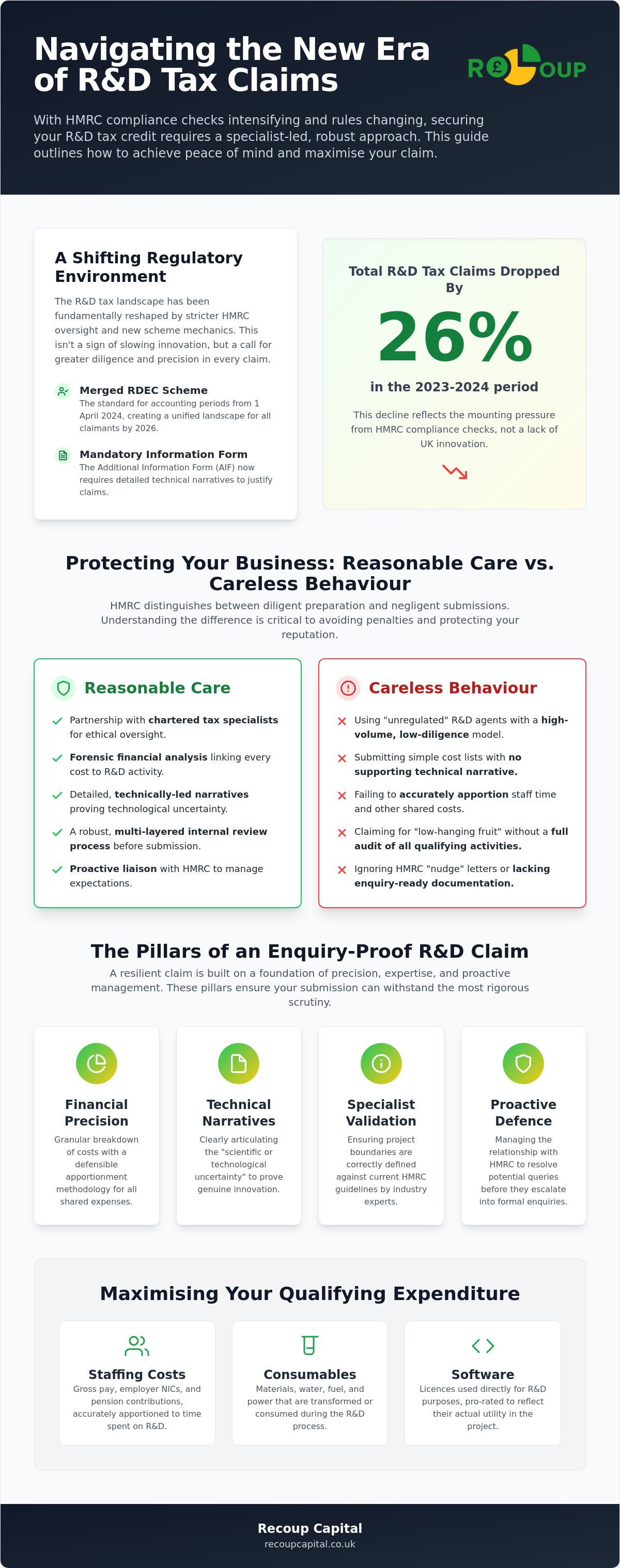
Did you know that the total number of R&D tax claims dropped by 26% in the 2023-2024 period? This sharp decline isn't a sign of slowing innovation, but rather a reflection of the mounting pressure from HMRC compliance checks and the fear of penalties for "careless" behaviour. When the rules change as rapidly as they have with the new merged scheme, seeking peace of mind for my R&D tax claim becomes more than just a preference; it's a strategic necessity for any forward-thinking business.
You likely feel the weight of these complex new regulations, especially with the mandatory Additional Information Form and the 20% RDEC credit rate now in play. It's frustrating to spend valuable time on technical documentation only to worry if it will actually withstand a forensic enquiry. You deserve to secure your R&D tax credit claim against HMRC scrutiny whilst maximising your eligible relief through a robust, specialist-led approach that prioritises accuracy.
This article explores how to transform potentially intimidating regulatory procedures into an approachable opportunity for business growth. We will examine the mechanics of forensic documentation, the impact of overseas expenditure restrictions, and how a proactive partnership ensures your claim is both defensible and maximised for the long term.
Key Takeaways
- Understand how the transition to the 2024 merged RDEC scheme impacts your eligibility and the specific documentation required for a successful submission.
- Learn to distinguish between "reasonable care" and "careless behaviour" to shield your business from financial penalties and reputational risk.
- Discover how forensic financial analysis and technically-led narratives provide total peace of mind for my R&D tax claim whilst maximising qualifying expenditure.
- Access a practical checklist for enquiry-proofing your innovation incentives by validating project boundaries against current HMRC guidelines.
- See how a success-based partnership with chartered tax accountants ensures your claim is robust enough to withstand the most rigorous compliance checks.
Navigating the New Era of HMRC R&D Compliance
HMRC has fundamentally rewritten the rulebook. The transition to the merged R&D Expenditure Credit (RDEC) scheme, which became the standard for accounting periods starting on or after 1 April 2024, has turned the spotlight onto technical rigour. By 2026, this merged landscape is the established reality for all UK innovators. For many directors, the primary goal has shifted from simply obtaining a refund to ensuring absolute peace of mind for my R&D tax claim. The days of "set and forget" submissions are gone. HMRC now issues "nudge" letters and compliance checks with unprecedented frequency, targeting claims that lack depth or forensic detail.
A robust claim in this regulatory climate is defined by its ability to withstand intense, retrospective scrutiny. It moves beyond the "low-hanging fruit" approach where businesses only claimed for obvious laboratory work. Today, a successful R&D tax credits submission requires a comprehensive audit of all qualifying activities, from software development to process engineering, backed by forensic financial evidence. Transparency is now the currency of compliance.
The Risk of the "Unregulated" R&D Agent
The rise of aggressive R&D boutiques has created a minefield for UK businesses. These entities often focus on high-volume, low-diligence submissions, which HMRC now identifies as a major liability. Red flags include agents who don't employ technical specialists or those who promise guaranteed returns without reviewing your project's specific technical barriers. Working with chartered tax accountants provides a layer of professional indemnity and ethical oversight that unregulated agents cannot match. High-volume claims without proper diligence are no longer just a risk; they are a direct invitation for an enquiry. Reliability is built on expertise, not just paperwork.
HMRC’s Expectations for Technical Narratives
Submitting a simple list of costs is no longer sufficient to secure relief. Since the introduction of the mandatory Additional Information Form (AIF) in August 2023, the focus has shifted entirely towards the technical narrative. HMRC expects a clear demonstration of "scientific or technological uncertainty" as defined in the global standards for R&D Tax Credits. You must prove that the problem you solved was not easily resolvable by a competent professional in your field. This level of transparency in the CT600 filing process ensures that only genuine innovation receives support, making a specialist-led approach vital for maintaining peace of mind for my R&D tax claim.
The Pillars of a Robust R&D Tax Claim
A truly resilient claim isn't built on guesswork. It requires a structural framework that aligns financial data with technical reality. Achieving total peace of mind for my R&D tax claim means moving beyond simple spreadsheets and embracing a methodology that HMRC recognises as "reasonable care". This involves a multi-layered internal review process where every figure is double-checked by both technical leads and tax experts before it ever reaches the portal. Precision is the goal; documentation is the means.
Proactive HMRC liaison is another vital pillar. Specialists don't just file a claim and wait for a response; they manage the relationship with the tax office, managing expectations and timelines from the outset. This proactive stance often resolves potential queries before they escalate into formal enquiries, ensuring your capital recovery remains a strategic asset rather than a source of stress.
Financial Precision and Qualifying Costs
Every penny claimed must be tied to a specific R&D activity. This requires breaking down costs into granular categories:
- Staffing costs: This includes gross pay, employer NICs, and pension contributions, accurately apportioned to the time spent on innovation.
- Consumables: Materials, water, fuel, and power transformed or "consumed" during the R&D process.
- Software: Licences used directly for R&D purposes, often pro-rated to reflect their actual utility in the project.
Apportionment must be handled with a defensible methodology. If a lead engineer spends 45% of their month on a prototype and 55% on routine maintenance, your records must reflect that split exactly. Under the 2026 standards for the merged scheme, managing contracted-out R&D is even more complex. Each cost must be forensically tracked to ensure it stays within the boundaries of the UK’s incentive regime, particularly with the strict rules regarding overseas expenditure.
Technical Evidence and Documentation
Evidence is the backbone of a successful submission. HMRC increasingly expects contemporaneous records gathered whilst the innovation was actually happening. This might include Slack logs, project meeting minutes, version control logs from GitHub, or even photographs of failed prototypes. Establishing the "baseline" of technology is critical; you must clearly define where current industry knowledge ends and your advancement begins.
In complex sectors like construction, forensic surveying plays a vital role in identifying R&D within large-scale infrastructure projects. Innovation is often hidden within traditional builds, such as developing a new method for ground stabilisation or bespoke engineering solutions for unique site constraints. If you are unsure whether your current project records meet these rigorous standards, you can explore how a structured approach can protect your future returns and provide the security your business needs.
Reasonable Care vs. Careless Behaviour: Protecting Your Reputation
HMRC categorises errors in tax filings into three distinct behaviours: careless, deliberate but not concealed, and deliberate and concealed. For most business owners, the fear of being labelled "careless" is the primary source of anxiety during an audit. However, the legal concept of "reasonable care" acts as a powerful shield against financial penalties. If you can prove you took every sensible step to ensure your submission was accurate, HMRC is significantly less likely to impose fines, even if they later disagree with a specific technical interpretation. This distinction is the foundation of peace of mind for my R&D tax claim.
Blindly following the advice of an unqualified R&D boutique doesn't constitute reasonable care. HMRC expects directors to exercise professional scepticism. Whilst your general accountant is an expert in your day-to-day finances, they may lack the deep, sector-specific technical knowledge required to identify the scientific uncertainties that qualify for relief. A specialist review identifies these risks early. It ensures your reputation remains untarnished by identifying potential "red flags" that a generalist might overlook.
Demonstrating Due Diligence to HMRC
To prove due diligence, you must show a clear audit trail of how you selected and worked with your advisors. HMRC looks for evidence that the Board was actively involved in the process, rather than delegating the entire task to an external third party without oversight. Our methodology at Recoup Capital is designed to mirror these "reasonable care" standards. We ensure your senior technical staff and directors are integrated into the narrative creation, validating every claim against real-world project outcomes. This collaborative approach doesn't just maximise your return; it documents your commitment to accuracy. You can learn more about the benefits of this rigour by exploring why businesses choose to claim through a structured partnership.
The Consequences of Non-Compliance
The financial impact of a failed claim can be severe. Penalties for "careless" errors typically range from 0% to 30% of the tax at stake. If HMRC deems an error to be deliberate, those figures can soar to 70% or even 100% in the most extreme cases of concealment. Beyond the immediate cost, there's the long-term reputational risk. Being placed on a "high-risk" claimant list means every future filing will be scrutinised with a magnifying glass. This can delay future innovation funding and create a cycle of administrative burden that stifles growth. Protecting your reputation is just as important as protecting your cash flow. Securing peace of mind for my R&D tax claim means ensuring your business is never viewed as a liability by the authorities.
A Checklist for Enquiry-Proofing Your Innovation Incentives
Prevention is the ultimate strategy. Most businesses only worry about HMRC when a letter arrives, but true peace of mind for my R&D tax claim is built during the project lifecycle, not months after submission. By establishing a proactive checklist, you ensure that every technical decision and financial entry is defensible from day one. This proactive rigour transforms a potential liability into a verified strategic asset. A robust defence is constructed through forensic documentation and a deep understanding of current legislation.
To enquiry-proof your incentives, focus on these five critical areas:
- Audit internal record-keeping to ensure technical and financial data align perfectly.
- Validate project boundaries against HMRC’s "Guidelines on the Meaning of R&D" to ensure they meet the scientific threshold.
- Cross-reference claims with other corporate incentives to avoid double-counting or conflicting data.
- Review technical narratives for scientific rigour, focusing on the specific uncertainties overcome.
- Consult with R&D tax credit specialists early in the financial year to set the right documentation standards.
Internal Process Audit
Organising project timesheets and staff logs is the first line of defence. You must clearly separate routine commercial activity from genuine innovation. For example, if a developer spends half their week fixing standard bugs and the other half overcoming a unique architectural hurdle, your records must reflect that distinction. Identifying "failed" projects is often where the most robust R&D evidence lies. A project that didn't meet its commercial goal still qualifies for relief if it sought to overcome a technological uncertainty. Documenting these failures proves you were pushing the boundaries of what's possible, providing absolute peace of mind for my R&D tax claim.
Strategic Relief Integration
A unified tax innovation strategy ensures your R&D claims don’t conflict with other incentives like Land Remediation Relief. In property-heavy sectors, it's vital to maximise Capital Allowances alongside R&D to ensure no qualifying expenditure is left on the table. For instance, the mechanical and electrical systems in a laboratory might qualify for Capital Allowances, whilst the bespoke software controlling them falls under R&D. Managing these overlaps requires forensic precision to avoid "double-dipping", which is a major red flag for HMRC. This holistic view prevents administrative friction and secures your financial returns.
Achieving a secure claim requires more than just ticking boxes; it requires a forensic view of your business’s technical landscape. If you're ready to move from a reactive stance to a proactive strategy, you can review our specialist approach to securing and maximising your innovation incentives.
Why a Specialist Partnership is the Ultimate Shield
In a landscape where the merged R&D scheme has increased the complexity of every filing, a specialist partnership is the most effective way to safeguard your business. We operate on a success-based fee model, which ensures our interests are perfectly aligned with yours. We only win when you do. This approach removes the financial barrier to entry, allowing you to seek peace of mind for my R&D tax claim without the risk of upfront costs. It is a relationship built on results rather than traditional sales pitches.
True protection comes from a combined team of industry specialists and chartered tax accountants. Whilst a generalist might understand the basic mechanics of a tax return, they often lack the technical depth to articulate the "uncertainty" in your specific field. By pairing financial expertise with sectoral knowledge, we ensure your technical narratives are as robust as your expenditure data. This dual-layered defence is essential for navigating the rigorous compliance standards established for the 2026 accounting periods.
The Recoup Capital Methodology
Our end-to-end process is designed to handle the heavy lifting whilst keeping you firmly in control. We manage everything from the initial technical assessment to the final HMRC liaison, ensuring every requirement of the Additional Information Form is met with forensic detail. We don't just file and disappear. Our commitment to long-term collaboration means we provide a "peace of mind" guarantee, offering full support through any HMRC enquiry that may arise. This proactive stance ensures peace of mind for my R&D tax claim, knowing that our experts are ready to defend the technical merits of your innovation at every stage.
Beyond the Refund: Strategic Corporate Finance
We believe in reframing tax credits as strategic assets rather than mere refunds. For many of our partners, R&D tax relief acts as a vital engine for broader Corporate Finance and M&A activity. A well-documented, maximised claim strengthens your balance sheet and increases the valuation of your intellectual property during investment rounds or acquisitions. Reinvesting these tax savings into further innovation creates a self-sustaining cycle of growth and technological advancement.
Innovation should be an opportunity, not an administrative burden. If you want to ensure your projects are fully maximised whilst remaining entirely compliant, we invite you to contact us for a no-cost technical assessment of your R&D potential. Let us help you transform your regulatory obligations into a powerful tool for your next growth phase.
Secure Your Innovation Journey
The landscape of UK tax incentives has shifted towards a higher standard of technical and financial rigour. By embracing the requirements of the merged RDEC scheme and prioritising forensic documentation, you transform a complex regulatory hurdle into a strategic business asset. Demonstrating "reasonable care" through every stage of your project lifecycle is the most effective way to ensure long-term stability and protection from penalties. It's about building a defensible narrative that stands up to the closest scrutiny.
Partnering with a combined team of chartered tax accountants and industry specialists provides an essential layer of security. Our success-based fee model ensures our interests are perfectly aligned with your success. With a proven track record in managing complex HMRC enquiries, we provide the technical depth required to secure peace of mind for my R&D tax claim. We act as your protective guide, turning potentially intimidating procedures into an approachable opportunity for growth.
Don't leave your capital recovery to chance. Speak to our specialists for peace of mind on your R&D claim. Together, we can ensure your innovation remains a catalyst for your business's future.
Frequently Asked Questions
What is the "reasonable care" standard HMRC expects for R&D claims?
HMRC defines "reasonable care" as the standard of a prudent person who takes sensible steps to ensure their tax affairs are correct. This includes reviewing technical narratives and verifying that costs align with the project's technological uncertainties. Taking this approach is the first step toward securing peace of mind for my R&D tax claim, as it acts as a legal defence against financial penalties if HMRC later disagrees with an interpretation.
Can I still claim R&D tax credits if my project was a technical failure?
You absolutely can claim for projects that ended in technical failure. In fact, failure is often the strongest proof that a technological uncertainty existed, which is the core requirement for R&D relief. As long as you were attempting to achieve a scientific or technological advancement and faced challenges that a competent professional couldn't easily resolve, the time and materials invested are usually eligible for relief.
How does the new merged R&D scheme affect my peace of mind?
The merged scheme, active for accounting periods starting on or after 1 April 2024, provides a unified 20% RDEC rate. It simplifies the landscape by removing the need to navigate two different sets of rules for SMEs and large companies. The requirement for an Additional Information Form (AIF) means you must be more transparent than ever. This clarity enhances peace of mind for my R&D tax claim by ensuring everything is documented correctly from the start.
Will claiming R&D tax credits increase my chance of an HMRC tax enquiry?
Claiming R&D tax credits doesn't inherently increase your risk of an enquiry, but the quality of your submission does. HMRC has increased its compliance staff to combat fraud, so every claim is now subject to more rigorous automated and manual checks. A technically robust, well-documented claim is far less likely to trigger a "nudge" letter or a formal enquiry than a vague or high-level submission based on guesswork.
What should I do if I think my previous R&D agent submitted an incorrect claim?
If you suspect an error in a previous filing, the best course of action is to make a voluntary disclosure to HMRC. Proactively identifying and correcting mistakes demonstrates "reasonable care" and can significantly reduce or even waive potential penalties. Specialists can help you audit past submissions to ensure they meet current compliance standards, protecting your business reputation and future funding eligibility whilst correcting any technical inaccuracies.
How long does HMRC typically take to process a robust R&D tax claim?
HMRC typically aims to process R&D claims within 28 to 40 days, though this can vary depending on the volume of submissions. Claims that are submitted with a complete Additional Information Form and clear technical narratives often move through the system more smoothly. If a claim is selected for a compliance check, the process can take several months, which is why forensic documentation is so vital for a streamlined experience.
Is it better to use my general accountant or a specialist for R&D?
Whilst a general accountant is excellent for day-to-day compliance, a specialist provides the technical sector knowledge required to identify eligible innovation. Specialists often employ engineers and scientists who can "speak the language" of your technical team, ensuring no qualifying expenditure is missed. This expertise allows for a more forensic analysis of project boundaries, which is often beyond the scope of general corporate finance or bookkeeping.
What specific documentation does HMRC require to support an R&D claim?
HMRC requires a mandatory Additional Information Form (AIF) submitted via the Government Gateway portal. This must be supported by a detailed breakdown of qualifying costs, including staffing, consumables, and software licences. You should also maintain contemporaneous evidence such as project timesheets, meeting minutes, and technical specifications. These documents prove that the work was undertaken and was directly related to overcoming a specific technological uncertainty in your field.


