

Did you know that in the 2023/24 tax year, roughly 17% of all R&D claims were subject to compliance checks by HMRC? For many innovative companies, this resulted in the sudden loss of planned reinvestment capital and the unsettling fear of financial penalties. Receiving a decision letter filled with complex technical jargon can make the path forward feel opaque, but appealing an HMRC R&D decision is a strategic opportunity to clarify the true merits of your innovation. We recognise that a rejection feels like a significant setback, yet it's often a challenge that can be overcome with a proactive and forensic approach to your technical narrative.
It's natural to feel concerned about the complexity of tax legislation, but you don't have to face the authorities alone. This guide will show you how to navigate the statutory timelines, including the critical 30 day window for reviews and the 120 day Alternative Dispute Resolution process. We'll explore the expert methodologies required to bridge the technical gap identified by HMRC and successfully defend your claim. You'll gain a clear roadmap to reversing unfavourable decisions and avoiding penalties, ensuring your R&D returns remain a vital asset for your business growth whilst protecting your long-term interests.
- Master the statutory timeline to ensure you don't miss the critical 30-day window for filing a formal challenge or requesting an independent review.
- Explore the strategic advantages of appealing an HMRC R&D decision through Alternative Dispute Resolution (ADR) to find a mediated path to capital recovery.
- Learn how to identify the "technical gap" in your original submission to reframe your innovation using forensic evidence and granular cost auditing.
- Understand the procedural differences between an internal HMRC review and the formal legal environment of the First-Tier Tribunal.
- Discover why specialist intervention is the most effective way to defend your R&D tax credits and transform a potential loss into a strategic business asset.
Understanding the HMRC Compliance Surge and Your Right to Appeal
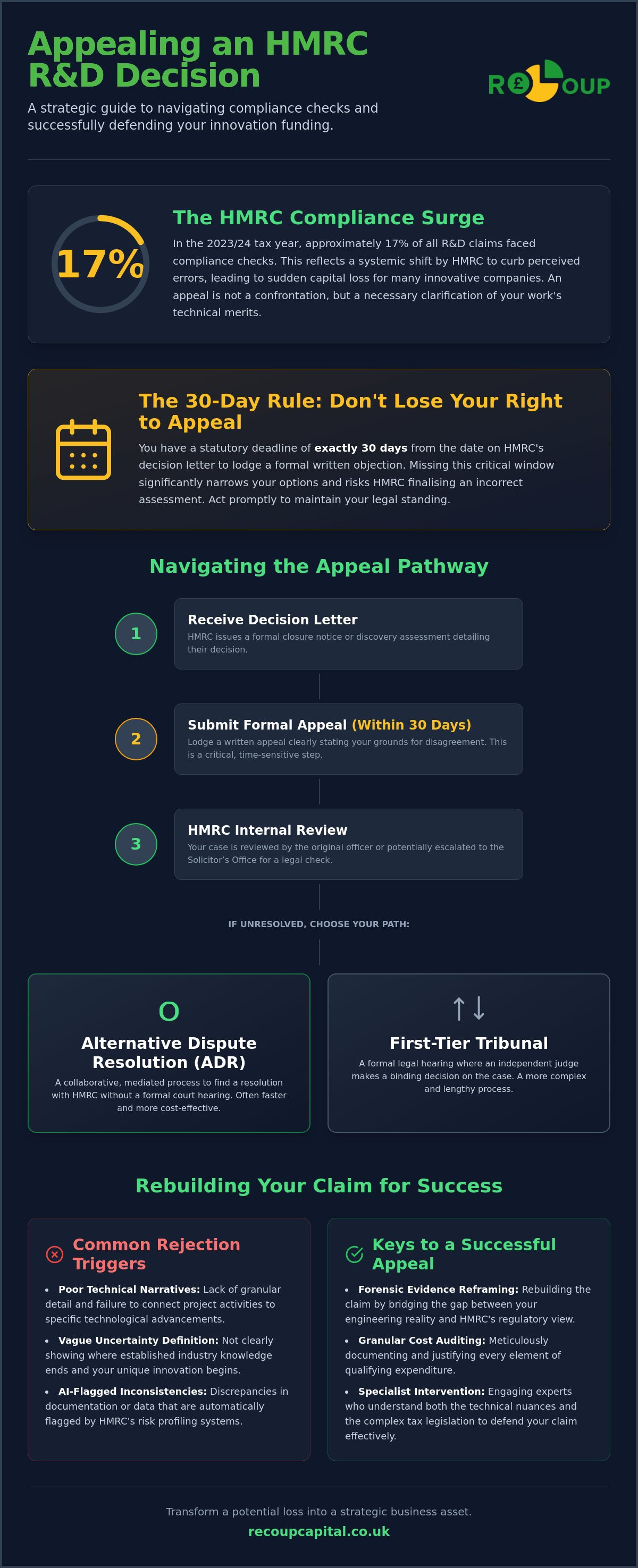
HMRC has fundamentally shifted its approach to the R&D tax incentive. In the 2023/24 tax year, approximately 17% of all claims faced compliance checks, reflecting a centralised effort to curb perceived error and fraud. This isn't just a minor administrative hurdle. It's a systemic change where compliance activity is now handled by the specialised Wealthy, Mid-Sized and Business Compliance (WMBC) teams. An adverse decision from these units can range from a total claim denial to a partial reduction in your qualifying expenditure. When your reinvestment capital is at stake, appealing an HMRC R&D decision becomes a necessary strategic defence of your company’s intellectual and financial assets.
Viewing an appeal as a confrontation is a mistake. Instead, see it as a forensic reframing of your innovation. Many rejections stem from a failure of communication rather than a lack of eligible activity. HMRC officers are tasked with applying rigid standards; if your technical narrative doesn't align perfectly with their current interpretation, they'll issue a challenge. By exercising your right to appeal, you're ensuring that the technical reality of your work is properly understood by the authorities. It’s about bridging the gap between your engineering reality and their regulatory expectations.
Why R&D Claims are Being Rejected in 2026
Rejections in 2026 are frequently triggered by AI-driven risk profiling that flags inconsistencies in technical narratives. HMRC officers now apply heightened scrutiny to the definition of "scientific or technological uncertainty". If your documentation doesn't clearly delineate where established knowledge ends and your innovation begins, the claim is likely to be flagged. It's also vital to distinguish between a "discovery assessment" for closed years and a formal enquiry closure notice for active ones. Both represent a formal challenge to your R&D tax credits, but they require slightly different procedural responses to resolve effectively. Poor technical narratives that lack granular detail remain the primary reason for these setbacks.
The 30-Day Rule: Don’t Lose Your Right to Object
The most critical factor in protecting your claim is the calendar. You have exactly 30 days from the date on the formal decision letter to lodge your objection in writing. This deadline is statutory. If you miss it, your options for appealing an HMRC R&D decision narrow significantly. Whilst HMRC or the First-Tier Tribunal might allow a late appeal if you can prove a "reasonable excuse", such as a significant business disruption or serious illness, relying on their leniency is a high-risk strategy. The best approach is to formally acknowledge the decision immediately whilst you begin the process of rebuilding your technical justification. This maintains your legal standing and prevents HMRC from finalising an incorrect assessment before you've had the chance to present your full defence.
The Statutory Appeal Process: Reviews, Timelines, and Postponements
Once you have received a closure notice or discovery assessment, the first step in appealing an HMRC R&D decision is to submit a formal letter of appeal to the officer who issued the ruling. You must state your grounds for appeal clearly. This isn't just a box-ticking exercise; it's your first opportunity to address the specific technical or financial points HMRC has contested. If the dispute involves complex legal interpretations of the official government guidance, your case may be referred to the Solicitor’s Office. This represents a more formal legal check of the decision’s validity. Whilst a standard reviewer looks at the facts, the Solicitor’s Office evaluates whether the decision is legally sustainable and follows the letter of the law. This stage acts as a critical filter, often identifying cases where the initial caseworker may have overstepped their statutory authority.
Following this initial stage, your strategy should move toward formal review or mediation. The goal is to resolve the dispute as efficiently as possible to avoid the prolonged uncertainty of a tribunal. If you're unsure about the specific grounds for your challenge, reviewing our R&D tax credits explained resource can help clarify the technical standards HMRC expects. This clarity is essential before moving to the next statutory step.
Requesting an Independent Internal Review
If the original caseworker stands by their decision, you can request an independent internal review. This is a vital mechanism where an officer with no prior involvement in your case examines the evidence. Their role is to ensure the original decision aligns with HMRC’s internal manuals and policy. Statistically, this stage is highly effective; many R&D disputes are resolved or significantly narrowed here without the need for costly litigation. HMRC usually has 45 days to complete this review, providing a relatively swift path to resolution compared to the years a tribunal can take. It’s a chance for a fresh pair of eyes to correct any procedural errors made during the enquiry.
Postponing Tax Payments During the Appeal
Appealing an HMRC R&D decision doesn't just protect your future credits; it protects your current cash flow. When HMRC issues a decision that results in a tax liability, you can apply for a "postponement of tax". This prevents the authorities from collecting the disputed amount whilst the appeal is ongoing. To succeed, you must demonstrate that the tax is in dispute and provide a reasonable estimate of the amount that should be postponed. Whilst interest will still accrue on any tax eventually found to be due, this keeps your business liquid and ensures your capital remains available for innovation during the dispute process.
Alternative Dispute Resolution (ADR) vs. The First-Tier Tribunal
Whilst internal reviews often narrow the scope of a dispute, appealing an HMRC R&D decision through mediation or litigation requires a deeper cost-benefit analysis. Most R&D cases don't actually reach a full Tribunal hearing; they're resolved through technical clarification once both parties sit down to bridge the "communication gap". However, when a stalemate occurs, you must choose between the collaborative environment of Alternative Dispute Resolution (ADR) and the formal legal path of the First-Tier Tribunal. This choice depends on whether the dispute is a matter of factual evidence or a fundamental disagreement on tax law; in such instances, you can discover TaxLawAdvisory for professional guidance on complex tax regulations. Weighing the potential credit recovery against legal fees is essential, as the financial stakes often dictate the most prudent route forward.
When to Opt for Alternative Dispute Resolution
ADR acts as a mediation process where a neutral HMRC officer, who hasn't been involved in your case, facilitates a resolution between you and the caseworker. It's most effective when there's a specific "sticking point" regarding technical definitions or the eligibility of certain activities. The ADR process typically resolves within 120 days, making it a much faster alternative to court proceedings. During these sessions, the focus remains on finding common ground whilst maintaining a professional, collaborative relationship with the authorities. If your project involves complex engineering or software development, ADR provides a forum to explain the technical nuances that a standard caseworker might have overlooked. It’s an opportunity to ensure your R&D tax credits are assessed with the technical depth they deserve.
Escalating to the First-Tier Tribunal
The First-Tier Tribunal (Tax) is the formal legal ruling path of last resort. If an internal review or ADR fails to produce a fair outcome, you must notify the Tribunal within 30 days. This is a significant escalation. A hearing for a standard or complex R&D case can take 12 to 24 months from the date of listing, requiring a long-term commitment to defending your innovation. Preparing for this stage involves the use of expert witnesses who can testify to the scientific or technological advancements achieved in your projects. Unlike internal reviews, Tribunal decisions are public and can set precedents for future R&D claim standards across the industry. This formal environment is designed to deliver a final, legally binding verdict on whether your work meets the statutory requirements for tax relief.
Rebuilding Your Claim: Forensic Evidence and Technical Justification
Rebuilding a claim after a rejection is about forensic accuracy. You need to identify exactly why HMRC felt the project fell short. Often, this is a failure to articulate the "technical gap" between existing industry knowledge and your specific project goals. Caseworkers are rarely technical experts; they rely on rigid guidelines to assess eligibility. You must use your internal "Competent Professionals" to counter their non-technical perspective. This involves gathering contemporaneous evidence like project logs, email chains, and version histories that prove an iterative process of trial and error occurred. If you can show that the solution wasn't readily deducible, you significantly strengthen your position when appealing an HMRC R&D decision.
The core of the issue is often a mismatch between your engineering reality and the caseworker's interpretation. Appealing an HMRC R&D decision requires you to dismantle their objections point by point. If they claim your work was "routine engineering", you must prove that the solution required a level of innovation beyond standard practice. This isn't just about what you did; it's about why it was difficult and why existing knowledge wasn't enough. Success lies in the granular details of your technical defence.
Bridging the Gap in Technical Narratives
Refining your technical narrative is the most impactful step in the appeal process. You must clearly define the "technological baseline" your project aimed to surpass. This means documenting exactly where the industry-standard knowledge ended and your specific challenge began. Don't just list the work performed. Instead, articulate the uncertainties encountered and the technical hurdles that forced your team to innovate. Within the software engineering sector, scientific advancement is the creation of novel architecture that resolves a systemic processing bottleneck where no existing open-source or commercial solution provides a viable path forward.
The Power of Forensic Cost Analysis
Granular cost auditing moves your claim beyond broad estimates and into the realm of undeniable fact. When appealing an HMRC R&D decision, you must link specific staff hours and subcontractor costs directly to individual technological challenges. This forensic approach often reveals "hidden" R&D costs that were missed in the original submission, such as indirect supervisory time or failed prototypes that were previously overlooked. Using our R&D tax credits explained framework can help you re-evaluate your expenditure with the precision HMRC now demands.
If you believe your technical evidence has been misunderstood, our specialists can help you reconstruct a robust defence of your innovation.
Strategic Recovery: Why Specialist Intervention Succeeds Where Generalists Fail
Generalist accountants provide vital support for standard tax compliance. Yet, they often lack the forensic technical expertise required to challenge HMRC's specialised compliance units. Successfully appealing an HMRC R&D decision requires more than just tax knowledge; it demands a deep understanding of the scientific uncertainties that defined your project. At Recoup Capital, we use a success-based fee model to ensure our goals are perfectly aligned with your capital recovery. This means we're as invested in the outcome as you are, creating a partnership built on transparency and shared success.
Our "Defence First" approach goes beyond standard administrative responses. We don't just submit a letter of objection. Instead, we forensicially rebuild your claim from the ground up, identifying the specific technical nuances that were previously overlooked. This rigorous process transforms a rejection into a compliant, future-proofed R&D strategy for your business. By partnering with experts, the process of appealing an HMRC R&D decision becomes a managed path toward capital recovery rather than an administrative nightmare. It's about turning a temporary setback into a long-term strategic advantage for your organisation's growth.
The Benefit of Specialist R&D Defence
When you work with a specialist, you gain immediate access to chartered tax accountants and industry-specific technical specialists who speak the same language as your engineers. We have a proven track record in successfully navigating HMRC enquiries and appeals, ensuring that every technical argument is backed by robust evidence. This level of expertise significantly reduces the administrative burden on your internal team. Whilst we handle the complex liaisons with HMRC, you can remain focused on your core business operations, confident that your innovation capital is being defended by professionals who understand the regulatory landscape inside out.
Next Steps: Securing Your Innovation Capital
The first step toward recovery is a no-obligation review of your decision letter. This allows us to identify the "technical gap" and determine the most effective statutory route for your appeal. Reframing your R&D tax credit as a strategic asset for business growth shifts the narrative from a simple refund to a powerful tool for future innovation. Don't let a technical misunderstanding stall your company's progress. We're here to act as your protective guide, ensuring your hard-won advancements receive the financial recognition they deserve. Protect your innovation, contact Recoup Capital for a specialist appeal review.
Defending Your Future Innovation
Your R&D tax credit is a strategic asset that fuels your company's growth. Successfully appealing an HMRC R&D decision relies on your ability to bridge the technical gap between your engineering reality and the caseworker's interpretation. By mastering statutory timelines and leveraging forensic evidence, you can transform a challenging enquiry into a successful capital recovery. We've demonstrated that technical reframing is the key to overturning adverse rulings and protecting your reinvestment potential.
Recoup Capital offers national expertise in complex R&D dispute resolution to ensure your claim is defended with professional authority. Our team of chartered tax accountants and technical specialists works on a success-based fee structure; this ensures our interests are perfectly aligned with your recovery. We act as your proactive guide through the regulatory landscape, focusing on results rather than just processing paperwork. Request a specialist review of your HMRC decision letter to begin securing your innovation capital today. You've done the hard work of innovating; now let's ensure you receive the financial recognition your business deserves.
Frequently Asked Questions
Can I appeal an HMRC R&D decision myself?
You can legally represent yourself when appealing an HMRC R&D decision, but it isn't recommended for most businesses. The process involves navigating dense tax legislation and articulating complex technical uncertainties in a way that satisfies non-technical caseworkers. Without specialist support, it's easy to miss procedural nuances or fail to bridge the technical gap identified in the original rejection letter.
How long does the R&D appeal process usually take?
Timelines vary significantly based on the chosen resolution path. An internal HMRC review is typically completed within 45 days, whilst the Alternative Dispute Resolution (ADR) process usually concludes within 120 days. If the case escalates to the First-Tier Tribunal, you should expect a much longer wait; hearings for standard or complex R&D cases often take 12 to 24 months from the date of listing.
What are the most common reasons for HMRC rejecting an R&D claim?
Most rejections stem from a perceived lack of "scientific or technological uncertainty" or poor technical narratives that fail to distinguish innovation from routine engineering. In the 2023/24 tax year, HMRC increased scrutiny, resulting in roughly 17% of claims undergoing compliance checks. Appealing an HMRC R&D decision in these cases often involves providing more granular forensic data to prove the technological baseline was surpassed.
Will appealing a decision trigger a full tax investigation into my company?
Appealing a specific R&D decision doesn't automatically trigger a full-scale corporate tax investigation, though it does keep your R&D activity under the spotlight. HMRC's specialised compliance teams focus specifically on the validity of your innovation claims. Whilst a challenge ensures your records remain under scrutiny, it's a necessary step to defend your reinvestment capital and clarify your technical standing.
Can I still claim R&D tax credits in the future if one claim was denied?
A single denial doesn't disqualify your company from making future claims for R&D tax credits. However, you should expect heightened scrutiny on subsequent submissions, as a rejection may flag your business for AI-driven risk profiling. It's vital to use the feedback from the appeal process to refine your future technical narratives and ensure your internal documentation meets the current rigid compliance standards.
What is the success rate for R&D tax credit appeals at the Tribunal?
Success rates at the First-Tier Tribunal vary because each case is decided on its specific technical merits and the quality of evidence provided. Whilst many disputes are resolved through technical clarification during internal reviews or ADR, those that reach the Tribunal often hinge on the testimony of expert witnesses. It's a formal legal environment where the burden of proof lies with the taxpayer to demonstrate scientific advancement.
How much does it cost to hire a specialist to appeal an HMRC decision?
Specialist costs depend on the complexity of the case and the volume of forensic evidence required to rebuild the claim. Many specialists, including Recoup Capital, operate on a success-based fee model, which aligns their interests with your capital recovery. This approach ensures you don't face significant upfront costs whilst your innovation is being defended against HMRC's compliance units.
What happens if I miss the 30-day deadline to appeal?
Missing the statutory 30-day window usually means you lose your legal right to object to the decision. You can request a late appeal if you have a "reasonable excuse", such as a serious illness or significant business disruption. However, HMRC or the Tribunal must agree to this extension, and they apply strict criteria when deciding whether to accept a late challenge.


