

Did you know that approximately 20% of all R&D claims now face formal compliance checks or enquiries? Receiving that brown envelope from HMRC can feel like an immediate threat to your focus and your finances. It's natural to feel concerned about potential penalties or the volume of technical evidence required, especially whilst you're trying to run a business. Understanding how to deal with an HMRC R&D compliance check is now a vital skill for any innovative company. You've worked hard for your innovation. The thought of it being scrutinised is understandably stressful.
This process doesn't have to be an exercise in damage limitation. We view these enquiries as a technical debate rather than a simple accounting dispute. Our professional framework is designed to help you navigate these complexities, protecting both your R&D tax credit claim and your business reputation. By approaching the enquiry with a strategic mindset, you can transform a regulatory hurdle into a long-term asset for your company's growth.
This guide provides a clear roadmap to achieving a full resolution with your claim intact. We'll explore how to minimise or avoid penalties, satisfy HMRC's rigorous evidence requirements, and establish a superior compliance process for the years ahead.
Key Takeaways
- Learn the critical differences between mandatory random enquiries and risk-based checks to understand exactly why HMRC has initiated contact.
- Discover why the technical narrative is the most important element of your defence; learn how to link project hurdles directly to your qualifying expenditure.
- Master a professional step-by-step framework on how to deal with an HMRC R&D compliance check, starting with a forensic pre-response audit of your original claim.
- Understand the 2026 penalty regime for careless or deliberate behaviours and how a proactive approach can minimise financial exposure whilst protecting your reputation.
- Reframe the enquiry process as a strategic opportunity to build a more robust and defensible R&D claim structure for future accounting periods.
Receiving the Letter: Understanding the Scope of an HMRC R&D Compliance Check
Receiving a letter from HMRC regarding your R&D claim often triggers immediate anxiety. In 2026, an HMRC R&D compliance check is a forensic examination of your claim's validity. It's no longer just a spot check on the numbers; it's a deep dive into the technical uncertainty of your projects. HMRC has scaled its compliance teams significantly, resulting in about 20% of claims facing scrutiny. Understanding how to deal with an HMRC R&D compliance check begins with identifying the "flavour" of the enquiry. Some are 'Mandatory Random Enquiries', which act as a quality control measure for the UK R&D tax incentive scheme. Others are 'Risk-Based Enquiries', triggered by specific data flags, such as inconsistencies in your technical report or high claim values relative to your sector's average.
You'll usually notice the letter comes from one of two units. The Individual and Small Business Compliance (ISBC) unit typically handles standard SME claims. The Wealthy and Mid-sized Business Compliance (WMBC) unit manages more complex or higher-value cases. Regardless of the source, the 30-day response window is absolute. Ignoring this deadline is a high-risk strategy that often leads to the summary rejection of your claim and potential penalties. It's a formal process, but it's also a chance to demonstrate the genuine innovation occurring within your business.
Immediate Actions: The First 48 Hours
Speed is secondary to accuracy. Your first step must be notifying your R&D specialist or accountant. They need to see the full, unedited letter immediately. Learning how to deal with an HMRC R&D compliance check requires a calm, evidence-led response rather than a defensive one. Adopt a 'Stop-Look-Listen' approach. This means preserving all internal data, from developer logs to project emails, before any records are inadvertently archived. Don't succumb to the urge to send a "quick" explanatory email to the inspector. Incomplete or rushed responses often create more questions than they answer. Lock down your evidence and wait for a professional review of the request.
Decoding the Information Request
HMRC's questions are rarely generic. They often focus on the specific "scientific or technological uncertainty" you've claimed to overcome. Analyse whether they're questioning the entire claim or just a specific project. Since the 2024 reforms, the Additional Information Form (AIF) has become a primary focus. If your initial submission lacked detail here, the enquiry will likely centre on bridging that gap. HMRC uses these requests to see if your project meets the strict definitions of innovation. For a deeper look at the mechanics of the scheme, you can read more about how R&D tax credits work in the current regulatory environment. Identifying these focal points early allows you to build a more robust defence.
The Root Causes: Why HMRC Targets Specific R&D Claims for Enquiry
HMRC's selection process for enquiries has undergone a digital transformation. By 2026, the department employs advanced AI and data analytics to risk-profile every submission. This isn't just about spotting mathematical errors. These algorithms compare your claim data against sector-specific benchmarks and historical filing patterns. If your qualifying expenditure appears disproportionately high relative to your turnover or industry average, the system flags it for human review. It's a precise, data-led approach that leaves little room for ambiguity.
Inconsistencies between your CT600 tax return and the mandatory Additional Information Form are another primary trigger. Mismatched figures or conflicting project descriptions suggest a lack of "reasonable care" in the claim's preparation. This is why understanding HMRC's official guidance on examining claims is so critical for your internal finance team. It helps you see your submission through the eyes of an inspector. If you're concerned about your current claim's profile, you might want to review your eligibility criteria with a specialist to ensure total alignment.
There's also the "Contagion Effect" to consider. If HMRC identifies a systemic error in your current claim, they're highly likely to open enquiries into previous accounting periods. This retrospective scrutiny can turn a single-year dispute into a multi-year financial burden. Learning how to deal with an HMRC R&D compliance check involves recognising that one year's data doesn't exist in a vacuum; it's part of a broader compliance history that HMRC tracks meticulously.
The 'Technical Uncertainty' Threshold
A common pitfall is confusing commercial innovation with scientific or technological advancement. HMRC frequently challenges claims that describe "new to the company" products rather than "new to the industry" solutions. If your technical report uses language focused on market share or user experience rather than resolving specific technical hurdles, you're at risk. You can find more details in our guide on R&D tax credits explained, which clarifies these definitions. Success in a check often depends on proving your project sought an advance in the overall field.
Common Red Flags in Construction and Engineering
In construction, the line between "standard industry practice" and genuine R&D is often blurred. HMRC is particularly sceptical of building projects that claim relief for routine problem-solving on-site. They're also scrutinising sub-contracted R&D costs more heavily under the 2026 merged scheme rules. For those in the sector, our article on Construction R&D Tax Relief: Innovation in UK Building offers specific strategies. Knowing how to deal with an HMRC R&D compliance check in these sectors requires demonstrating that your solution wasn't readily deducible by a competent professional amongst your peers.
Navigating the Process: Technical Narrative vs. Financial Substantiation
A compliance check is rarely won on the strength of your spreadsheet alone. Whilst the financial figures provide the quantitative basis for your claim, the technical narrative serves as the qualitative heart of your defence. HMRC's current strategy often involves a high-volume approach to enquiries, as noted in the ICAEW evidence on HMRC's compliance strategy. Understanding how to deal with an HMRC R&D compliance check requires you to demonstrate that your project sought an advance in science or technology through the resolution of specific uncertainties. This requires the active involvement of your 'Competent Professionals', those individuals with the specialised expertise to define the technological baseline and explain why the solution wasn't obvious to others in the field.
Bridging the gap between a technical hurdle and a specific line item on a payroll report is a forensic task. HMRC will often request granular data, including sub-contractor invoices and internal timesheets, to verify that the claimed costs directly relate to the R&D activities described. Knowing how to deal with an HMRC R&D compliance check means being prepared to justify every pound. You must be able to show that the time your lead developer spent on a specific project was focused on overcoming the uncertainties identified, rather than routine maintenance or commercial updates. If your documentation feels light, reviewing our frequently asked questions can help you identify the types of records HMRC expects.
The Burden of Proof: What HMRC Really Wants to See
HMRC's expectations for evidence have shifted from retrospective summaries to contemporaneous records. They want to see the "working out" of your innovation as it happened. This includes email chains discussing technical failures, version logs from software repositories, or CAD files showing iterative design changes. Moving beyond "we worked hard" to "we solved a technological uncertainty" is essential. Presenting financial data that mirrors the project timeline is equally vital. If you can show that a spike in expenditure aligns perfectly with a documented period of technical testing, your claim becomes significantly more defensible.
Managing HMRC Meetings and Phone Calls
The prospect of a "fact-finding" meeting or phone call with a compliance officer can be intimidating. Whilst HMRC often presents these as informal chats, they are formal evidence-gathering exercises. There is a high risk of verbal evidence being misinterpreted or leading to "scope creep," where the enquiry expands into unrelated areas of your business. Having a specialist present is critical to keep the conversation focused on the technical merits of the claim. If you're unsure of your position, it's often safer to request that all questions are submitted in writing, allowing your team the time to provide a considered, evidence-backed response.
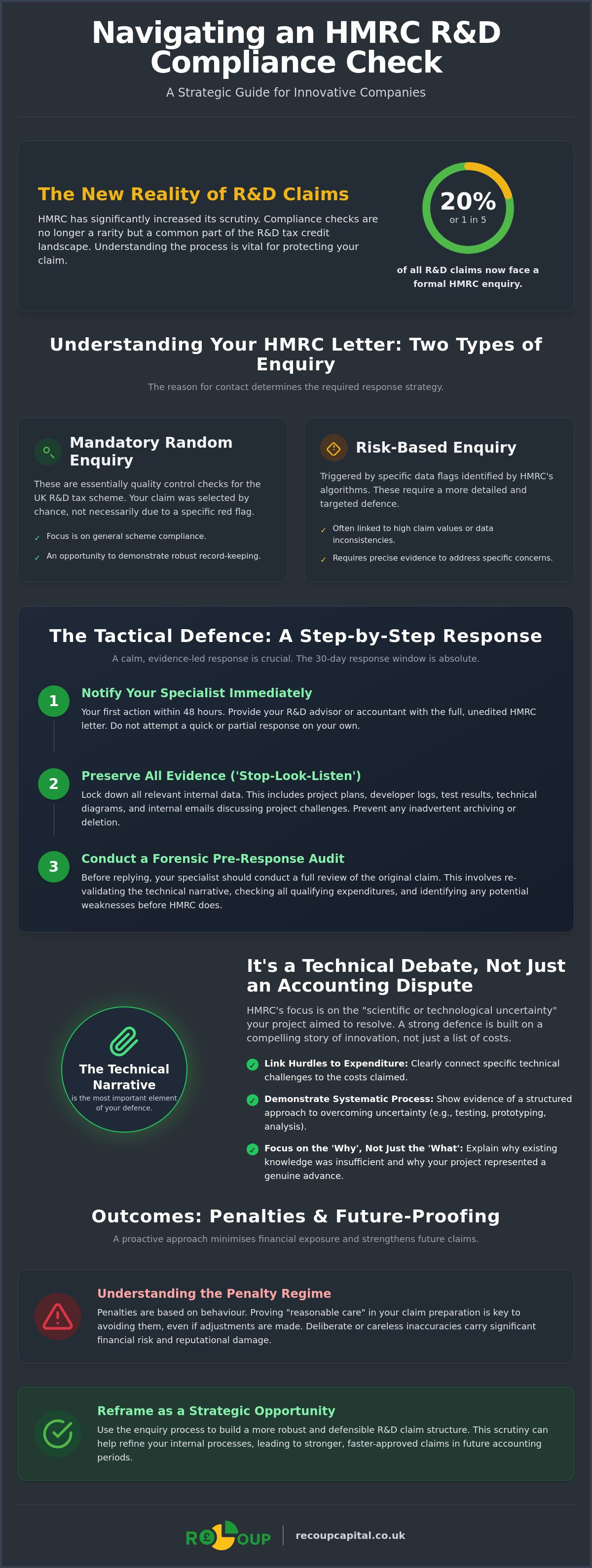
The Tactical Defence: A Step-by-Step Response Framework
Approaching an enquiry without a plan often leads to fragmented responses that invite further scrutiny. To protect your claim, you need a structured defence that addresses HMRC's concerns with precision. Understanding how to deal with an HMRC R&D compliance check requires a transition from passive concern to active management. This isn't just about answering questions; it's about controlling the narrative of your innovation. Consistency is everything. If your technical lead's description of a project doesn't align perfectly with the financial records, the inspector will likely dig deeper.
We recommend a five-step framework to manage the response process efficiently:
- Step 1: Conduct an internal 'Pre-Response Audit'. Re-examine the original claim with a critical eye. Identify any gaps in evidence or potential weaknesses before HMRC points them out.
- Step 2: Formalise the defence team. Assign clear roles to your Technical Lead, Finance Lead, and a Specialist Advisor. This ensures that technical expertise and financial data are perfectly synchronised.
- Step 3: Draft a structured response. Mirror HMRC's numbering and logic exactly. This makes the caseworker's job easier and demonstrates that you are being transparent and thorough.
- Step 4: Review for 'Harmonisation'. Ensure that every technical milestone described has a corresponding financial footprint in your payroll or invoice data.
- Step 5: Proactive follow-up. After submission, maintain professional contact with the HMRC caseworker. This shows you are taking the matter seriously and are committed to a resolution.
Evaluating the Strength of Your Original Claim
Honesty is your best asset during an audit. If your internal review uncovers an error, it is often better to make a voluntary disclosure early. This can significantly mitigate penalties by demonstrating that you've taken reasonable care. It's also a time to remind yourself why you claimed R&D tax credits in the first place. Your innovation has value, and a well-prepared defence protects that strategic asset. If you are currently facing a letter, our team can help you secure your R&D tax credits by managing the forensic audit of your technical narrative.
Organising Your Internal Resources
An enquiry can easily paralyse your R&D department if not managed correctly. Brief your staff clearly but calmly. They need to understand the importance of providing evidence without feeling like their professional competence is under attack. Managing the "burn" of an enquiry means keeping your developers focused on future innovation whilst a specialist advisor handles 90% of the administrative burden. Learning how to deal with an HMRC R&D compliance check involves protecting your team's time as much as your company's capital.
Resolving the Dispute: Outcomes, Penalties, and Future Compliance
The final stage of the enquiry is where your strategic preparation pays off. By this point, you've submitted your evidence and engaged in a technical debate with the caseworker. There are three primary outcomes: full acceptance of the claim, a partial amendment, or a full rejection. A partial amendment is often the result of a negotiation where certain projects are accepted whilst others are deemed ineligible. Understanding how to deal with an HMRC R&D compliance check at this juncture requires a pragmatic approach to these results. If the caseworker proposes an amendment, you must decide whether to accept their logic or escalate the matter further.
The 2026 penalty regime is strictly tied to behaviour. If HMRC identifies an error, they will categorise it as follows:
- Careless errors: These occur when a company fails to take reasonable care. Penalties range from 0% to 30% of the potential lost revenue.
- Deliberate errors: If HMRC believes you knew the claim was inaccurate, penalties rise to between 20% and 70%.
- Deliberate and concealed errors: These carry the heaviest weight, with penalties reaching up to 100%.
One of the most effective ways to mitigate financial impact is through the negotiation of 'Suspended Penalties'. For careless errors, HMRC may agree to suspend the penalty if you implement specific improvements to your compliance processes. This effectively turns a potential fine into a roadmap for better record-keeping. If you find yourself at a deadlock with a caseworker, Alternative Dispute Resolution (ADR) provides a mediation route. ADR involves an independent HMRC officer who hasn't been involved in your case, acting as a neutral third party to help resolve technical or factual disputes without the need for a costly tribunal.
Appeals and Statutory Reviews
If you disagree with the final decision, you have 30 days to request a statutory review. This is an independent internal review conducted by a different HMRC officer. It's a vital step before considering the Tax Tribunal, which handles legal deadlocks. Staying informed on HMRC R&D Tax Claim Transparency and AI is essential for understanding how these modern reviews are conducted. A statutory review can often overturn a caseworker's decision if you can prove they haven't followed the correct guidance or misinterpreted your technical evidence.
Future-Proofing Your Business
The best way to manage a check is to ensure your next claim is beyond reproach. Implementing 'Contemporaneous Record Keeping' as a standard business process ensures that evidence is captured as innovation happens, not months after the fact. Learning how to deal with an HMRC R&D compliance check should ultimately lead to a more robust internal culture of documentation. A specialist 'Pre-Submission Audit' acts as a final filter, catching potential red flags before HMRC's AI does. You can protect your future claims with Recoup Capital's specialist R&D support, ensuring your innovation remains a strategic asset rather than a regulatory risk.
Protecting Your Innovation in a New Era of Scrutiny
Managing a compliance enquiry is a technical challenge that requires more than just standard accounting. We've explored how AI-driven profiling and the 2026 penalty regime have fundamentally shifted the landscape. Success now depends on harmonising your technical narrative with forensic financial evidence. Knowing how to deal with an HMRC R&D compliance check is about transforming a regulatory hurdle into a long-term strategic advantage for your business. It's an opportunity to refine your internal processes and secure the integrity of your future claims.
Secure your R&D claim with an expert-led compliance defence from Recoup Capital
Your innovation represents the future of your company. Let's ensure it's protected with the rigour and specialist expertise it deserves.
Frequently Asked Questions
How long does an HMRC R&D compliance check usually take in 2026?
Most enquiries take between six and nine months to reach a final resolution. This timeline varies based on the complexity of the technical projects and the speed at which your team provides requested data. Rushed or incomplete responses often extend the process, as they prompt additional rounds of questioning from the caseworker. Ensuring your initial response is forensic and complete is the best way to keep the timeline short.
Can HMRC ask for my R&D tax credit money back after they have already paid it?
HMRC has the power to request a full repayment of R&D tax credits that have already been issued to your bank account. This occurs if an enquiry reveals that the original claim was inaccurate or that the projects didn't meet the necessary innovation criteria. Interest is also charged on any overclaimed amounts. As of January 2026, the interest rate stands at 7.75%, which can add a significant burden to the repayment.
What are the typical penalties for an inaccurate R&D claim?
Penalties are calculated as a percentage of the 'potential lost revenue' and depend on the behaviour that led to the error. Careless errors typically attract penalties between 0% and 30%, provided you can show you tried to follow the rules. Deliberate errors range from 20% to 70%, whilst deliberate and concealed errors can lead to a penalty of up to 100%. Taking professional advice is often viewed as evidence of taking 'reasonable care'.
Do I need to hire a specialist to handle an HMRC R&D enquiry?
Whilst you aren't legally required to hire a specialist, it's a strategic move for businesses that value their time and reputation. Professionals who understand how to deal with an HMRC R&D compliance check can bridge the technical gap between your engineering work and HMRC's strict tax definitions. This expertise prevents "scope creep" and ensures that the technical narrative is presented in a way that satisfies the inspector's rigorous requirements.
Will an R&D enquiry trigger a full corporation tax investigation into my company?
An enquiry into R&D doesn't automatically trigger a full corporation tax investigation, but it can lead there if systemic issues are identified. If HMRC's AI profiling flags widespread inconsistencies in your accounting or payroll, they may choose to expand their review. Maintaining high-quality records across all financial areas is the best way to prevent this contagion effect and keep the enquiry focused solely on the R&D claim.
What happens if I cannot find the original documentation for a project from two years ago?
Missing documentation makes defending a claim significantly harder, as HMRC expects contemporaneous evidence recorded at the time of the project. If you've lost original logs, you should attempt to reconstruct the timeline using email archives, witness statements from lead developers, or version control history. Demonstrating that you've made every effort to find evidence shows "reasonable care," which can be a vital factor in avoiding or minimising penalties.
Can I withdraw my R&D claim once an enquiry has started?
You can technically withdraw or amend a claim after an enquiry has started, but this won't necessarily stop HMRC's investigation into the original filing. If they suspect deliberate error or concealment, they may continue the check to determine if penalties are due. It's usually a more effective strategy to work through the process with a specialist to reach a formal resolution, rather than attempting to retract the claim entirely.
Is it possible to settle an R&D dispute with HMRC without going to court?
It is entirely possible to settle a dispute without going to court, and most cases are resolved this way. HMRC offers Alternative Dispute Resolution (ADR), which uses a neutral mediator to help both parties reach a fair agreement. This is a faster, more cost-effective way to resolve technical disagreements whilst keeping the claim's integrity intact. It allows for a pragmatic discussion of the facts before escalating to a formal tribunal.


