

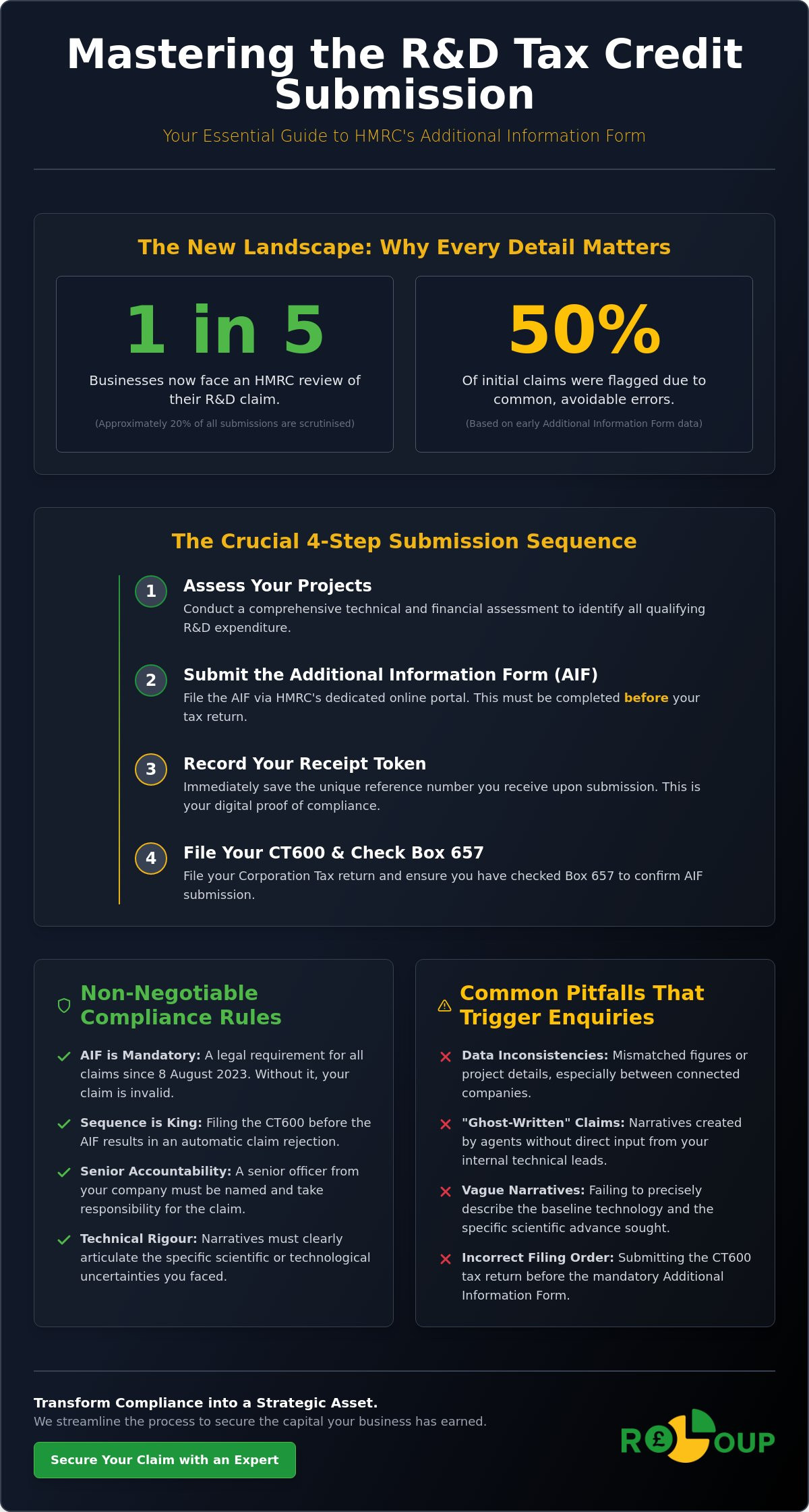
Did you know that HMRC now reviews approximately 20% of all R&D claims? That is one in five businesses facing a potential enquiry simply because of how they documented their innovation. Understanding the additional information form for R&D has become the single most important factor in protecting your tax credit from unnecessary scrutiny. It's natural to feel a sense of dread when faced with strict character limits and complex technical questions, especially when you'd rather focus on growing your company than navigating administrative hurdles.
We believe that regulatory compliance should be an opportunity for growth, not a barrier to it. You deserve a process that is as efficient as the technology you're developing. This guide provides a clear roadmap through the mandatory 2026 filing standards, showing you how to describe your technical uncertainties with precision. We'll explore exactly how to align your submission with HMRC's current expectations, ensuring you minimise administrative back-and-forth and secure the capital your business has rightfully earned.
Key Takeaways
- Learn why submitting the Additional Information Form before your CT600 is a non-negotiable requirement for a successful, undisputed payout.
- Gain clarity on selecting and describing the right sample of projects to satisfy HMRC's focus on scientific and technological advances.
- Improve your claim's robustness by understanding the additional information form for R&D and how to avoid common data inconsistencies that trigger enquiries.
- Discover the critical importance of Box 657 on your tax return and why this small administrative step is often the difference between success and rejection.
- Explore how aligning your technical narratives with the 2026 'competent professional' standard can transform your R&D tax credit into a strategic business asset.
The Mandatory Role of the Additional Information Form in R&D Claims
Since 8 August 2023, the Additional Information Form (AIF) has shifted from a best-practice recommendation to a non-negotiable legal requirement. It's a digital-first hurdle designed to ensure every claim meets a baseline of technical rigour. HMRC uses this standardised format to combat what they define as "error and fraud" within the tax system. By requiring specific technical data before the tax return is even filed, they've created a more transparent, albeit more demanding, environment for innovation. Understanding the additional information form for R&D is now the first step in any successful claim strategy.
This mandate applies universally across the board. Whether your company operates under the merged R&D scheme or qualifies for the Enhanced R&D Intensive Support (ERIS), the AIF must be completed. If you fail to submit the form before your CT600, HMRC will treat your claim as invalid. This isn't a minor administrative slip; it's a total block on your R&D tax relief until the error is rectified. HMRC's goal is to ensure that R&D tax credits are only awarded to those who can clearly articulate their scientific or technological journey.
Who is Responsible for the Submission?
Accountability is a central theme in the 2026 compliance landscape. HMRC requires a named senior officer within the company to take formal responsibility for the AIF. This individual must be someone with the authority to vouch for the technical and financial accuracy of the claim. Whilst a specialised R&D agent can facilitate the process, they cannot act in isolation. The "ghost-written" claims of the past, where external consultants wrote technical narratives without internal input, are now considered high-risk. Your internal technical leads must be involved to ensure the descriptions reflect the actual scientific or technological uncertainties faced during the project.
The Complexity of Connected Companies
For businesses operating within a group structure, the AIF adds a layer of logistical complexity that many competitors overlook. If your organisation shares R&D resources or staff amongst several connected companies, you must ensure your reporting remains consistent across every submission. HMRC's digital systems are increasingly adept at spotting discrepancies between related entities.
A thorough understanding the additional information form for R&D is particularly vital when dealing with subcontractors or externally provided workers (EPWs). You must clearly delineate who holds the risk and who is directing the R&D. You need to report the costs and technical contributions of these third parties with precision to avoid triggering a compliance check. Consistency is your best defence; if Company A claims for an EPW's time, Company B's records should reflect that same allocation. This proactive approach transforms a complex regulatory procedure into a streamlined opportunity for business growth.
Key Deadlines and the Crucial Link to Your CT600 Tax Return
The sequence of your submission is just as vital as the content itself. HMRC has established a strict chronological order that must be followed; filing your Corporation Tax return (CT600) before your Additional Information Form will lead to an automatic rejection of your claim. This digital-first workflow ensures that the technical evidence is already on file when the financial figures arrive. Understanding the additional information form for R&D means mastering this specific timeline to avoid unnecessary administrative delays.
To maintain total compliance with 2026 standards, follow this five-step process:
- Step 1: Complete a comprehensive technical and financial assessment of your R&D projects to ensure all qualifying expenditure is captured.
- Step 2: Submit the Additional Information Form via the dedicated HMRC online portal, following the official HMRC guidance for technical narratives.
- Step 3: Once submitted, you will receive a unique "receipt token." Record this immediately; it is your digital proof of compliance.
- Step 4: File your CT600. You must check Box 657 to signal to HMRC that the AIF has been successfully submitted.
- Step 5: Retain the full submission summary. This document is your primary line of defence should HMRC initiate a compliance check later.
Accounting Periods and Multi-Year Claims
Managing projects that span multiple accounting periods requires a strategic approach. You cannot simply copy and paste technical descriptions from previous years. HMRC expects to see how the project evolved, what new uncertainties were encountered, and how the baseline of knowledge shifted. If your business has undergone a restructure or sale resulting in a "short" accounting period, the AIF must be tailored to that specific window. Every submission should reflect a distinct chapter of your innovation journey.
Synchronising with Your General Accountant
The "receipt token" is the critical bridge between your R&D specialist and your general accountant. If your accountant files the CT600 without this token or forgets to tick Box 657, the claim is effectively dead on arrival. Timing errors remain one of the most common reasons for claim failure. Ensuring your internal teams and external advisors are perfectly synchronised is the only way to guarantee a smooth process. For a broader look at how these elements fit together, you can explore our guide on R&D tax credits explained. If you're concerned about hitting these tight filing windows, our specialists can help organise your submission timeline to ensure every deadline is met with precision.
Describing Your Innovation: HMRC’s Project Detail Requirements
HMRC has moved away from accepting broad summaries of business activity. They now require a granular look at a representative sample of your work, typically between 3 and 10 projects. If your claim involves fewer than three projects, you must describe them all. This shift ensures that inspectors can see the technical reality behind the numbers. Understanding the additional information form for R&D requires a move away from marketing-speak and toward technical precision. You are no longer "selling" your product to a customer; you are explaining a technological journey to a tax inspector.
The core of your description must be the "scientific or technological advance" you sought to achieve. HMRC isn't interested in the commercial success of the project. They want to know how you attempted to improve the overall knowledge base of your industry. This means documenting the iterations, the failed prototypes, and the unexpected roadblocks. Evidence of failure is often the strongest proof that a project qualifies for claiming R&D tax credits, as it demonstrates that the solution was not easily found.
The "Competent Professional" Benchmark
Your technical narrative must be written from the perspective of a "competent professional." This is an individual with relevant qualifications and experience in the specific field of your R&D. To satisfy HMRC, you must prove that the solution to your problem was not "readily deducible" to someone with this level of expertise. Before your project began, the baseline of technology consisted of the publicly available knowledge and standard industry practices that failed to provide a viable solution to your specific technical challenge. Defining this baseline clearly is the only way to measure the height of the advance you eventually achieved.
Articulating Technical Uncertainty
There is a vital distinction between business uncertainty and technical uncertainty. HMRC does not care if you didn't know if the product would sell or if the project would stay within budget. Those are commercial risks. Technical uncertainty arises when your team cannot predict whether a specific outcome is achievable or how to achieve it based on current knowledge. You must show a "Systematic Investigation" where you tested hypotheses and refined your approach based on technical results. By focusing on these technical hurdles rather than commercial outcomes, you align your submission with the latest compliance standards and protect your claim from being flagged for further review.
Avoiding Common Pitfalls: Why 50% of Initial Claims Were Flagged
The transition to the AIF mandate has been a steep learning curve for many UK businesses. Data suggests that 50% of initial claims were flagged by HMRC for errors or inconsistencies during the first year of the new system. Most of these rejections weren't due to poor innovation, but rather simple administrative oversights. Forgetting to check Box 657 on the CT600 remains the most common reason for a claim to be invalidated immediately. This tiny box is the digital handshake that tells HMRC your AIF is already on file. Without it, your return is incomplete.
Financial discrepancies are another major trigger. If the qualifying expenditure on your AIF doesn't match the figures on your tax return, HMRC's automated systems will flag the claim for a manual review. This often happens when businesses use generic SIC codes that don't align with the technical work described. For example, a software developer using a retail SIC code will likely face questions. Understanding the additional information form for R&D involves ensuring every data point, from staff cost apportionment to industry classification, is internally consistent.
2026 Transparency and AI Compliance
HMRC's compliance toolkit has evolved significantly. By 2026, they are using sophisticated automated tools to scan submissions for "template" or AI-generated project descriptions. If your technical narrative feels generic or lacks the specific details of your unique journey, it's more likely to be rejected. Relying on non-specialist software to produce these narratives is a high-risk strategy. You can learn more about HMRC R&D Tax Claim Transparency and AI and how to stay ahead of these digital checks by ensuring your technical narratives are written by competent professionals.
The Danger of "Qualifying Indirect Activities"
Over-claiming for administrative support or maintenance is a frequent pitfall. Whilst "Qualifying Indirect Activities" (QIAs) like HR or payroll support for R&D staff are eligible, they must be proportionate to the core technical work. HMRC is currently cracking down on claims where QIAs make up an unusually high percentage of the total cost. You must document the "why" behind every cost centre included in the form to justify its inclusion. A thorough understanding the additional information form for R&D requires a meticulous approach to cost allocation. If you're concerned about your current claim's accuracy, you can request a professional compliance review to ensure your submission is robust and protected.
Strategic Compliance: How Recoup Capital Streamlines Your R&D Submission
The current regulatory environment requires more than just a surface-level submission. It demands a partnership with experts who can navigate the intricacies of HMRC's evolving expectations. Recoup Capital acts as a protective guide throughout the entire AIF and CT600 process, ensuring your business remains compliant whilst maximising your capital recovery. Our team of chartered tax accountants takes the weight off your shoulders by translating your technical achievements into the precise language HMRC expects. Understanding the additional information form for R&D is what we do daily; this allows you to focus on the innovation that drives your business forward.
Our approach is built on technical rigour. We ensure every technical narrative meets the 2026 'competent professional' standard, providing the depth and evidence of uncertainty that inspectors now require. Beyond the narratives, we perform a full forensic review of your costs. This ensures that the financial data on your AIF matches your accounting records exactly, removing the inconsistencies that often trigger enquiries. Because we operate on a success-based fee model, our interests are perfectly aligned with yours. We succeed only when your claim is compliant and undisputed.
Beyond the Form: Long-Term Innovation Partnership
HMRC's digital-first approach means that record-keeping is no longer a retrospective task. We help you organise your internal processes to make future AIFs easier to complete, transforming a reactive administrative burden into a proactive strategy. By reframing your R&D returns as strategic assets rather than one-off refunds, you can better plan for future growth. If you are ready to begin Claiming R&D Tax Credits with confidence, we are here to support your long-term innovation journey.
Ready to Secure Your Innovation Funding?
Timing is everything in the 2026 compliance landscape. We recommend starting the AIF process at least 30 days before your filing deadline to ensure every technical detail is captured accurately. This lead time allows for a thorough review and prevents the rushed errors that often lead to flagged claims. We offer a no-cost introductory consultation to review your current claim structure and identify potential risks before they reach HMRC. Speak to a Recoup Capital Specialist Today to ensure your innovation funding is secure, robust, and fully compliant.
Future-Proof Your Innovation Strategy
Mastering the technical rigour required for the 2026 standards is the only way to ensure your claim remains undisputed. From synchronising receipt tokens with your accountant to articulating technical uncertainties with precision, every detail counts. Understanding the additional information form for R&D is no longer just about filling in boxes; it's about building a robust, evidence-based defence of your innovation.
Our team of chartered tax accountants brings deep HMRC enquiry experience and national expertise across the construction, engineering, and tech sectors. We operate on a success-based fee structure, ensuring our results-driven consultancy is perfectly aligned with your business goals. You don't have to face these regulatory complexities alone.
Secure your R&D claim with a specialist review today. We're ready to act as your protective guide, transforming intimidating procedures into a clear opportunity for your company's long-term growth and success.
Frequently Asked Questions
Is the Additional Information Form required for every R&D claim?
Yes, the form is a mandatory requirement for all R&D tax relief claims submitted to HMRC. This rule applies to every company regardless of its size, sector, or the specific tax credit scheme it's using. Understanding the additional information form for R&D is essential because failing to provide it results in an automatic rejection of your claim. It's a digital gatekeeper that ensures HMRC has the necessary technical context before they process your financial figures.
When should I submit the Additional Information Form to HMRC?
You must submit the form before you file your Corporation Tax return (CT600). HMRC's systems are designed to check for the presence of the AIF the moment your tax return arrives. If the form isn't already on file, your R&D claim will be removed from the return immediately. We recommend submitting the form at least several days in advance to ensure the digital records are fully synchronised across HMRC's platforms.
Can my accountant submit the AIF on my behalf?
A registered tax agent or specialist accountant can submit the form for you. However, a senior officer from your company must still be named within the document to take formal responsibility for the accuracy of the technical and financial data. The process requires close collaboration between your internal technical team and your advisors. This ensures the descriptions accurately reflect the R&D work performed during the specific accounting period.
What happens if I submit my CT600 without the Additional Information Form?
HMRC will automatically invalidate your R&D claim and remove the tax relief from your Corporation Tax return. You'll receive a notification stating that the claim has been rejected because the mandatory form was missing. Whilst you can often rectify this by submitting the AIF and re-filing an amended return, it creates significant delays. It also increases the risk of your company being flagged for a more detailed compliance review.
How many projects do I need to describe in the AIF?
You must describe a representative sample of your projects, which usually ranges between 3 and 10. If your total R&D claim covers three projects or fewer, you're required to provide a detailed description for every single one. These descriptions must collectively account for at least 50% of the total qualifying expenditure. This ensures HMRC has a clear view of the most significant technical activities and costs within your claim.
What is the "receipt token" and why is it important?
The receipt token is a unique digital identifier provided by HMRC once you successfully submit the AIF online. It serves as your formal proof of submission and must be recorded carefully by your team. Your accountant will need this token to cross-reference the form when filing your CT600. Without this token, there's no digital link between your technical narratives and your tax return, which often leads to processing errors and claim rejections.
Does the AIF apply to both SME and RDEC schemes?
Yes, the requirement for understanding the additional information form for R&D applies to all companies, including those using the merged R&D scheme or the intensive support (ERIS). Since the regulatory transitions in 2024, the form has become the universal standard for reporting innovation costs. It ensures that every claimant, regardless of their specific scheme, provides the same high level of technical transparency and financial detail to HMRC.
How detailed do the project descriptions need to be in 2026?
Project descriptions must be highly specific, focusing on the technological uncertainties and the "competent professional" standard. HMRC expects you to move beyond high-level summaries and explain the exact technical hurdles your team faced. You should document the baseline of knowledge you started with and the systematic investigation you followed. Clear, concise evidence of technical trial and error is far more valuable to an inspector than marketing-led project overviews.


