

Did you know that an HMRC enquiry into an R&D tax claim is actually a technical audit of your innovation narrative, rather than just a simple check of your balance sheet? With compliance check rates climbing to over 20% in recent years, receiving that official letter can feel like a significant threat to your company’s financial stability. It’s completely understandable to feel concerned about potential clawbacks or the prospect of a 12-month investigation that distracts your best minds from their core projects.
We believe that a robust enquiry response is about more than just numbers; it's about clearly proving the scientific or technological uncertainty your team has conquered. This guide provides you with a strategic roadmap to handle HMRC scrutiny with confidence. You'll learn how to defend your innovation effectively, minimise the risk of penalties, and secure the tax relief your business deserves. We will explore the essential steps to transform an intimidating regulatory procedure into a streamlined opportunity to strengthen your internal compliance and protect your future growth.
Key Takeaways
- Understand why HMRC has significantly increased compliance activity and how AI-driven screening now identifies high-risk claims across specific sectors.
- Identify the common triggers for an HMRC enquiry R&D tax claim so you can proactively address potential red flags in your technical documentation.
- Gain a clear understanding of the typical compliance check timeline and the specific information requests you should expect to receive from HMRC.
- Learn how to gather robust contemporary evidence and reframe your technical narrative to align perfectly with official HMRC guidelines.
- Discover the strategic advantage of pairing chartered tax accountants with technical specialists to ensure a successful defence and a minimised-penalty outcome.
Understanding the HMRC R&D Enquiry Landscape in 2026
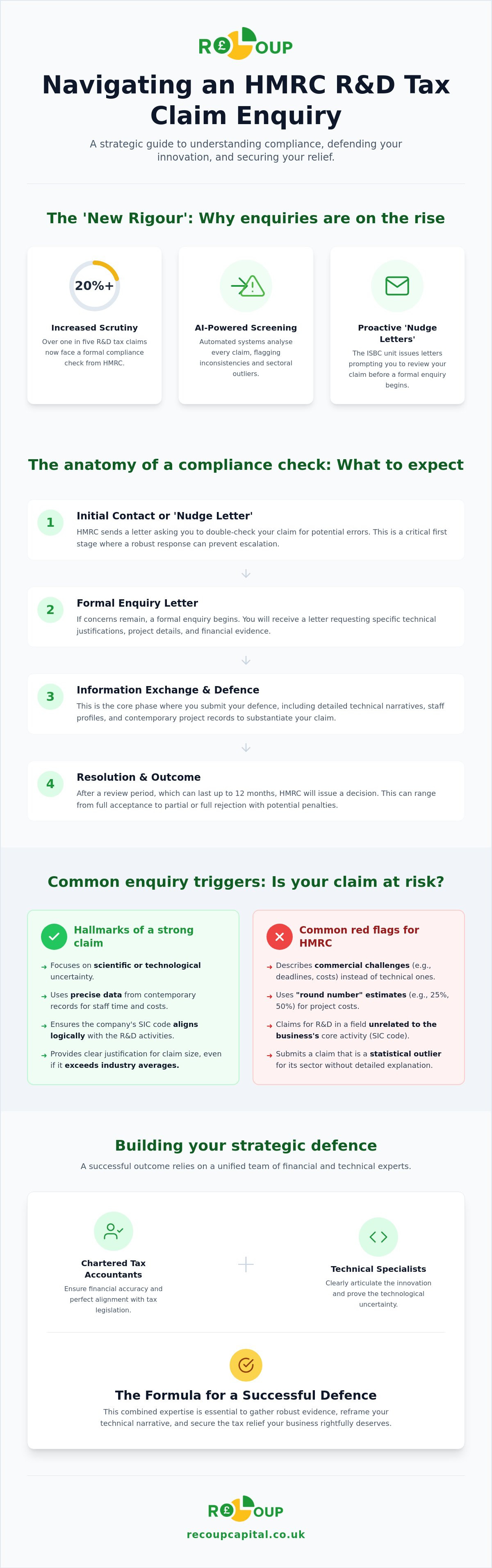
An HMRC enquiry R&D tax claim is a formal compliance check designed to verify that your business activities truly meet the statutory definition of innovation. It's a technical audit that goes far beyond simple bookkeeping. HMRC has entered an era of "New Rigour," having significantly bolstered its compliance workforce and deployed AI-powered screening tools to analyse every submission for inconsistencies. While the UK's R&D Tax Credit Scheme has historically been a lifeline for growth, the landscape has shifted toward high-frequency scrutiny.
The introduction of the mandatory Additional Information Form (AIF) in 2023 was a turning point. This form requires a granular breakdown of technical projects and costs before a claim is even processed. For accounting periods beginning on or after 1 April 2024, most companies now operate under a single merged scheme, replacing the previous distinction between the SME and RDEC frameworks. This unified approach allows HMRC to apply standardised, rigorous testing across the board, making technical precision more vital than ever for securing your relief.
Why Enquiries Are the "New Normal" for UK Tech
HMRC’s aggressive stance was largely influenced by ONS BERD statistics, which suggested that error and fraud in the scheme were higher than previously estimated. This data triggered a shift in strategy. HMRC now uses sectoral benchmarking to flag "outliers," which are claims that appear disproportionately high compared to industry averages. If your expenditure doesn't align with typical patterns for your sector, the AI screening tools will likely trigger a check. Furthermore, random sampling has become a standard tool, meaning even the most diligent, legitimate companies are frequently selected for investigation to ensure overall scheme integrity.
The Role of the Individual and Small Business Compliance (ISBC) Unit
The Individual and Small Business Compliance (ISBC) unit now manages the majority of SME enquiries. Their approach is characterised by "volume compliance," where standardised queries are sent to hundreds of businesses at once. You might first encounter this through a "nudge letter," a proactive prompt from HMRC suggesting you re-examine your claim for potential errors. It's a critical moment for your business. A nudge letter isn't a formal enquiry yet, but your response determines whether HMRC closes the matter or escalates it to a full investigation. Understanding this R&D tax credits explained framework helps you recognise that these letters require a specialised, technical response rather than a generic administrative one.
HMRC Enquiry Red Flags: Why Your R&D Claim Was Selected
While Section 1 highlighted that some compliance checks are random, the majority of investigations are risk-based. HMRC’s AI algorithms don't just read your numbers; they scan for patterns that suggest a lack of technical rigour or financial precision. In the 2026 landscape, certain sectors like construction and engineering are under intense scrutiny. This is often because these industries frequently involve bespoke projects where the line between standard commercial work and genuine innovation can become blurred. If your claim doesn't clearly articulate where routine problem-solving ends and true R&D begins, you are far more likely to trigger an HMRC enquiry R&D tax claim.
Technical Uncertainties vs. Commercial Challenges
HMRC inspectors are trained to spot a fundamental mistake: describing a project as "difficult" rather than "technically uncertain." A project can be commercially challenging, expensive, or physically demanding without qualifying as R&D. To pass the test, you must prove that the solution was not readily deducible by a competent professional in your field. If your technical narrative focuses on tight deadlines or supply chain issues instead of scientific or technological advances, it flags your claim for a deeper dive. This is why claiming R&D tax credits requires a meticulous approach to documenting the specific technical hurdles your team overcame.
Financial Inconsistencies and Administrative Errors
Financial red flags are often the easiest for HMRC’s AI to identify. One of the most common triggers is the use of "round numbers" in staff time estimates. If every employee on a project is listed as spending exactly 20% or 50% of their time on R&D, it suggests a lack of contemporary record-keeping. Furthermore, your Standard Industrial Classification (SIC) code must align with your claimed activities. A company registered for "general retail" claiming significant software engineering R&D will trigger an automatic risk alert.
Consistency across your entire tax filing is non-negotiable. Your CT600 must perfectly mirror the figures in your technical report and the Additional Information Form. If you discover that your previous submissions contain these errors, you should consult the HMRC guidance on R&D tax relief errors to understand the voluntary disclosure process. Addressing these discrepancies before an enquiry begins is always the preferred strategy. Our specialists act as a protective guide to help you identify these risks before they become liabilities at recoupcapital.co.uk.
The Anatomy of a Compliance Check: What to Expect
Receiving notification of an HMRC enquiry R&D tax claim marks the beginning of a structured, often rigorous process that typically spans between 6 and 18 months. It isn't a simple administrative check. HMRC usually issues a formal "Request for Information" (RFI) that can span several pages, containing dozens of detailed queries. These questions target both the technical validity of your projects and the granular breakdown of your qualifying costs. For many businesses, this creates a significant operational burden, as your lead engineers and finance directors must pivot from their primary roles to dig through historical records and project logs.
The potential outcomes of this process vary significantly based on the quality of your defence. HMRC may conclude the check with:
- Full Acceptance: Your claim is approved in its entirety, and the tax relief is secured.
- Partial Rejection: Specific projects or cost categories are disallowed, reducing the total benefit.
- Full Rejection: The entire claim is dismissed, often leading to a clawback of funds already paid.
- Penalties: If HMRC determines that errors were "careless" or "deliberate," they can apply financial penalties ranging from 15% to 100% of the tax at stake.
Beyond the financial risk, the emotional toll on your team shouldn't be underestimated. The uncertainty of a long-term investigation can cast a shadow over future innovation plans. Understanding the process through our R&D tax credit FAQs can help demystify these steps and reduce the stress on your internal teams.
The Initial Letter and the 30-Day Window
The first 30 days after receiving HMRC’s letter are the most critical. This window is your opportunity to set a professional, cooperative tone for the entire enquiry. HMRC is looking for a response that is structured, evidence-based, and directly addresses their specific concerns. Providing too little information can make you appear ill-prepared, whilst dumping unorganised data can lead to confusion and even more follow-up questions. A balanced, technical response is essential to demonstrate that your claim was prepared with due care and attention.
Interviews, ADR, and Tax Tribunals
If written evidence doesn't resolve HMRC’s doubts, they may request a technical interview with your "Competent Professionals." This is a high-pressure setting where your lead innovators must explain complex technical uncertainties to a tax inspector. If a deadlock occurs, Alternative Dispute Resolution (ADR) allows a neutral HMRC mediator to facilitate a settlement. Only if these avenues fail does a case move to the First-tier Tribunal (Tax). This is a formal, court-like environment and represents the final resort for resolving a dispute. Having a protective guide throughout these stages ensures your technical narrative remains consistent and robust. For those who also manage business interests in the United States and require similar high-level legal support for IRS disputes, you can discover Kovan Tax Law.
Strategic Defence: How to Respond to an HMRC Enquiry
Successfully defending an HMRC enquiry R&D tax claim requires a shift in perspective. You're no longer just reporting costs; you're proving that a specific technical advancement took place. This isn't a task for your finance team alone. It demands a partnership between your lead engineers and tax specialists to ensure the narrative is both technically accurate and compliant with HMRC’s Corporate Intangibles and Research and Development (CIRD) guidelines. Professionalism is your greatest asset here. You must maintain your ground on technical facts whilst remaining cooperative and transparent throughout the dialogue.
Evidence Gathering and Documentation
HMRC has little patience for retrospective time-writing or estimated journals created months after the work finished. They want to see "Hard Evidence" that proves the R&D was happening in real-time. This includes project blueprints, testing logs, git commits, and even minutes from failed sprint meetings. These documents show the journey of discovery, highlighting the uncertainties your team encountered. Contemporary evidence refers to documentation generated at the actual time the R&D activity occurred, providing a real-time record of the technical uncertainties and trials undertaken. Without this foundation, even the most innovative projects can be disqualified during a compliance check.
Technical Reframing: Speaking HMRC’s Language
The most common reason a defence fails is the use of "marketing speak." HMRC isn't interested in how "revolutionary" or "market-leading" your product is; they want to know about the scientific or technological advance. You must translate complex engineering challenges into the specific framework of "Advance" and "Uncertainty." This means clearly defining the baseline of existing technology and explaining exactly why your solution wasn't a straightforward deduction for a competent professional. For a deeper dive into these definitions, our guide on R&D tax credits explained provides the necessary clarity to align your narrative with regulatory expectations.
The "Competent Professional" is the linchpin of your defence. HMRC respects the expertise of your lead technical staff, but they must be prepared to articulate the technical hurdles in a way that aligns with tax law. If you’re currently facing a challenge, our technical specialists can review your evidence and help build a robust defence at recoupcapital.co.uk. We act as your protective guide, ensuring your innovation is described with the technical depth required to satisfy an inspector's scrutiny.
Navigating HMRC Enquiries with Recoup Capital
Facing an HMRC enquiry R&D tax claim shouldn't be a solitary battle. Whilst generalist accountants provide excellent support for standard corporation tax, they often lack the deep technical expertise required to challenge an HMRC inspector’s scientific queries. At Recoup Capital, we bridge this gap. We pair Chartered Tax Accountants with technical specialists who speak the language of your engineers. This multi-disciplinary approach ensures your technical narrative is defended with the same rigour used to create it. We operate on a success-based fee model; our interests are perfectly aligned with yours, as we only win when your claim is successfully defended.
By handling the heavy lifting of the enquiry process, we allow your team to return to what they do best: driving your business forward. We manage the detailed Requests for Information, coordinate with HMRC, and lead technical discussions. This transforms a stressful investigation into a managed professional procedure. Our goal is to act as your protective guide, ensuring that your innovation is recognised and your capital is recovered without unnecessary distraction from your core operations.
The Value of a Specialist R&D Partner
Our team has deep-rooted expertise in high-scrutiny sectors like construction and engineering, where "hidden" R&D often requires a specialist eye to uncover. We don't just react to letters. We can review your past claims to identify and rectify potential risks before HMRC even flags them. This proactive stance is part of our commitment to long-term collaboration. You can learn more about our unique approach and why claim with Recoup Capital to see how we’ve helped others secure their innovation assets through expert technical defence.
Protecting Your Future Claims
A successfully defended enquiry does more than just secure a single year of tax relief; it provides a "Compliance Blueprint" for all your future submissions. We help you implement robust R&D tracking systems that capture contemporary evidence as it happens. This significantly reduces the risk of an HMRC enquiry R&D tax claim in the future. By turning a regulatory challenge into a strategic asset, we ensure your business is better prepared for the evolving rigours of the UK tax system. If you’re ready to defend your innovation narrative with confidence, speak to our specialists about your HMRC enquiry today. We offer a time-limited, no-cost initial review to help you understand your position and secure your long-term capital recovery.
Secure Your Innovation with a Robust Defence Strategy
Managing an HMRC enquiry R&D tax claim requires a strategic shift from simple cost reporting to a sophisticated technical defence. Success lies in your ability to produce contemporary evidence and translate complex engineering hurdles into the specific language of scientific advancement. By reframing your financial returns as strategic assets, you transform a potentially intimidating regulatory check into an opportunity to strengthen your internal compliance and future innovation potential.
Our specialist team of chartered tax accountants and technical experts provides national UK coverage to act as your protective guide through every stage of the process. With our success-based fee model, we ensure our goals are perfectly aligned with your business outcomes, allowing you to focus on growth whilst we handle the technical rigour of the investigation. Don't leave your tax relief to chance; proactive preparation is the most effective way to secure the capital your innovation deserves.
Protect your R&D claim and speak to a specialist today and discover how a partnership-oriented approach can safeguard your company's future.
Frequently Asked Questions
How long does an HMRC R&D enquiry typically last?
An HMRC enquiry R&D tax claim typically lasts between 6 and 18 months, depending on the complexity of the technical challenges raised. Whilst HMRC aims to process standard payable claims within 40 days, those selected for a compliance check require a much deeper dive into your contemporary evidence and project logs. We act as a protective guide during this period to keep the momentum going and minimise operational disruption.
Can I still claim R&D tax credits if I have been enquired into before?
Yes, you can absolutely continue to claim R&D tax credits even if you've undergone a compliance check in the past. A successfully defended enquiry often provides a robust blueprint for future submissions, helping you refine your internal tracking. It's vital to implement the lessons learned from previous checks to ensure your technical narrative and cost apportionments meet HMRC’s evolving standards for rigour.
What are the penalties for an incorrect R&D tax claim?
Financial penalties for an incorrect claim usually range from 15% to 100% of the tax relief at stake. HMRC bases these charges on whether they deem the error to be "careless" or "deliberate." Engaging a specialist early in the process helps demonstrate that you've taken reasonable care, which is the most effective way to minimise or even eliminate potential penalties during an investigation.
Should I use my regular accountant to defend an HMRC enquiry?
Whilst your regular accountant is excellent for general corporation tax, they may lack the technical engineering or scientific background required to defend a complex enquiry. HMRC inspectors often ask granular questions about technological uncertainties that require a specialist's perspective to answer effectively. We recommend a partnership approach where your accountant handles the figures whilst technical specialists defend the innovation narrative.
What is the "Additional Information Form" and why is it important?
The Additional Information Form (AIF) is a mandatory digital submission that must be completed before you file your R&D claim. It requires detailed technical descriptions and a granular breakdown of costs for every project included in your claim. A poorly completed AIF is now a primary trigger for an enquiry; it's a critical document for establishing your claim's credibility from the outset.
Will an HMRC enquiry trigger an audit of my entire corporation tax return?
An enquiry into your R&D claim is usually ring-fenced to the specific R&D figures and technical projects. However, if HMRC discovers significant inconsistencies in your staff costs or payroll data, they may choose to widen the scope of their investigation to other areas of your return. Centralised units like the Wealthy and Mid-sized Business Compliance (WMBC) unit now oversee these checks to ensure specialist oversight.
What happens if HMRC rejects my R&D claim?
If HMRC rejects your claim, you'll receive a closure notice detailing their decision and any tax relief you're required to repay. This often involves a "clawback" of funds already received, alongside potential interest and penalties. It’s a serious outcome that can impact your cash flow, but it isn't necessarily the end of the road if you have grounds for a technical disagreement.
Can I appeal an HMRC decision on my R&D tax credit?
You have a legal right to appeal an HMRC decision within 30 days of the date on your closure notice. This process often starts with an internal review by a different HMRC officer or through Alternative Dispute Resolution (ADR) to break a deadlock. If these routes don't lead to a resolution, your case can be taken to the First-tier Tribunal (Tax) for a formal ruling.


