

Is your business treating its R&D tax claim as a simple year-end refund, or is it the strategic capital your next breakthrough requires? Understanding how are R&D tax credits calculated UK in 2026 is no longer just a compliance task; it's a forensic exercise in unlocking growth. You're likely feeling the weight of the Merged Scheme and ERIS regulations, perhaps worrying if your staff cost apportionments will stand up to HMRC's increased scrutiny. It's a common concern, especially when the line between qualifying activity and day-to-day operations feels blurred.
This guide will demystify the 20% gross credit and the 14.5% ERIS payable credit, ensuring you can forecast your innovation funding with absolute precision. We'll break down the specific mechanics of the new regimes, help you categorise qualifying expenditure correctly, and provide a framework to turn tax relief into a high-impact business asset. By the end of this article, you'll have the certainty needed to claim with confidence and the clarity to reinvest your returns effectively.
Key Takeaways
- Learn how the transition to the Merged Scheme and ERIS impacts your eligibility and the potential value of your 2026 innovation funding.
- Discover precisely how are R&D tax credits calculated UK by building a robust Qualifying Indirect Expenditure (QIE) pool to ensure no eligible cost is left behind.
- Identify the specific staffing and subcontractor costs that qualify for relief, using a forensic approach to ensure accurate apportionment and compliance.
- Understand the mandatory Additional Information Form (AIF) requirements to protect your claim from HMRC scrutiny and avoid costly calculation errors.
- Recognise how to transform your tax relief from a simple refund into a strategic growth asset that fuels your company's long-term competitive advantage.
The Foundation: Understanding the UK R&D Tax Credit Schemes in 2026
R&D tax credits serve as a robust government incentive, rewarding UK limited companies for their willingness to invest in the unknown. To qualify, your project must seek a genuine advance in science or technology through the resolution of scientific or technological uncertainty. It isn't enough to simply improve a product; you must be solving a problem that isn't readily deducible by a competent professional in your field. Understanding how are R&D tax credits calculated UK starts with identifying which of the two primary routes your company follows in the current fiscal year. Knowing how are R&D tax credits calculated UK involves more than just plugging numbers into a spreadsheet; it requires a deep understanding of which regime applies to your specific accounting period and how the mandatory Additional Information Form (AIF) impacts your submission.
This shift reflects HMRC's increased focus on compliance and technical quality, moving away from simple paperwork processing toward a more forensic validation of innovation. For businesses managing tax obligations across multiple territories, CiDATax SRL offers specialised regulatory support to ensure seamless compliance in the UK, EU, and US.
The Merged Scheme: A Unified Approach for Most Businesses
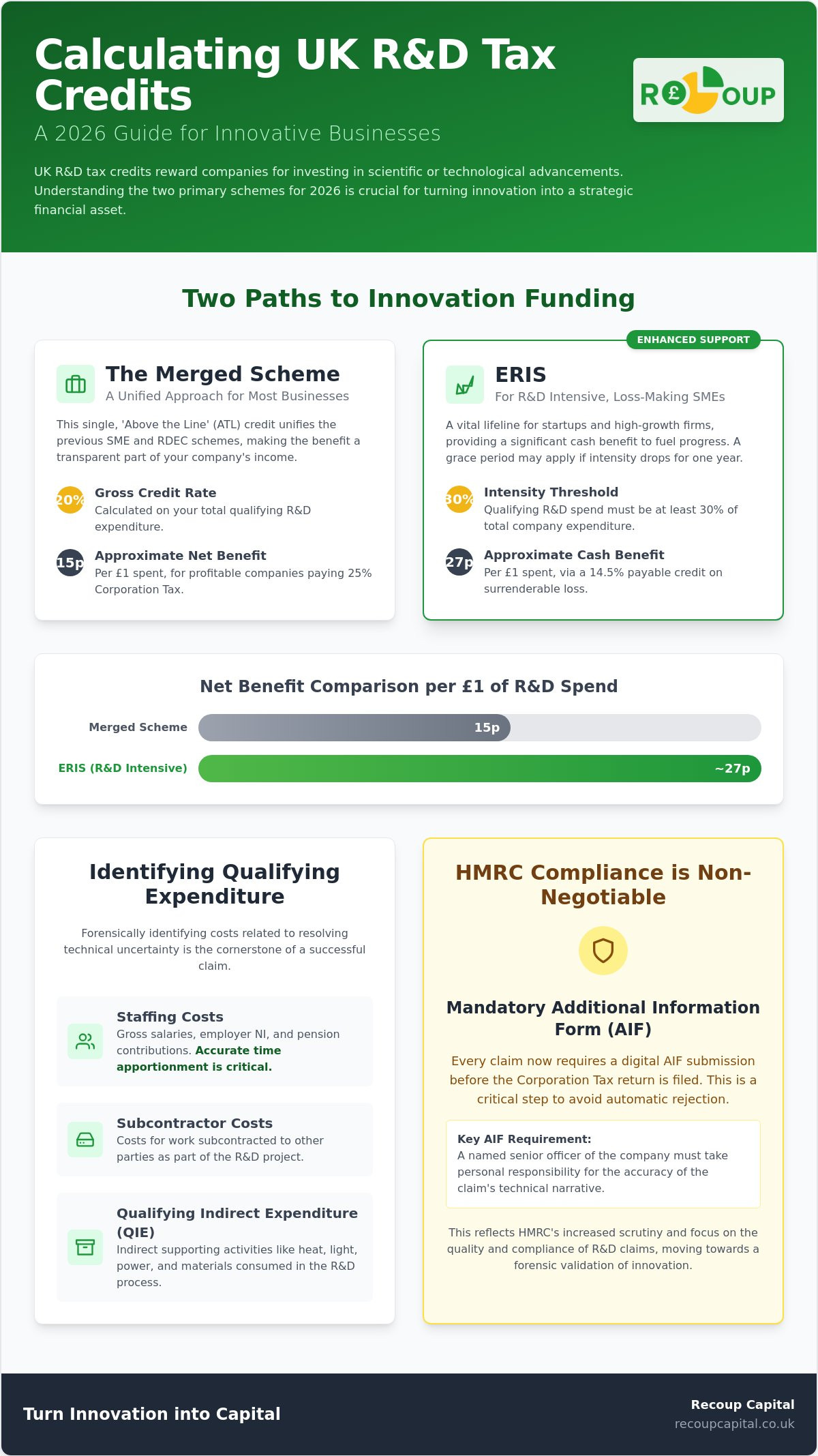
The Merged Scheme, established in April 2024, unified the previous SME and RDEC incentives into a single "Above the Line" (ATL) credit. This change means the benefit is recorded as income in your accounts before tax, rather than a mere deduction from your tax liability. The gross credit rate is set at 20% of your qualifying expenditure. However, because this credit is taxable, your actual net benefit depends on your Corporation Tax rate. For a profitable company paying the main rate of 25%, the net return is approximately 15p for every £1 spent on innovation. This streamlined approach was designed to simplify the UK R&D Tax Credit Schemes, offering more transparency for mid-market firms whilst ensuring that the incentive remains a strategic tool for financial planning.
ERIS: Enhanced Support for R&D Intensive SMEs
For loss-making Small and Medium-sized Enterprises (SMEs) that invest heavily in innovation, the ERIS pathway offers a vital lifeline. To qualify as "R&D Intensive" in 2026, your relevant R&D expenditure must be at least 30% of your total expenditure. Eligible companies can deduct an additional 86% of qualifying costs and claim a payable tax credit of up to 14.5% of the surrenderable loss. This results in an effective cash benefit of approximately 27% of your qualifying spend. It's a significant boost for startups and high-growth firms where cash flow acts as the primary engine for progress. If your intensity drops below 30% in a single year, a grace period often allows you to maintain your ERIS status if you met the threshold in the previous accounting period. You can find more details on how these schemes differ here to ensure you're pursuing the most lucrative route for your specific financial situation.
Identifying Qualifying Expenditure: What Costs Can You Actually Claim?
Determining exactly which costs to include is where many businesses falter. It isn't just about total spend; it's about the forensic identification of innovation-related outgoings. When looking at how are R&D tax credits calculated UK, the focus must remain on the specific activities that drove the technological advance. You can't simply claim for every person in the building. You need to isolate the technical effort. HMRC provides official government guidance to help businesses navigate these categories, yet the nuances of 'indirect' support often remain a grey area for many claimants.
Staffing and Apportionment: The Core of Your Calculation
Staffing costs usually form the largest part of an R&D claim. This includes gross salaries, employer National Insurance contributions, and employer pension contributions. However, you can only claim for the time spent directly on R&D projects. Apportionment is the systematic division of staff time based on technical project involvement. Accuracy here is paramount. If a lead engineer spends 60% of their month solving a technical uncertainty and 40% on routine maintenance, only 60% of their total package is eligible. You should also consider technical support staff, such as lab assistants or CAD technicians, whose work is vital to the project's success. If you are unsure whether your specific engineering or software projects meet these criteria, our team specialises in claiming R&D tax credits with a forensic focus that uncovers often-overlooked qualifying spend.
Subcontractors and EPWs: Navigating the New Restrictions
Navigating subcontractor costs requires a firm grasp of the 65% rule. For unconnected third parties, you generally claim 65% of the invoice value. This reflects the reality that the subcontractor is likely making their own margin. A major shift in 2026 is the restriction on overseas expenditure. Unless specific exemptions apply, the R&D work must physically occur in the UK to be eligible for relief. This is a significant hurdle for companies that previously outsourced development to cheaper international markets. You must also distinguish between subcontractors and Externally Provided Workers (EPWs). EPWs are usually individuals provided by an agency who work under your direct supervision, whilst subcontractors are independent entities hired to deliver a specific outcome. The calculation logic for how are R&D tax credits calculated UK treats these two groups differently, making precise record-keeping essential.
Software, Consumables, and Utilities
Modern claims must reflect the modern tech stack. Software license fees and cloud computing costs are now fully integrated into the calculation logic. If you're paying for server capacity specifically to run R&D simulations or hosting development environments, these are often qualifying costs. Consumables are also vital. These include materials 'transformed or consumed' during the R&D process, such as chemicals in a lab or prototypes in an engineering workshop. You can even claim a proportion of your utilities, like heat and light, provided they were used specifically for the qualifying activity. Every detail counts toward the final value of your strategic capital return.
The Step-by-Step Calculation Process for UK Limited Companies
Once you've forensically identified your qualifying costs, the focus shifts to the arithmetic of your claim. Understanding how are R&D tax credits calculated UK requires a logical progression from raw data to net benefit. This process ensures your innovation funding is both accurate and compliant with the latest HMRC mandates. For those seeking the granular details, the Official GOV.UK R&D Calculation Guide provides the regulatory framework that underpins these steps.
The first stage involves collating all qualifying expenditure into a single Qualifying Indirect Expenditure (QIE) pool. This includes your apportioned staffing costs, consumables, and software. Once this figure is finalised, you apply the relevant scheme rate. For the Merged Scheme, this is a flat 20%. For ERIS-eligible firms, the calculation is more complex, involving an enhancement of the original spend. You then factor in the 'notional tax' to arrive at your net benefit. This is a critical step; because the Merged Scheme is an "Above the Line" credit, it is taxable at your current Corporation Tax rate. Finally, you determine if the benefit will manifest as a reduction in your tax liability or a direct cash payment from HMRC. The precise logic behind how are R&D tax credits calculated UK ensures that every pound of innovation is accounted for whilst protecting your business from potential enquiries.
Calculating the Merged Scheme Benefit (Example)
Consider a profitable company with £100,000 in qualifying R&D spend, paying the main Corporation Tax rate of 25%. Under the Merged Scheme, the gross credit is £20,000 (20%). However, this credit is treated as taxable income. HMRC applies a notional tax of 25% to this £20,000, which amounts to £5,000. This leaves a net benefit of £15,000, or 15% of the original spend. This "Above the Line" treatment is advantageous because it increases your pre-tax profit, making your company's financial health appear stronger to potential investors or lenders. It effectively transforms a tax task into a strategic asset for your balance sheet.
Calculating the ERIS Benefit for Intensive SMEs
For loss-making SMEs that meet the 30% intensity threshold, the calculation offers a more significant cash injection. ERIS allows you to deduct an additional 86% of your qualifying costs from your taxable profits. On a £100,000 spend, this creates a total deduction of £186,000. If this results in a surrenderable loss, you can claim a cash credit of up to 14.5%. This results in an effective cash benefit of approximately £27,000. This 27% return is specifically designed to support high-growth startups where reinvesting every penny is essential for survival. It's a powerful mechanism for turning technical hurdles into capital opportunities. If you're navigating these figures for the first time, our frequently asked questions can help clarify how these rates apply to different business structures.
Common Pitfalls and Compliance: Why Accuracy Matters to HMRC
Accuracy in your R&D claim isn't just about ensuring you receive the correct amount of funding; it's your primary defence against HMRC scrutiny. With the tax authority significantly increasing its enquiry rates, aggressive or inflated calculations have become immediate red flags. When businesses ask how are R&D tax credits calculated UK, they often overlook the fact that the calculation is only as strong as the evidence supporting it. Errors in cost categorisation or over-claiming for non-qualifying activities can lead to lengthy investigations, potential penalties, and reputational damage.
Subsidised R&D remains a complex area that can easily derail your math. Whilst the Merged Scheme has simplified how grants and third-party funding interact with tax relief, you must still ensure you aren't double-claiming for the same expenditure. If your project received a grant, the way those specific costs are treated in the calculation pool requires careful handling. Beyond the numbers, your technical narrative must prove the 'why' behind the spend. It isn't enough to show a salary; you must demonstrate the specific technological uncertainty that person was working to resolve. Understanding HMRC compliance and why companies claim is essential for any business looking to turn innovation into a secure financial asset.
The Additional Information Form (AIF) Requirement
The 2026 landscape leaves no room for procedural errors. Since August 2023, all R&D claims must be preceded by a digital Additional Information Form to be valid. If this form is missing or contains inconsistencies with your Corporation Tax return, HMRC will likely reject the claim out of hand. A senior officer within your company, usually a director, must sign off on the submission, taking personal responsibility for the accuracy of both the technical and financial data. This requirement ensures that the methodology behind how are R&D tax credits calculated UK is transparent and fully endorsed by the company's leadership.
Avoiding the 'Salami Slicing' of Staff Costs
One of the most common triggers for an enquiry is the unrealistic apportionment of staff time, often referred to as 'salami slicing'. Claiming that a Director or senior manager spends 100% of their time on qualifying R&D is a major red flag. It's rarely the case that a senior leader has zero administrative or commercial responsibilities. To protect your claim, you need robust records. Whilst timesheets are the gold standard, reasonable estimates backed by project logs and meeting minutes can suffice if they're applied consistently. General accountants often miss specific exclusions, such as the costs of staff members who aren't directly involved in the resolution of technical uncertainties. Our forensic approach to R&D claims ensures every staff cost is apportioned with the precision required to withstand a full HMRC audit.
Maximising Your Claim with Recoup Capital: Turning Innovation into Capital
Why settle for a surface-level estimate when a forensic approach uncovers the true value of your innovation? A generalist accountant might grasp the basics of tax compliance, but they often lack the industry-specific depth required for complex sectors like construction, engineering, or software development. On average, our forensic specialists identify 20-30% more qualifying spend than a generalist. This discrepancy often stems from a lack of familiarity with how are R&D tax credits calculated UK under the newest 2026 regulations. We move beyond simple data entry to provide a comprehensive technical assessment that aligns your innovation with HMRC's specific mandates. You can find more about our R&D tax credits explained through our detailed, results-driven methodology.
Our success-based fee model ensures that our goals are perfectly aligned with your business objectives. We only succeed when you recover capital, creating a partnership built on transparency and results rather than traditional sales pitches. From the initial technical assessment to the final HMRC liaison, we act as a protective guide through the regulatory landscape. This streamlined process allows you to focus on your core operations whilst we handle the forensic details of your claim.
Beyond Paperwork: R&D Credits as a Strategic Business Tool
Recovered capital shouldn't just sit on a balance sheet; it should be the fuel for your next breakthrough. Our clients frequently use these recovered funds as strategic capital for debt restructuring, new acquisitions, or further technological investment. By viewing these credits through a wider lens, we help you transform a tax relief claim into a long-term growth engine. Our corporate finance advisory services complement this strategy, ensuring that the liquidity you recover is deployed effectively to increase your company's market value. This is the difference between a one-off filing and a long-term innovation partnership that prioritises your bottom line.
Get a Professional Calculation Review
The complexity of how are R&D tax credits calculated UK means that even small errors in cost apportionment can trigger a time-consuming enquiry. To mitigate this risk, we offer a time-limited, no-cost introductory review to assess your eligibility and potential claim value without any financial commitement. Should HMRC raise any questions, our chartered tax accountants handle the entire liaison process on your behalf, providing you with total peace of mind. It's time to treat your innovation with the forensic seriousness it deserves to ensure your strategic assets are fully protected. Book your specialist R&D consultation with Recoup Capital today to unlock the true value of your innovation.
Unlocking the Strategic Value of Your Innovation
Mastering how are R&D tax credits calculated UK is about more than just year-end numbers; it's about validating the technical risks your business takes every day. We've explored the transition to the Merged Scheme, the specific criteria for ERIS, and the forensic precision required to meet HMRC's 2026 compliance standards. By identifying the true breadth of your qualifying staff, consumables, and software costs, you transform a complex tax task into a powerful engine for reinvestment and growth.
Recoup Capital acts as your protective guide through this regulatory landscape. Our team of chartered tax accountants and sector specialists brings a proven track record in construction, engineering, and tech to every claim. With our success-based fee model, we only get paid if you save money, ensuring our goals are perfectly aligned with yours. Don't leave your innovation funding to chance or generalist estimates.
Maximise your innovation funding with a specialist R&D review and take the first step toward a long-term partnership that prioritises your bottom line. Your next breakthrough deserves the best possible financial foundation, and we're here to help you build it.
Frequently Asked Questions
How are R&D tax credits calculated for the 2026 tax year?
For the 2026 tax year, how are R&D tax credits calculated UK depends on whether your company falls under the Merged Scheme or the Enhanced R&D Intensive Support (ERIS) pathway. Most businesses use the Merged Scheme, which provides a 20% gross credit on qualifying expenditure. This is an 'Above the Line' credit, meaning it's taxable at your Corporation Tax rate, typically resulting in a net benefit of 15p for every £1 spent for companies paying the 25% main rate.
Can I claim R&D tax credits if my company is making a loss?
Yes, loss-making companies can still recover significant capital through a payable tax credit. If you don't have a tax liability to offset, you can surrender your R&D losses to HMRC in exchange for a cash payment. For R&D-intensive SMEs under the ERIS scheme, this cash benefit is approximately 27% of your qualifying expenditure, providing a vital liquidity boost for high-growth startups and innovators.
What is the difference between the Merged Scheme and ERIS?
The Merged Scheme is the default incentive for most UK companies, offering a taxable 20% credit. In contrast, ERIS is specifically designed for loss-making SMEs where R&D expenditure accounts for at least 30% of total business spend. ERIS offers a more generous relief rate, allowing for an additional 86% deduction on top of the original costs and a 14.5% payable credit for surrendered losses.
How much can I claim back for subcontractor costs in 2026?
When you hire unconnected subcontractors for R&D activities, you can typically include 65% of the invoice value in your calculation. This 65% rule accounts for the subcontractor's internal margin. It's vital to remember that from 2024 onwards, HMRC has restricted claims for overseas subcontractor work, meaning the activities must generally take place within the UK to qualify for relief.
What happens if HMRC disagrees with my R&D calculation?
If HMRC identifies inconsistencies or feels a claim is inflated, they may open a formal enquiry to validate your figures. This process involves a detailed review of your technical narrative and cost breakdowns. Having a specialist partner helps manage this risk, as they ensure your Additional Information Form (AIF) is robust and that every penny of your how are R&D tax credits calculated UK logic is backed by forensic evidence.
Do I need to provide timesheets to calculate staff costs for R&D?
HMRC doesn't strictly mandate the use of timesheets, but you must provide a 'reasonable' and justifiable apportionment of staff time. Whilst timesheets are considered the gold standard for evidence, you can use project logs, calendar records, or structured interviews to estimate the percentage of time spent on qualifying activities. The key is consistency and being able to explain the methodology behind your staff cost division.
Can I claim for R&D work conducted by overseas staff?
Under the current 2026 regulations, expenditure on overseas R&D is generally excluded from claims unless very specific criteria are met. These exceptions include cases where it's geographically, environmentally, or legally impossible to conduct the research in the UK. For most businesses, this means staff and subcontractors must be physically located in the UK for their costs to be eligible for tax relief.
How long does it take to receive the cash credit after the calculation is submitted?
Most companies receive their cash credit or tax reduction within 28 to 40 days of submitting their Corporation Tax return and Additional Information Form. HMRC aims to process claims efficiently, though complex cases or those selected for enquiry may take longer. Ensuring your calculation is accurate and your technical report is comprehensive from the outset is the best way to prevent delays in receiving your strategic capital.


