

What if the "scientific breakthrough" HMRC is looking for isn't happening in a laboratory, but on your factory floor or within your bespoke software architecture? Many directors assume that research and development is reserved for white-coat scientists, yet the reality of modern UK tax relief is far more inclusive. It's common to feel overwhelmed by technical terminology or to fear an HMRC enquiry if a claim isn't perfect. You likely recognise that your team is solving difficult problems, but the barrier of complex regulations often feels too high to climb without a map.
This guide provides a definitive look at what qualifies as R&D for tax purposes in 2026, stripping away the jargon to reveal the precise criteria your projects must meet. We promise to move beyond vague definitions and provide a practical framework for identifying qualifying innovation within your daily operations. You will discover how the Merged Scheme impacts your potential returns, which specific costs like staff and cloud computing are now recoverable; and how to document your technical journey with total confidence. We will outline the path from technical uncertainty to successful capital recovery, ensuring you can treat your innovation as the strategic financial asset it truly is.
Key Takeaways
- Understand the core HMRC definition and learn exactly what qualifies as R&D for tax purposes by focusing on technical advances rather than just commercial success.
- Distinguish between technical and commercial uncertainty to identify projects that resolve genuine scientific or technological challenges within your industry.
- Identify recoverable expenditure beyond basic salaries, including costs for subcontractors, externally provided workers, and essential cloud computing services.
- Learn how to document the "technical journey" to satisfy HMRC’s focus on additionality and project-specific record-keeping.
- Master the requirements of the Additional Information Form to ensure your claim remains robust and compliant under the 2026 Merged Scheme.
The HMRC Definition: What Qualifies as R&D for Tax Purposes?
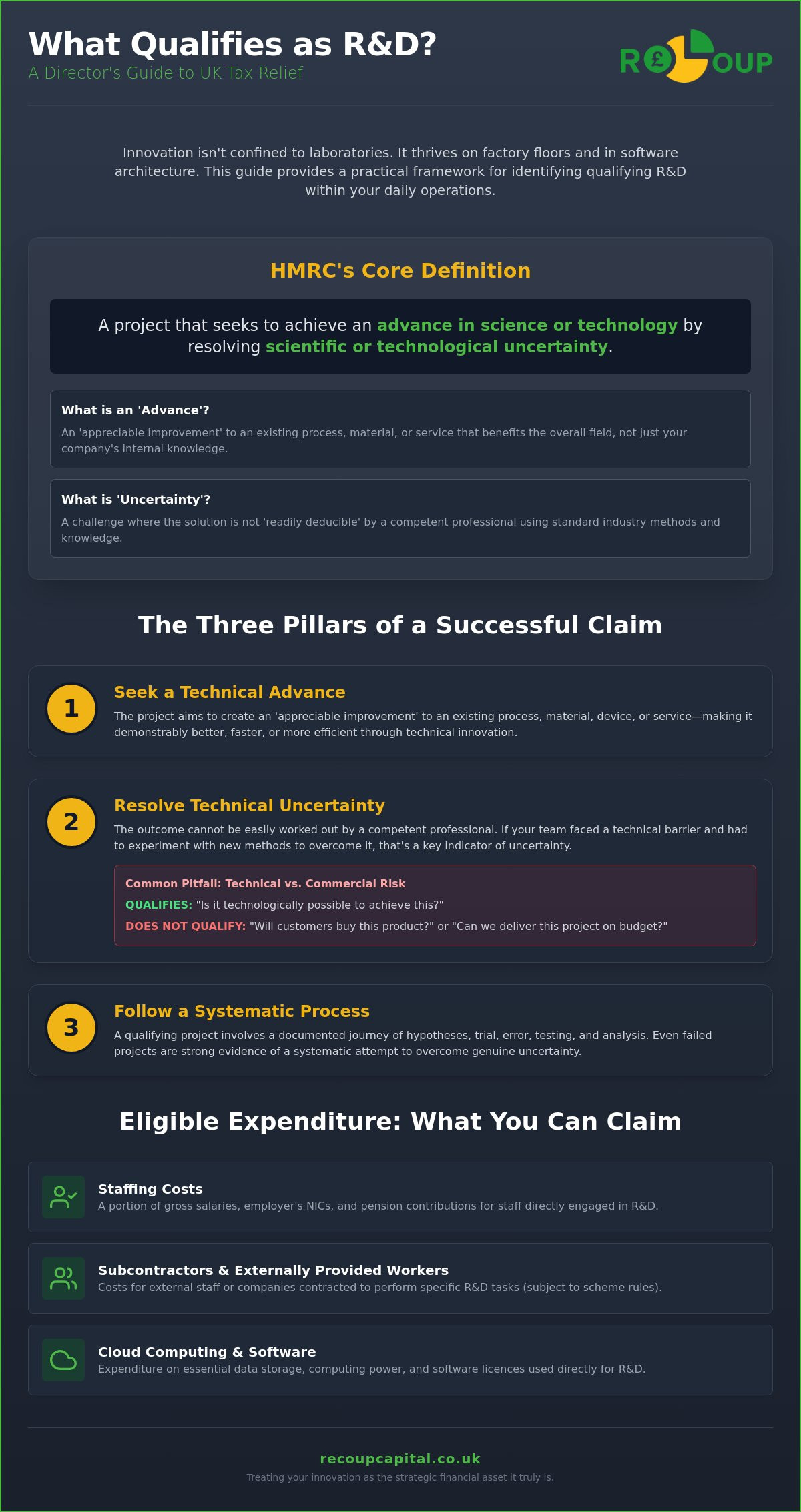
R&D tax relief is a powerful government incentive designed to reward UK limited companies that invest in innovation. It isn't a grant or a handout. Instead, it functions as a strategic tax break or a cash payment that offsets the costs of technical problem-solving. To understand what qualifies as R&D for tax purposes, you must first look past the commercial goals of your project and focus on the technical journey itself. HMRC defines R&D as a project that seeks to achieve an "advance in science or technology" by resolving scientific or technological uncertainty.
For a claim to be valid, the work must relate directly to your company's trade. This could be a trade you already carry out or one you intend to start based on the results of the R&D. The core of R&D tax credits explained lies in the requirement that the advance must not be "readily deducible" by a professional working in the field. If a solution could be found by a competent person through routine methods, it won't meet the threshold. You're looking for the moments where your team hit a wall and had to find a new way around it.
Context is vital when applying The HMRC Definition: What Qualifies as R&D for Tax Purposes? to your business. It's about the "how" and the "why" of your project, not just the "what".
The Scope of Science and Technology
HMRC maintains strict boundaries on what constitutes "science" and "technology". Whilst the definition excludes social sciences such as economics or psychology, a significant update in 2023 expanded the scope to include pure mathematics. This change acknowledges the growing role of data science and complex algorithms in modern business. Technology, in this context, refers to the practical application of scientific principles to create something functional. Qualification doesn't always require a brand-new invention. An "appreciable improvement" to an existing process, material, or service often suffices. If you've made a system significantly faster, more durable, or more efficient through technical innovation, you've likely crossed the qualifying line.
The "Competent Professional" Test
HMRC uses the persona of a "competent professional" as a benchmark to judge the validity of your claim. This is a hypothetical individual who has the right qualifications, skills, and experience in the relevant field. They are the ones who can look at a problem and say, "We didn't know if this was possible." If this professional struggled to find a solution using standard industry knowledge, you have evidence of a technical uncertainty. A competent professional is an individual with relevant qualifications and significant industry experience who possesses the expertise to judge whether a technical problem represents a genuine uncertainty or a routine task.
The Three Vital Criteria for a Successful R&D Claim
To build a robust case for tax relief, you must align your activities with three specific pillars: Technical Advance, Technical Uncertainty, and Technical Resolution. These aren't just tick-box exercises; they form the narrative of your innovation. A common stumbling block for directors is confusing commercial uncertainty with technical uncertainty. Commercial uncertainty asks whether a product will sell or if a project can stay within budget. HMRC isn't interested in these business risks. Instead, technical uncertainty asks whether it's scientifically or technologically possible to achieve a specific outcome using existing knowledge. Understanding what qualifies as R&D for tax purposes means separating your market goals from your engineering challenges.
Interestingly, a project that ends in failure is often the strongest evidence for a claim. It proves that the solution was not obvious and that you faced genuine technical barriers that couldn't be overcome by routine methods. This is where real-time documentation becomes your greatest asset. Capturing the "trial and error" process as it happens, rather than trying to reconstruct it months later, ensures your claim stands up to scrutiny. If you are unsure if your recent project meets these standards, you might find it helpful to learn more about how R&D tax credits work in practice. For a detailed breakdown of the financial side, you can consult the official guidance on Eligible Costs: What Expenditure Can You Claim? to see how these technical efforts translate into tax relief.
Seeking a Technical Advance
An advance means moving the "state of the art" forward within your sector. This doesn't require a Nobel Prize-winning discovery. It can be an incremental improvement, such as making a component 20% more heat-resistant or developing a more efficient way to process high-volume data. The key is that the knowledge gained must be an advance for the industry as a whole, not just a capability your company lacked previously. If you're simply catching up to a competitor using standard methods, it won't qualify; you must be attempting to push the boundaries of what is currently possible.
Overcoming Technical Uncertainties
Uncertainty exists when a competent professional cannot say for certain how to achieve the desired outcome. Resolving this requires a "systematic investigation". This involves testing, prototyping, and analysis to find a path forward. HMRC wants to see the journey of resolution. They value the logs, the failed prototypes, and the technical debates that occurred along the way. If you're ready to see how these pillars apply to your specific sector, speaking with a specialist can clarify your eligibility without any initial commitment.
Eligible Costs: What Expenditure Can You Claim?
Identifying what qualifies as R&D for tax purposes involves more than just spotting a clever idea; it requires a meticulous audit of your financial ledger to capture every pound invested in innovation. HMRC allows you to claim for a specific range of costs that directly support your technical journey. Staff costs usually form the backbone of most claims. You can recover a proportion of gross salaries, Employer National Insurance, and pension contributions for those directly involved in the technical work. It's important to remember that dividends and benefits-in-kind are excluded from these calculations, making it vital to structure your team's remuneration with these rules in mind.
Consumables represent another significant category. This includes materials that are either transformed or used up during the R&D process, such as chemicals in a lab or prototypes in a workshop. You can also claim a portion of your utilities, specifically heat, light, and power, provided they were consumed during the R&D activity. Modernisation of the scheme in 2023 and 2024 has further expanded these boundaries. For accounting periods beginning on or after 1 April 2023, the costs of data licences and cloud computing services are now eligible. If your project relies on heavy computational power for simulations or vast datasets for machine learning, these digital overheads represent a strategic asset in your claim.
Apportioning Staff Time
Most employees don't spend 100% of their time on innovation. You must therefore apportion their time based on their actual involvement in qualifying projects. This includes those performing "indirectly contributory" activities, such as technical administration, project management, or even certain clerical tasks that directly support the R&D team. Maintaining a clear log of these hours is essential for compliance. For a deeper look at how to structure these records, you can follow the Recoup Capital guide on claiming R&D tax credits to ensure no eligible minute is overlooked.
Subcontractors and the Merged Scheme
The introduction of the Merged Scheme for accounting periods starting on or after 1 April 2024 has changed how subcontractor costs are handled. Under these new rules, the company that "intended" for the R&D to take place and initiated the project is generally the one entitled to claim the 20% taxable credit. This prevents double-claiming and clarifies who holds the right to the relief. If you are the customer contracting out the work, you must demonstrate that you directed the R&D and held the technical risk. Robust contracts and clear project briefs are the best way to prove the subcontractor's role in your innovation whilst protecting your claim from HMRC scrutiny.
Sector Realities: Does Your Industry Innovate?
Many directors overlook significant opportunities because they believe innovation requires a laboratory and white coats. In reality, what qualifies as R&D for tax purposes is often found amongst the daily challenges of "business as usual" projects. If your team is forced to adapt standard techniques to overcome a unique technical hurdle, they are likely conducting R&D. This is particularly true in sectors where every contract is bespoke; you don't need a patent or a brand-new invention to qualify. You simply need to be seeking an appreciable improvement through the resolution of technical uncertainty.
To identify "hidden" R&D in your operations, consider this checklist of common indicators:
- Did we have to modify a standard process because it wouldn't work for a specific client's constraints?
- Did we conduct testing or prototyping to see if a new material would meet performance targets?
- Did a competent professional in our team struggle to find an off-the-shelf solution for a technical problem?
- Were we forced to integrate two incompatible systems to create a new, high-performance workflow?
R&D in Construction and Engineering
Engineering firms frequently solve technical uncertainties on every bespoke contract they sign. Whether it's developing bespoke cladding systems for high-rise developments or overcoming unique site constraints that render standard foundations useless, the technical journey is what matters. These projects often involve improving structural integrity or environmental performance beyond current industry standards. For those in the building sector, it's also worth investigating Land Remediation Relief as a complementary tax incentive for cleaning up contaminated or derelict sites whilst you innovate.
Innovation in Food Technology
In the food industry, innovation is rarely about discovering a new ingredient; it's about the technical challenge of reformulation. Reducing sugar without losing texture or extending shelf-life whilst maintaining flavour requires significant experimentation. The process of scaling a kitchen-tested recipe to a factory production line often introduces new technical uncertainties regarding heat transfer or ingredient stability. Packaging innovation also qualifies. Developing biodegradable materials or reducing plastic usage through technical engineering are valid R&D activities that can drive significant capital recovery.
If your business is solving problems that others find insurmountable, you're likely sitting on a strategic financial asset. You should explore why claiming R&D tax credits is a vital step for any business committed to long-term growth and technical excellence.
Maximising Your Claim Whilst Staying Compliant
The regulatory landscape for innovation incentives has shifted significantly. Since the introduction of the mandatory Additional Information Form (AIF) in 2023, HMRC requires a level of technical granularity that many businesses find daunting. It is no longer enough to provide high-level summaries of your spending. You must now submit a detailed digital breakdown of every project, identifying the specific technical uncertainties and the competent professionals involved. Understanding what qualifies as R&D for tax purposes in this stricter environment is the difference between a successful capital injection and a stressful enquiry.
This increased scrutiny makes the role of chartered tax accountants more vital than ever. While the market has seen a rise in "R&D cowboys" offering aggressive but poorly documented claims, professional transparency remains the only path to long-term security. HMRC has increased its compliance checks significantly; a trend that has led to a sharper focus on genuine additionality. We believe in demonstrating value through results. Our success-based fee model ensures that our interests are perfectly aligned with yours. We act as a protective guide, ensuring your claim is "HMRC-ready" before it is ever submitted.
The Importance of Robust Documentation
HMRC values contemporary evidence that proves the work happened as described. You should maintain a trail of project logs, technical emails, meeting minutes, and versions of prototypes or software code. These documents form the backbone of a technical narrative that speaks HMRC’s language, shifting the focus from commercial goals to scientific resolution. If you have specific questions about how to categorise your records, our Recoup Capital FAQs provide clear answers on the finer points of compliance. Strong documentation doesn't just support a claim; it defends it.
Why Use an R&D Specialist?
Generalist accountants provide excellent broad service, but they often lack the deep technical expertise required to identify the full scope of what qualifies as R&D for tax purposes. A specialist understands the nuances of technical "uncertainty" across complex sectors like engineering and food tech. This insight often allows specialists to uncover 30% to 40% more qualifying expenditure that a generalist might overlook as routine business activity. We focus on transforming your technical challenges into strategic business tools, providing the confidence you need to reinvest in your future growth. If you are ready to explore the true value of your innovation, you can book a no-obligation consultation with Recoup Capital to discuss your eligibility.
Transforming Technical Challenges into Strategic Assets
Innovation isn't restricted to laboratories; it's found in the bespoke engineering solutions and structural adaptations your team delivers every day. By focusing on the technical journey rather than just the commercial outcome, you can accurately identify what qualifies as R&D for tax purposes. We've explored how the 2026 Merged Scheme rewards those who resolve genuine scientific uncertainties, whether through physical prototyping or advanced digital simulations. Success now relies on a robust technical narrative and meticulous documentation to satisfy HMRC’s rigorous compliance standards.
You don't have to navigate these complex regulatory landscapes alone. Our team of chartered tax accountants specialise in sectors like construction and engineering, ensuring every claim is robust and fully compliant. We operate on a success-based fee model; this means we only succeed when you do. This partnership-oriented approach allows you to focus on your next breakthrough whilst we secure the capital you've already earned. Discover how much your innovation is worth with Recoup Capital and turn your technical efforts into a powerful tool for future growth. Your next phase of innovation starts with a conversation.
Frequently Asked Questions
Can I claim R&D tax credits if my project failed?
Yes, you can claim for projects that did not reach their commercial or technical goals. In fact, a failed project is often the clearest evidence of technical uncertainty because it proves the solution was not readily deducible by your team. HMRC rewards the attempt to innovate, provided you followed a systematic process of investigation and testing to try and resolve the problem.
How far back can I claim for R&D tax purposes?
You can generally claim for the two most recent completed accounting periods. This means you have a two-year window from the end of your financial year to submit or amend a claim. It is vital to act quickly to ensure you don't lose out on recovering costs from previous years of innovation, as HMRC is strict regarding these statutory deadlines.
What is the difference between the SME scheme and RDEC?
As of 2026, most companies now use the Merged Scheme, which provides a 20% taxable credit for both small and large entities. The separate SME and RDEC schemes have largely been replaced to simplify the system and reduce fraud. However, loss-making SMEs that are R&D-intensive may still access Enhanced R&D Intensive Support (ERIS) if their qualifying expenditure meets the 30% intensity threshold.
Does software development qualify for R&D tax credits?
Software development qualifies if the project seeks a technical advance in computer science rather than just routine programming. This includes creating new algorithms, improving data processing speeds, or integrating incompatible systems in a way that wasn't previously possible. Such technical breakthroughs are also essential in the field of digital forensics; you can discover Prime Asset Recovery to learn how these advanced methodologies are used to trace and reclaim stolen blockchain assets. Simply using existing software tools to build a standard website or application does not meet the criteria for what qualifies as R&D for tax purposes.
How long does it take for HMRC to process an R&D claim?
Can I claim if I have already received a grant for the same project?
Under the Merged Scheme, receiving a grant no longer prevents you from claiming R&D tax relief on the same project expenditure. This is a significant improvement over the old SME scheme, where state aid often forced companies into the less generous RDEC system. You can now often utilise both grants and tax credits to support your technical development, provided the costs are correctly apportioned.
What happens if HMRC opens an enquiry into my R&D claim?
If HMRC opens an enquiry, they will request detailed evidence and further explanation regarding your technical uncertainties and the "competent professional" involved. This is a standard compliance procedure and shouldn't cause alarm if your claim is robustly documented. Having chartered tax accountants on your side ensures that these enquiries are handled professionally, with every technical decision backed by contemporary evidence.
Is my business too small to qualify for R&D tax relief?
There is no minimum turnover or spend required to qualify for R&D tax relief, provided you are a UK limited company paying Corporation Tax. Whether you are a pre-revenue startup or an established firm, the focus is on the technical difficulty of your work rather than the size of your balance sheet. Understanding what qualifies as R&D for tax purposes is just as important for micro-businesses as it is for large corporations.


