

The most valuable innovations in your construction projects don't happen in a sterile laboratory; they occur during those 'head-scratching' moments on-site when a bespoke structural challenge requires a completely new approach. Many firms dismiss these breakthroughs as just part of the job, yet they represent untapped capital that could be reinvested into your business. Engaging r&d tax credit specialists for construction ensures that these technical uncertainties are translated into robust, HMRC-compliant claims rather than being left on the table.
It's understandable if you feel hesitant about the 2026 landscape. With the transition to the merged R&D scheme and heightened HMRC scrutiny, the fear of an audit can often outweigh the excitement of a potential tax refund. We understand that you'd rather focus on building than deciphering complex tax legislation. This guide will show you how specialist guidance can transform your site-based problem solving into significant tax relief while maintaining 100% compliance. We'll explore the specific rules of the 2026 merged scheme, identify often-overlooked qualifying activities, and explain how to treat tax credits as a strategic asset for your firm's future growth.
Key Takeaways
- Learn to identify the 'head-scratching' moments on-site that qualify as R&D, moving beyond simple aesthetics to capture genuine technical innovation.
- Understand why partnering with r&d tax credit specialists for construction is essential for navigating the complex 2026 merged scheme rules while protecting your firm from HMRC audits.
- Gain clarity on the 2026 Merged Scheme and how the transition to a single RDEC system affects your ability to claim for subcontractor expenditure.
- Recognise why generalist accountants often underclaim by failing to account for the time your team spends resolving bespoke structural or environmental challenges.
- Discover how to transform your tax relief into a strategic asset for growth through a success-based model that prioritises your firm's long-term capital utility.
What Defines R&D Tax Credits for the Construction Sector?
At its core, the R&D tax relief system is a government-backed incentive designed to reward UK limited companies for investing in innovation. Whilst many directors assume this is reserved for pharmaceutical labs or software houses, the construction industry is one of the largest contributors to technical advancement in Britain. The scheme allows businesses to recoup a significant portion of their investment when they attempt to resolve scientific or technological uncertainties. Depending on your company's tax position, this relief is delivered either as a reduction in your Corporation Tax bill or as a direct cash payment from HMRC.
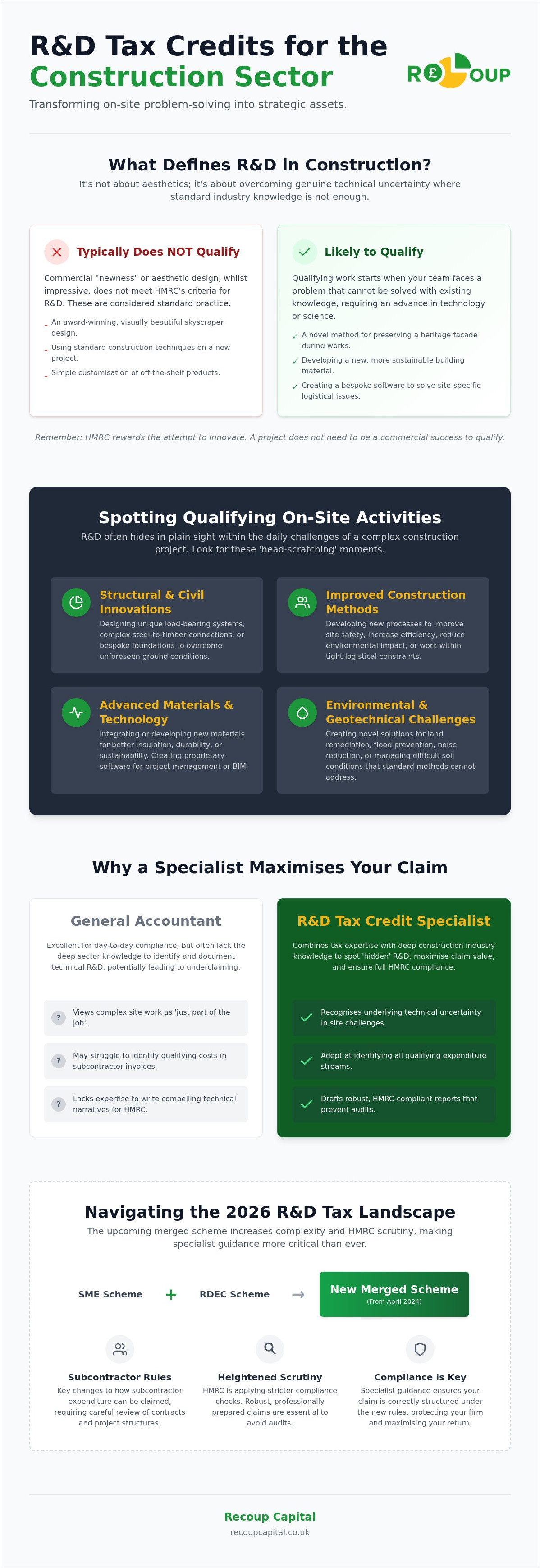
It's vital to distinguish between commercial "newness" and technical innovation. Designing a beautiful, award-winning skyscraper is a feat of architecture, but it doesn't necessarily qualify for R&D Tax Credits. Qualifying work begins when your team faces a problem that cannot be solved using standard industry knowledge. The UK government prioritises these claims because they drive economic growth and improve the national infrastructure. By reframing these technical challenges as strategic assets, you can transform the high costs of bespoke builds into reinvestable capital. For a deeper dive into the mechanics of these incentives, you can explore how R&D tax credits are explained for your specific sector.
The Core Criteria: Advancement and Uncertainty
To secure a successful claim, your project must seek an "advancement in science or technology." In a building context, this often involves developing new materials or creating more efficient construction methods that don't yet exist. You must also prove you faced "technical uncertainty." These are the moments where your lead engineers or site managers couldn't simply look up a solution in a manual. Interestingly, a project doesn't need to be a success to qualify. HMRC rewards the attempt to innovate; if you spent money trying to solve a technical hurdle and failed, those costs are still eligible for relief.
Why a Specialist is Essential for Construction Claims
Generalist accountants provide excellent service for day-to-day compliance, but they often lack the sector-specific depth required to spot "hidden" R&D. They might view a complex piling project on a constrained site as just a difficult job, whereas r&d tax credit specialists for construction recognise the underlying technical uncertainty. Specialists are adept at identifying qualifying expenditure amongst messy subcontractor invoices and complex payroll data. Most importantly, they possess the expertise to draft technical narratives that speak HMRC's language, ensuring your claim is both maximised and fully compliant with the latest 2026 regulations.
Identifying Qualifying R&D Activities in Your Building Projects
HMRC doesn't just reward work conducted in sterile laboratories; it incentivises the grit and ingenuity found on a live building site. For many firms, the challenge lies in recognising that their daily problem-solving actually meets the criteria for tax relief. Qualifying R&D often hides within the projects where standard methods fail. When your engineers must adapt construction techniques to overcome unforeseen ground conditions or environmental constraints, they're likely engaging in R&D. This is where r&d tax credit specialists for construction provide immense value, as they possess the sector-specific knowledge to document these 'site-fixes' as formal technical advancements.
The scope of eligibility is broader than many directors realise. It extends from the development of proprietary digital tools used to improve site safety to the creation of bespoke structural solutions for heritage sites where original facades must be preserved. According to the official government guidance on R&D tax relief, the activity must aim to resolve a scientific or technological uncertainty. If your team is debating how to implement a solution because the 'textbook' answer doesn't apply, you've likely found a qualifying activity.
Structural and Civil Engineering Innovations
Innovation often begins with a unique architectural vision that defies standard load-bearing systems. Designing complex steel-to-timber connections or developing methods to stabilise foundations in high-risk, urban environments requires significant technical trial and error. Furthermore, the refinement of modular construction techniques to reduce waste and site time involves rigorous testing of structural integrity and thermal performance. These aren't just project requirements; they're opportunities to recoup costs through specialized tax incentives.
Sustainability and Material Science
The drive toward net-zero targets has turned construction sites into testing grounds for material science. Testing novel, high-performance insulation or cladding systems to meet stringent fire safety and thermal standards often qualifies. Your firm might be developing carbon-neutral concrete alternatives or experimenting with recycled aggregates to maintain structural strength whilst reducing environmental impact. Integrating complex renewable energy systems into the existing fabric of older buildings frequently presents 'head-scratching' technical hurdles that fall squarely within the R&D remit. If you're currently managing site-specific challenges like contaminated soil or complex groundwork, you may also find that land remediation relief complements your R&D claim.
Identifying these activities is the first step toward transforming your operational hurdles into strategic financial assets. If you're unsure whether your current project's technical difficulties qualify for relief, a brief review of your recent projects could reveal significant unclaimed value.
Navigating the 2026 R&D Tax Landscape: The Merged Scheme
The 2026 tax landscape is defined by the Merged R&D Scheme, a unified framework that replaced the separate SME and RDEC systems for accounting periods beginning on or after 1 April 2024. For the majority of construction firms, this means a standard gross credit of 20% on qualifying expenditure. Once corporation tax is factored in, profitable companies typically see a net benefit of approximately 15% to 16.2%. This shift has simplified the headline rates, but it has also fundamentally changed how r&d tax credit specialists for construction must structure your claim to ensure maximum capital recovery.
Whilst the merged scheme is the new standard, the Enhanced R&D Intensive Support (ERIS) remains a vital lifeline for loss-making, high-innovation firms. To qualify for ERIS, your qualifying R&D expenditure must hit a threshold of at least 30% of your total business expenditure. For those who meet this criteria, a more generous payable tax credit of up to 27% is available. This is particularly relevant for firms pivoting heavily into green technology or proprietary modular systems where R&D makes up a substantial portion of the annual budget.
The Impact on Subcontracted R&D
One of the most complex changes in the 2026 rules involves how subcontracted work is treated. The right to claim relief now generally sits with the company that "intended" or "contemplated" the R&D at the start of the project. In the construction supply chain, this makes contract wording a critical strategic asset. If you are a subcontractor, you must establish whether you are performing R&D on your own behalf or simply providing labour for a client's innovation. Under the merged rules, 65% of qualifying subcontractor costs can still be claimed, but only if the hierarchy of innovation is clearly documented. Securing your right to relief whilst working amongst multiple project partners requires a proactive approach to contract management from the outset.
Compliance and HMRC Transparency Standards
HMRC has significantly raised the bar for documentation in 2026. Every claim must now be accompanied by a digital Additional Information Form (AIF), which requires granular technical narratives and a precise breakdown of costs. HMRC is scrutinising the sector with increased intensity to ensure that common qualifying R&D activities for contractors are not being confused with standard, non-qualifying practice.
This higher threshold for evidence means that contemporaneous record-keeping is no longer optional. By having R&D tax credits explained through the lens of these latest compliance standards, your firm can build a robust evidence trail whilst the work is actually happening on-site. This "compliance-first" mindset not only maximises the value of the claim but also acts as a protective shield against the stress of a potential HMRC enquiry.
Common Pitfalls: Why General Accountants Often Underclaim
Generalist accountants provide vital support for standard compliance, yet they often lack the sector-specific depth required to identify the nuances of construction innovation. This frequently leads to the "standard practice" trap. In this scenario, an accountant assumes a complex project is simply business as usual because your team is skilled enough to handle it. r&d tax credit specialists for construction understand that your team's ability to solve a problem doesn't make the challenge routine; it makes it a qualifying innovation. When a generalist overlooks the technical uncertainty behind a bespoke build, they leave your hard-earned capital on the table.
Another frequent oversight involves the granular detail of qualifying expenditure. Whilst most accountants capture basic payroll, they often fail to account for the full spectrum of costs, including:
- Site-Based Problem Solving: The significant hours project managers and engineers spend on-site resolving technical hurdles rather than routine management.
- Consumable Materials: The cost of materials, water, and fuel used specifically during the testing, prototyping, or "trial and error" phases of a project.
- Software Licences: A proportion of costs for specialised BIM or structural analysis software used directly to resolve technical uncertainties.
The Risk of an HMRC Enquiry
HMRC has significantly increased its scrutiny of construction claims in 2026. Poorly structured submissions that rely on vague, non-technical descriptions act as immediate red flags. A failed enquiry doesn't just result in a reduced payout; it carries financial penalties and can damage your firm's professional reputation. We don't just process paperwork; we act as a protective guide. Recoup Capital provides a robust defence as part of our specialised service, ensuring every technical narrative is built on a foundation of contemporaneous evidence that meets the highest transparency standards.
Maximising the Value of Your Claim
A specialist approach ensures you aren't just claiming for the obvious. We look at the interplay between different incentives, such as identifying capital allowances on plant and machinery that complement your R&D tax position. By framing your tax relief as a strategic asset, we help you reinvest those savings into new equipment or skilled staff. Our success-based fee model means our interests are perfectly aligned with yours; we only win when you win. This partnership-oriented approach ensures that your claim is maximised without the pressure of traditional sales tactics. If you're ready to see how much your innovation is truly worth, you can discover the potential of your recent projects through a no-cost introductory assessment.
Partnering with Recoup Capital for Construction Innovation
Choosing the right partner is about finding a team that understands the nuance between a routine foundation and a technically uncertain structural challenge. As r&d tax credit specialists for construction, Recoup Capital manages the entire end-to-end process, allowing you to stay focused on your builds whilst we secure your capital. We don't just process numbers; we act as a bridge between your site engineering team and HMRC's technical requirements. Our experts translate your complex problem-solving into a robust narrative that stands up to the highest levels of scrutiny.
Beyond R&D, our holistic approach often identifies additional opportunities such as land remediation relief. This is particularly valuable for construction firms dealing with contaminated sites or urban redevelopment. By looking at your business through a wider lens, we ensure that no eligible expenditure is missed. We view these financial returns as strategic assets. Whether it's reinvesting in sustainable equipment or expanding your workforce, we help you turn technical hurdles into fuel for future growth.
Our Specialist Construction Team
Our team comprises chartered tax accountants with deep sector-specific knowledge. We don't believe in one-off transactions; we prioritise long-term collaboration that evolves with your business. This relationship-first approach is why we focus on claiming R&D tax credits with a success-based fee model. There is zero upfront risk to your firm. We only receive a fee when we successfully deliver results, ensuring our goals are entirely aligned with yours. This removes the pressure of traditional sales tactics and replaces it with a commitment to evidence-based value.
Ready to Discover Your Unclaimed Capital?
We know your time is precious. Our process is designed to minimise the burden on your technical and finance teams. It begins with a no-cost, no-obligation introductory assessment to determine your eligibility. This streamlined experience ensures you don't feel overwhelmed by technical regulations. If you've been wondering why claim now, the answer lies in the 2026 landscape. Securing your firm's future starts with a proactive look at your current innovations. Let us act as your protective guide through the complexities of the merged scheme, transforming your technical challenges into a competitive advantage.
Transform Your Construction Innovations Into Strategic Assets
The 2026 merged R&D scheme doesn't have to be a barrier to your firm's growth. By identifying the technical uncertainties in your site-based problem solving and ensuring your narratives meet HMRC's heightened transparency standards, you can secure the capital your business deserves. Relying on generalist support often leads to missed opportunities; however, partnering with r&d tax credit specialists for construction provides the sector-specific depth required to maximise every claim whilst maintaining total compliance. We help you turn those 'head-scratching' moments on-site into a tangible financial advantage.
Our approach is built on a foundation of reliability and results. With a success-based fee model, specialist construction tax accountants, and full HMRC enquiry support included as standard, we act as a protective guide through the complexities of regulatory change. We don't just process paperwork; we help you reframe financial returns as strategic assets to fuel your next project. It's time to stop leaving your innovation unrewarded and start viewing tax relief as a driver for long-term collaboration. We're ready to help you build a more innovative future.
Book your no-obligation construction R&D assessment with Recoup Capital
Frequently Asked Questions
Can construction companies still claim R&D tax credits in 2026?
Yes, construction companies can absolutely claim R&D tax credits in 2026 under the unified merged scheme. The UK government continues to incentivise technical innovation in the sector to drive economic growth and support net-zero initiatives. Whilst the regulatory framework has evolved, the opportunity to transform site-based problem solving into a strategic financial asset remains a significant benefit for eligible firms.
What qualifies as R&D in a construction project?
Qualifying R&D occurs when a project seeks an advancement in science or technology by resolving technical uncertainties that standard industry knowledge cannot solve. This includes developing novel building materials, creating bespoke structural solutions for constrained sites, or innovating with sustainable cladding systems. It is not about the aesthetic design; it focuses on the "head-scratching" moments where your engineers must find a new path forward.
How much can a construction company claim back in tax relief?
Under the 2026 merged scheme, companies usually receive a 20% gross credit on qualifying R&D expenditure. For profitable companies, this typically results in a net benefit of approximately 15% to 16.2%, depending on their specific corporation tax rate. Loss-making, R&D-intensive SMEs may qualify for the Enhanced R&D Intensive Support (ERIS), which offers a higher payable tax credit of up to 27%.
Does my regular accountant have the expertise to handle a construction R&D claim?
Whilst regular accountants are excellent for general compliance, they often lack the technical depth required to identify the nuances of construction innovation. Engaging r&d tax credit specialists for construction ensures that subtle site-based advancements aren't overlooked. Specialists translate engineering challenges into the technically robust narratives HMRC requires, which helps to maximise the claim's value whilst significantly reducing the risk of an enquiry.
What happens if my construction project was technically a failure?
You can still claim for projects that were technically unsuccessful or were abandoned before completion. HMRC rewards the attempt to achieve a scientific or technological advancement, not just the successful outcome. If your team spent time and resources trying to resolve a technical uncertainty and failed to find a solution, those costs are still eligible for relief under the current scheme rules.
How far back can I claim for R&D tax credits in the construction industry?
You can typically make a claim for R&D tax relief up to two years after the end of the accounting period in which the costs were incurred. This allows you to look back at previous projects and recover capital that may have been missed during the initial filing. It is a valuable way to inject cash back into your business to fund future equipment, staff, or innovation; for those also looking to recover capital through expert commercial debt recovery, you can visit Whole King Company Limited.
What are the risks of an HMRC enquiry for my construction business?
The primary risk of an enquiry is the potential for reduced payouts, financial penalties, and a significant time burden on your technical team. HMRC has increased its scrutiny in 2026, targeting claims that lack robust technical evidence or include routine work. Partnering with r&d tax credit specialists for construction mitigates this risk by ensuring 100% compliance and providing expert defence as part of the service.
How do the 2026 merged scheme rules affect construction subcontractors?
The merged scheme rules generally grant the right to claim to the company that intended or contemplated the R&D from the outset of the project. For subcontractors, this means your ability to claim often depends on the specific wording of your contracts and whether you are performing R&D on your own behalf. Establishing clear hierarchies of innovation amongst multiple project partners is now a critical step in securing your right to relief.


