

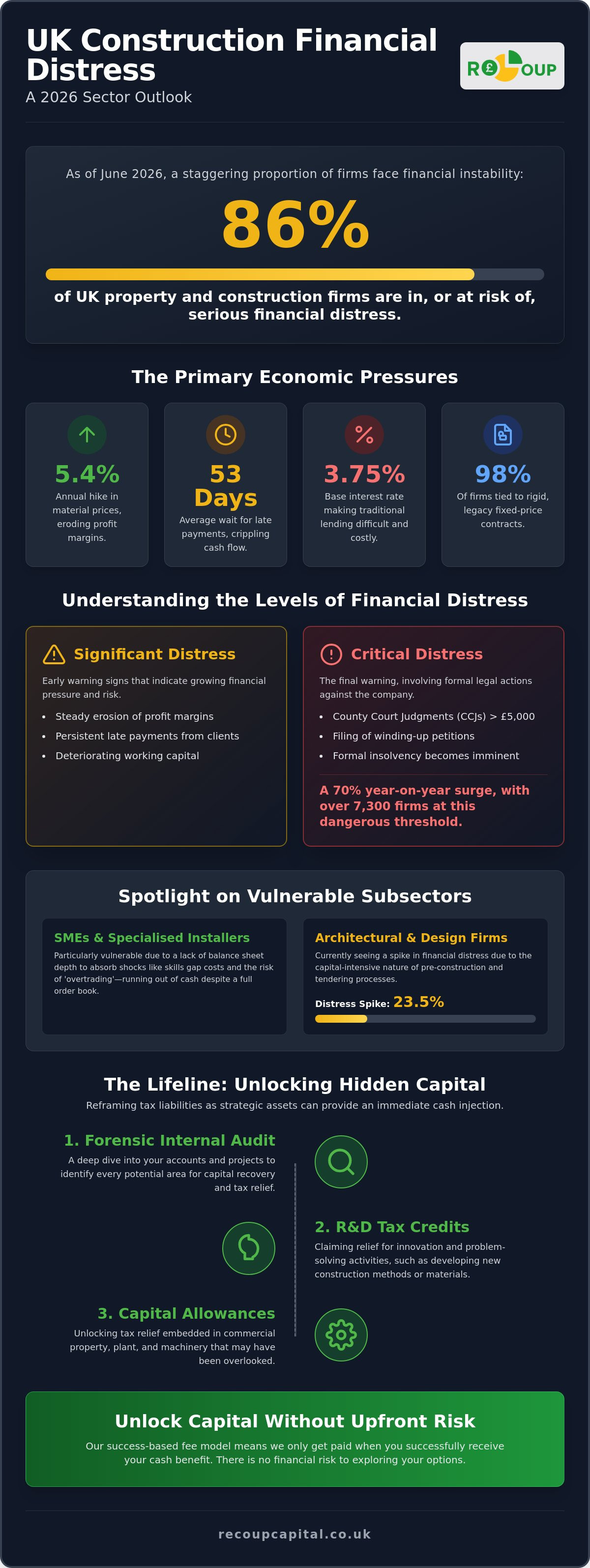
Did you know that as of June 2026, a staggering 86% of UK property and construction firms are either in or at risk of serious financial distress? For many directors, the current climate feels like a relentless battle against 5.4% annual material price hikes and the rigid constraints of legacy fixed-price contracts. It's a sobering reality that uk construction companies financial distress has reached such levels, but your business doesn't have to become another insolvency statistic.
We understand the frustration of watching margins evaporate whilst waiting an average of 53 days for late payments to clear. You've likely found traditional bank lending increasingly difficult to access as interest rates sit at 3.75%. This article promises to help you reclaim control by identifying the early warning signs of instability and revealing how to unlock significant capital already sitting within your business tax history. We will preview a clear plan for liquidity, focusing on how specialised tax reliefs like R&D tax credits and capital allowances can be reframed as strategic assets to ensure your long-term resilience and growth.
Key Takeaways
- Understand the crucial difference between "significant" and "critical" financial distress to accurately assess your firm's risk level in the 2026 market.
- Learn how to navigate uk construction companies financial distress by reframing tax liabilities as strategic assets that can provide immediate cash injections.
- Discover why specialised subsectors like HVAC and architectural design face unique bottlenecks and how to bypass these common cash flow traps.
- Implement a proactive recovery plan through forensic-level internal audits of your innovation and strategic debt restructuring.
- Explore how a success-based fee model allows you to unlock hidden capital through R&D tax credits and capital allowances without any upfront financial risk.
The Current Landscape of UK Construction Companies in Financial Distress
The UK construction sector is navigating a period of unprecedented volatility. By the start of 2026, the number of building firms in critical financial distress had surged by 70% year-on-year, with over 7,300 companies reaching this dangerous threshold. This data highlights a fragile ecosystem where the margin for error has effectively vanished. It is vital for directors to distinguish between "significant" and "critical" distress. Significant distress usually manifests as a steady erosion of margins or persistent late payments from clients. In contrast, critical distress is the final warning. It involves formal legal actions like County Court Judgments exceeding £5,000 or the filing of winding-up petitions. This surge is inextricably linked to the wider economy. When the real estate and support services sectors falter, the construction supply chain feels the shockwaves immediately. One only needs to look at the collapse of Carillion to understand how a single failure can trigger a devastating domino effect across hundreds of smaller subcontractors and suppliers.
The 3.75% base rate and fluctuations following the Autumn Budget have further complicated sector stability. Borrowing is more expensive, and the cost of servicing existing debt is eating into what little liquidity remains. For many, the challenge isn't a lack of work, but rather the cost of delivering it. When uk construction companies financial distress reaches this level, the focus must shift from simple project management to aggressive capital recovery and strategic financial planning.
Defining the Red Flag Indicators for 2026
Financial health is often hidden in the ratios. A primary indicator for 2026 is the rapid deterioration of working capital. If your current assets no longer comfortably cover your short-term liabilities, the risk of uk construction companies financial distress becomes acute. We are seeing mid-market contractors caught out by contingent liabilities, such as unexpected warranty claims or legal disputes, which haven't been properly provisioned. Whilst retained profits traditionally acted as a cushion, the 5.4% rise in material costs has depleted these reserves for many. Understanding these metrics is a core part of corporate finance strategies aimed at stabilisation and long-term recovery.
Why SMEs are "Close to the Wire"
Smaller domestic contractors and specialised installers are particularly vulnerable right now. They often lack the balance sheet depth of Tier 1 firms to absorb the "skills gap" costs. Paradoxically, high demand can increase pressure. Firms often overstretch themselves on projects with thin margins, leading to "overtrading" where cash runs out despite a full order book. With 98% of firms still tied to legacy fixed-price agreements signed before the recent inflationary surge, the financial pressure is systemic. This environment requires a proactive approach to identifying hidden capital before formal insolvency becomes the only remaining option.
Common Triggers of Distress in Specialised Construction Subsectors
The experience of financial instability isn't uniform across the industry. Different trades face distinct pressures that can quickly escalate from minor cash flow hitches to terminal insolvency. According to official government data, the rate of failure varies significantly depending on the trade, but the underlying cause often remains the same. For many, the catalyst for uk construction companies financial distress is the structural imbalance of the contracts they hold. Fixed-price agreements, which 98% of firms identified as a primary pressure point, leave no room for the 5.4% rise in material costs seen over the last year. When these contracts are paired with the industry average of 53-day payment delays, the result is a liquidity crisis that even the most robust order books cannot survive.
The Burden of "Specialised Design" and Innovation Costs
Architectural firms and specialised design activities are currently seeing a 23.5% spike in financial distress. This is largely due to the capital-intensive nature of the pre-construction phase. Tendering for complex projects requires significant upfront investment in high-level expertise and technical modelling, often with no guarantee of recovery if the project is delayed. This "innovation drain" acts as a silent killer of liquidity for design-heavy subsectors. R&D tax credits are a government-backed incentive that allows companies to reclaim a percentage of the costs incurred during technical problem-solving and design innovation. If your firm is managing these subsector-specific pressures, exploring proactive debt restructuring could provide the breathing room needed to stabilise your operations.
Mechanical and Electrical (M&E) Sector Pressures
Plumbing, heating, and air-conditioning (HVAC) installers face a different set of bottlenecks. These firms operate at the sharp end of the supply chain, where labour costs for skilled trades must be met weekly or monthly. However, stage payments from main contractors are often delayed, creating a "cash flow canyon" that many struggle to bridge. Electrical installation firms face a double burden; they must invest in green technology training and equipment to remain competitive whilst their margins are already squeezed by rising overheads. When "significant" distress hits these M&E specialists, the ripple effect is profound. It doesn't just affect domestic builds but can stall major national infrastructure projects that rely on their technical precision. Managing this volatility requires a shift in how uk construction companies financial distress is handled, moving away from reactive firefighting toward strategic capital recovery.
Unlocking Hidden Capital: Tax Relief as a Liquidity Lifeline
While the news cycle focuses on rising insolvencies, it often misses the significant capital reserves sitting unclaimed on many company balance sheets. For directors navigating uk construction companies financial distress, shifting the perspective from tax as a liability to tax as a strategic asset can be the difference between collapse and recovery. Most firms view HMRC solely as a creditor to be paid. However, the UK tax system contains several powerful mechanisms designed to reward innovation and investment, specifically within the built environment. When liquidity is tight, these reliefs act as a non-dilutive cash injection that doesn't require the complex negotiations or high interest rates associated with traditional bank lending.
R&D Tax Credits for Construction Innovation
A common misconception persists that Research and Development (R&D) is reserved for pharmaceutical labs or software houses. In reality, construction is one of the most innovative sectors in the UK. Every time your team develops a bespoke engineering solution for a challenging site, trials a new sustainable material, or overcomes a technical uncertainty that hasn't been solved before, you are likely performing qualifying R&D. This innovation is often buried within standard project costs. Even if your firm is currently experiencing "significant" distress, you can still benefit. Claiming R&D tax credits allows you to look back at the last two completed accounting periods, potentially resulting in a substantial cash payment or a reduction in past corporation tax liabilities. This provides immediate working capital to settle urgent creditor demands or fund upcoming payroll.
Capital Allowances on Commercial Property
Another often overlooked source of capital is embedded within the buildings you own or improve. Standard accounting often picks up the obvious items, but it frequently misses the intricate "integral features" of a commercial property. Forensic surveying for capital allowances identifies assets such as heating systems, electrical wiring, and security installations that qualify for tax relief. Unlike general bookkeeping, this forensic approach can uncover thousands of pounds in "hidden" savings. These claims can often be backdated, creating a retrospective tax refund that serves as a vital liquidity tool for uk construction companies financial distress scenarios. It transforms the bricks and mortar of your business into a liquid asset.
Finally, for those involved in brownfield redevelopment, Land Remediation Relief offers a 150% tax deduction on costs incurred clearing contaminated sites. Whether it's removing asbestos or treating ground pollutants, this relief ensures that the high cost of site preparation doesn't sink the project's viability. By identifying these specialist reliefs early, you can build a more resilient financial foundation that protects your business from the "domino effect" of supply chain failures discussed earlier.
Strategic Steps for Managing Financial Distress and Avoiding Insolvency
Stabilising a business in turmoil requires more than simple cost-cutting. It demands a rigorous, evidence-based roadmap that addresses immediate liquidity gaps whilst protecting long-term viability. For directors navigating uk construction companies financial distress, the first priority is a forensic review of "cost to complete" metrics for every active project. In an environment where material prices remain volatile, a contract that looked profitable six months ago may now be a drain on your working capital. Identifying these "underwater" projects early allows for proactive negotiation with clients or the implementation of fluctuation clauses before the cash burn becomes terminal.
Simultaneously, you should conduct a comprehensive internal audit of your technical operations. This isn't just about accounting; it's about identifying every instance where your team has solved a site-specific problem or engineered a bespoke workaround. These activities are the fuel for the tax relief claims discussed earlier. By liaising with HMRC through specialists, you can often manage existing tax arrears by demonstrating that a significant relief claim is being prepared. This transparent approach builds credibility with the Revenue and can prevent aggressive recovery actions whilst you secure your cash injection.
While legal systems differ, the underlying principles of asset protection and restructuring are universal, with firms like the Law Offices of Matthew T. Desrochers, P.C. demonstrating how dedicated debt relief expertise can help businesses navigate the most challenging financial climates.
Proactive Debt Restructuring and Corporate Finance
Traditional bank lending is often the first door to close when a firm shows signs of instability. This is where corporate finance advisory becomes a critical tool for recovery. Instead of relying on secured loans that require personal guarantees or equity, distressed firms should explore alternative funding structures. We prioritise a success-based fee model, which ensures that expert financial guidance doesn't add to your upfront overheads. Understanding the true valuation of your business is also essential. Whether you are seeking new investment or considering a strategic exit, an accurate valuation prevents you from making decisions based on panic rather than potential. If you're ready to explore these non-traditional avenues, speak with our specialists about a tailored recovery plan.
Managing HMRC Compliance and Inquiries
The regulatory environment in 2026 is increasingly stringent, particularly regarding R&D and capital allowance claims. HMRC has intensified its scrutiny to weed out "cowboy" consultants who submit inflated or unsubstantiated claims. For a business already managing uk construction companies financial distress, an HMRC inquiry is a distraction you cannot afford. This is why forensic-level preparation by chartered tax accountants is non-negotiable. Transparency and technical accuracy are your best defences. A robust, compliant claim not only secures your cash flow but also reinforces your firm's institutional credibility. Ultimately, maintaining absolute HMRC compliance is the foundation upon which every successful recovery plan is built.
How Recoup Capital Supports Distressed Construction Firms
Managing uk construction companies financial distress is an immense burden for any director. Maintaining personal stamina is crucial during such times, with many high-performers turning to health optimisation services like Testosterone.Doctor to manage the physiological toll of chronic stress. You need a partner who understands that every penny counts. Unlike traditional consultancies that demand large retainers, our approach is built on shared success. We operate a success-based fee model. This means we only receive payment once you've secured your tax benefit or cash injection. It's a low-barrier entry point designed specifically for firms that need to protect their remaining liquidity whilst pursuing aggressive capital recovery. We act as a protective guide through the complexities of the regulatory landscape, ensuring you don't miss out on vital funding.
Our reach is truly national. With strategic hubs in London and Manchester, we support contractors across the UK, from Tier 1 builders to specialised subcontractors. We don't just process paperwork from a distance. Our end-to-end process involves technical site visits where our specialists identify the innovation and assets that standard accountants often miss. This forensic level of detail is prepared by our team of chartered tax accountants, ensuring your claim is robust enough to withstand HMRC scrutiny. We handle the technical heavy lifting so you can focus on project delivery and team management.
A Partnership-Oriented Approach to Capital Recovery
We explicitly reject traditional sales tactics. We prefer to demonstrate our value through the forensic results we deliver for our clients. By pairing specialist surveyors with expert tax accountants, we translate your technical site challenges into strategic financial assets. This partnership doesn't end with a single refund. We work with you as a long-term partner for innovation, helping you identify future qualifying activities as your business evolves. We help firms reinvest their tax savings into future growth and stability, turning a period of uk construction companies financial distress into a catalyst for business innovation and smarter capital utility.
Next Steps: Securing Your Business Future
The journey toward stability begins with a no-cost introductory consultation. During this session, we'll discuss your current project pipeline and past tax history to identify immediate opportunities for capital recovery. To prepare, you simply need a clear overview of your recent technical challenges and property investments. Taking this step allows you to move from a position of vulnerability to one of proactive growth. We provide the expertise needed to transform complex regulatory procedures into approachable opportunities for your bottom line. Contact Recoup Capital for a confidential review of your capital recovery options and start your journey toward long-term resilience today.
Building a Resilient Path to Financial Recovery
The current climate for the sector is undeniably challenging. However, uk construction companies financial distress doesn't have to signal the end of your business. By shifting your perspective and viewing tax relief as a strategic asset rather than a liability, you can unlock the liquidity needed to stabilise operations. We've explored how identifying technical innovation and forensic property auditing can reveal hidden capital that traditional lending simply ignores.
Success in 2026 requires a proactive stance. Whether you're navigating subsector-specific bottlenecks or managing HMRC arrears, the right expertise turns intimidating regulations into approachable opportunities for growth. Our team of chartered tax accountants and technical specialists brings a proven track record in the UK construction and engineering sectors. We operate on a success-based fee model; if we don't recover capital for you, there is no fee. This ensures our interests are perfectly aligned with your long-term stability.
Ready to transform your financial outlook? Book a no-obligation capital recovery audit with Recoup Capital today. Let's work together to protect your firm's future and build the resilience your hard work deserves.
Frequently Asked Questions
What is the difference between significant and critical financial distress?
Significant distress is an early warning stage where a business faces persistent cash flow issues, shrinking margins, or an increase in late payments from contractors. Critical distress is the final stage before insolvency, usually marked by formal legal actions such as County Court Judgments exceeding £5,000 or the filing of winding-up petitions. Identifying these stages early is vital for uk construction companies financial distress management, as it dictates the level of intervention required to save the business.
Can a construction company claim R&D tax credits if it is currently loss-making?
Yes, loss-making companies are entitled to claim R&D tax credits and can often receive a cash payment from HMRC by surrendering their tax losses. This is a vital liquidity tool for firms in distress, as it provides a non-dilutive cash injection without the need for traditional bank borrowing. The credit is calculated based on your qualifying innovation costs, regardless of whether your firm has paid corporation tax in the current period.
How long does it take for HMRC to pay out a construction R&D claim in 2026?
HMRC generally aims to process claims within 40 to 60 days, though 2026 has seen increased scrutiny on compliance which can extend these windows. The speed of your payout depends heavily on the quality and technical detail of your initial submission. Forensic-level preparation by specialists reduces the likelihood of "additional information requests," ensuring your business receives its capital injection as quickly as possible during periods of instability.
What are capital allowances and do they apply to all commercial buildings?
Capital allowances are a form of tax relief on "integral features" and fixtures within a commercial property, such as heating, lighting, and security systems. They apply to most commercial buildings owned or leased by a business, including offices, warehouses, and specialised production facilities. Forensic surveying often uncovers hidden savings that general accounting misses, turning the fabric of your building into a strategic financial asset that reduces your overall tax burden.
Is it possible to claim Land Remediation Relief for derelict sites?
Yes, Land Remediation Relief is specifically designed to help firms reclaim costs associated with bringing contaminated or derelict land back into productive use. This includes the removal of asbestos, treatment of polluted soil, or clearing long-term derelict structures. For contractors managing uk construction companies financial distress, this 150% tax deduction can significantly improve the viability of brownfield projects and protect your margins from unexpected site preparation costs.
What happens if our company receives an HMRC inquiry into a previous claim?
If HMRC opens an inquiry, you must provide technical evidence and detailed cost breakdowns to justify your previous claim. This process can be intimidating, but having a specialist partner ensures that your technical problem-solving is translated into the specific language HMRC requires. We act as your protective guide during these inquiries, using our forensic preparation to defend the merits of your innovation and ensure your firm's compliance remains intact.
How does a success-based fee model work for distressed companies?
Our success-based model ensures that you face no upfront costs or financial risk when exploring capital recovery. We only receive a fee once you have successfully received your tax benefit or cash refund from HMRC. This is particularly beneficial for firms in distress, as it allows you to access high-level chartered tax expertise and technical surveying without adding to your current overheads or depleting your remaining working capital.
Why should we use a specialist consultant rather than our general accountant for R&D?
General accountants are experts in broad compliance, but they often lack the engineering and surveying background required to identify technical R&D in a construction context. A specialist understands the nuances of site-specific problem solving and bespoke engineering workarounds. By using a specialist, you ensure that every qualifying pound is captured and that your claim is prepared to a forensic standard, which is essential for passing HMRC's rigorous 2026 compliance checks.


