

In 2026, submitting an R&D tax claim without specialist technical oversight is no longer just a missed opportunity; it's a significant regulatory risk. With HMRC now demanding mandatory pre-notifications and granular Additional Information Forms, the margin for error has vanished. You likely feel the pressure of these evolving definitions, especially when you're already stretched thin managing complex engineering or construction projects. It's natural to worry that a simple mistake could trigger a time-consuming enquiry or costly penalties.
We understand that you want to reinvest your hard-earned capital into your next breakthrough without the constant fear of a tax audit. Knowing how to choose an r&d tax specialist is the difference between a transactional refund and a robust, compliant financial strategy. In this article, you'll discover how to identify a partner who provides the technical firepower to maximise your claim's value whilst keeping you firmly on the right side of HMRC. We'll break down the essential qualifications for 2026, from sector-specific expertise to the importance of a success-based partnership that prioritises your long-term growth.
Key Takeaways
- Understand why HMRC’s 2026 digital requirements make specialist technical oversight a necessity for protecting your business from scrutiny.
- Learn how to choose an r&d tax specialist who employs technical analysts to bridge the gap between complex engineering and tax law.
- Identify qualifying innovation within your specific sector, from site-specific construction challenges to advanced software and AI development.
- Discover how to integrate R&D claims with other incentives like Capital Allowances to maximise your total capital recovery and reinvestment potential.
- Recognise the value of a results-driven partnership that replaces traditional sales tactics with a success-based model focused on long-term growth.
What is an R&D Tax Specialist and Why are They Vital in 2026?
An R&D tax specialist acts as a vital translator. They sit at the intersection of complex UK tax legislation and technical innovation. Whilst your general accountant is essential for annual compliance and filing your CT600, they often lack the technical depth to identify where "business as usual" ends and qualifying research begins. In 2026, this distinction is critical. HMRC has shifted from a light-touch approach to a rigorous, digital-first scrutiny model that requires more than just a passing knowledge of tax law.
Understanding how to choose an r&d tax specialist is no longer about finding someone to fill in a form; it's about securing a partner who can defend your claim under intense regulatory pressure. The current landscape is defined by the mandatory Additional Information Form (AIF). This document requires precise technical descriptions of your projects before your tax return is even submitted. Without a specialist to bridge this gap, businesses risk missing out on significant capital or, worse, facing penalties for unsubstantiated claims.
The Evolution of R&D Tax Compliance
HMRC has systematically tightened the definitions of qualifying expenditure to ensure only genuine innovation is rewarded. For accounting periods starting on or after 1 April 2024, the majority of UK limited companies now operate under a single merged scheme. This change makes Research and Development (R&D) Tax Credits more streamlined but also significantly more demanding. Innovation is no longer defined by what is new to your business. Instead, it's defined by "technological uncertainty" that hasn't been resolved by the wider industry. Specialists look for the friction points in your projects where standard knowledge failed, whereas generalists may miss these nuances entirely.
The Specialist Advantage: Technical Firepower
A true specialist brings technical analysts to the table. These are often professionals with backgrounds in engineering, software development, or construction. They don't just look at your profit and loss statement; they look at your blueprints and code repositories. They identify "hidden" R&D in the everyday problem-solving that your team might take for granted. By translating site notes and project logs into HMRC-ready technical reports, they ensure your claim is robust enough to withstand an enquiry. This level of detail is exactly what general accountants often struggle to provide because they lack the industry-specific vocabulary to describe a technological advance. Identifying how to choose an r&d tax specialist who understands your specific sector is the first step toward securing your firm's financial future.
Choosing the right expert involves looking for those who prioritise long-term collaboration over quick wins. It's about finding a guide who understands that a successful claim is a strategic business asset. When you have technical firepower on your side, you transform a potentially intimidating regulatory procedure into a predictable opportunity for growth and reinvestment.
Specialist vs General Accountant: The Real Cost of Choice
Many business owners assume their general accountant is the natural choice for handling R&D claims. It's a logical thought. After all, they already manage your corporation tax and payroll. However, this often leads to what we call the "Accountant Trap". Generalists, by their very nature, must maintain a broad knowledge of many tax areas. To avoid the risk of an HMRC enquiry, they often take an overly conservative approach to R&D. This caution results in "light-touch" claims that leave significant capital on the table, often missing the technical nuances that drive higher returns.
When you consider how to choose an r&d tax specialist, you're looking for a partner who understands that compliance and maximisation are two sides of the same coin. Specialists identify significantly more qualifying spend because they look beyond the balance sheet. They dive into the technical challenges your team faced on the factory floor or in the laboratory. They also utilise a success-based fee model. This structure aligns the consultant's incentives with your business outcomes. It ensures that the focus remains on delivering a robust, high-value claim rather than simply clocking billable hours.
Why Your Accountant Might Be Missing Qualifying Spend
General bookkeeping rarely captures the full picture of innovation. Traditional accountants often miss indirect R&D activities, such as supervisory time, technical training, or the specific costs of failed prototypes. In the high-scrutiny environment of 2026, these omissions are costly. HMRC now requires a level of detail that generalists often struggle to provide without significant technical input. In 2026, HMRC defines a "Competent Professional" as an individual with enough expertise in the relevant scientific or technological field to accurately judge whether a project has resolved a technological uncertainty. If your advisor cannot speak the language of your engineers, they cannot effectively argue your case. You can explore understanding why you should claim R&D tax credits to see how deep these qualifying activities can go.
Navigating the HMRC Enquiry Process
The psychological and financial toll of a poorly managed HMRC enquiry can be devastating. It's a time-intensive process that can distract your leadership team for months. A specialist acts as a protective guide, managing the entire dialogue with HMRC on your behalf. We provide the technical evidence and legislative justification needed to defend your claim's integrity. This proactive approach transforms a potentially intimidating regulatory procedure into a manageable part of your business growth. If you're unsure if your current claims are as robust as they could be, it might be time to assess your current innovation incentives with a fresh pair of eyes.
Identifying R&D in Your Sector: Beyond the Laboratory
Many business owners mistakenly believe R&D is reserved for pharmaceutical labs or high-tech aerospace firms. In reality, innovation happens daily on construction sites, within software houses, and across manufacturing plants. This is why knowing how to choose an r&d tax specialist who employs technical analysts is so vital. They don't just look for scientists; they look for engineers and developers who are solving technical problems that have no obvious solution.
The core of every successful claim is the "Technological Uncertainty" test. This isn't about whether a project was successful. It's about whether the technical solution was readily available to a competent professional in the field. If your team had to conduct trials, build prototypes, or develop new methods because the standard industry approach failed, you are likely sitting on a significant tax relief opportunity.
R&D in the Construction Industry
Innovation in construction often arises from necessity. You might be developing new materials to meet specific thermal requirements or creating bespoke methods for Land Remediation Relief for developers when cleaning contaminated sites. Solving structural uncertainties in complex architectural designs, where standard building regulations don't provide a clear path forward, is a prime example of qualifying activity. These site-specific challenges are frequently overlooked by generalists but are the bread and butter of a specialist technical analyst.
Manufacturing and Engineering Breakthroughs
In the manufacturing and food tech sectors, R&D is often woven into the production cycle itself. Automation and the development of bespoke tooling are classic examples of qualifying expenditure for SMEs. Food tech companies often find qualifying spend whilst innovating to extend shelf-life or improving process efficiency through new ingredient interactions. Whether you are reducing waste through new environmental efficiency innovations or re-engineering a product to improve its performance, these activities represent a technological advance. The process of scaling up a laboratory-proven concept to a full-scale industrial production line often involves resolving unforeseen technological uncertainties, which qualifies the associated costs for tax relief.
Software and AI development also face stricter scrutiny in 2026. Standard coding or using well-established APIs rarely qualifies. However, if you are pushing the boundaries of machine learning or resolving conflicts between legacy systems that shouldn't technically work together, you're in R&D territory. When you are deciding how to choose an r&d tax specialist, ensure they have the expertise to document these technical dead ends, as they are often the strongest evidence of a genuine R&D effort.
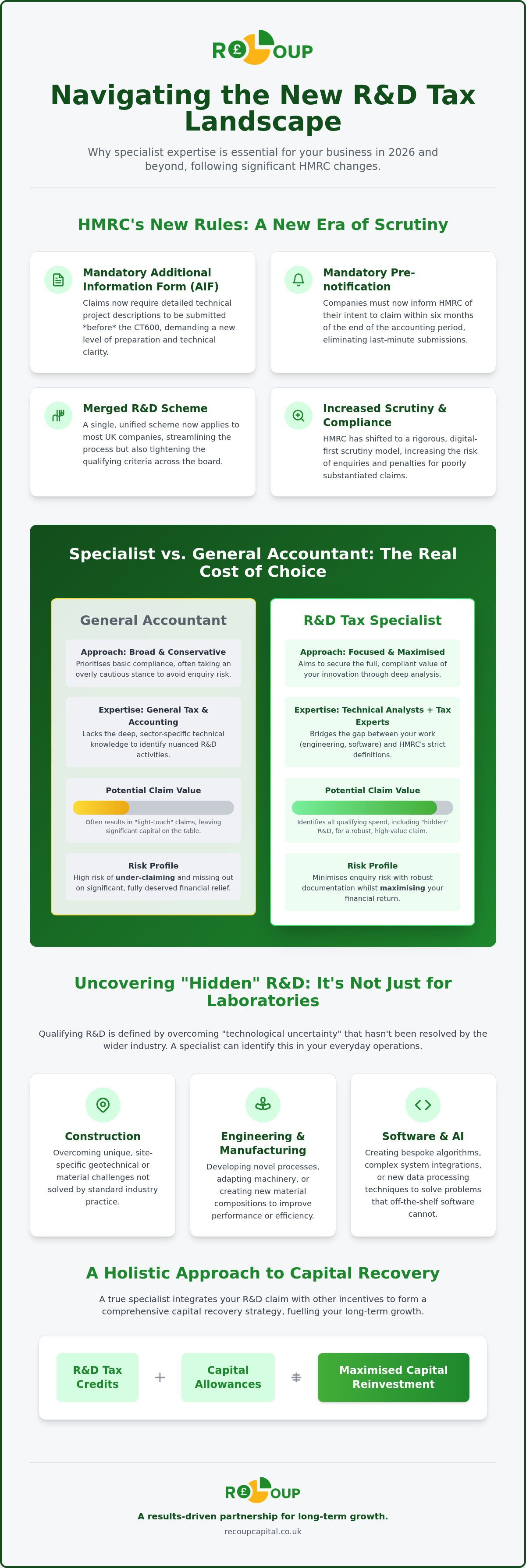
A Holistic Approach: Integrating R&D with Total Tax Relief
R&D tax credits are a powerful tool, but they shouldn't exist in a vacuum. To truly capitalise on your innovation, you need a strategy that looks at your entire tax profile. When considering how to choose an r&d tax specialist, look for a partner who understands how different reliefs interact. A siloed approach often leaves significant capital unclaimed. For example, the technical data gathered for an R&D claim often serves as the perfect foundation for a Patent Box application. In the 2026 regulatory environment, HMRC expects consistency across all your filings. An integrated approach ensures that the "technological uncertainty" described in your R&D technical report aligns perfectly with the innovative claims in your Patent Box submission.
Maximising Property-Based Tax Relief
Many businesses overlook the value hidden within their own walls. Capital Allowances allow you to claim tax relief on embedded fixtures within your commercial property, such as heating systems, lighting, and specialised cabling. Identifying these requires forensic surveying that goes far beyond standard accounting. It involves a physical inspection of the premises by specialists who understand both construction and tax law. By integrating this with your R&D strategy, you can significantly improve your business cash flow. You can read our expert guide to Capital Allowances to understand how forensic accounting uncovers these strategic assets. This combined approach often reveals relief opportunities that generalist accountants miss because they lack the surveying expertise to identify qualifying plant and machinery embedded in the building's fabric.
The Patent Box Advantage
The Patent Box regime is one of the most generous incentives in the UK, offering a reduced Corporation Tax rate of 10% on profits derived from patented inventions. However, the barrier to entry is high. You must prove that your innovation meets strict technical criteria. This is where the synergy with R&D becomes clear. The detailed technical reports prepared for your R&D claim provide the necessary evidence base for your Patent Box submission. Structuring your intellectual property correctly from the outset ensures long-term tax efficiency. Knowing how to choose an r&d tax specialist who can also navigate the complexities of Patent Box is essential for protecting your margins as you scale.
Strategic corporate finance is the final piece of the puzzle. Recovered tax relief isn't just a refund; it's a strategic asset for reinvestment. Specialists can help you allocate this capital to drive maximum ROI and business growth. Whether you are funding your next engineering breakthrough or expanding a manufacturing facility, these funds provide a non-dilutive way to scale. This integrated perspective is a hallmark of a true long-term partner. If you want to see how these combined reliefs could transform your bottom line, you should explore our corporate finance and tax relief integration today.
The Recoup Capital Process: A Results-Driven Partnership
Our approach is built on a "Success-First" philosophy. We explicitly reject traditional sales tactics, preferring to demonstrate our value through the strength of your claim. When deciding how to choose an r&d tax specialist, the fee structure is a primary indicator of their commitment to your success. At Recoup Capital, our fees are only due once your claim has been successfully processed by HMRC. This model ensures our incentives are perfectly aligned with your business outcomes, providing a risk-free path to capital recovery.
The end-to-end journey is designed to be as streamlined as possible. We recognise that you have a business to run, so we handle the heavy lifting. From the initial technical assessment to the final receipt of cash in your bank account, we manage every detail. Our proactive approach to HMRC liaison means we don't just file paperwork; we act as a protective guide. We provide a transparent and robust defence for every claim, ensuring that your innovation is documented with the technical depth required in 2026.
What to Expect During Your Initial Consultation
Your journey begins with a no-cost discovery phase. In under 30 minutes, we can typically identify whether your business has a potential claim. This isn't a surface-level chat. You'll speak with technical analysts who understand the specific language of your engineers and developers. We dive into the friction points of your projects to uncover the "technological uncertainty" that generalists often overlook. You can see how this fits into the wider framework in our guide on the R&D claim process explained for UK firms. This initial review sets the stage for a robust technical report that stands up to the most rigorous HMRC scrutiny.
Long-Term Strategic Collaboration
We don't view an R&D claim as a one-off transaction. Instead, we position ourselves as a long-term partner invested in your future growth. Recovered tax relief is a strategic asset, and we help you decide how to best deploy it. Our relationship-first approach extends beyond tax returns to include ongoing support for corporate finance, business restructuring, and debt advisory. By reframing financial returns as tools for innovation, we help you scale your operations with confidence. We encourage you to explore our Strategic Corporate Finance services to see how we can support your business through every stage of its lifecycle. Choosing the right specialist means choosing a guide who understands your bottom line as well as they understand the tax code.
Future-Proof Your Innovation Strategy
The UK tax environment in 2026 demands a higher standard of technical evidence and a proactive approach to compliance. Moving beyond "light-touch" claims is essential for any business that values long-term stability and maximised capital recovery. By prioritising technical analysts over generalist bookkeepers, you ensure your projects are documented with the precision HMRC now requires. Understanding how to choose an r&d tax specialist is the first step toward transforming your tax returns into strategic business assets that fuel future growth.
At Recoup Capital, we don't just process paperwork; we act as your protective guide through the complexities of regulatory change. Our success-based fee structure ensures our goals are perfectly aligned with yours, whilst our technical analysts provide the industry-specific knowledge needed to bridge the gap between engineering and tax law. With comprehensive national support, we're ready to help you unlock the full value of your innovation. Book a no-cost R&D assessment with our specialists today and take the first step toward total compliance peace of mind. It's time to turn your technical challenges into your greatest financial opportunities.
Frequently Asked Questions
What is the difference between a general accountant and an R&D tax specialist?
A general accountant focuses on your broad tax compliance and annual filings, whilst an R&D tax specialist possesses the technical depth to identify "technological uncertainty" within specific engineering or software projects. Specialists employ technical analysts who bridge the gap between your innovation and the tax code. They translate complex site notes into the robust technical narratives required by HMRC, ensuring you don't leave capital on the table through an overly conservative approach.
How much do R&D tax specialists charge for their services in 2026?
Most reputable firms operate on a success-based fee model, meaning costs are only incurred once your claim has been successfully processed by HMRC. This structure aligns the consultant's interests with your own and ensures they are motivated to maximise your claim's value whilst maintaining total compliance. It removes the financial risk of exploring a claim, allowing you to focus on innovation without worrying about upfront consultancy fees.
Can I still claim R&D tax credits if my innovation project failed?
Yes, you can claim for projects that did not reach a successful conclusion. R&D tax relief is based on the attempt to resolve a scientific or technological uncertainty, not the commercial success of the final product. In fact, documenting your technical failures and "dead ends" often strengthens a claim, as it provides concrete evidence that the solution was not readily available to a competent professional in your field.
What specific documents do I need to provide to an R&D tax specialist?
You will typically need to provide payroll records for staff involved in the project, invoices for relevant subcontractors, and a breakdown of consumable materials or software licenses used. A specialist will also review your technical project logs, blueprints, or code repositories. These documents allow them to build the detailed technical narrative required for the mandatory Additional Information Form (AIF) that accompanies every submission in 2026.
How long does it take for HMRC to process an R&D tax credit claim in 2026?
HMRC generally aims to process R&D tax credit claims within 28 days, though this can vary depending on the complexity of the submission and current volume. Knowing how to choose an r&d tax specialist who submits error-free, comprehensive documentation is the most effective way to ensure your claim moves through the system quickly. Providing a robust technical report from the outset reduces the likelihood of HMRC requesting further information, which can cause significant delays.
Is it possible to claim R&D tax relief for previous financial years?
You can usually claim for the two most recently completed accounting periods. This allows you to recover tax relief for innovation work carried out up to two years ago, provided the claim is submitted before the relevant deadline. It's a valuable opportunity to recoup capital from past projects that you may have previously overlooked or assumed did not qualify under older definitions.
What happens if HMRC opens an enquiry into my R&D claim?
If HMRC opens an enquiry, a specialist acts as your protective guide by managing the entire dialogue on your behalf. They provide the technical evidence and legislative justification needed to defend the claim's integrity. This proactive approach ensures your team isn't distracted by complex regulatory queries, allowing you to maintain focus on your core business operations whilst the enquiry is resolved professionally.
Do R&D tax specialists help with the new Additional Information Form (AIF)?
Yes, assisting with the mandatory Additional Information Form is a fundamental part of a specialist's role in 2026. HMRC now requires granular technical descriptions and cost breakdowns before any claim can be processed. A specialist ensures these digital-first requirements are met with the necessary depth and accuracy, which is a critical factor when deciding how to choose an r&d tax specialist to represent your firm's interests.


