

HMRC's compliance checks on R&D claims may have stabilised at around 17 per cent, but the forensic depth of each enquiry has reached a new peak. Receiving a 'nudge' letter or facing technical questions about your Additional Information Form (AIF) often triggers immediate anxiety about penalties or the prospect of repaying vital funding. You aren't alone in feeling that the regulatory goalposts have shifted. Successfully navigating hmrc r&d compliance checks in 2026 is no longer just about the numbers; it's about the technical narrative you build to protect your investment.
We recognise that these rigorous hurdles can feel like a barrier to your company's growth. This guide provides the strategic clarity you need to master HMRC's scrutiny and defend your innovation funding with confidence. You'll gain a clear understanding of the modern enquiry process and learn actionable steps to organise your technical documentation. We will explore how to resolve these checks whilst keeping your claim entirely intact, transforming a stressful audit into a showcase of your company's legitimate brilliance.
Key Takeaways
- Understand why HMRC has shifted towards a 'Volume Compliance' model and how this increased scrutiny affects the security of your innovation funding.
- Learn to identify the specific technical red flags and boundary issues that frequently trigger formal enquiries and 'nudge' letters.
- Discover a structured roadmap for navigating hmrc r&d compliance checks, from the initial Information Notice to a successful resolution.
- Recognise the strategic importance of forensic technical narratives over generic descriptions to safeguard your claim and avoid costly penalties.
- Gain clarity on typical enquiry timelines and why specialist technical oversight is essential for defending complex claims in high-scrutiny sectors.
What is an HMRC R&D Compliance Check? The 2026 Landscape
An HMRC R&D compliance check is a formal enquiry initiated by the tax authority to verify that a company's claim for the UK tax incentive for R&D meets the stringent legislative criteria for scientific or technological advancement. It is a technical audit designed to ensure that the public money distributed through tax credits is reaching legitimate innovators. In the current environment, these checks are no longer reserved for the largest multinational corporations. HMRC has shifted toward a "Volume Compliance" model, casting a much wider net to capture perceived errors and fraud across all sectors.
The introduction of the mandatory Additional Information Form (AIF) has fundamentally altered how these enquiries begin. This digital submission acts as a filter; if your technical narrative fails to explicitly define the "scientific or technological uncertainty" or the "advancement" sought, it often triggers an automatic red flag. Successfully navigating hmrc r&d compliance checks in 2026 requires a forensic approach to this documentation. You must distinguish between "nudge letters", which are informal prompts to review your claim, and formal Section 9A enquiries, which represent the official start of a rigorous technical investigation.
The Evolution of HMRC Scrutiny
HMRC's strategy has matured significantly since the 2023/24 legislative reforms. They've moved away from random sampling in favour of sophisticated risk-based profiling. By using AI tools to compare your technical descriptions against industry benchmarks, the department can identify outliers with startling efficiency. It's a proactive stance that prioritises data accuracy over simple eligibility. To put it simply: a compliance check is a targeted verification process used by HMRC to confirm that your R&D activities and associated costs align perfectly with current tax law.
Types of HMRC Interventions
Not every enquiry is identical in scope. You might face an "aspect enquiry," which focuses on a specific project or a particular category of expenditure, such as subcontractor costs. Alternatively, your business could be subject to a "full enquiry," a comprehensive audit that scrutinises every element of your submission. Understanding these distinctions is the first step toward a successful defence. If you are new to the process, it's helpful to understand the basics of R&D tax credits before drafting your formal response. This foundational knowledge ensures you can speak HMRC's language whilst protecting your company's financial interests.
Anatomy of an HMRC Enquiry: What to Expect
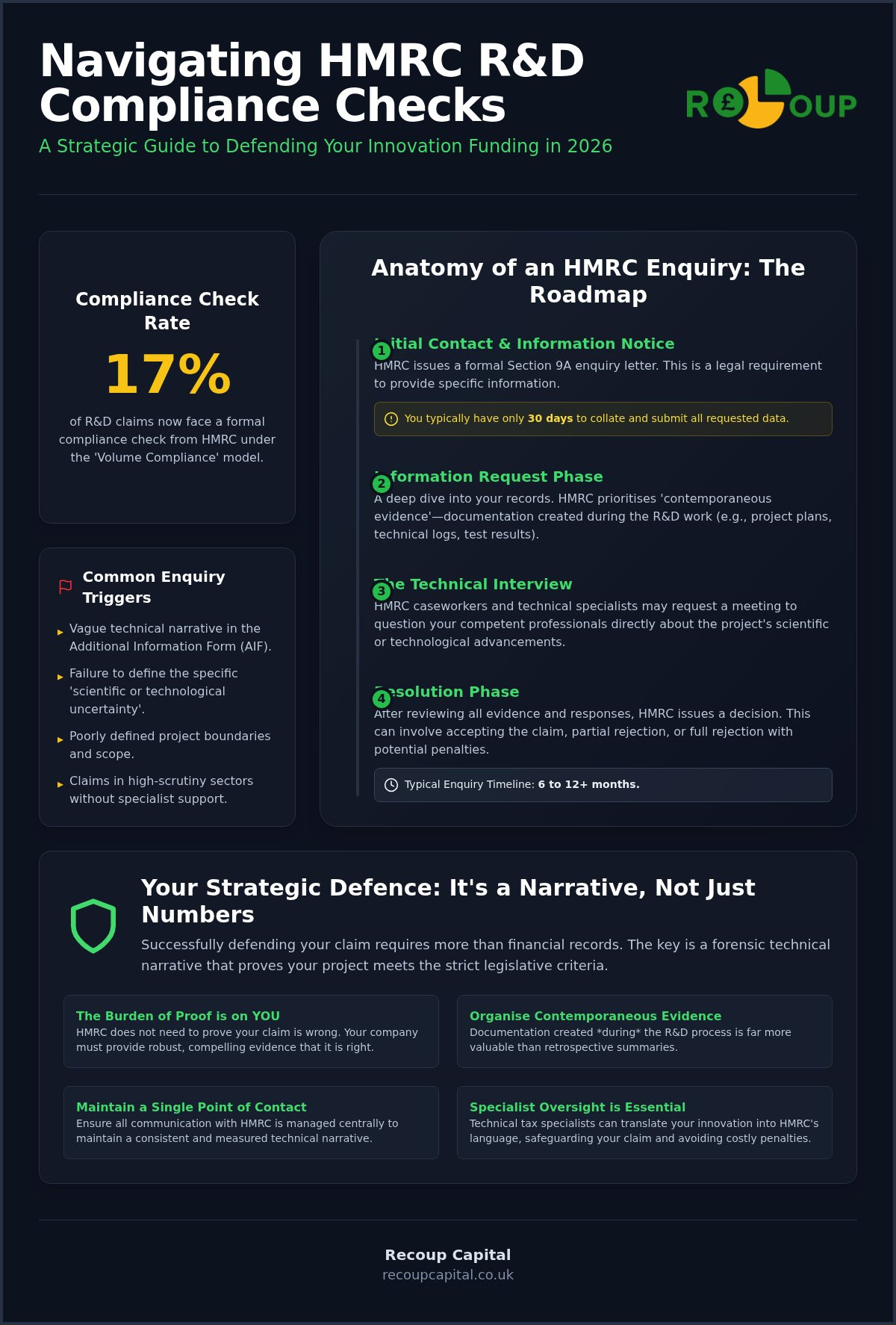
The process usually starts with a formal letter, often accompanied by an 'Information Notice'. This document isn't just a request; it's a legal requirement to provide specific data within a set timeframe. Whilst the official HMRC guidance outlines the broad rules, the reality of an enquiry is much more granular. You'll need to demonstrate exactly how your project sought an advancement in science or technology. It's vital to remember that the burden of proof rests entirely on your business. HMRC doesn't have to prove your claim is wrong; you must prove it's right.
Patience is a necessity. Navigating hmrc r&d compliance checks is rarely a swift experience. Most enquiries last between six and twelve months, though complex cases in sectors like engineering can easily stretch beyond a year. Managing this timeline requires disciplined communication. Every response to a caseworker should be measured, factual, and delivered through a single point of contact to avoid conflicting statements. This ensures the technical narrative remains consistent throughout the investigation.
The Information Request Phase
Once the enquiry is open, HMRC will request a deep dive into your records. Expect to provide project plans, payroll records, and technical logs that date back to the period of the claim. The department prioritises 'contemporaneous evidence', which is documentation created at the time the work was done, over retrospective summaries. You typically have only 30 days to collate and submit this data. Missing these deadlines can lead to penalties or the summary rejection of your claim. If you find the volume of data overwhelming, you might want to seek specialist support to defend your claim and ensure every document aligns with the technical narrative.
The Technical Interview
In many 2026 enquiries, HMRC caseworkers request a technical interview. They want to speak directly with your 'Competent Professionals', the lead engineers or developers who actually performed the work. This is a critical moment. Your team must be prepared to explain technical uncertainties, without drifting into routine commercial challenges. The goal is precise technical disclosure. Over-explaining can accidentally introduce new areas of doubt, whilst being too vague suggests a lack of qualifying activity. Preparation is the difference between a claim being upheld and a costly repayment demand.
Identifying Red Flags: Why HMRC Targets Certain Claims
HMRC's automated risk-profiling tools are designed to spot inconsistencies that a human might overlook. One of the most frequent triggers is the use of generic technical narratives. If your project descriptions look like they've been copied from a textbook or another claim, HMRC's AI will flag them for manual review. They are looking for specific, idiosyncratic details that prove your team actually grappled with a technical hurdle. Vague language is your enemy. When navigating hmrc r&d compliance checks, you'll find that a lack of project-specific detail is often interpreted as a lack of qualifying activity.
Sector-specific triggers also play a massive role. If you operate in construction or engineering, your claim is statistically more likely to be scrutinised. HMRC has identified these as high-risk areas where routine work is often incorrectly labelled as innovation. For instance, applying a standard engineering solution to a complex site is usually considered routine development, even if the project itself was difficult to complete. Ensuring these details are correct is vital when navigating hmrc r&d compliance checks to prevent an enquiry from escalating into a full-scale audit.
Technical vs Routine Development
The Department for Business, Innovation and Skills (BIS) guidelines provide a strict framework for what constitutes R&D. A common error is failing to distinguish between a difficult commercial problem and a true technological uncertainty. Solving a tricky logistical issue might be vital for your business, but it doesn't qualify for tax relief unless it advances the overall knowledge in your field. A commercial challenge involves meeting a budget or deadline, whereas a technological challenge arises when the method for achieving a result is not readily deducible by a competent professional. You must align your claim with the official HMRC R&D guidance to ensure every project listed meets this high bar.
Financial and Administrative Red Flags
Discrepancies between your CT600 tax return and the mandatory Additional Information Form (AIF) are immediate red flags. HMRC's systems are built to cross-reference these documents instantly. If your staff cost ratios seem unusually high compared to your total turnover, it suggests that your boundaries for qualifying time might be too broad. We often see issues arise when companies use low-cost R&D boutiques that prioritise volume over technical accuracy. These entities often lack the deep sector expertise required to explain the nuances of R&D tax credits effectively. Ineligible costs, such as misallocated utility bills or incorrectly claimed subcontractor fees, can also lead to a full audit of your financial records.
The Compliance Roadmap: How to Respond and Defend Your Claim
Receiving an enquiry letter can be unsettling, but it's important to treat it as a manageable project rather than a crisis. Whilst the initial instinct might be to provide a quick rebuttal, navigating hmrc r&d compliance checks requires a calm, evidence-led strategy that addresses the caseworker's specific concerns without conceding legitimate grounds. A methodical response not only protects your current claim but sets a standard for your company's future relationship with the tax office.
Your defence should follow a structured roadmap to ensure no technical or financial detail is overlooked. When navigating hmrc r&d compliance checks, we recommend this four-step approach:
- Step 1: Conduct an immediate internal audit. Re-examine the disputed claim with fresh eyes. Identify the specific projects HMRC has flagged and verify that the technical boundaries align with the original submission.
- Step 2: Engage a specialist R&D consultant. Generalist accountants may lack the deep technical expertise required to debate engineering or scientific nuances with HMRC's specialist units. A consultant can provide an objective gap analysis of your evidence.
- Step 3: Refine technical narratives. Ensure your documentation aligns with HMRC's Guidelines for Compliance (GfC3). This means explicitly linking every activity to a technological uncertainty.
- Step 4: Prepare a robust 'Letter of Response'. This document must address every point raised in the Information Notice. It should be factual, concise, and supported by evidence that leaves no room for ambiguity.
Building a Forensic Technical Narrative
HMRC caseworkers are looking for proof of a systematic investigation. To satisfy this, your project descriptions must move beyond high-level summaries and focus on the 'advance' and 'uncertainty'. Don't just tell them what you built; explain why it was technically difficult and why the solution wasn't obvious to a competent professional. You can significantly strengthen your case by using diagrams, code snippets, or architectural plans as supporting evidence. This level of detail demonstrates that your claim is rooted in real-world technical challenges. For a deeper look at this process, read our guide on how to claim R&D tax credits successfully.
Managing Potential Penalties
The goal of any defence is to resolve the check with the claim intact and zero penalties. HMRC can issue fines for 'careless' or 'deliberate' errors, but you can often avoid these by demonstrating a 'Reasonable Care' defence. This involves proving that you took sensible steps, such as seeking professional advice, to ensure your claim was accurate. In some instances, HMRC may agree to a suspension of penalties if you implement specific improvements to your record-keeping processes. If you reach an impasse with a caseworker, you may have the option of 'Alternative Dispute Resolution' (ADR), where a neutral HMRC mediator helps resolve the conflict. If you are currently facing an enquiry, it is vital to defend your innovation funding with expert technical support.
Future-Proofing Your Innovation: Why Professional Oversight is Essential
The era of "submit and forget" is over. Relying on generalist accounting firms for complex R&D claims carries inherent risks in 2026. Whilst your regular accountant is essential for statutory filings, they may not possess the technical engineering or software background required for navigating hmrc r&d compliance checks. HMRC's caseworkers are now technical specialists; your defence must match that level of expertise to avoid the stress of clawbacks or penalties.
Establishing "best-in-class" record-keeping habits is the most effective way to insulate your business from future scrutiny. This involves moving from retrospective summaries to real-time technical logs and precise payroll allocations. A pre-submission 'Enquiry-Ready' audit serves as a vital stress test, identifying potential boundary issues before HMRC ever sees the claim. It transforms a reactive process into a proactive strategy, ensuring your innovation funding remains a secure asset rather than a liability.
The Recoup Capital Advantage
We specialise in high-scrutiny sectors such as construction, engineering, and advanced manufacturing. Our chartered tax accountants work alongside a specialist technical team to ensure every claim is vetted with forensic precision. This partnership approach means we act as a protective buffer between your business and the tax authority, handling the complex correspondence so you can focus on growth. Our success-based fee model ensures our goals are perfectly aligned with yours. Discover more about why work with Recoup Capital to secure your future claims and maintain a robust technical standing.
Moving Forward with Confidence
Successful R&D tax relief isn't just about a one-off refund; it's about reframing these returns as strategic assets for your business. When you treat capital recovery as a tool for growth, the complexity of navigating hmrc r&d compliance checks becomes a manageable part of your innovation cycle. We focus on long-term collaboration, helping you maximise capital utility whilst maintaining absolute transparency with HMRC. By integrating expert oversight into your annual process, you can innovate with the confidence that your funding is defended by specialists.
Ready to secure your innovation funding and protect your business from unnecessary scrutiny? Book a no-cost compliance review with our specialists today.
Securing Your Technical Advantage and Funding
The landscape of R&D tax relief has matured into a space where technical precision is the only currency HMRC accepts. Successfully navigating hmrc r&d compliance checks is no longer about simply filing a claim; it's about building a defensive technical narrative that proves your work meets the high bar of scientific or technological advancement. By prioritising contemporaneous evidence and aligning your project descriptions with the latest Guidelines for Compliance, you transform a potential regulatory hurdle into a showcase of your company's legitimate brilliance.
At Recoup Capital, our team of specialist chartered tax accountants and technical experts acts as your protective guide through these complexities. We bring proven expertise in high-scrutiny sectors like construction and tech, ensuring your claims are vetted to the highest standards. Our success-based fee model ensures our interests are perfectly aligned with your outcomes, focusing on demonstrating value through results. Protect your innovation and respond to HMRC with confidence; contact Recoup Capital today. We're ready to help you turn your capital recovery into a powerful strategic asset for long-term growth.
Frequently Asked Questions
How long does an HMRC R&D compliance check typically take?
Most compliance checks last between six and twelve months, though complex cases in engineering or software can exceed a year. The timeline depends heavily on the speed of your responses and the volume of technical queries raised by the caseworker. HMRC's ISBC unit manages these enquiries in cycles, so providing clear, forensic evidence in your first response is the best way to prevent unnecessary delays.
Can HMRC ask for my R&D tax credit money back?
Yes, HMRC has the authority to demand the full repayment of tax credits if an enquiry finds that your projects didn't meet the qualifying criteria. This 'clawback' can include the original credit amount plus interest. In cases where they identify a lack of reasonable care, they may also apply financial penalties on top of the repaid amount, which can impact your company's future cash flow.
What is an HMRC nudge letter for R&D tax credits?
An HMRC nudge letter is an informal prompt designed to encourage companies to double-check their R&D submissions for common errors. It isn't a formal enquiry, but it's a clear signal that your claim has been flagged by their risk-profiling tools. Treating these letters as a priority and conducting an internal audit allows you to correct any mistakes before a more intrusive Section 9A enquiry begins.
Does an enquiry mean I have done something wrong?
An enquiry doesn't necessarily imply that your claim is fraudulent or incorrect. It's a standard technical audit used to verify that the relief is being distributed according to current legislation. With HMRC checking approximately 17 per cent of claims in the 2023/24 tax year, many legitimate innovators are selected simply because they operate in high-scrutiny sectors like construction or manufacturing.
What documents do I need to provide for an R&D audit?
You'll need to provide contemporaneous evidence that supports both your technical narrative and your financial figures. This typically includes technical logs, project plans, payroll records, and contracts for subcontractors. HMRC wants to see documentation that was created whilst the R&D was actually taking place, as this proves your team was systematically tackling a specific technological uncertainty.
Should I use my regular accountant to handle an HMRC enquiry?
Whilst your regular accountant understands your general tax position, navigating hmrc r&d compliance checks requires a deep understanding of scientific and technological boundaries. HMRC caseworkers often ask highly technical questions that go beyond standard accounting. Using a specialist technical team ensures you can defend the nuances of your innovation with the forensic detail required to keep your claim intact.
What are the penalties for an incorrect R&D claim in 2026?
Penalties are calculated based on whether an error was 'careless' or 'deliberate', with fines potentially reaching a significant percentage of the tax at stake. However, if you can demonstrate that you took 'reasonable care' by seeking specialist professional advice, HMRC may waive the penalty entirely. They often focus on the quality of your vetting process when deciding whether to apply these financial sanctions.
How can I avoid an HMRC R&D enquiry in the future?
The most effective way to avoid future enquiries is to ensure your Additional Information Form (AIF) is project-specific and avoids generic descriptions. Implementing a robust record-keeping system that captures technical hurdles as they happen makes your claim much harder to challenge. A pre-submission audit by a specialist consultant can also identify and resolve red flags before they trigger HMRC's automated risk filters.


