

Did you know that for every £1,000,000 your business spends on cleaning up a brownfield site, you could be entitled to a £375,000 reduction in your corporation tax bill? It's a substantial figure that many firms unfortunately overlook. We understand that the exorbitant costs of removing asbestos or Japanese knotweed often feel like a direct hit to your project's ROI. When you combine those expenses with complex HMRC compliance and the uncertainty of whether derelict land qualifies alongside contaminated sites, the process of land remediation can feel like a daunting financial hurdle.
We're here to help you reframe these environmental liabilities as strategic financial assets. This guide will show you exactly how to claim up to 150% tax relief on your cleanup costs, providing a clear path to reducing the financial burden of site preparation. You'll learn the vital distinctions between relief rates, how to secure a 16% cash credit if your company is currently loss-making, whilst clarifying the specific criteria for derelict land claims. We'll provide the clarity you need to move forward with confidence and maximise your project returns.
Key Takeaways
- Maximise your project ROI by claiming up to 150% tax relief on the costs of cleaning up contaminated or derelict land.
- Identify qualifying expenditure for land remediation, including the removal of man-made contaminants like asbestos and naturally occurring substances like radon.
- Clarify whether your business qualifies for the 150% investor rate or the 50% developer benefit to ensure accurate financial planning.
- Secure your claim by understanding the necessary documentation and the three-year window available for retrospective capital recovery.
- Explore how a success-based consultancy model can help you uncover significant tax savings that general accountants often overlook.
What is Land Remediation Relief and Why Does it Matter?
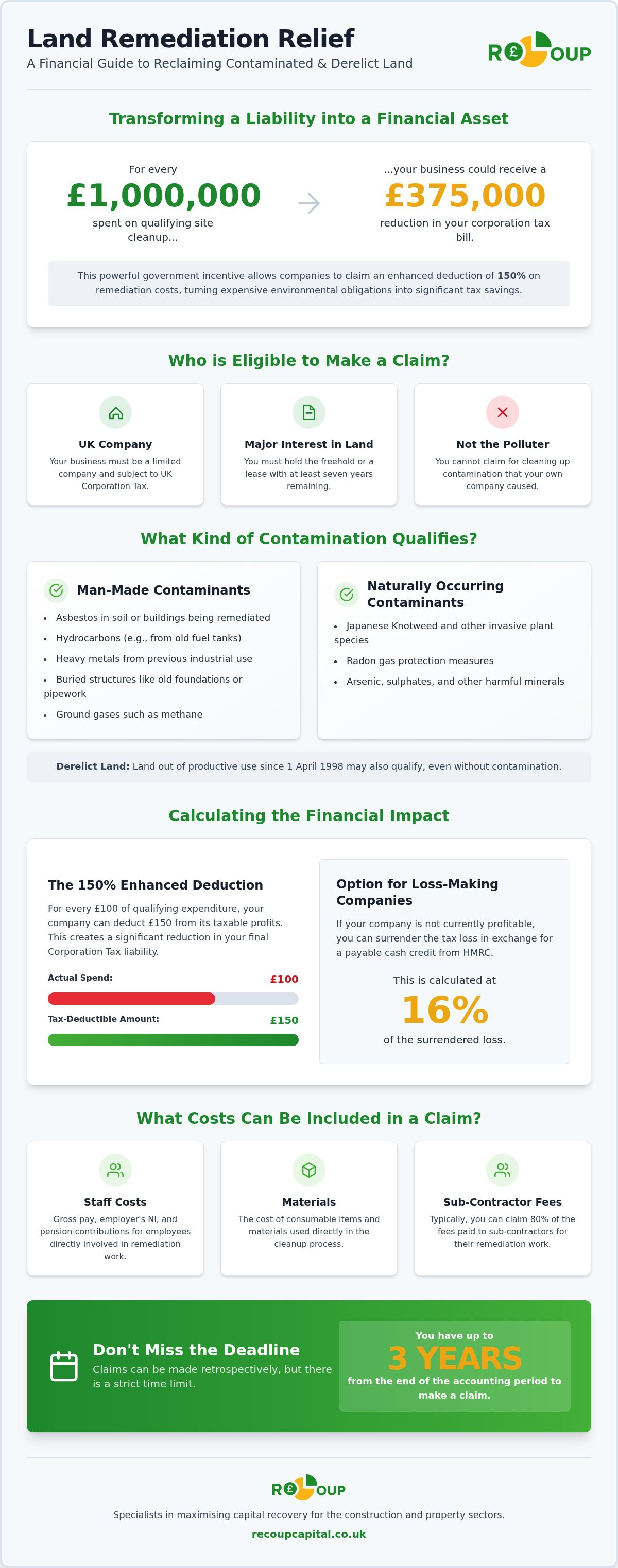
Land remediation is often viewed as a costly barrier to development. However, the UK government provides a powerful incentive known as Land Remediation Relief (LRR) to transform these liabilities into strategic financial assets. It's a corporation tax relief that allows companies to claim a deduction of 150% of qualifying expenditure on cleaning up land. This means for every £100,000 spent, you can reduce your taxable profit by £150,000. With the current corporation tax rate at 25%, this relief is a vital tool for protecting your project's bottom line.
The strategic importance of this relief cannot be overstated. With a national target to build 1.5 million new homes over the next five years, the regeneration of brownfield land is essential. LRR acts as the primary catalyst for this shift. It bridges the financial gap between expensive, contaminated sites and easier "greenfield" projects, ensuring that sustainable urban development is both viable and profitable.
It's vital to distinguish between "contaminated" and "derelict" land. Contamination refers to sites where substances in, on, or under the land cause a risk of serious harm to people or the environment. Derelict land is currently defined as land that has been out of use since 1 April 1998, though the government is currently consulting on moving this date to make the relief more accessible. Understanding these nuances is the first step toward a successful land remediation claim.
The Core Purpose of LRR in the UK Economy
LRR exists to encourage the reuse of land that has fallen into disuse. By incentivising the cleanup of difficult sites, the government reduces the environmental impact of new builds on greenfield locations. This supports broader environmental goals, such as biodiversity net gain and carbon reduction. It transforms neglected urban spaces into thriving residential or commercial hubs, providing a boost to local economies whilst preserving the countryside.
Who is Eligible to Make a Claim?
Eligibility is strictly limited to UK companies subject to Corporation Tax. This means that individuals, partnerships, and trusts are excluded from making a claim. To qualify, your company must hold a "major interest" in the land, which is defined as either a freehold or a lease with at least seven years remaining at the time the work was undertaken.
A fundamental rule is the "polluter pays" principle. You cannot claim for cleaning up contamination that your own company caused. The relief is specifically designed for the party that acquires already-contaminated land with the intention of bringing it back into productive use. It's a partnership between the state and the private sector to fix historical environmental issues.
Identifying Qualifying Contamination and Remediation Costs
Understanding what actually counts as a qualifying cost is the most critical step in securing your relief. It isn't enough for a site to be "dirty" or "old". To meet the criteria set out in the official HMRC guidance, the substances present must pose a serious risk of relevant harm to people or the environment. This definition is broader than many realise, covering both industrial legacy and natural hazards.
Qualifying expenditure generally falls into three main categories: staff costs, materials, and sub-contractor fees. If your employees are directly involved in the land remediation work, you can claim for their gross pay, employer National Insurance, and pension contributions. For sub-contractors, you can typically claim 80% of their fees. These costs must be directly attributed to the remediation process itself, rather than general site preparation or construction. This distinction is where many businesses fail to maximise their recovery.
Man-made vs. Naturally Occurring Contaminants
Man-made contaminants are the most common triggers for a claim. These include asbestos, hydrocarbons from old fuel tanks, and heavy metals left behind by industrial processes. Buried structures, such as old foundations or redundant pipework, also qualify if they prevent the land from being used. Asbestos is a prime example. Removing it from a building during a standard refurbishment usually won't qualify. However, if the asbestos is in the ground or you're removing it as part of a total site clearance to remediate the land itself, it becomes a strong candidate for a claim.
Naturally occurring substances are frequently overlooked. Arsenic, radon, and sulphates can all qualify for relief if they are present at levels that require active intervention. For instance, if you're forced to install expensive radon membranes or treat high levels of naturally occurring arsenic to make a site safe for residential use, those costs are likely eligible. The key is proving the substance poses a "serious risk" in its current state.
Excluded Methods: The "Dig and Dump" Rule
HMRC actively encourages sustainable remediation. This is why the "dig and dump" method for biological threats like Japanese Knotweed is often excluded from relief. If you simply dig up the weed and transport it to a landfill, you might find your claim rejected if more environmentally friendly on-site treatments were available. To ensure compliance, your remediation strategy should prioritise methods like on-site burial, root barriers, or chemical treatment.
Navigating these technicalities requires a specialist eye to ensure your strategy aligns with tax requirements. If you're dealing with complex site conditions, you might want to review your land remediation eligibility before finalising your project budget.
Calculating the Financial Impact: 150% vs. 50% Relief
Calculating the financial impact of your project requires more than just a surface-level glance at your invoices. The real value of Land Remediation Relief lies in its ability to transform a £100,000 environmental liability into a £37,500 tax saving or a £24,000 cash injection. These figures aren't just theoretical; they represent significant capital that can be reinvested into your next project or used to offset the high costs of specialised site preparation. Understanding which rate applies to your business is the key to unlocking this value.
The 150% rate is designed for companies holding land as a capital asset. This includes property investors and owner-occupiers who intend to use the site for their own business operations or long-term rental. When you undertake land remediation, you're effectively allowed to deduct the cost one and a half times over against your taxable profits. For a company paying the main rate of Corporation Tax at 25%, this provides a net benefit of 37.5% of the qualifying expenditure. It’s a powerful incentive that directly rewards businesses for taking on the risks associated with brownfield sites.
Property developers operate under slightly different rules because the land is classified as "trading stock" rather than a long-term asset. In these cases, you already deduct 100% of the remediation costs as a standard business expense. The relief provides an additional 50% deduction, bringing the total to 150%. While the final tax saving is the same as for investors, the accounting treatment differs. You can find more detail on these specific accounting requirements in the Official HMRC Guidance on Land Remediation Relief.
Investor vs. Developer: Which Rate Applies to You?
The distinction between a developer and an investor depends on your intent at the time of acquisition. If you're building to sell, the land is trading stock. If you're building to hold, it's a capital asset. This affects the timing of your claim; investors typically claim in the period the work is done, whilst developers usually realise the benefit upon the sale of the property. Mixed-use developments often require a more granular approach to ensure that costs are correctly apportioned between different parts of the project.
The Cash Credit Option for Loss-Making Companies
If your company isn't currently making a profit, the relief doesn't just disappear. You have the option to surrender the resulting tax loss for a payable cash credit from HMRC. This credit is calculated at 16% of the enhanced loss (the 150% deduction), which effectively equates to a 24% cash return on your original remediation spend. This 24% credit serves as a strategic cash-flow tool that injects liquidity into your project exactly when it's needed most. It’s a vital lifeline for early-stage development projects where outgoings are high and revenue is still on the horizon. To see how this could apply to your current project, you can explore our land remediation services to calculate your potential recovery.
Navigating the LRR Claim Process and Compliance
Securing your relief isn't just about performing the physical work; it's about proving it to a standard that satisfies HMRC. The claim itself is integrated into your CT600 Corporation Tax return. Whilst the financial returns are significant, the burden of proof rests entirely on your ability to document the transition from a contaminated site to a safe, usable asset. HMRC expects precision. You must provide a clear audit trail that links every penny of expenditure to a specific remediation activity. Common pitfalls often include failing to separate general site preparation from actual land remediation or neglecting to prove that the contamination existed at the point of purchase.
To avoid unwanted inquiries, your documentation must be robust. This includes a comprehensive suite of site surveys, detailed remediation strategies, and itemised invoices. You should also be prepared to show that your company was not responsible for the original contamination. HMRC adheres strictly to the "polluter pays" principle, so your evidence must clearly establish that you acquired the land in its contaminated state. If your records are incomplete, even the most legitimate claim can be delayed or rejected.
Evidencing Your Remediation Strategy
Technical reports are non-negotiable for high-value claims. You need a "before and after" narrative supported by professional assessments. A pre-remediation survey should identify the specific contaminants and the risks they posed. Following the work, a verification report must confirm that the remediation strategy was successful and the risk has been mitigated. These reports act as your primary defence during an HMRC review, providing the technical weight needed to justify the 150% deduction. Without these specialised documents, you're essentially guessing at your eligibility.
The Retrospective Claim Opportunity
One of the most valuable aspects of this incentive is the ability to look back. Your business has a three-year retrospective window to claim for costs incurred on past projects. This means you can review any development completed in the last 36 months to recover overpaid tax from previous accounting periods. Many companies discover significant "hidden" assets by auditing their recent site history. If you've overlooked Land Remediation Relief on a previous project, it isn't too late to claim that capital back and bolster your current cash flow.
Don't leave your capital recovery to chance; arrange a professional compliance review to ensure your documentation meets HMRC's rigorous standards before you submit your next return.
Maximising Capital Recovery with Recoup Capital
General accountants provide an essential service for day-to-day compliance, but they often lack the specialised technical expertise required to identify every land remediation opportunity. This relief sits at the intersection of environmental science, construction engineering, and complex tax legislation. Because it requires a deep understanding of site-specific contaminants and remediation strategies, it frequently remains a "hidden" saving on many balance sheets. At Recoup Capital, we bridge this gap by acting as your protective guide through the regulatory landscape, ensuring no eligible expenditure is left on the table.
Our success-based fee model is designed to remove the perceived risk of making a claim. We believe in demonstrating our value through tangible results rather than traditional sales pitches. If we don't secure a tax saving or cash credit for your business, you don't pay a fee. This approach ensures our interests are perfectly aligned with yours, allowing us to focus entirely on maximising your capital recovery whilst you focus on your core development objectives. We manage the entire end-to-end HMRC liaison, handling the technical queries and documentation so you can enjoy the benefits of a streamlined, efficient process.
Beyond LRR: A Holistic Approach to Tax Incentives
We don't view your project in isolation. A single brownfield development often contains multiple layers of potential tax incentives that can be stacked to significantly improve your ROI. For instance, the innovative methods used to treat soil or manage complex site challenges may qualify for additional support. You can find more information on how these technical breakthroughs are rewarded in our guide to R&D Tax Credits Explained. Identifying these opportunities within complex construction projects requires a forensic eye for detail.
Similarly, your project may hold "embedded" savings within the building's fixtures and systems. Our specialist team conducts deep-dive Capital Allowances reviews to uncover tax relief on items like heating, lighting, and security systems that are often missed during standard accounting. By taking this holistic view, we transform your tax position from a mere compliance exercise into a strategic business tool for long-term growth.
The Recoup Capital Partnership
Our process is designed to be low-friction and high-impact. It begins with an initial site audit conducted by our specialist chartered tax accountants, who possess the industry-specific knowledge to spot qualifying costs that others overlook. From there, we build a robust, evidence-based claim and manage all communications with HMRC on your behalf. We view our role not as a service provider for one-off transactions, but as a long-term partner invested in your company's ongoing innovation and growth. This relationship-first approach ensures that as your business evolves, your tax strategy remains agile and fully optimised for success.
Transform Your Environmental Liabilities into Strategic Assets
Cleaning up contaminated sites shouldn't be a drain on your project's profitability. As we've explored, the UK government provides a powerful mechanism to offset these costs, allowing you to reclaim up to 150% of your expenditure. Whether you're dealing with the legacy of industrial asbestos or naturally occurring radon, land remediation incentives are designed to make brownfield regeneration both viable and rewarding. It's about turning a complex regulatory hurdle into a strategic financial tool that strengthens your bottom line.
Our team of specialist chartered tax accountants provides national UK coverage, ensuring your business accesses the full range of available incentives. We work on a success-based fee structure, meaning we only succeed when you do. Don't let your previous projects go unexamined; with a three-year retrospective window, there's often significant capital waiting to be recovered. We're ready to act as your protective guide through the compliance landscape and help you innovate with confidence.
Ready to unlock the hidden value in your development portfolio? Book a No-Cost Consultation to Maximise Your Land Remediation Claim and start your journey toward smarter capital recovery today.
Frequently Asked Questions
Can I claim Land Remediation Relief if I was the one who contaminated the land?
No, you cannot claim this relief if your company or a connected party caused the original contamination. HMRC operates on the "polluter pays" principle; the incentive is strictly for businesses that acquire land already in a contaminated or derelict state. This ensures the relief supports the regeneration of historical brownfield sites rather than subsidising a company's own environmental cleanup obligations.
Is Japanese Knotweed removal always eligible for 150% tax relief?
Eligibility depends entirely on the remediation method you choose. Whilst Japanese Knotweed is a qualifying biological contaminant, simply digging it up and moving it to a landfill is generally excluded from the relief. To secure the full 150% benefit, your strategy should employ more sustainable, on-site treatments such as root barriers or chemical management that HMRC prioritises.
How does Land Remediation Relief interact with R&D Tax Credits?
These are two distinct incentives that can be strategically combined on a single project to maximise recovery. Land remediation relief covers the direct costs of cleaning up the site, whilst R&D Tax Credits can be claimed for the technical innovation used to solve those environmental challenges. Stacking these incentives allows you to recover capital across both the cleanup and the engineering phases.
What is the time limit for making a retrospective LRR claim?
You have a three-year window to make a retrospective claim for qualifying costs. This time limit is calculated from the end of the accounting period in which the remediation expenditure was originally incurred. This provides a significant opportunity to review past projects completed within the last 36 months and recover overpaid corporation tax or secure missed cash credits.
Can I claim LRR for removing asbestos from a building I am renovating?
Removing asbestos from a building during a standard renovation is typically ineligible for this specific relief. To qualify, the asbestos must either be in the ground itself or removed as part of a comprehensive site clearance designed to remediate the land for new use. The relief focuses on the state of the land rather than the maintenance of existing structures.
Is Land Remediation Relief available for residential property developers?
Yes, residential developers are eligible, though the accounting treatment varies from that of long-term investors. Developers treat land as trading stock, meaning they claim a 50% additional deduction on top of the standard 100% business expense. This relief is usually realised when the developed property is sold, providing a vital boost to the project's final margin.
What happens if my company is currently making a loss but has high remediation costs?
Loss-making companies have the option to surrender their enhanced tax loss for a payable cash credit from HMRC. This credit is paid at a rate of 16% of the qualifying loss, which effectively returns 24% of your actual remediation spend as immediate liquidity. It's a critical cash-flow tool for developers who haven't yet reached a profitable stage in their project lifecycle.
Do I need a specific type of survey to qualify for the relief?
Professional technical reports are essential for a successful and compliant claim. You must provide a site survey that identifies the specific contaminants present at the time of purchase and a subsequent verification report proving the land remediation was successful. These documents provide the necessary evidence to satisfy HMRC's rigorous standards and protect your claim during an inquiry.


