
What if the capital your business has already spent could be quietly working to reduce your tax bill right now? For many Manchester businesses, that's not a hypothetical; it's an overlooked reality. Capital allowances manchester specialists consistently find that eligible assets go unclaimed, not because business owners don't care, but because the rules are genuinely complex and the stakes of getting it wrong feel uncomfortably high.
You're right to take this seriously. HMRC scrutiny around capital allowances claims has sharpened considerably, and the anxiety of a potential inquiry, combined with uncertainty about which assets actually qualify, is enough to make many businesses either under-claim or avoid the process altogether. A generalist accountant can cover the basics, but maximising your position in 2026 requires a level of specialist depth that goes well beyond a standard tax return.
This guide is here to change that. You'll gain a clear understanding of which assets qualify, how the latest HMRC regulations affect your claims, and how a structured, specialist-led approach can transform your capital expenditure into a genuine strategic asset. Consider this your practical roadmap to confident, compliant, and maximised capital allowances relief.
Key Takeaways
- Capital allowances are a legitimate form of tax relief on capital expenditure that many UK businesses are significantly under-claiming, leaving money on the table that could be reinvested into growth.
- The 2026 HMRC compliance landscape demands greater transparency and rigour, meaning the way you structure and evidence your capital allowances claims has never mattered more.
- A generalist accountant may cover the basics, but specialist consultants are equipped to identify qualifying costs that a standard tax return process routinely misses - including nuanced staff-related expenditure.
- Qualifying assets extend further than most business owners realise, and understanding the full scope of claimable costs is the single most effective way to maximise your relief position.
- A structured, specialist-led approach - combining thorough initial assessment with broader corporate finance strategy - transforms capital allowances from a compliance exercise into a genuine strategic asset.
What are Capital Allowances and Why are They Important for Your Business?
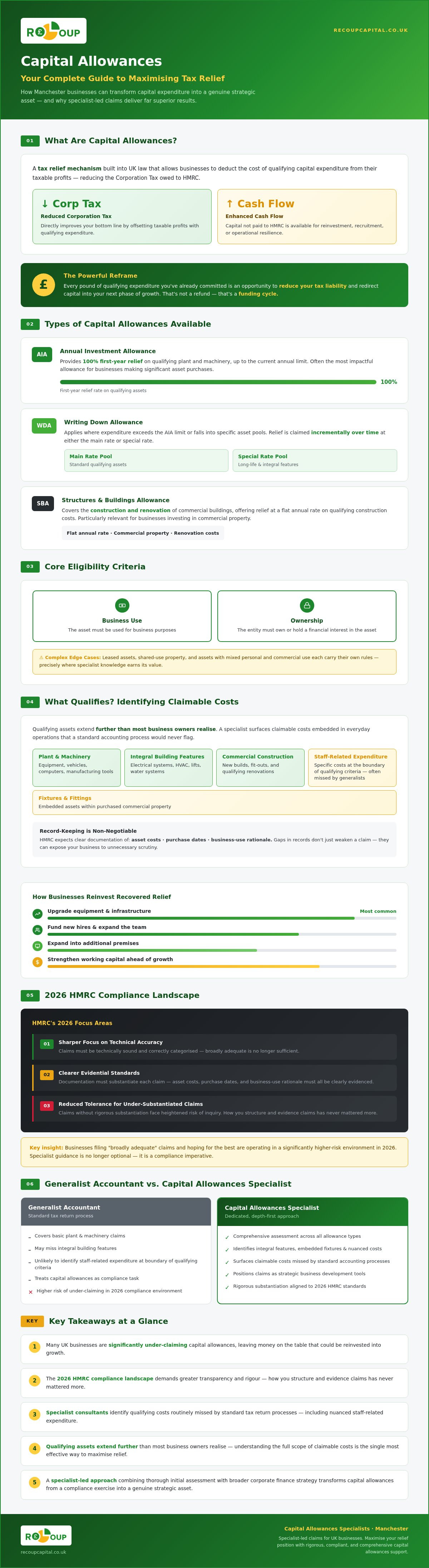
Capital allowances are a form of tax relief that allows businesses to deduct the cost of qualifying capital expenditure from their taxable profits. Rather than treating a major purchase as a one-off expense that disappears into your accounts, HMRC permits you to claim relief on those costs over time, or in some cases immediately, reducing the Corporation Tax you owe. It's a mechanism built into the UK tax system specifically to reward businesses that invest in their own infrastructure and operations.
The distinction that matters here is strategic. Most guides frame capital allowances as a way to "claim back" money, which is technically accurate but misses the point entirely. The more powerful framing is this: every pound of qualifying expenditure you've already committed represents an opportunity to reduce your tax liability and redirect that capital into your next phase of growth. That's not a refund. That's a funding cycle. Understanding capital allowances explained in this way reframes the entire exercise from a compliance task into a genuine business development tool.
Two benefits sit at the core of every successful claim. First, reduced Corporation Tax, which directly improves your bottom line. Second, enhanced cash flow, because money you're not paying to HMRC is money available for reinvestment, recruitment, or operational resilience. For businesses operating across Manchester's competitive commercial landscape, that liquidity advantage is far from trivial.
The Types of Capital Allowances Available
The UK tax system offers several distinct allowance types, each suited to different asset categories and expenditure profiles:
- Annual Investment Allowance (AIA): Provides 100% first-year relief on qualifying plant and machinery, up to the current annual limit. This is often the most impactful allowance for businesses making significant asset purchases.
- Writing Down Allowance (WDA): Applies where expenditure exceeds the AIA limit or falls into specific asset pools. Relief is claimed incrementally over time at either the main rate or special rate, depending on the asset type.
- Structures and Buildings Allowance (SBA): Introduced to cover the construction and renovation of commercial buildings, offering relief at a flat annual rate on qualifying construction costs. This is particularly relevant for capital allowances Manchester businesses investing in commercial property.
Eligibility hinges on two core criteria: the asset must be used for business purposes, and the claiming entity must own or have the financial interest in the asset. Leased assets, shared-use property, and assets with mixed personal and commercial use each carry their own rules, which is precisely where specialist knowledge earns its value.
How Businesses Can Benefit from Capital Allowances
The practical applications of recovered relief are wide-ranging. Businesses routinely use the improved cash position to upgrade equipment, fund new hires, expand into additional premises, or strengthen working capital ahead of a growth phase. The relief doesn't dictate how you reinvest; it simply gives you the resource to do so.
Accurate record-keeping is non-negotiable. HMRC expects clear documentation of asset costs, purchase dates, and business-use rationale. Gaps in records don't just weaken a claim; they can expose a business to unnecessary scrutiny. A specialist's role isn't simply to identify qualifying assets on paper; it's to surface claimable costs embedded in everyday operations that a standard accounting process would never flag, from integral building features to specific staff-related expenditure that sits at the boundary of qualifying criteria.
Navigating the 2026 HMRC Compliance Standards: What You Need to Know
The compliance environment surrounding capital allowances has shifted considerably. HMRC's approach in 2026 is characterised by a sharper focus on technical accuracy, clearer evidential standards, and a reduced tolerance for claims that lack rigorous substantiation. For businesses that have been filing broadly adequate claims and hoping for the best, that shift carries real consequences.
This isn't about HMRC becoming adversarial. It's about the system demanding a higher standard of proof. Claims that were once accepted with minimal scrutiny are now subject to closer examination, particularly where asset classification, apportionment methodology, or expenditure categorisation is involved. The businesses caught off guard are typically those relying on processes built for a less demanding era.
Understanding the New Compliance Framework
The 2026 compliance framework places particular emphasis on three areas: the technical classification of qualifying assets, the robustness of cost apportionment between qualifying and non-qualifying expenditure, and the completeness of the claim history across prior periods. HMRC expects businesses to demonstrate not just what they've claimed, but why each element qualifies under the relevant legislation. The overarching goal of the new standards is straightforward: to ensure that relief is claimed accurately, consistently, and with a clear audit trail that can withstand scrutiny at any point.
For capital allowances Manchester businesses operating across commercial property, manufacturing, or construction, the implications are practical. Asset pools must be correctly allocated. Mixed-use expenditure requires defensible apportionment. And where prior-year claims exist, they need to be consistent with current positions, because inconsistencies across tax years are a recognised trigger for further investigation.
The Importance of Accurate Reporting
HMRC's increased scrutiny has changed what a "strong" claim actually looks like. It's no longer sufficient to identify qualifying assets and attach a figure. A robust claim in 2026 includes:
- Detailed asset schedules that clearly distinguish between plant and machinery, integral features, and non-qualifying structural elements.
- Supporting invoices and contracts that evidence both the cost and the business purpose of each asset claimed.
- A documented methodology for any cost apportionment, particularly where expenditure spans qualifying and non-qualifying categories.
- Consistency across prior claims, demonstrating that the current position aligns with previously filed returns.
The risk of an HMRC inquiry isn't just the inquiry itself; it's the retrospective exposure it can create. A poorly evidenced current claim can prompt a review of prior years, compounding the problem significantly. Specialist capital allowance support services exist precisely to prevent that scenario, ensuring that every element of a claim is technically sound before it's submitted.
Preparation is the most effective form of protection. If your current claim process doesn't produce the level of documentation described above, that's the gap worth addressing before HMRC identifies it first.
Why Specialist Consultants are Essential for Maximising Capital Allowances
Here's the objection that comes up constantly: "My accountant already handles this." It's an understandable position, and in most areas of business finance, a skilled generalist accountant is exactly what you need. Capital allowances aren't most areas. The technical depth required to identify every qualifying asset, correctly classify expenditure, and build a claim that holds up under HMRC scrutiny is a discipline in its own right. Treating it as a line item on a standard tax return is how legitimate relief gets left on the table.
Common Pitfalls of General Accountants
Generalist accountants are trained to produce accurate, compliant accounts. That's a different skill set from forensic asset analysis. The qualifying costs that specialist consultants routinely surface, including embedded plant within commercial fit-outs, integral building features, and sector-specific expenditure in construction and engineering, rarely appear on a standard asset register. A conservative claim isn't a safe claim; it's an incomplete one. The relief you don't claim doesn't disappear; it simply stays with HMRC.
The practical consequences are significant. Businesses that rely on a generalist approach typically claim against obvious, depreciating assets: equipment, vehicles, machinery. What they miss are the grey-area costs that a chartered tax accountant or technical specialist would examine as a matter of course. Those overlooked categories frequently represent the largest portion of unclaimed relief, particularly for capital allowances Manchester businesses operating across commercial property or specialist infrastructure.
Working with chartered tax accountants and industry specialists isn't about distrust of your existing accountant. It's about recognising that this is a niche discipline, and niche disciplines reward specialists.
The Benefits of a Strategic Partnership
The most effective way to approach capital allowances isn't as a one-off exercise. Specialists who act as long-term partners in capital recovery bring continuity across tax years, ensuring that prior claims are consistent with current positions and that emerging expenditure is captured as it occurs rather than retrospectively.
A no-cost initial assessment is where that partnership typically begins. It allows a specialist to evaluate the realistic scope of your claim before any commitment is made, giving you a clear picture of potential relief without financial risk. That low barrier to entry matters, because it shifts the dynamic from a sales conversation to an evidence-based evaluation.
The success-based fee model reinforces this alignment. When a consultant's return is tied directly to the relief they recover for you, their incentives and yours are identical. There's no motivation to file a quick, superficial claim; the entire commercial logic points toward thoroughness. You can explore more about why claiming capital allowances through a specialist approach delivers materially better outcomes than a standard process.
Specialists also absorb the administrative and technical complexity of the claim process, freeing your team to focus on running the business rather than managing HMRC correspondence and asset documentation. That's not a secondary benefit. For most businesses, it's the difference between a claim that gets done properly and one that gets deferred indefinitely.
Identifying Qualifying Costs: What Your Business Can Claim
Most businesses think they know what qualifies. They're usually wrong, or at least incomplete. The scope of claimable expenditure under HMRC's capital allowances framework extends considerably beyond machinery and equipment, and understanding exactly where those boundaries sit is where genuine relief is found. For capital allowances Manchester businesses operating across diverse sectors, the gap between what's claimed and what's claimable is often substantial.
Staff costs are a prime example of this. Where employees are directly engaged in qualifying activity, a proportion of their gross pay, employer National Insurance Contributions, and pension contributions can be attributed to a claim. The key is demonstrating a clear, documented link between the individual's time and the qualifying work. Vague allocations won't hold up; defensible time-apportionment records will.
Subcontracted work introduces further complexity. Payments to external contractors or externally provided workers can qualify, but the rules differ depending on whether the subcontractor is connected to your business and how the contract is structured. Connected-party payments are subject to additional scrutiny, and the qualifying amount is typically capped at the lower of cost or market rate. Getting this wrong is a common source of claim exposure.
Materials consumed directly in qualifying activity are claimable, as are certain utility costs where they can be reliably apportioned to that activity. The apportionment methodology must be consistent and documented; a reasonable estimate supported by evidence is acceptable, but an undocumented assumption is not.
Examples of Qualifying Expenditures
Qualifying costs vary by sector, but the principle is consistent: expenditure that advances a qualifying purpose, and can be evidenced as such, is claimable. Across the sectors where businesses most frequently under-claim:
- Construction: Site preparation costs, expenditure on developing sustainable materials, and investments in innovative building methods can all qualify where the work involves genuine technical advancement.
- Technology: Software development costs, IT infrastructure investments, and system integration expenditure are frequently claimable, particularly where the work addresses a specific technical problem rather than implementing an off-the-shelf solution.
- Manufacturing: Process optimisation projects, tooling development, and investments in production efficiency that go beyond routine upgrades are strong candidates for relief.
The detail matters here. Generic descriptions don't qualify; specific, evidenced expenditure does. For a comprehensive breakdown of what your business can legitimately claim, claiming capital allowances sets out the full qualifying criteria in practical terms.
Understanding Technical Uncertainty
Technical uncertainty is a defined concept within HMRC's framework. It describes situations where the outcome of a particular approach wasn't known in advance and couldn't be determined without the work being carried out. Establishing this uncertainty is often central to substantiating a claim, particularly in construction and technology sectors.
A robust claim file should include:
- Contemporaneous project records documenting the challenges encountered and the approaches tested
- Time-recording evidence linking staff costs to qualifying activity
- Invoices and contracts for subcontracted work, including evidence of arm's-length pricing where relevant
- A technical narrative or specialist report explaining why the work met qualifying criteria
- Apportionment calculations for shared costs, with the methodology clearly described
A well-constructed technical report doesn't just support your claim; it actively reduces the risk of HMRC challenge by demonstrating that the qualifying determination was made rigorously and in good faith. That's not bureaucracy for its own sake. It's the difference between a claim that stands and one that unravels under scrutiny.
If you're uncertain whether your existing records would withstand that level of examination, a no-cost initial assessment with a specialist is the most efficient way to find out.
The Recoup Capital Approach: Streamlining Your Capital Allowances Claims
Knowing that relief exists and actually recovering it are two entirely different things. The process between those two points is where most businesses lose ground, either through incomplete analysis, inadequate documentation, or a claim structure that doesn't hold up under scrutiny. Recoup Capital's approach is built to close that gap, combining forensic technical expertise with a commercial structure that keeps your interests and theirs perfectly aligned.
From Assessment to Claim Submission
The process follows three clearly defined stages, each designed to build on the last:
- Step 1: Initial consultation. The engagement begins with a no-cost assessment to identify potential qualifying assets across your business. This isn't a generic checklist exercise; it's a structured conversation with chartered tax accountants and technical specialists who understand which costs are routinely overlooked and where the strongest relief opportunities typically sit for your sector.
- Step 2: Forensic cost analysis. Once the scope is established, the team conducts a detailed review of your capital expenditure, asset records, contracts, and supporting documentation. This is where the real work happens. Staff costs, subcontracted work, embedded plant, integral building features; every category is examined with the rigour that 2026 HMRC compliance standards demand.
- Step 3: Claim preparation and submission. A fully evidenced, technically substantiated claim is prepared and submitted to HMRC. The documentation standard isn't just adequate; it's defensible, with clear asset schedules, apportionment methodologies, and a technical narrative that anticipates scrutiny rather than reacting to it.
The success-based fee model underpins the entire process. Recoup Capital is paid only upon successful recovery, which means there's no financial risk to engaging and no incentive to file anything other than the most thorough claim possible. That alignment matters.
Long-Term Financial Strategies Beyond Capital Allowances
For capital allowances Manchester businesses with broader capital recovery potential, the relationship doesn't stop at a single claim. Recoup Capital's national reach and corporate finance expertise means that qualifying expenditure identified during the capital allowances process frequently surfaces opportunities in adjacent reliefs. Land Remediation Relief, for instance, is a significant and consistently under-claimed relief for businesses dealing with contaminated or derelict land, and it's rarely identified through a standard tax return process.
The strategic value of this integrated approach is real. Capital recovered through one relief strengthens the position from which you pursue the next. That's the funding cycle in practice: each successful claim becomes the resource that funds your next phase of investment, which in turn generates further qualifying expenditure. It's not a one-off transaction. It's a long-term partnership built around your financial growth.
If you haven't yet had your capital expenditure examined by a specialist, the gap between what you've claimed and what you could claim is likely wider than you'd expect. Book your no-obligation capital allowances assessment today and find out exactly where you stand.
Your Next Step Towards Maximised Tax Relief
Capital allowances represent one of the most consistently under-utilised reliefs available to Manchester businesses. The 2026 compliance landscape demands greater rigour, qualifying costs extend further than most business owners realise, and the difference between a standard claim and a specialist-led one is rarely trivial.
The case for acting now is straightforward. Every accounting period that passes without a thorough review is a period of relief that can't be recovered. Recoup Capital's team of chartered tax accountants and technical specialists work on a success-based fee model, meaning their incentives are entirely aligned with yours. There's no financial risk to finding out where you stand.
If your capital allowances Manchester claims haven't been examined by a specialist, the opportunity is almost certainly larger than you'd expect. Secure your no-obligation capital allowances assessment with Recoup Capital and take the first step towards turning your existing capital expenditure into a genuine strategic asset. The relief is there. It simply needs the right expertise to recover it.
Frequently Asked Questions About Capital Allowances
How long does a typical capital allowances claim take?
The timeline varies depending on the complexity of your capital expenditure and the quality of your existing records. A straightforward claim for a business with well-maintained asset schedules can be prepared and submitted within a few weeks. More complex claims involving commercial property, embedded plant, or multiple asset pools typically take two to three months from initial assessment through to submission.
HMRC's processing time adds further to the overall timeline. Once submitted, routine claims are generally processed within a few weeks, though claims subject to additional queries can take considerably longer. Thorough preparation upfront is the most reliable way to avoid delays at the HMRC stage.
Can my business claim capital allowances on leased equipment?
Generally, no. Capital allowances follow ownership, not use. If you're leasing equipment under an operating lease, the lessor retains ownership and claims the allowances. However, finance leases and hire purchase agreements are treated differently; where you bear the economic risks of ownership, you may be entitled to claim allowances on the asset even before legal title transfers.
The distinction between lease types is a common source of confusion and missed relief. If your business has a mix of leased and owned assets, a specialist review will clarify exactly which assets qualify and ensure you're not inadvertently leaving legitimate relief unclaimed.
What types of assets can qualify for capital allowances?
Qualifying assets are broader than most business owners expect. Plant and machinery covers an extensive range, including manufacturing equipment, IT hardware, commercial vehicles, and office furniture. Integral features within commercial buildings, such as electrical systems, heating, air conditioning, and lifts, also qualify under specific rules. For capital allowances Manchester businesses investing in commercial property, identifying these embedded assets is frequently where the most significant unclaimed relief sits.
Structures and Buildings Allowance extends relief to qualifying construction and renovation costs on commercial premises. What doesn't qualify includes land itself, most residential property, and assets with no genuine business purpose. The boundaries are technical and sector-specific, which is why specialist analysis consistently surfaces qualifying costs that a standard review overlooks.
What happens if HMRC queries my capital allowances claim?
An HMRC query isn't automatically cause for alarm, but it does require a prompt, well-evidenced response. HMRC may request supporting documentation, ask for clarification on asset classification, or question your apportionment methodology. If your claim was prepared with thorough documentation, including asset schedules, invoices, and a clear technical narrative, responding is largely a matter of presenting what you already have.
The risk escalates when claims lack proper evidential support. Gaps in documentation can prompt HMRC to widen the scope of their enquiry into prior tax years, compounding the original issue significantly. Working with specialist consultants who build defensible claims from the outset is the most effective way to reduce this exposure before it arises.
Is it possible to claim for work done in previous years?
Yes, in many cases. HMRC allows businesses to make retrospective claims on qualifying expenditure from prior accounting periods, subject to specific time limits. For Corporation Tax purposes, you generally have up to two years from the end of the relevant accounting period to amend a return, though the rules differ depending on your circumstances and the nature of the expenditure involved.
Retrospective claims can represent substantial unclaimed relief, particularly for businesses that have made significant capital investments without specialist input. A no-cost initial assessment is the most efficient starting point for understanding how far back your claim could reach and what the realistic recovery opportunity looks like.
Do I need to have a business plan to qualify for capital allowances?
No. Capital allowances are based on qualifying capital expenditure your business has already incurred, not on future plans or strategic documents. There's no requirement to present a business plan to HMRC as part of a claim. What matters is that the assets were purchased for genuine business use and that you can evidence the costs and their qualifying purpose.
What you do need is accurate records: purchase invoices, asset registers, contracts, and documentation that connects the expenditure to your business operations. A business plan won't strengthen a weak claim, but solid contemporaneous records will.
How much do specialist capital allowances consultants charge?
Pricing structures vary across the industry, but the model most aligned with your interests is a success-based fee, where the consultant is paid only upon successful recovery of relief. This removes financial risk from the engagement entirely and ensures the consultant's incentive is to recover as much legitimate relief as possible rather than to file quickly and move on.
We won't quote specific fee figures here, as these vary based on claim complexity, sector, and the scope of expenditure involved. What matters is understanding the fee structure before you engage. A transparent, success-based arrangement means the initial assessment carries no cost, and you only pay when relief is recovered on your behalf.
Can I claim capital allowances if my business is in financial distress?
Yes, eligibility for capital allowances isn't conditional on your current financial position. If your business has incurred qualifying capital expenditure, the relief is available regardless of whether you're currently profitable. That said, capital allowances reduce taxable profits, so the immediate benefit depends on whether your business has a Corporation Tax liability to offset against.
Where a business is loss-making, unclaimed allowances can still be valuable. They can be carried forward to offset future profits, or in certain circumstances, losses incorporating capital allowances may be available for group relief. A specialist can assess how best to structure a claim given your current financial position and ensure any relief is applied in the most advantageous way.


