

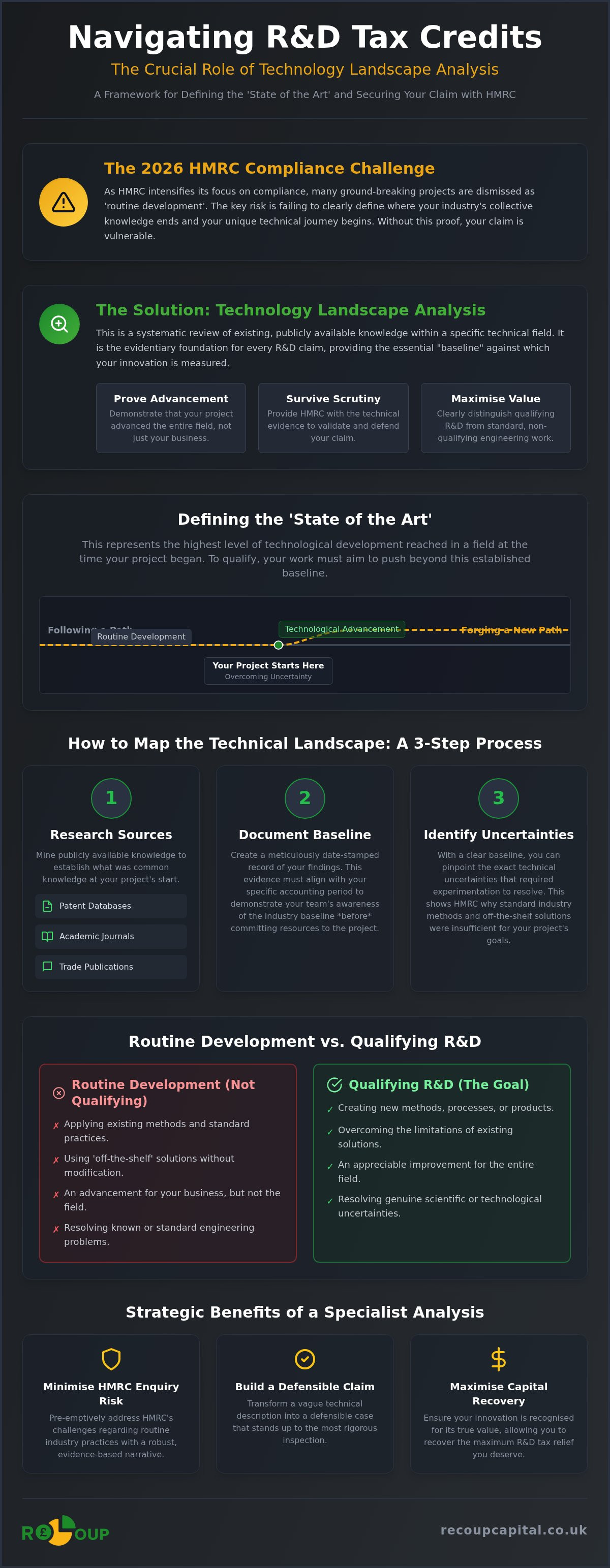
In 2026, HMRC isn't just looking for innovation; they're looking for the exact line where your industry's collective knowledge ends and your unique technical journey begins. It's a frustrating reality that many ground-breaking projects are dismissed as routine development simply because the baseline wasn't clearly defined. You know your work is transformative, but proving it meets the strict state of the art criteria can feel like aiming at a moving target, especially as HMRC intensifies its focus on compliance and error prevention.
Integrating a robust technology landscape analysis r&d tax credits into your process is the most effective way to protect your business from enquiry and validate the scientific advancements you've achieved. This guide provides a clear framework for documenting your technological starting point, helping you distinguish complex R&D from standard engineering with absolute confidence. We'll explore how to build an evidentiary backbone that defines your uncertainties and ensures your claim passes even the most rigorous inspection, allowing you to focus on growth rather than paperwork.
Key Takeaways
- Define the 'state of the art' as the essential foundation for identifying and proving genuine scientific or technological advancements.
- Discover how technology landscape analysis r&d tax credits provides the necessary technical evidence to survive HMRC's increased focus on claim transparency.
- Learn to distinguish between routine software or engineering work and the qualifying technological uncertainties that maximise your claim's value.
- Identify the critical research sources, such as patents and academic journals, required to document your technical baseline with absolute precision.
- Understand the strategic importance of specialist technical assessments in pre-emptively addressing HMRC's challenges regarding routine industry practices.
What is Technology Landscape Analysis in the Context of R&D Tax Credits?
A comprehensive technology landscape analysis r&d tax credits is the systematic review of existing, publicly available knowledge within a specific technical field. It's the process of looking beyond your company's internal expertise to understand what the rest of the world has already achieved. For UK limited companies, this isn't just a research exercise; it's the evidentiary foundation for every claim. It provides the "baseline" against which your innovation is measured.
In any R&D tax credits explained session, we start here because HMRC requires you to prove that your project sought an advancement in the field, not just an advancement for your own business. If a solution was already available in a trade journal or a patent, your work might be considered routine development rather than qualifying R&D. Distinguishing between what your team knows and what the industry knows is vital for a successful outcome.
The Concept of the 'State of the Art'
The 'State of the Art' represents the highest level of development reached in a particular field at the time your project began. HMRC's eligibility criteria are built entirely around this concept. To qualify for relief, you must demonstrate that your project aimed to achieve a scientific or technological advancement by moving beyond this established baseline. It's about pushing the boundaries of what is possible, not just what is convenient.
This baseline is dictated by information that is 'publicly available'. This includes academic papers, patents, and technical forums. This systematic gathering of Technology intelligence allows a business to pinpoint the exact moment they stop following a manual and start writing a new one. Without this context, you cannot accurately identify where the 'uncertainty' begins. It's the difference between following a path and forging one.
Why a Landscape Review is Crucial for UK Limited Companies
With HMRC's increased focus on claim transparency in 2026, a robust technical narrative is no longer optional. A robust technology landscape analysis r&d tax credits provides the necessary proof that your team did their due diligence before claiming for R&D costs. It prevents the common pitfall of misidentifying routine engineering or software work as qualifying innovation. It's about protecting your claim from scrutiny.
By mapping the landscape, you can clearly show HMRC:
- The specific constraints of existing 'off-the-shelf' solutions.
- Why standard industry methods were insufficient for your project requirements.
- The exact technical uncertainties that required experimentation to resolve.
This level of detail transforms a vague technical description into a defensible, evidence-based claim that stands up to scrutiny. It gives you the confidence that your innovation is recognised for its true value. Ultimately, it ensures that your business receives the maximum capital recovery it deserves.
Mapping the 'State of the Art': The Mechanics of Technical Research
Mapping the 'State of the Art' requires a disciplined approach to evidence gathering. It isn't enough to simply state that a solution didn't exist; you must prove that you looked for it. A rigorous technology landscape analysis r&d tax credits involves mining patents, academic journals, and trade publications to establish what was common knowledge at the start of your project. This research must be meticulously date-stamped to align with your specific accounting period. HMRC needs to see that your technical directors were aware of the industry baseline before they committed resources to overcoming uncertainties. Whilst the IRS Research Credit guidelines provide a useful global perspective on what constitutes qualifying research, the UK's HMRC focuses heavily on the 'competent professional' test within your specific field.
Utilising Patent Searches and Academic Databases
Patent databases are invaluable for identifying what was considered novel or obvious at the time your project commenced. They help you define the standard solutions that your project bypassed. Technical directors should consult a variety of sources to build a complete picture. This isn't about being an expert in patent law; it's about proving you've surveyed the available technical landscape. Consider the following checklist for your research:
- Espacenet: Use this to search global patent filings and identify existing technical solutions.
- Google Scholar: Perfect for finding peer-reviewed academic papers that outline theoretical limits.
- IET Digital Library or IEEE Xplore: These provide specific engineering and technology standards.
Synthesising these findings into a baseline report creates a robust narrative. It shows you didn't just guess that a problem was hard; you verified it through data. If you're unsure where your routine work ends and qualifying R&D begins, our team can help you identify the strategic value in your technical journey.
The Role of Competitor Analysis in R&D Claims
Evaluating competitors is tricky when you don't have access to their proprietary 'black box' designs or source code. However, you can still assess their public-facing technical specifications, API documentation, and performance benchmarks. The key is distinguishing between a product that is simply 'better' and a technology that is fundamentally 'advanced'. A product might have a sleeker interface, but that doesn't mean the underlying technology has moved the needle for the industry.
You must document that a solution was not readily deducible by a competent professional in your team. If the answer wasn't available in the public domain and required significant experimentation to achieve, you're likely looking at qualifying R&D. By benchmarking against what is commercially available, you highlight the technical gap your project aimed to bridge. This evidence is vital for protecting your business from the fear of HMRC enquiries due to poor documentation.
Differentiating Routine Development from Technological Advancement
Routine development is the bread and butter of most engineering and software teams. It involves tasks that a competent professional could resolve using established methods, standard tools, or existing libraries. Whilst these projects are often commercially vital, they don't necessarily meet the threshold for tax relief. For a claim to succeed, you must identify the exact moment your team exhausted standard practices and encountered a technical wall. This is where a technology landscape analysis r&d tax credits becomes your most valuable asset. It allows you to pinpoint the 'point of departure' from industry norms, providing a clear boundary between standard work and genuine innovation.
Without this rigorous research, HMRC may argue that your project was simply a complex application of existing knowledge. Complexity alone is not a substitute for advancement. You might spend months building a bespoke system, but if that system was constructed using well-understood principles, it remains routine. Understanding these nuances is a core part of the decision regarding why claim R&D tax credits. You're seeking recognition for the technical risks your business took to push the boundaries of your field.
The 'Competent Professional' Test
HMRC's benchmark revolves around the 'competent professional', an individual with relevant qualifications and experience in the specific technical field. According to HMRC's official guidelines, an advancement is only qualifying if it wasn't readily deducible to such an individual. You should document the credentials of your lead researchers to establish their expertise. Landscape analysis then proves that even with their deep understanding of the current state of the art, the technical hurdles remained 'uncertain'. It demonstrates that the solution wasn't just a search query away; it required iterative testing and genuine scientific discovery.
Common Pitfalls: When Routine Work Masquerades as Innovation
A frequent sticking point for many businesses is the distinction between system integration and systemic uncertainty. Connecting two software packages via an API might be time-consuming, but if the methods used are standard, it remains routine development. True R&D occurs when the integration itself creates a new technical problem that standard methods cannot solve. Consider these distinctions:
- Scaling a database: Using standard cloud configuration tools is routine. Developing a new data-sharding algorithm because existing ones failed at high throughput is an advancement.
- Bespoke Engineering: Building a bridge using standard materials in a known environment is routine. Experimenting with novel alloys to withstand unprecedented seismic stress is R&D.
- Software Customisation: Tailoring a CRM for a specific client is routine. Creating a machine learning model to predict user behaviour where no previous model existed is an advancement.
By clearly separating the routine from the revolutionary, you build a technical narrative that is both high in value and low in risk. This clarity ensures that your claim stands up to the most rigorous inspection from tax authorities.
Best Practices for Conducting a Technology Landscape Review
Executing a thorough technology landscape analysis r&d tax credits requires a structured methodology. It's about building a narrative that HMRC can follow from initial research to the final technical hurdle. Retrospective research often misses the subtle technical nuances that prove a project's eligibility, so a proactive approach is vital. Follow these five steps to ensure your review is robust:
- Step 1: Define the specific scientific or technological field. Be precise; 'software development' is too broad, whilst 'optimising low-latency data processing in distributed systems' provides the necessary focus.
- Step 2: Identify the constraints of current 'off-the-shelf' solutions. Document exactly why existing tools or methods failed to meet your specific requirements.
- Step 3: Document the specific uncertainties that the landscape review could not resolve. This is the heart of your claim.
- Step 4: Maintain a contemporaneous log of technical hurdles and failed attempts. These records prove that the solution was not readily deducible.
- Step 5: Cross-reference your technical findings with the financial costs identified for claiming R&D tax credits to ensure every pound spent is backed by evidence.
Contemporaneous Documentation: The Gold Standard
Capturing data in real-time is far more effective than trying to reconstruct a project's history months later. HMRC increasingly expects to see evidence that was created whilst the work was actually happening. You can use existing project management tools like Jira or Trello to capture technical research and decision-making processes. Don't scrub out your mistakes; 'evidence of failure' is a powerful indicator of genuine R&D. It proves that you were facing real technical uncertainties that required experimentation to overcome.
Bridging the Gap Between Technical and Financial Teams
A common pitfall is the disconnect between the engineers doing the work and the finance team calculating the claim. Your landscape findings should directly dictate which staff costs and sub-contractor fees are eligible. If a specific phase of the project was identified as routine development during your review, those costs must be excluded. This process of technical-to-financial mapping ensures your CT600 filing is consistent and accurate. A unified report that links technical advancement to specific expenditure reduces the risk of HMRC enquiries significantly. If you want to ensure your documentation is water-tight, our specialists can help you organise your technical evidence for maximum protection.
Strategic Benefits: Why Specialist Analysis Minimises HMRC Enquiry Risk
HMRC has shifted its focus towards absolute transparency in 2026. They aren't just interested in the final figures; they want to see the technical logic that justifies them. A robust technology landscape analysis r&d tax credits acts as a proactive defence. It provides the clear, evidence-based narrative that HMRC inspectors now demand to see in every submission. By demonstrating that you've surveyed the field before claiming, you show a level of diligence that immediately sets your claim apart from more speculative entries.
This technically-backed approach provides a level of peace of mind that a purely accounting-led claim cannot match. Whilst a spreadsheet can show what you spent, it can't explain why the work was innovative. Specialists pre-emptively answer HMRC's questions by addressing the 'state of the art' directly in the technical report. This reduces the likelihood of back-and-forth enquiries, which can be both time-consuming and stressful for your internal teams. It's about getting the claim right the first time.
Future-Proofing Claims Against 2026 Compliance Standards
HMRC is increasingly deploying AI tools to identify generic or templated narratives. If your technical description looks like a standard industry overview, it's likely to trigger an automated red flag. Bespoke landscape analysis is the only way to bypass these digital checks. It proves that your project was a unique response to a specific technical challenge, not just a routine update. The quality of your technical narrative is now the primary factor in determining whether a claim is accepted without question or flagged for a manual review.
The Recoup Capital Advantage: Technical and Tax Synergy
At Recoup Capital, we bridge the gap between technical innovation and tax compliance. Our team includes both chartered tax accountants and technical specialists who understand the nuances of the construction, engineering, and tech sectors. This synergy ensures that every claim is technically sound and financially optimised. We operate on a success-based model, which means our goals are perfectly aligned with yours. We only win when your landscape analysis is strong enough to secure the relief you deserve.
Beyond the immediate tax benefit, we view these returns through a corporate finance lens. We help you reframe these credits as strategic assets for future innovation and reinvestment. We invite you to join us for a no-obligation technical assessment to map your own technology landscape. It's a chance to transform a complex regulatory requirement into a clear pathway for sustained business growth and long-term collaboration.
Securing Your Technical Future in 2026
The 2026 tax landscape demands more than just a list of costs; it requires a narrative that proves your work pushed the boundaries of known technology. By implementing a rigorous technology landscape analysis r&d tax credits, you transform your technical hurdles into a robust defence against HMRC scrutiny. This process ensures that your innovation is measured against the true industry baseline, clearly separating routine engineering from the high-value advancements that drive business growth.
Protecting your business from the uncertainty of enquiries starts with evidence. Our team of specialist chartered tax accountants and technical experts understand the complexities of construction, engineering, and software. We operate on a success-based fee structure, ensuring our interests are perfectly aligned with yours as we navigate these regulatory requirements together. It's about turning your R&D efforts into the strategic assets your business deserves.
Ready to validate your technical journey? Book a no-obligation technical assessment with our R&D specialists today. We're here to act as your protective guide through the complexities of capital recovery, ensuring your innovation is recognised and rewarded.
Frequently Asked Questions
What is the difference between a market analysis and a technology landscape analysis?
Market analysis focuses on commercial factors like consumer demand, pricing, and competitor sales figures. In contrast, technology landscape analysis r&d tax credits focuses on the scientific baseline and technical capabilities of existing solutions. HMRC isn't interested in whether your product is a commercial success. They care if it represents a technical advancement. Distinguishing between what people want to buy and what the industry can technically achieve is vital for a compliant narrative.
Do I need to perform a landscape review if my product is entirely new to the world?
Yes, you still need a review to prove that no similar technology exists in adjacent fields. Even if your specific application is unique, HMRC will look for state of the art benchmarks in related scientific disciplines. A landscape review documents that you've searched patents and journals, confirming that your solution wasn't already available or easily deducible by a competent professional. It establishes the technical white space your innovation occupies.
How much detail does HMRC expect in the technical narrative regarding the State of the Art?
HMRC expects a granular description of the specific technical constraints you encountered. This shouldn't be a high-level summary but a detailed account of why standard methods failed. You must explicitly reference the state of the art you identified during your research. Providing specific citations from journals or patent numbers demonstrates a level of due diligence that satisfies 2026 transparency requirements and reduces the risk of automated red flags.
Can I use internal R&D logs as my primary source for technology landscape analysis?
Internal logs are excellent for documenting your journey, but they aren't a substitute for an external landscape review. Your logs show what you did, whereas the landscape analysis shows why it was R&D compared to the rest of the industry. You must pair your internal documentation with external benchmarks like academic papers or trade publications. This dual approach proves your work sought an advancement in the field, not just your business.
What happens if HMRC challenges my definition of the technological baseline?
If HMRC challenges your baseline, you'll need to provide additional evidence to support your state of the art definition. This often involves a detailed technical response or a formal liaison process. Having a robust technology landscape analysis r&d tax credits from the start makes this much easier to defend. Our specialists handle these technical enquiries directly, using the researched landscape data to pre-emptively address and resolve HMRC's specific concerns.
Is technology landscape analysis required for both the SME and RDEC schemes in 2026?
Yes, the requirement to demonstrate a scientific or technological advancement applies to the merged R&D scheme and the Enhanced R&D Intensive Support (ERIS) scheme. Since April 2024, the technical definitions for what constitutes qualifying R&D have remained consistent across these structures. Whether you're a large company or a loss-making SME, documenting the technical baseline is essential for proving that your project moved beyond routine industry development and standard practice.
How often should a technology landscape review be updated for ongoing R&D projects?
Reviews should be updated at least once per accounting period to ensure they reflect the current state of the art. Technology moves quickly, and what was an uncertainty last year might be a standard solution today. Keeping your analysis contemporaneous ensures that your claim only includes activities that were genuinely uncertain at the time the work was performed. Regular updates prevent you from claiming for work that has since become routine.
Can a general accountant perform a technology landscape analysis for an R&D claim?
Whilst a general accountant can handle the financial calculations, they often lack the sector-specific expertise to perform a technical landscape review. Identifying state of the art benchmarks requires deep knowledge of engineering, software, or science. At Recoup Capital, our chartered tax accountants work alongside technical specialists to bridge this gap. This ensures your technical narrative is as robust as your financial data, providing a much higher level of protection against enquiry.


